When it comes to managing visitor registration and maintaining accurate records, the Drivers License form plays a pivotal role. This form is not merely a document; it’s a vital tool that utilizes advanced technology, specifically Optical Character Recognition (OCR), to efficiently scan and process driver licenses and IDs. The OCR technology aims to achieve the highest possible recognition rate, with current systems boasting an impressive accuracy rate of 95-99% when set up correctly. However, it’s important to note that no OCR technology is infallible. Newer driver license designs often incorporate holograms, which can obstruct critical text and challenge the scanning process. To address these issues, innovative solutions like the Snapshell IDR scanner have been developed, enhancing light management to improve data capture. Regular updates to the software development kit (SDK) ensure compatibility with the latest license designs, but users must remain vigilant. If a license fails to scan properly, troubleshooting steps are crucial, including checking settings, recalibrating scanners, and, if necessary, collecting secure scans for technical support. Understanding the intricacies of the Drivers License form and its associated technologies is essential for anyone involved in visitor management or security operations.

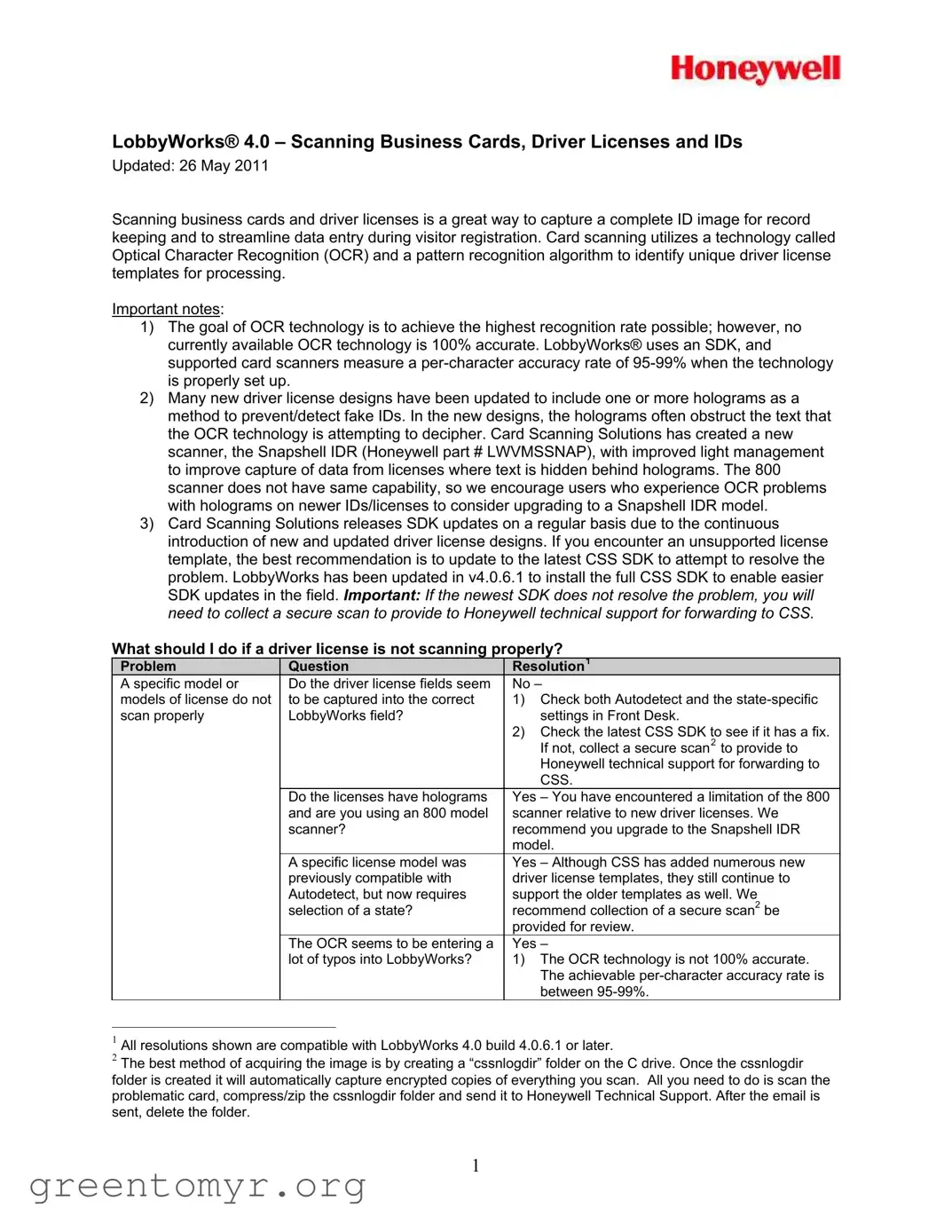
LobbyWorks® 4.0 – Scanning Business Cards, Driver Licenses and IDs
Updated: 26 May 2011
Scanning business cards and driver licenses is a great way to capture a complete ID image for record keeping and to streamline data entry during visitor registration. Card scanning utilizes a technology called Optical Character Recognition (OCR) and a pattern recognition algorithm to identify unique driver license templates for processing.
Important notes:
1)The goal of OCR technology is to achieve the highest recognition rate possible; however, no currently available OCR technology is 100% accurate. LobbyWorks® uses an SDK, and supported card scanners measure a
2)Many new driver license designs have been updated to include one or more holograms as a method to prevent/detect fake IDs. In the new designs, the holograms often obstruct the text that the OCR technology is attempting to decipher. Card Scanning Solutions has created a new scanner, the Snapshell IDR (Honeywell part # LWVMSSNAP), with improved light management to improve capture of data from licenses where text is hidden behind holograms. The 800 scanner does not have same capability, so we encourage users who experience OCR problems with holograms on newer IDs/licenses to consider upgrading to a Snapshell IDR model.
3)Card Scanning Solutions releases SDK updates on a regular basis due to the continuous introduction of new and updated driver license designs. If you encounter an unsupported license template, the best recommendation is to update to the latest CSS SDK to attempt to resolve the problem. LobbyWorks has been updated in v4.0.6.1 to install the full CSS SDK to enable easier SDK updates in the field. Important: If the newest SDK does not resolve the problem, you will need to collect a secure scan to provide to Honeywell technical support for forwarding to CSS.
What should I do if a driver license is not scanning properly?
Problem |
Question |
Resolution1 |
A specific model or |
Do the driver license fields seem |
No – |
models of license do not |
to be captured into the correct |
1) Check both Autodetect and the |
scan properly |
LobbyWorks field? |
settings in Front Desk. |
|
|
2) Check the latest CSS SDK to see if it has a fix. |
|
|
If not, collect a secure scan2 to provide to |
|
|
Honeywell technical support for forwarding to |
|
|
CSS. |
|
Do the licenses have holograms |
Yes – You have encountered a limitation of the 800 |
|
and are you using an 800 model |
scanner relative to new driver licenses. We |
|
scanner? |
recommend you upgrade to the Snapshell IDR |
|
|
model. |
|
A specific license model was |
Yes – Although CSS has added numerous new |
|
previously compatible with |
driver license templates, they still continue to |
|
Autodetect, but now requires |
support the older templates as well. We |
|
selection of a state? |
recommend collection of a secure scan2 be |
|
|
provided for review. |
|
The OCR seems to be entering a |
Yes – |
|
lot of typos into LobbyWorks? |
1) The OCR technology is not 100% accurate. |
|
|
The achievable |
|
|
between |
1All resolutions shown are compatible with LobbyWorks 4.0 build 4.0.6.1 or later.
2The best method of acquiring the image is by creating a “cssnlogdir” folder on the C drive. Once the cssnlogdir folder is created it will automatically capture encrypted copies of everything you scan. All you need to do is scan the problematic card, compress/zip the cssnlogdir folder and send it to Honeywell Technical Support. After the email is sent, delete the folder.
1

|
|
2) To help achieve the highest accuracy, it is |
|
|
|
important that the scanned image shows the |
|
|
|
entire card and that the image is good. If using |
|
|
|
an 800 scanner, recalibrate. If recalibration |
|
|
|
does not help, we recommend collection of a |
|
|
|
secure scan be provided for review. |
|
No card scans properly |
Are you using an 800 scanner? |
Yes – |
|
|
|
1) Please confirm that the 800 model is |
|
|
|
compatible and recalibrate the scanner. Note: |
|
|
|
there are models of the 800 scanner that do |
|
|
|
image capture only without OCR support. |
|
|
|
2) Please confirm card is being inserted into |
|
|
|
scanner with proper orientation (image face |
|
|
|
down). |
|
|
Front Desk starts but the |
Yes – This may be caused by an installation error |
|
|
Snapshell IDR does not power |
of the driver or SDK. Uninstall both the driver/SDK |
|
|
up? |
using Add/Remove Programs and then reinstall |
|
|
|
driver followed by SDK. |
|
|
Front Desk starts but does not |
Yes – |
|
|
detect the scanner? |
1) Confirm that another open application is not |
|
|
|
using the scanner. A scanner can only connect |
|
|
|
to one software application at a time. If this is |
|
|
|
the problem, close the application and restart |
|
|
|
Front Desk. |
|
|
|
2) The scanner driver may not have been |
|
|
|
installed properly. Apply the hot fix for |
|
|
|
LobbyWorks 4.0.6.1. Uninstall the CSS SDK |
|
|
|
using Add/Remove programs. Install the latest |
|
|
|
SDK (9.42.37 or later). If the scanner was the |
|
|
|
800 model, recalibrate the scanner. |
|
|
Front Desk displays errors when |
Yes – |
|
|
attempting to start the application |
1) If you encounter any device compatible error |
|
|
|
during launch of Front Desk, manually register |
|
|
|
the following DLLs located in the LobbyWorks |
|
|
|
installed path bin folder: |
|
|
|
- |
BIZCOM.dll |
|
|
- |
ScanW.dll |
|
|
- |
ScanWex.dll |
|
|
2) The CSS SDK may have been uninstalled. |
|
|
|
Please confirm that a single version of the |
|
|
|
CSS SDK is installed. |
|
What does a
A 99% OCR accuracy rate does not mean that only one license out of 100 will be wrong. It means that approximately one character will misread on every license (assuming that each license has approximately 100 characters). A misread could be O vs 0, i vs l, u vs v, etc. This does not mean that every card will have one mistake – you could have three cards read perfectly and one card with multiple mistakes.
Why do some licenses work in Autodetect mode while for other licenses I need to select a specific state?
Auto detection like OCR works on visual information but instead of looking for characters it is looking for shapes, usually the shape of the word that represents the state or some other unique identifier that can only be found on one state. To help the SDK with auto detection, it is important that the scanned image shows the entire card and that the image is good.
How do I recalibrate the 800 scanner on LobbyWorks 4.0.6.1 or later?
When calibration of the scanner completes via Front Desk or Kiosk, the following files will be created in the ScanShell800 folder in the system:
•PixGan6.dat
2

•PixGanG6.dat
•PixOff6.dat
•PixOffG6.dat
To recalibrate the scanner, delete these files and relaunch the Front Desk or Kiosk application in the system.
•Path for WinXP: C:\Documents and Settings\All Users\Application Data\Card Scanning Solutions\ScanShell800
•Path for VISTA: C:\ProgramData\Card Scanning Solutions\ScanShell800
•Path for Windows 7: C:\ProgramData\Card Scanning Solutions\ScanShell800
3
| Fact Name | Description | Governing Law |
|---|---|---|
| OCR Technology Accuracy | The Optical Character Recognition (OCR) technology achieves a per-character accuracy rate of 95-99%, but it is not 100% accurate. | Not applicable |
| Hologram Limitations | New driver licenses often include holograms that can obstruct text, making it difficult for OCR to read the information. | Not applicable |
| Scanner Upgrade Recommendation | Users experiencing OCR issues with holograms should consider upgrading to the Snapshell IDR scanner for better performance. | Not applicable |
| SDK Updates | Card Scanning Solutions releases SDK updates regularly to accommodate new driver license designs. Keeping the SDK updated is crucial for proper scanning. | Not applicable |
| Secure Scans | If a license does not scan properly, collect a secure scan to send to technical support for troubleshooting. | Not applicable |
| Calibration Process | To recalibrate the 800 scanner, delete specific files from the ScanShell800 folder and relaunch the application. | Not applicable |
Filling out your driver's license form can seem daunting, but with a little guidance, it becomes a straightforward task. Once you have completed the form, you will be ready to submit it for processing, which is the next step in obtaining your driver's license.
If a driver license is not scanning correctly, start by checking the settings in the LobbyWorks software. Ensure that both Autodetect and state-specific scan settings are properly configured. If the issue persists, check if the latest CSS SDK has an update that addresses the problem. If not, collect a secure scan of the license to provide to Honeywell technical support for further assistance.
There are several reasons why a license might not be recognized. If the license has holograms, this could obstruct the text, making it difficult for the scanner to read. In such cases, consider upgrading to the Snapshell IDR model, which is designed to handle these situations better. Additionally, if a specific license model was previously compatible but now requires manual selection, a secure scan should be collected for review.
A per-character accuracy rate of 99% does not imply that one out of every hundred licenses will be read incorrectly. Instead, it means that on average, one character may be misread per license. For example, this could lead to confusion between similar characters like O and 0 or i and l. The number of errors can vary from card to card.
Autodetect mode relies on visual patterns rather than text alone. It looks for unique shapes or identifiers that represent a specific state. If the scanned image does not clearly show the entire card, the software may struggle to make an accurate identification. Ensuring a clear and complete image can help improve the chances of successful autodetection.
To recalibrate the 800 scanner, you need to delete specific calibration files from the ScanShell800 folder on your system. After deleting the files, relaunch the Front Desk or Kiosk application. The paths for these files vary depending on your Windows version:
If Front Desk fails to detect the scanner, first check if another application is using it, as a scanner can only connect to one software at a time. If that’s not the issue, ensure that the scanner driver was installed correctly. You may need to apply a hot fix for LobbyWorks and reinstall the latest CSS SDK.
If you receive device compatibility errors when launching Front Desk, you may need to manually register specific DLL files located in the LobbyWorks installation path. Additionally, confirm that only one version of the CSS SDK is installed on your system. If issues continue, reinstall the SDK to ensure proper functionality.
Filling out a driver's license form can seem straightforward, but many people make common mistakes that can lead to delays or complications. One frequent error is failing to double-check personal information. Individuals often rush through the form and overlook critical details such as their name, address, or date of birth. These inaccuracies can cause significant issues, especially if the information does not match other identification documents.
Another mistake occurs when applicants neglect to provide a valid signature. A signature is a crucial part of the driver's license application process. Without it, the form may be deemed incomplete, and the application can be rejected. It's essential to sign the form clearly and in the designated area to avoid any confusion.
People also tend to overlook the importance of providing accurate identification documents. Many applicants submit copies of their IDs that are either outdated or do not meet the required specifications. This can result in delays as the authorities may need to request additional documentation. Always ensure that the documents you provide are current and comply with the requirements set by the licensing authority.
In addition, applicants sometimes forget to review the application for any additional requirements specific to their state. Each state may have unique requirements, such as proof of residency or additional identification forms. Not being aware of these can lead to unnecessary setbacks in the application process.
Lastly, many individuals fail to keep a copy of their completed application for their records. This can lead to confusion if there are any follow-up questions or issues with the application. Keeping a copy allows applicants to refer back to their submission and resolve any discrepancies that may arise.
When applying for or renewing a driver's license, several other forms and documents may be needed to ensure a smooth process. Below is a list of commonly used documents that can accompany the driver's license form. Each serves a specific purpose in verifying identity or fulfilling legal requirements.
Gathering these documents ahead of time can help streamline the application process for your driver's license. Being prepared not only saves time but also reduces the likelihood of any issues arising during your visit to the licensing office.
When filling out the Driver's License form, there are important dos and don'ts to keep in mind to ensure a smooth process. Here’s a helpful list:
Misconceptions about the Drivers License form can lead to confusion and inefficiencies. Here are seven common misconceptions, along with clarifications to help you navigate the process more effectively.
Understanding these misconceptions can help improve the efficiency of your scanning process and enhance the accuracy of your data entry. Always ensure that you are using the latest technology and following best practices for scanning.
Here are four key takeaways about filling out and using the Drivers License form: