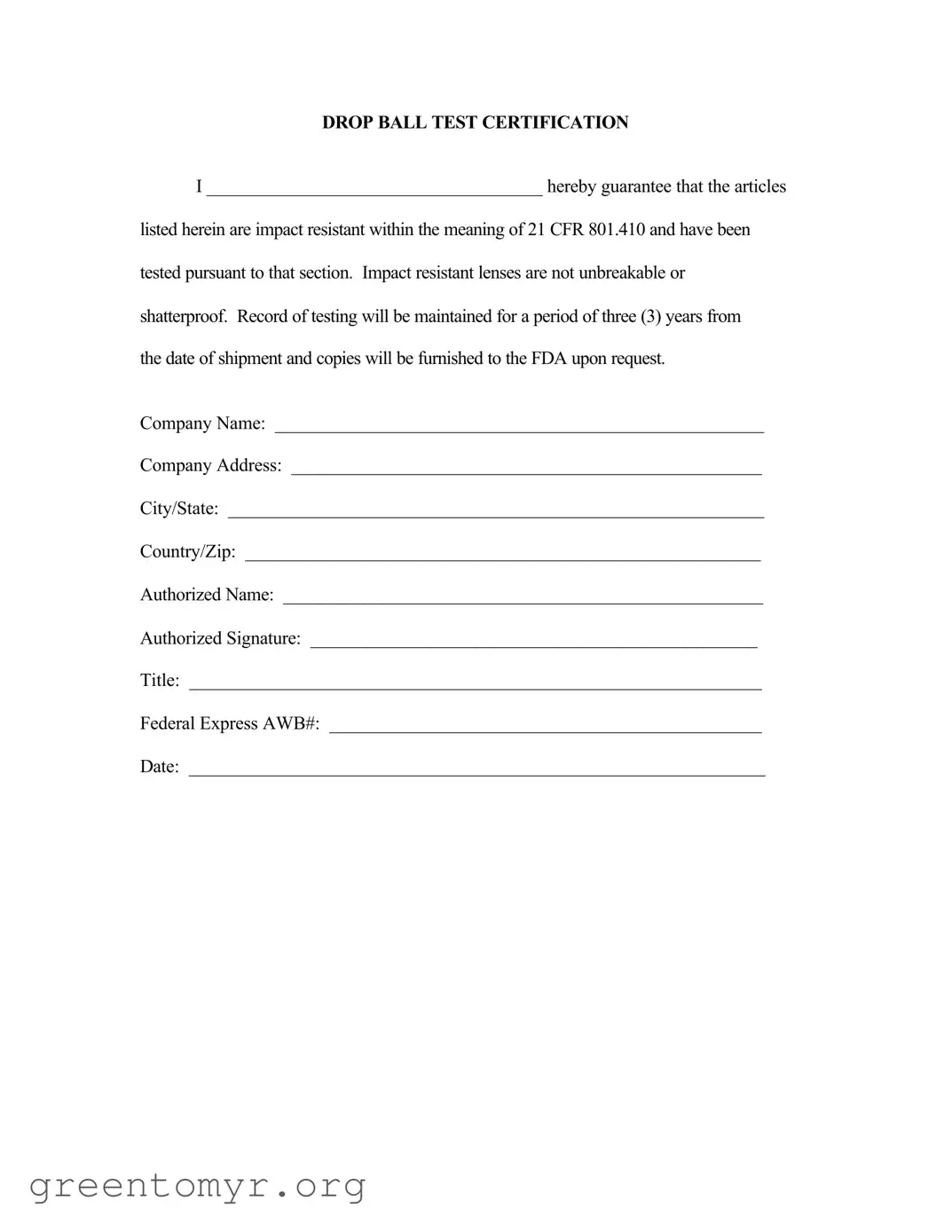
The Drop Ball Certificate form plays a crucial role in ensuring the safety and compliance of impact-resistant eyewear. This form serves as a formal declaration by a manufacturer or distributor, affirming that their products have undergone rigorous testing to meet the standards set forth in 21 CFR 801.410. While the term "impact resistant" is used, it's important to note that it does not imply that lenses are unbreakable or shatterproof. Instead, the form highlights the commitment of the company to uphold these safety standards, ensuring that the eyewear can withstand specific impacts. Each certificate includes essential details, such as the company name, address, and the authorized representative’s signature, providing a clear chain of accountability. Additionally, records of the testing must be kept for three years from the date of shipment, with the understanding that these records are available for review by the FDA upon request. This not only reinforces the manufacturer's responsibility but also enhances consumer trust in the products they choose.
DROP BALL TEST CERTIFICATION
I _____________________________________ hereby guarantee that the articles
listed herein are impact resistant within the meaning of 21 CFR 801.410 and have been tested pursuant to that section. Impact resistant lenses are not unbreakable or shatterproof. Record of testing will be maintained for a period of three (3) years from the date of shipment and copies will be furnished to the FDA upon request.
Company Name: _____________________________________________________
Company Address: ___________________________________________________
City/State: __________________________________________________________
Country/Zip: ________________________________________________________
Authorized Name: ____________________________________________________
Authorized Signature: _________________________________________________
Title: ______________________________________________________________
Federal Express AWB#: _______________________________________________
Date: ______________________________________________________________
| Fact Name | Details |
|---|---|
| Certification Requirement | The Drop Ball Certificate confirms that certain articles are impact resistant as defined by federal regulations. |
| Governing Law | This certification adheres to the standards set forth in 21 CFR 801.410. |
| Testing Duration | Records of testing must be maintained for three years from the date of shipment. |
| FDA Compliance | Copies of testing records must be provided to the FDA upon request. |
| Impact Resistance Clarification | Impact resistant lenses are not guaranteed to be unbreakable or shatterproof. |
| Company Information | Details such as company name, address, and authorized personnel must be included in the form. |
Filling out the Drop Ball Certificate form is an important step in ensuring compliance with safety standards. Once you have completed the form, it will serve as a record of your guarantee regarding the impact resistance of your articles. Follow these steps to accurately fill out the form.
The Drop Ball Certificate form is a document that certifies that certain articles, specifically impact-resistant lenses, have been tested and meet the requirements outlined in 21 CFR 801.410. This form serves as a guarantee of the product's impact resistance, although it is important to note that such lenses are not considered unbreakable or shatterproof.
Manufacturers or distributors of impact-resistant lenses are typically required to complete the Drop Ball Certificate form. This ensures that they comply with federal regulations regarding the safety and testing of their products.
The form requires several key pieces of information, including:
The record of testing must be maintained for a period of three years from the date of shipment. This allows for adequate documentation in case of inquiries or inspections.
Yes, copies of the testing records can be furnished to the FDA upon request. This is an important aspect of compliance with federal regulations.
"Impact resistant" refers to the ability of the lenses to withstand certain levels of impact without breaking. However, it is crucial to understand that this does not imply that the lenses are entirely unbreakable or shatterproof.
No, the form is specifically required for impact-resistant lenses. Other types of lenses may have different certification requirements depending on their intended use and regulatory standards.
If a company fails to complete the Drop Ball Certificate form when required, it may face regulatory consequences. This could include fines, product recalls, or other enforcement actions from the FDA.
The Drop Ball Certificate form can typically be obtained from industry associations, regulatory agencies, or directly from manufacturers of impact-resistant lenses. It is important to ensure that you are using the most current version of the form.
If you have questions regarding the Drop Ball Certificate form, it is advisable to contact a regulatory affairs specialist or legal counsel familiar with FDA regulations. They can provide guidance tailored to your specific situation.
Filling out the Drop Ball Certificate form can seem straightforward, but many people make mistakes that could lead to complications. One common error is failing to provide a complete company name. The form requires the full legal name of the company. Omitting any part of this name can create confusion and may delay the certification process.
Another frequent mistake is neglecting to include the company address. This detail is crucial for identifying the location of the business. Incomplete or inaccurate addresses can result in issues when the FDA needs to contact the company for verification or further information.
Many individuals also overlook the importance of filling in the city and state fields. This information is essential for proper identification and communication. If these fields are left blank or filled incorrectly, it can cause unnecessary delays in processing the certification.
Some people forget to include the country and zip code. These elements are vital for ensuring that all correspondence reaches the correct destination. Missing this information can lead to significant logistical challenges.
Another common mistake involves the authorized name and signature. It is crucial to ensure that the person signing the form is authorized to do so. If the signature does not match the name provided or if an unauthorized individual signs, the certification may be deemed invalid.
Individuals sometimes fail to include their title on the form. This information helps clarify the authority of the person signing the document. Without a title, it may raise questions about the legitimacy of the certification.
People often overlook the Federal Express AWB number. This number is important for tracking shipments and ensuring that the certification can be linked to specific shipments. Omitting this detail can complicate the verification process.
Another mistake is not dating the form. The date is essential for establishing the timeline of the certification. Without a date, it may be unclear when the testing occurred, which can affect compliance with regulations.
Lastly, some individuals do not understand the importance of maintaining a record of testing for three years. This requirement is not just a formality; it is a legal obligation. Failing to keep these records can lead to penalties or issues with compliance.
By being mindful of these common mistakes, individuals can ensure that their Drop Ball Certificate form is filled out correctly. This attention to detail helps facilitate a smoother certification process and ensures compliance with regulations.
The Drop Ball Certificate form is an essential document for certifying that certain articles, typically eyewear, meet specific impact resistance standards. Alongside this form, several other documents are commonly utilized to ensure compliance with regulatory requirements and to maintain thorough records. Below is a list of related forms and documents that are often used in conjunction with the Drop Ball Certificate.
Utilizing these documents alongside the Drop Ball Certificate form helps ensure that all necessary information is available for regulatory compliance and product safety. Maintaining accurate records and documentation is essential for manufacturers in the eyewear industry.
The Drop Ball Certificate form is similar to several other documents in terms of purpose and content. Below is a list of ten documents that share similarities with the Drop Ball Certificate form:
When filling out the Drop Ball Certificate form, it is essential to follow certain guidelines to ensure accuracy and compliance. Here are some important dos and don'ts to keep in mind:
Following these guidelines can help streamline the certification process and ensure compliance with regulatory standards.
Misconceptions about the Drop Ball Certificate form can lead to confusion regarding its purpose and requirements. Here are five common misunderstandings:
When it comes to ensuring safety and compliance in eyewear, the Drop Ball Certificate form plays a crucial role. Here are some key takeaways to keep in mind when filling out and using this form:
By following these guidelines, you can ensure that the Drop Ball Certificate form is filled out correctly and used effectively to meet regulatory standards.