The DWC 83 form plays a crucial role in defining the relationship between hiring contractors and independent contractors in Texas, particularly within the building and construction sectors. This form serves as a declaration that outlines the qualifications of an independent contractor, as specified by the Texas Workers' Compensation Act. It emphasizes that the independent contractor is not an employee of the hiring contractor, which has significant implications for workers' compensation coverage. By completing this form, both parties agree that the independent contractor and their employees will not be entitled to workers' compensation benefits from the hiring contractor. The DWC 83 also requires the hiring contractor to notify the Texas Department of Insurance if any agreements arise that do not fall under the provisions of this declaration. Additionally, it allows for the establishment of an employer-employee relationship for the purpose of workers' compensation, should both parties choose that option. This form must be filed within ten days of execution, ensuring compliance with state regulations while protecting the interests of both contractors involved.
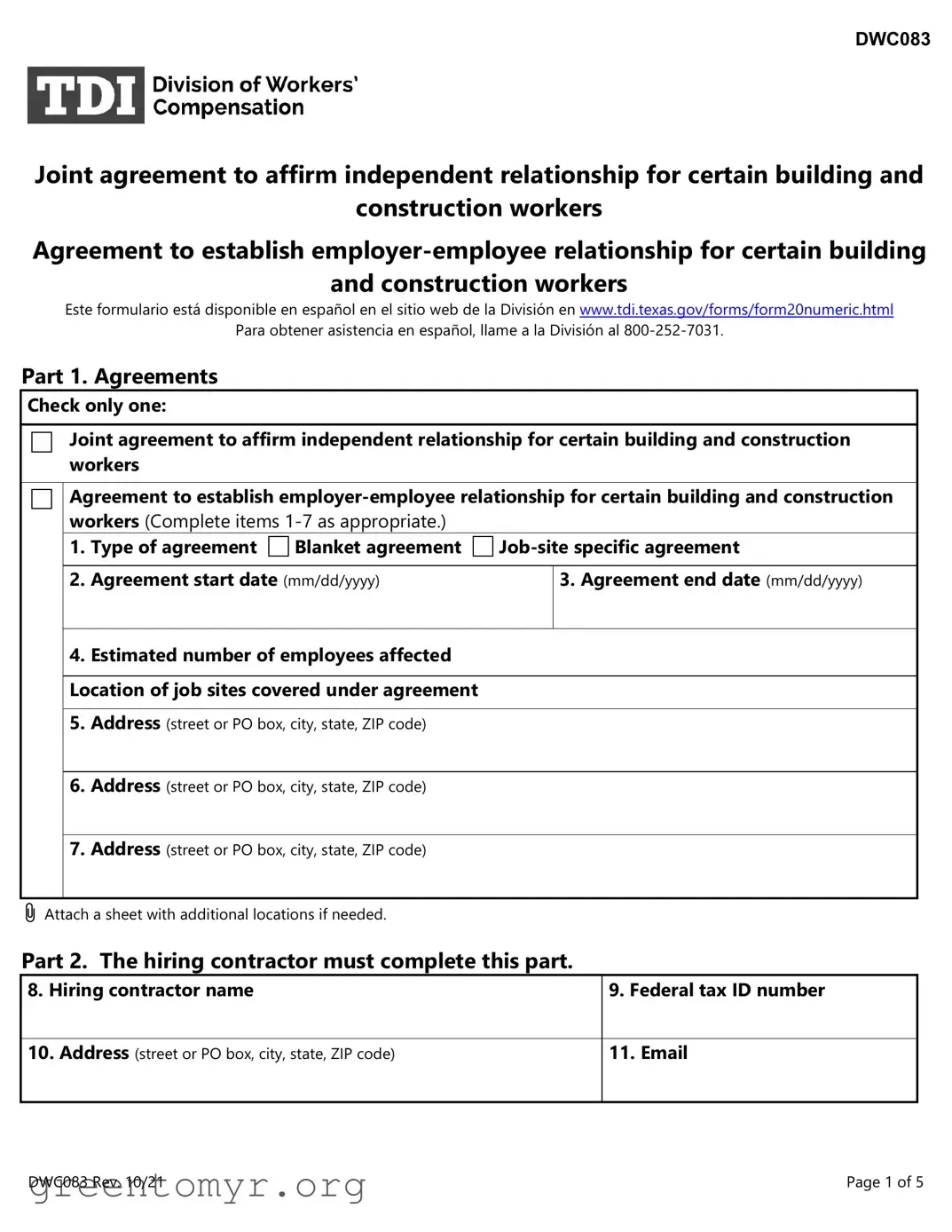
DWC083
Joint agreement to affirm independent relationship for certain building and
construction workers
Agreement to establish
and construction workers
Este formulario está disponible en español en el sitio web de la División en www.tdi.texas.gov/forms/form20numeric.html
Para obtener asistencia en español, llame a la División al
Part 1. Agreements
Check only one:
Joint agreement to affirm independent relationship for certain building and construction workers
Agreement to establish
1. Type of agreement Blanket agreement
2. Agreement start date (mm/dd/yyyy)
4.Estimated number of employees affected Location of job sites covered under agreement
5.Address (street or PO box, city, state, ZIP code)
6.Address (street or PO box, city, state, ZIP code)
7.Address (street or PO box, city, state, ZIP code)
📎📎 Attach a sheet with additional locations if needed.
Part 2. The hiring contractor must complete this part.
8. Hiring contractor name
9. Federal tax ID number
10. Address (street or PO box, city, state, ZIP code)
11. Email
DWC083 Rev. 10/21 |
Page 1 of 5 |
DWC083
12.Hiring contractor's affirmations Check only one:
Joint agreement to affirm independent relationship for certain building and construction workers
I declare that the independent contractor meets the qualifications under Texas Labor Code Section 406.141, and the independent contractor is not an employee of the hiring contractor. The independent contractor and the independent contractor's employees are not entitled to workers' compensation insurance coverage from the hiring contractor. The hiring contractor's workers' compensation insurance carrier will not require the hiring contractor to pay premiums to cover the independent contractor or the independent contractor's employees, helpers, or subcontractors. Once this agreement is signed, the subcontractor and the subcontractor's employees will not be entitled to workers' compensation coverage from the hiring contractor unless a subsequent written agreement is signed, and filed according to division rules, expressly stating that this agreement does not apply.
Agreement to establish
I will |
withhold |
not withhold the cost of workers' compensation insurance coverage from the |
independent contractor's price. I agree that the hiring contractor will purchase workers' compensation |
||
insurance coverage for the independent contractor and the independent contractor's employees. |
||
I agree that I am the employer of the independent contractor for the purpose of providing workers’ compensation insurance coverage, and no other purpose.
13. Signature of hiring contractor
14. Date of signature (mm/dd/yyyy)
Part 3. The independent contractor must complete this part.
15. Independent contractor name |
16. |
Federal tax ID number |
|
|
|
17. Address (street or PO box, city, state, ZIP code) |
18. |
|
|
|
|
DWC083 Rev. 10/21 |
Page 2 of 5 |
DWC083
19.Independent contractor's affirmations Check only one:
Joint agreement to affirm independent relationship for certain building and construction workers
I declare that I meet the qualifications under Texas Labor Code Section 406.141, and I am not an employee of the hiring contractor. My employees and I are not entitled to workers' compensation insurance coverage from the hiring contractor. The hiring contractor's workers' compensation insurance carrier will not require the hiring contractor to pay premiums to cover me, my employees, helpers, or subcontractors.
Agreement to establish
I agree that the hiring contractor employs the independent contractor for the purpose of providing workers’ compensation insurance coverage, and no other purpose.
20. Signature of independent contractor
21. Date of signature (mm/dd/yyyy)
DWC083 Rev. 10/21 |
Page 3 of 5 |
DWC083
FAQ
Joint agreement to affirm independent relationship for certain building and construction workers
Agreement to establish
Who may use this agreement?
Texas Labor Code Section 406.145 allows certain building and construction workers, specifically, hiring contractors and independent contractors, to agree that the independent contractor is not an employee of the hiring contractor, and the hiring contractor is not responsible for workers' compensation insurance coverage for the independent contractor.
Texas Labor Code Section 406.144 allows certain building and construction workers, specifically, hiring contractors and independent contractors, to agree on who will provide workers' compensation insurance coverage to the subcontractor and the employees of the subcontractor.
Who is an independent contractor?
Texas Labor Code Section 406.141(2) defines an independent contractor as a person who contracts to perform work or provide a service for the benefit of another, and who is:
•paid by the job, not by the hour or some other
•free to hire as many helpers as desired and determine what to pay each helper; and
•free to work for other contractors or send helpers to work for other contractors, while under contract with the hiring employer.
How do I know if I should sign this agreement?
You may want to talk to an attorney if you are not sure if all parties meet the requirements to enter into these agreements.
When does the agreement take effect?
The agreement takes effect the date both parties have signed it or on the start date of the agreement, whichever is later.
How long is the joint agreement to affirm an independent relationship in effect?
Texas Labor Code Section 406.145 states that the agreement to affirm an independent relationship applies to all hiring agreements the hiring contractor and the independent contractor make until the first anniversary of the date the hiring contractor filed the agreement with their workers' compensation insurance carrier. The agreement does not apply to a new hiring agreement if the new agreement states this agreement does not apply.
The hiring contractor and independent contractor must notify the hiring contractor's workers' compensation insurance carrier in writing within 10 days after the date they make a hiring agreement that does not apply to this agreement.
The subcontractor and the subcontractor's employees are not entitled to workers' compensation coverage from the hiring contractor once this agreement is signed. The hiring contractor and independent contractor must make a new written agreement to establish an
Where should I send this agreement?
DWC083 Rev. 10/21 |
Page 4 of 5 |
DWC083
The hiring contractor must file a legible and complete copy of this agreement with their workers’ compensation insurance carrier within 10 days after signing the agreement. The hiring contractor must keep the original. The independent contractor should also keep a copy. If the hiring contractor changes workers' compensation insurance carriers during the effective dates of the agreement, the hiring contractor should file this form with their new insurance carrier.
You may file this form with Texas Department of Insurance, Division of Workers' Compensation (DWC) under Labor Code Section 406.145.
Note: With few exceptions, you are entitled to:
•be informed about the information DWC collects about you;
•receive and review the information (Government Code Sections 552.021 and 552.023); and
•have DWC correct information that is incorrect (Government Code Section 559.004).
For more information, contact [email protected] or go to the Corrections Procedure section at www.tdi.texas.gov.
DWC083 Rev. 10/21 |
Page 5 of 5 |
| Fact Name | Description |
|---|---|
| Governing Law | The DWC 83 form is governed by the Texas Workers' Compensation Act, specifically Texas Labor Code, Section 406.141. |
| Purpose | This form is used to establish an independent contractor relationship for certain building and construction workers. |
| Independent Contractor Definition | Under Texas law, an independent contractor is someone who is paid by the job, can hire helpers, and can work for multiple contractors. |
| Workers' Compensation Coverage | By signing the DWC 83, the independent contractor and their employees are not entitled to workers' compensation coverage from the hiring contractor. |
| Effective Date | The declaration takes effect upon receipt by the Texas Department of Insurance, Division of Workers' Compensation. |
| Agreement Duration | This declaration applies to all hiring agreements executed within one year after it is filed unless a new agreement is made. |
| Notification Requirement | If a hiring agreement is made that does not apply, both parties must notify the Texas Department of Insurance within 10 days. |
| Form Copies | Four copies of the DWC 83 must be completed and filed with the appropriate authorities within 10 days of execution. |
| Filing Method | The agreement must be filed by personal delivery or registered/certified mail to the Division. |
Completing the DWC 83 form is a crucial step in establishing the relationship between a Hiring Contractor and an Independent Contractor in Texas. Once the form is filled out and submitted, it will help clarify the nature of the working relationship and the associated responsibilities regarding workers' compensation coverage.
The DWC 83 form is a declaration used in Texas to establish the independent contractor status of a worker in the building and construction industry. It outlines the relationship between the hiring contractor and the independent contractor, confirming that the independent contractor is not considered an employee for workers' compensation purposes.
The hiring contractor and the independent contractor both need to fill out and sign the DWC 83 form. This ensures that both parties acknowledge the independent contractor's status and agree on the terms regarding workers' compensation coverage.
Under the Texas Workers' Compensation Act, an independent contractor must:
Once the form is signed, it takes effect immediately and applies to all hiring agreements made within the year following its filing. If a new hiring agreement is created that does not apply, both parties must notify the Texas Department of Insurance and the workers' compensation insurance carrier within 10 days.
No, independent contractors and their employees are not entitled to workers' compensation coverage from the hiring contractor once the DWC 83 form is filed. The form explicitly states that the hiring contractor's insurance carrier will not require premiums for the independent contractor or their employees.
The hiring contractor must file the completed form with the Texas Department of Insurance and their workers' compensation insurance carrier within 10 days of signing. This can be done through personal delivery or by registered or certified mail. Both parties should keep a copy for their records.
If the hiring contractor's workers' compensation insurance carrier changes during the coverage period, it is advisable to file the DWC 83 form with the new insurance carrier. This ensures that the independent contractor's status is recognized under the new policy.
Yes, the form requires a specified term, indicating the start and end dates of the agreement. This term helps clarify the duration of the independent contractor's status and the applicable coverage during that period.
Filling out the DWC 83 form can be a straightforward process, but there are common mistakes that individuals often make. One frequent error is failing to accurately identify the parties involved. Both the Hiring Contractor and the Independent Contractor must be clearly stated, along with their respective addresses and Federal Tax I.D. numbers. Omitting or misspelling this information can lead to confusion and delays in processing the form.
Another mistake involves not checking the appropriate box that applies to the relationship between the Hiring Contractor and the Independent Contractor. The form includes options for affirming an independent relationship or establishing an employer-employee relationship for certain building and construction workers. Selecting the wrong option can result in legal complications and misunderstandings regarding workers' compensation coverage.
People also often overlook the importance of providing the term dates of the agreement. The section that asks for the start and end dates must be filled out completely. Leaving this information blank can render the agreement invalid, as it is crucial for determining the duration of the coverage.
In addition, failing to file the form within the required timeframe is a common pitfall. The DWC 83 form must be submitted to both the Texas Department of Insurance and the workers' compensation insurance carrier within 10 days of signing. Delays in filing can lead to issues with coverage and compliance, which may affect both parties.
Lastly, individuals sometimes neglect to retain copies of the completed form. Both the Hiring Contractor and the Independent Contractor should keep a copy for their records. This step is essential for future reference and can help avoid disputes regarding the terms of the agreement.
When dealing with the DWC 83 form, several other documents may come into play to ensure compliance and clarity in your independent contractor agreements. Understanding these forms can help streamline your processes and protect your interests. Here’s a brief overview of nine essential documents often associated with the DWC 83 form.
Each of these documents plays a vital role in the workers' compensation process, ensuring that all parties are informed and compliant with Texas laws. Taking the time to familiarize yourself with these forms can make a significant difference in navigating the complexities of independent contractor agreements and workers' compensation claims.
The DWC 83 form serves a specific purpose in the realm of Texas workers' compensation, particularly concerning the classification of independent contractors. Several other documents fulfill similar roles in defining relationships between contractors and employers. Here is a list of seven documents that share similarities with the DWC 83 form:
When filling out the DWC 83 form, it is essential to approach the process with care and attention to detail. Here are some important dos and don’ts to keep in mind:
By following these guidelines, you can help ensure that the DWC 83 form is filled out correctly and submitted on time, thus protecting the interests of all parties involved.
Misconceptions about the DWC 83 form can lead to misunderstandings regarding independent contractor relationships and workers' compensation coverage in Texas. Below are ten common misconceptions explained.
Understanding these misconceptions can help both hiring contractors and independent contractors navigate their responsibilities and rights under Texas law more effectively.
Understanding the DWC 83 form is crucial for both hiring contractors and independent contractors in Texas. Here are some key takeaways: