The Eagle Scout Project Workbook is an essential tool for Scouts embarking on their journey to achieve the prestigious Eagle Scout rank. This form serves as a comprehensive guide, detailing the planning, execution, and documentation of a service project that reflects the Scout's leadership skills and commitment to community service. It includes sections for project ideas, objectives, and a timeline, allowing Scouts to outline their vision clearly. Additionally, the workbook requires Scouts to identify and engage with community stakeholders, ensuring that their project addresses a genuine need. Progress tracking is also a critical component, as Scouts must document their efforts and any challenges encountered along the way. Finally, the workbook culminates in a reflection section, where Scouts can evaluate their experiences and the impact of their project, fostering personal growth and a deeper understanding of service. Overall, the Eagle Scout Project Workbook not only guides Scouts through the logistics of their projects but also emphasizes the values of leadership, responsibility, and community involvement.
Eagle Scout Service Project Workbook
Eagle Scout candidate’s name ___________________________________________

Message From the Chief Scout Executive
Congratulations on attaining the rank of Life Scout. Each year, approximately 57,000 Scouts just like you reach this milestone. And, since you’re reading this, I know you are looking forward to achieving the pinnacle of your Scouting experience: the rank of Eagle Scout.
Think of your Eagle Scout service project as the ultimate “application phase” of what you have learned thus far in Scouting: leadership. . . responsibility. . . managing projects. . . applying your Scout
Some may suggest how big your project should be, or how many hours should be spent on it, but that is entirely up to you. Service, impact, and leadership are the objectives and measurements. Use these as your criteria to consider, select, develop, and evaluate your project. For most, the Eagle Scout service project becomes a truly defining moment in your quest for excellence. Planning and leadership skills utilized and memories of outcomes achieved will last you a lifetime. You will want to share those stories with others, so make it a worthy project!
Legendary
Robert J. Mazzuca
Chief Scout Executive
Scouts and Parents or Guardians
Be sure to read “Message to Scouts and Parents or Guardians” on page 21 and “Excerpts and Summaries From the Guide to Advancement” on page 22. Those pages contain important information that will help you ensure requirements are properly administered according to National Council policies and procedures.
Completing This Workbook
If you are working from a printed copy of the Eagle Scout Service Project Workbook, you may complete it legibly in ink, or with a typewriter. Feel free to add as many pages as you wish. This may be necessary if more space is needed, or as you include photographs, photocopies, maps, or other helpful printed materials.
A fillable version of the new workbook is available at www.scouting.org (click on “Youth,” then “Boy Scout,” then “Advancement, Awards, Recognition”). If you experience difficulties with the fillable PDF, you may need to download a more recent version of Adobe Acrobat reader (available free online). Or, it might be necessary to use a printed copy.
At the time of this printing, the national Advancement Team was actively coordinating the production of a new electronic version of the workbook. If testing proves successful, we will replace the fillable PDF version with it. Regardless, the workbook will continue to be available for printing a hard copy that can be completed by hand or with a typewriter.
2

Eagle Scout Service Project Workbook
Contents
Message From the Chief Scout Executive |
2 |
Meeting Eagle Scout Requirement 5 |
4 |
Project Purpose |
4 |
Choosing a Project |
4 |
Restrictions |
4 |
How to Use This Workbook |
5 |
Contact Information |
6 |
Eagle Scout Service Project Proposal |
7 |
Eagle Scout Service Project Final Plan |
11 |
Eagle Scout Service Project Fundraising Application |
17 |
Procedures and Limitations on Eagle Scout Service Project Fundraising |
18 |
Eagle Scout Service Project Report |
19 |
Message to Scouts and Parents or Guardians |
21 |
Excerpts and Summaries from the Guide to Advancement |
22 |
Only the Offcial Workbook May Be Used
Eagle Scout candidates must use the offcial Eagle Scout Service Project Workbook, No.
No council, district, unit, or individual has the authority to produce or require additional forms, or to add or change requirements, or to make any additions, deletions, or changes in the text, outlines, links, graphics, or other layout or informational elements of the workbook. It is permissible, however, to print, copy, or send individual pages or forms within the workbook as long as they are not changed in the process.
Attention: Unit, District, and Council Reviewers
Eagle Scout projects must be evaluated primarily on impact: the extent of benefit to the religious institution, school, or community, and on the leadership provided by the candidate. There must also be evidence of planning and development. This is not only part of the requirement but relates to practicing the Scout motto, “Be Prepared.” However, in determining if a project meets Eagle Scout requirement 5, reviewers must not require more planning and development than necessary to execute the project. These elements must not overshadow the project itself, as long as the effort was well led and resulted in otherwise worthy results acceptable to the beneficiary.
3

Meeting Eagle Scout Requirement 5
Eagle Scout Requirement 5
While a Life Scout, plan, develop, and give leadership to others in a service project helpful to any religious institution, any school, or your community. (The project must beneft an organization other than Boy Scouting.) A project proposal must be approved by the organization benefting from the effort, your unit leader and unit committee, and the council or district before you start. You must use the Eagle Scout Service Project Workbook, No.
Project Purpose
In addition to providing service and fulfilling the part of the Scout Oath, “to help other people at all times,” one of the primary purposes of the Eagle Scout service project is to demonstrate or hone, or to learn and develop, leadership skills. Related to this are important lessons in project management and taking responsibility for a significant accomplishment.
Choosing a Project
Your project must be for any religious institution, any school, or your community. It is important to note, however, that the Boy Scouts of America has recently redefined “your community” to include the “community of the world.” Normally, “your community” would not refer to individuals, although a council or district advancement committee may consider scenarios in which an individual in need can affect a community. It is then a matter of identifying
a source representing the “community” who will provide approvals. For more information, see the Guide to Advancement, No. 33088, section 9.0.2.5.
Your project must present an opportunity for planning, development, and leadership. For example, if a blood drive is chosen and the blood bank provides a set of “canned” instructions to be implemented with no further planning, the planning effort would not meet the test. You may need to meet with blood bank officials and work out an approach that requires planning, development, and leadership. This might involve developing and carrying out a marketing and logistics plan, or coordinating multiple events.
An Internet search can reveal hundreds of service project ideas. Your project doesn’t have to be original, but it could be. It might be a construction, conservation, or remodeling project, or it could be the presentation of an event with a worthwhile purpose. Conversations with your unit leader, teachers, your religious leader, or the leaders of various community organizations can also uncover ideas. In any case, be sure the project presents a challenge that requires leadership, but also something that you can do with unskilled helpers, and within a reasonable period of time.
Restrictions
•There are no required minimum hours for a project. No one may tell you how many hours must be spent on it.
•Routine labor is not normally appropriate for a project. This might be defined as a job or service you may provide as part of your daily life, or a routine maintenance job normally done by the beneficiary (for example, pulling weeds on the football field at your school.)
•While projects may not be of a commercial nature or for a business, this is not meant to disallow work for community institutions, such as museums and service agencies (like homes for the elderly, for example), that would otherwise be acceptable. Some aspect of a business operation provided as a community service may also be
•A project may not be a fundraiser. In other words, it may not be an effort that primarily collects money, even for a worthy charity. Fundraising is permitted only for securing materials and facilitating a project, and it may need to be approved by your council. See “Eagle Scout Service Project Fundraising Application” on page 17.
•No more than one Eagle Scout candidate may receive credit for working on the same Eagle Scout service project.
•Projects may not be performed for the Boy Scouts of America, or its councils, districts, units, or properties.
4

How to Use This Workbook
This workbook includes valuable information that can help ensure your success. It also includes four forms: a proposal, a final plan, a fundraising application, and a project report.
Before completing any of the forms, read with your parent or guardian the “Message to Scouts and Parents or Guardians” found on page 21. If your project is worthy and meets Eagle Scout requirement 5 as it is written, the message will help you successfully present your proposal through the approval process.
Preparing the Project Proposal (Pages
Your proposal must be completed first. It is an overview, but also the beginnings of planning. It shows your unit leader, unit committee, and council or district that the following tests can be met. For your proposal to be approved, it must show the following:
1.It provides suffcient opportunity to meet the Eagle Scout service project requirement. You must show that planning, development, and leadership will take place; and how the three factors will benefit a religious institution, a school, or your community.
2.It appears to be feasible. You must show the project is realistic for you to complete.
3.Safety issues will be addressed. You must show you have an understanding of what must be done to guard against injury, and what will be done if someone does get hurt.
4.Action steps for further detailed planning are included. You must make a list of the key steps you will take to make sure your plan has enough details to be carried out successfully.
5.You are on the right track with a reasonable chance for a positive experience.
Your proposal need only be detailed enough to show a reviewer that you can meet the tests above. If you find in order to do that, the proposal must be lengthy and complicated, your project might be more complex than necessary.
If your project does not require materials or supplies, etc., simply mark those spaces “not applicable.” Remember, do not begin any work or raise any money or obtain any materials until your project proposal has been approved. If you submit your proposal too close to your 18th birthday, it may not be approved in time to finish planning and executing the project.
The Final Plan (Pages
Complete the Eagle Scout Service Project Final Plan after your proposal has been approved. This is a tool for your
The Fundraising Application (Pages
If your fundraising effort involves contributions only from the beneficiary or you, your parents or relatives, your unit or its chartered organization, or parents or members in your unit, submitting the fundraising application is not necessary. If you will be obtaining money or materials from any other sources, you must submit a completed application to the local council service center. For more information, see “Procedures and Limitations on Eagle Scout Service Project Fundraising” on page 18.
The Project Report (Pages
Complete this portion after the project has been finished. Note the space for you to sign (confirming that you led and completed the project), and also the signature lines for the beneficiary and your unit leader’s approval that your project met Eagle Scout requirement 5. As with the proposal and final plan, if materials, etc., were not required, mark those spaces “not applicable.”
5

Contact Information
Eagle Scout Candidate
Full legal name: |
|
|
Birth date: |
|
|
BSA PID No.*: |
|
||
Email address: |
|
|
|
|
|
|
|
|
|
Address: |
|
|
|
City: |
|
|
|
State: |
Zip: |
Preferred phone Nos.: |
|
|
|
|
Life board of review date: |
|
|||
*Personal ID No., found on the BSA membership card |
|
|
|
|
|
|
|
||
Current Unit Information |
|
|
|
|
|
|
|
|
|
|
|
|
|
|
|
|
|
||
Check one: |
Troop |
Team |
Crew |
Ship |
|
Unit No. |
|
||
|
|
|
|
|
|
|
|||
District name: Orange |
|
|
|
|
|
Council name: Occoneechee |
|||
|
|
|
|
|
|
|
|
|
|
Unit Leader Check one: |
Scoutmaster |
Varsity Coach |
Crew Advisor |
Skipper |
|
|
|
|
|
Name: |
|
Preferred phone Nos.: |
|
|
|
|
|
|
|
Address: |
|
City: |
State: |
Zip: |
|
|
|
|
|
Email address: |
|
|
BSA PID No.: |
|
|
|
|
|
|
Unit Committee Chair |
|
|
|
|
|
|
|
|
|
Name: |
|
Preferred phone Nos.: |
|
|
|
|
|
|
|
Address: |
|
City: |
State: |
Zip: |
|
|
|
|
|
Email address: |
|
|
BSA PID No.: |
|
|
|
|
|
|
Unit Advancement Coordinator |
|
|
|
|
|
|
|
|
|
Name: |
|
Preferred phone Nos.: |
|
|
|
|
|
|
|
Address: |
|
City: |
State: |
Zip: |
|
|
|
|
|
Email address: |
|
|
|
|
|
|
|
||
Project Benefciary (Name of religious institution, school, or community) |
|
|
||
|
|
|
|
|
Name: |
|
Preferred phone Nos.: |
|
|
|
|
|
|
|
Address: |
|
City: |
State: |
Zip: |
|
|
|
|
|
Email address: |
|
|
|
|
|
|
|||
Project Benefciary Representative (Name of contact for the project beneficiary) |
|
|||
|
|
|
|
|
Name: |
|
Preferred phone Nos.: |
|
|
Address: |
|
City: |
State: |
Zip: |
Email address: |
|
|
|
|
Your Council Service Center |
|
|
|
|
|
|
|
|
|
Council name: Occoneechee |
|
|
Phone No.: |
|
|
|
|
|
|
Address: P.O. Box 41229 |
|
City: Raleigh |
State: NC |
Zip: 27629 |
|
|
|
|
|
Email address: (Eagle Service Desk) [email protected]
Council or District Project Approval Representative
(Your unit leader, unit advancement coordinator, or council or district advancement chair may help you learn who this will be.)
Name: Alfred Reid |
Preferred phone Nos.: |
||
|
|
|
|
Address: 307 Bolin Creek Drive |
City: Carrboro |
State: NC |
Zip: 27510 |
Email address: [email protected] |
|
|
|
|
|
|
|
Project Coach
(Your council or district project approval representative may help you learn who this will be.)
Name: |
Preferred phone Nos.: |
|
|
|
|
|
|
Address: |
City: |
State: |
Zip: |
|
|
|
|
Email address: |
|
|
|
|
|
|
|
6
Eagle Scout Service Project Proposal
Eagle Scout candidate’s name ___________________________________________
Eagle Scout Requirement 5
While a Life Scout, plan, develop, and give leadership to others in a service project helpful to any religious institution, any school, or your community. (The project must benefit an organization other than Boy Scouting.) A project proposal must be approved by the organization benefiting from the effort, your unit leader and unit committee, and the council or district before you start. You must use the Eagle Scout Service Project Workbook, No.
7
Eagle Scout Service Project Proposal
Project Description and Beneft |
Eagle Scout candidate: |
When do you plan to begin work on the project?
How long do you think it will take to complete?
Giving Leadership
Approximately how many people will be needed to help on your project?
Where will you recruit them (unit members, friends, neighbors, family, others)? Explain:
Materials
(Materials are things that become part of the fnished project, such as lumber, nails, and paint.)
What types of materials, if any, will you need? You do not yet need a detailed list of exact quantities, but you must show you have a reasonable idea of what is required.
Supplies
(Supplies are things you use up, such as masking tape, tarps, and garbage bags.)
What kinds of supplies, if any, will you need? You do not yet need a detailed list or exact quantities, but you must show you have a reasonable idea of what is required.
8
Eagle Scout Service Project Proposal
Tools
What kinds of tools, if any, will you need?
Permits and Permissions
(Note that property owners normally secure permits.)
Will you need to secure permissions or permits (for example, building permits)? Who will obtain them? How much will they cost? How long will it take to secure them?
Preliminary Cost Estimate
(You do not need exact costs. Reviewers will just want to see if you can reasonably expect to raise enough money to cover an initial estimate of expenses.)
(Enter your estimated expenses) Fundraising Explain where you will get the money for total costs indicated below, left.
Items |
Cost |
|
Materials |
|
|
|
|
|
Supplies |
|
|
Tools |
|
|
|
|
|
Other* |
|
|
|
|
|
Total costs: |
0 |
|
*Such costs as food, water, gasoline, parking, permits, equipment rental, sales tax, etc.
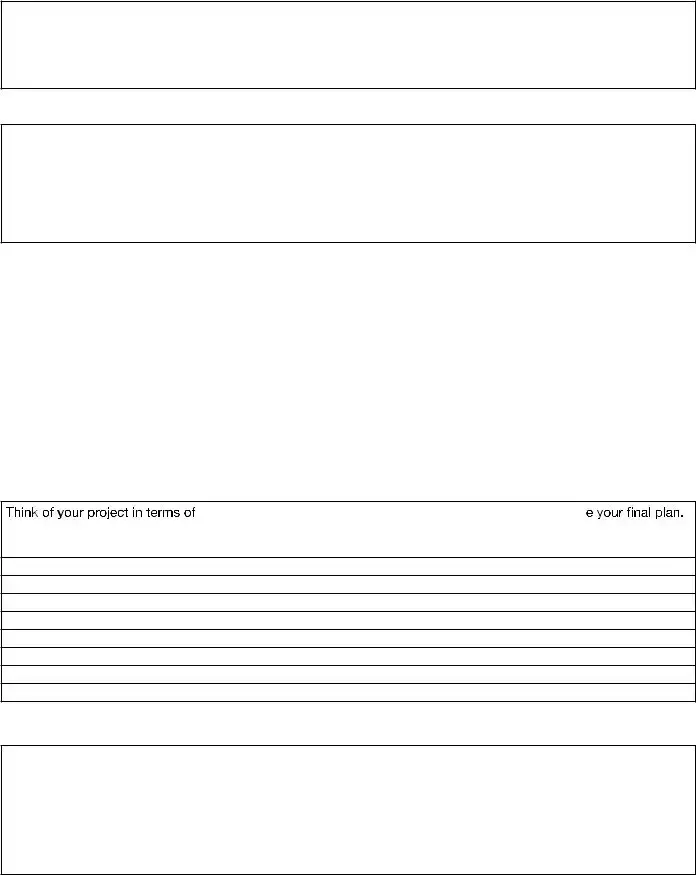
Project Phases
Others might include fundraising, preparation, execution, and reporting. You may have as many phases as you want, but it is not necessary to become overly complicated.
1.
2.
3.
4.
5.
6.
7.
8.
Logistics
(A Tour Plan has also been called a “Tour Permit.” Check with your council service center to determine if one is required.)
How will you handle transportation of materials, supplies, tools, and helpers? Will you need a Tour Plan?
9
Eagle Scout Service Project Proposal, continued
Safety Issues
(The Guide to Safe Scouting is an important resource in considering safety issues.)
Describe the hazards and safety concerns you and your helpers should be aware of as this project is conducted.
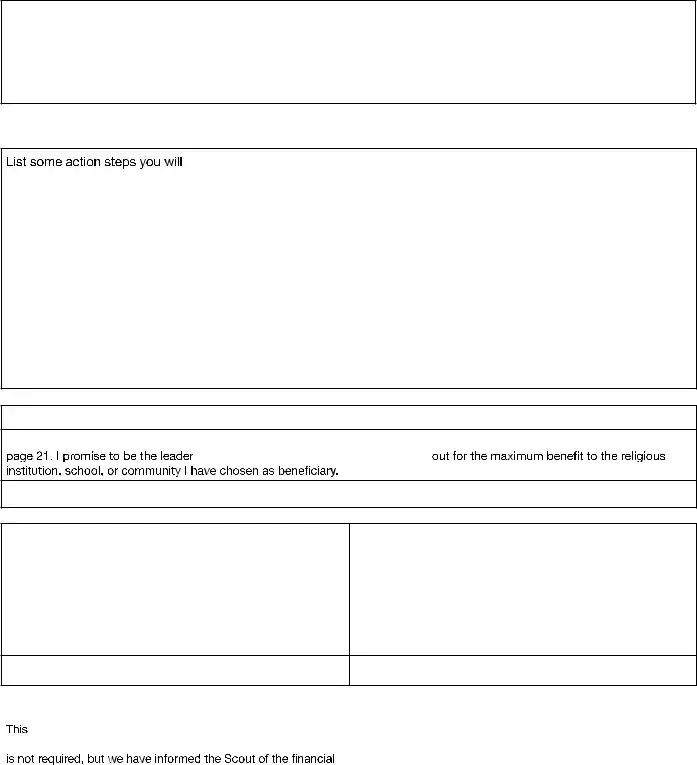
Further Planning (You do not have to list every step, but it must be enough to show you have a reasonable idea of how to complete a fnal plan.)
or example, “Complete a more detailed set of drawings.”
Candidate’s Promise (Signed before approvals below are granted)
On my honor as a Scout, I have read this entire workbook, including the “Message to Scouts and Parents or Guardians” on
SignedDate
Unit Leader Approval* |
Unit Committee Approval* |
|
|
I have reviewed this proposal and discussed it with the |
This Eagle Scout candidate is a Life Scout, and registered in |
candidate. I believe it provides impact worthy of an Eagle |
our unit. I have reviewed this proposal, I am comfortable the |
Scout service project, and will involve planning, development, |
project is feasible, and I will do everything I can to see that our |
and leadership. I am comfortable the Scout understands |
unit measures up to the level of support we have agreed to |
what to do, and how to lead the effort. I will see that the |
provide (if any). I certify that I have been authorized by our unit |
project is monitored, and that adults or others present will not |
committee to provide its approval for this proposal. |
overshadow him. |
|
Signed |
Date |
Signed |
Date |
Benefciary Approval* |
|
Council or District Approval |
|
|
|
I have read sections 9.0.2.0 through 9.0.2.15, regarding the |
|
do all we can to see it through. We realize funding on our part |
Eagle Scout Service Project, in the Guide to Advancement, No. |
||
|
|
33088. I agree on my honor to apply the procedures as written, |
|
support (if any) that we have agreed to. We understand any |
and in compliance with the policy on “Unauthorized Changes |
||
fundraising he conducts will be in our name and that funds left |
to Advancement.” Accordingly, I approve this proposal. I will |
||
over will come to us. We will provide receipts to donors |
|
|
|
as required. |
|
encourage him to share it with a project coach. |
|
Signed |
Date |
Signed |
Date |
|
|
|
|
*While it makes sense to obtain them in the order they appear, there shall be no required sequence for the order of obtaining approvals marked with an asterisk (*). However, council or district approval must come after the others.
10
| Fact Name | Description |
|---|---|
| Purpose | The Eagle Scout Project Workbook is designed to help Scouts plan, execute, and document their service projects. |
| Eligibility | Only Scouts who are registered members of the Boy Scouts of America can use this workbook to complete their Eagle Scout requirements. |
| Components | The workbook includes sections for project planning, budgeting, and reflection on the project experience. |
| Approval Process | Before starting the project, Scouts must obtain approval from their unit leader and the council. |
| State-Specific Forms | Some states may have specific guidelines or forms that align with local laws regarding youth service projects. |
| Documentation | Scouts must document their project thoroughly, including hours worked and materials used, to ensure proper credit for the Eagle Scout rank. |
Completing the Eagle Scout Project Workbook form is an essential step in the process of planning and executing an Eagle Scout project. This form helps organize thoughts, outline project details, and ensure all necessary components are addressed. Follow the steps below to fill out the form accurately.
Once you have filled out the form, you will be prepared to present your project plan to your Scoutmaster or Eagle Scout Board of Review. This is an important step in moving forward with your Eagle Scout journey.
The Eagle Scout Project Workbook is a tool designed to help Scouts plan, execute, and reflect on their Eagle Scout service project. It serves as a structured guide that outlines the necessary steps and documentation required to complete the project successfully. This workbook not only helps Scouts organize their thoughts but also ensures they meet the requirements set by the Boy Scouts of America (BSA) for the Eagle Scout rank.
Any Scout who is working towards achieving the rank of Eagle Scout must complete the Eagle Scout Project Workbook. This requirement is part of the Eagle Scout service project process, which is a crucial component of the Eagle Scout rank advancement. The workbook helps Scouts articulate their project ideas and document their progress.
The Eagle Scout Project Workbook typically includes several key sections:
The Eagle Scout Project Workbook can be obtained from the official Boy Scouts of America website. It is available as a downloadable PDF, making it easy for Scouts to access and print. Additionally, local Scout councils may provide physical copies upon request.
While there is no specific deadline for completing the workbook itself, Scouts must complete their service project and submit their Eagle Scout application before their 18th birthday. It is advisable to start the project well in advance to allow ample time for planning, execution, and any potential delays.
Yes, changes can be made to the project after the workbook has been submitted, but these changes must be approved. Scouts should communicate with their Scout leader and the Eagle Scout board of review to ensure that any modifications align with the project's original goals and requirements.
The Eagle Scout service project must be a significant undertaking that benefits a community organization or a group in need. Acceptable projects can vary widely and may include:
Scouts should ensure that their project demonstrates leadership and service, fulfilling the requirements outlined by the BSA.
The completed workbook is evaluated during the Eagle Scout board of review. Board members will assess the project based on several criteria, including the planning process, execution, and the impact of the project on the community. Scouts should be prepared to discuss their experiences and what they learned throughout the project.
Completing the Eagle Scout Project Workbook is a critical step in the journey toward achieving the Eagle Scout rank. However, many candidates make common mistakes that can delay the approval process. One frequent error is failing to provide sufficient detail in the project description. A vague description can leave reviewers confused about the project's scope and objectives. It's important to clearly outline what the project entails, including the goals and the steps involved.
Another mistake involves inadequate planning. Candidates often underestimate the time and resources needed to complete the project. This can lead to incomplete projects or last-minute changes that disrupt the timeline. A well-thought-out plan should include a timeline, a budget, and a list of materials. By being thorough in the planning phase, Scouts can avoid complications later on.
Not involving the right people is also a common pitfall. The workbook requires input from a project coach and other stakeholders. Some candidates neglect to consult these individuals early in the process. Engaging with the project coach can provide valuable insights and guidance, ensuring that the project aligns with the expectations of the Eagle Scout Board of Review. It is crucial to communicate with all parties involved to gather feedback and make necessary adjustments.
Lastly, some candidates overlook the importance of documenting the project’s progress. Keeping detailed records of the project, including photographs and notes, is essential. This documentation serves not only as a reflection of the work done but also as evidence of the Scout's leadership and organizational skills. Failing to maintain proper records can lead to difficulties when it comes time to present the project to the review board.
The Eagle Scout Project Workbook is a crucial document for any Scout pursuing the rank of Eagle Scout. It outlines the project plan and provides a framework for documenting progress. However, several other forms and documents complement the Workbook, ensuring a thorough and organized approach to the Eagle Scout project. Below is a list of these essential documents.
These documents work together to create a comprehensive overview of the Eagle Scout's achievements and contributions. Each one plays a vital role in the journey toward earning the Eagle Scout rank.
The Eagle Scout Project Workbook is a crucial tool for aspiring Eagle Scouts, guiding them through the planning and execution of their service projects. Several other documents share similarities with this workbook in terms of structure, purpose, and the information they require. Here are nine such documents:
Understanding these similarities can help Scouts appreciate the importance of planning and documentation in various contexts, enhancing their skills for future endeavors.
Completing the Eagle Scout Project Workbook is an important step in the journey to achieving the rank of Eagle Scout. It is essential to approach this task with care and attention to detail. Below are five recommendations on what to do and what to avoid when filling out the form.
Many people have misunderstandings about the Eagle Scout Project Workbook form. Clarifying these misconceptions can help Scouts and their families navigate the process more smoothly. Here are five common misconceptions:
In reality, this workbook serves as a planning tool. It guides Scouts through the process of conceptualizing, organizing, and executing their Eagle Scout project.
Scouts can make updates and revisions to the workbook as their project evolves. Flexibility is key to adapting to new challenges and ideas.
This is not true. Scouts are encouraged to take their time. Breaking the project down into manageable parts can lead to better planning and execution.
While the Scout is responsible for the project, input from mentors, leaders, and family members can be invaluable. Collaboration can enhance the project's success.
Although it plays a crucial role in the review process, the workbook is also a valuable resource for planning and reflection throughout the project.
Filling out the Eagle Scout Project Workbook is an important step in achieving the rank of Eagle Scout. Here are some key takeaways to keep in mind:
By following these takeaways, you can effectively fill out the Eagle Scout Project Workbook and set yourself up for success in your Eagle Scout journey.