Employee Incident Investigation Report
Instructions: Complete this form as soon as possible after an incident that results in serious injury or illness.
(Optional: Use to investigate a minor injury or near miss that could have resulted in a serious injury or illness.)
This is a report of a: Death Lost Time Dr. Visit Only First Aid Only Near Miss
Date of incident:
This report is made by: Employee Supervisor Team Other_________
Step 1: Injured employee (complete this part for each injured employee)
Name: |
Sex: Male Female |
|
Age: |
|
|
|
|
Department: |
Job title at time of incident: |
|
|
|
|
|
|
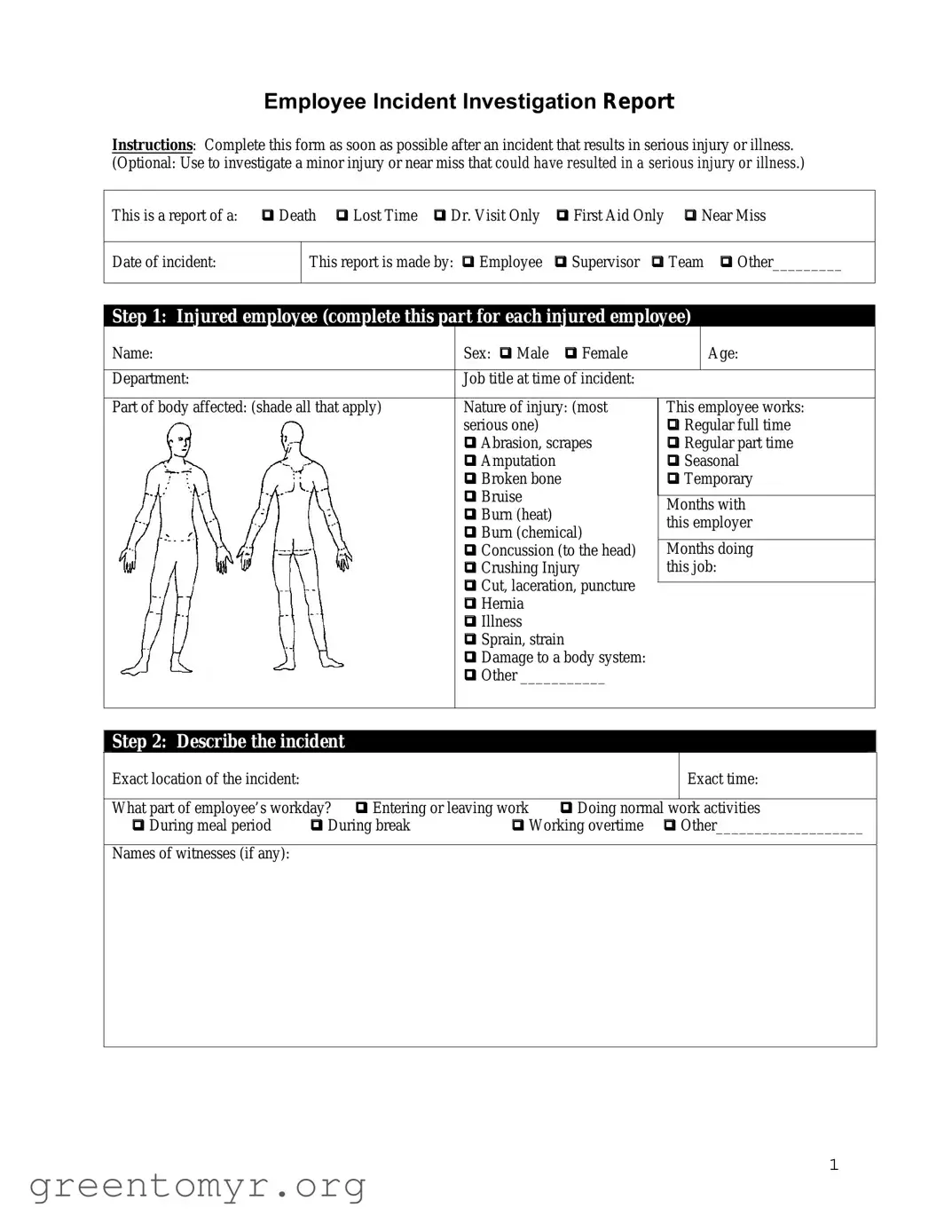
Part of body affected: (shade all that apply) |
Nature of injury: (most |
This employee works: |
|
|
serious one) |
Regular full time |
|
|
Abrasion, scrapes |
Regular part time |
|
|
Amputation |
Seasonal |
|
|
Broken bone |
Temporary |
|
|
Bruise |
Months with |
|
|
|||
|
Burn (heat) |
||
|
this employer |
||
|
Burn (chemical) |
||
|
|
|
|
|
Concussion (to the head) |
Months doing |
|
|
Crushing Injury |
this job: |
|
|
Cut, laceration, puncture |
|
|
|
|
|
|
|
Hernia |
|
|
|
Illness |
|
|
|
Sprain, strain |
|
|
|
Damage to a body system: |
|
|
|
Other ___________ |
|
|
|
|
|
|
Step 2: Describe the incident
Exact location of the incident:
Exact time:
What part of employee’s workday? Entering or leaving work |
Doing normal work activities |
||
During meal period |
During break |
Working overtime Other___________________ |
|
Names of witnesses (if any):
1

Number of attachments:
Written witness statements:
Photographs:
Maps / drawings:
What personal protective equipment was being used (if any)?
Describe,
|
Description continued on attached sheets: |
|
|
|
|
Step 3: Why did the incident happen? |
|
Unsafe workplace conditions: (Check all that apply) |
Unsafe acts by people: (Check all that apply) |
Inadequate guard |
Operating without permission |
Unguarded hazard |
Operating at unsafe speed |
Safety device is defective |
Servicing equipment that has power to it |
Tool or equipment defective |
Making a safety device inoperative |
Workstation layout is hazardous |
Using defective equipment |
Unsafe lighting |
Using equipment in an unapproved way |
Unsafe ventilation |
Unsafe lifting |
Lack of needed personal protective equipment |
Taking an unsafe position or posture |
Lack of appropriate equipment / tools |
Distraction, teasing, horseplay |
Unsafe clothing |
Failure to wear personal protective equipment |
No training or insufficient training |
Failure to use the available equipment / tools |
Other: _____________________________ |
Other: __________________________________ |
|
|
Why did the unsafe conditions exist?
Why did the unsafe acts occur?
Is there a reward (such as “the job can be done more quickly”, or “the product is less likely to be damaged”) that may
have encouraged the unsafe conditions or acts? Yes No If yes, describe:
Were the unsafe acts or conditions reported prior to the incident? |
Yes |
No |
|
|
|
Have there been similar incidents or near misses prior to this one? |
Yes |
No |
2

Step 4: How can future incidents be prevented?
What changes do you suggest to prevent this incident/near miss from happening again?
|
Stop this activity |
Guard the hazard |
Train the employee(s) |
Train the supervisor(s) |
|
Redesign task steps |
Redesign work station |
Write a new policy/rule |
Enforce existing policy |
Routinely inspect for the hazard Personal Protective Equipment Other: ____________________
What should be (or has been) done to carry out the suggestion(s) checked above?
Description continued on attached sheets:
Step 5: Who completed and reviewed this form? (Please Print)
Written by: |
Title: |
Department: |
Date: |
|
|
Names of investigation team members: |
|
Reviewed by:
Title:
Date:
3
| Fact Name | Description |
|---|---|
| Purpose | The Employee Accident Report form is designed to document workplace accidents, ensuring that all relevant details are recorded for safety and legal purposes. |
| Required Information | This form typically requires information such as the date and time of the accident, a description of the incident, and any injuries sustained by the employee. |
| State-Specific Forms | Many states have their own versions of the Employee Accident Report form, which may be influenced by specific state laws governing workplace safety and workers' compensation. |
| Governing Laws | In California, for example, the form must comply with the California Labor Code Section 6409. In New York, it is governed by the New York Workers' Compensation Law. |
After an accident occurs at work, it is essential to document the details accurately. Completing the Employee Accident Report form is a crucial step in this process. This report will help ensure that the incident is properly recorded and addressed. Follow these steps carefully to fill out the form correctly.
Once you have completed the form, submit it to your supervisor or the designated safety officer. They will review the report and take any necessary actions based on the information provided.
When filling out the Employee Accident Report form, many people make common mistakes that can lead to complications later on. One frequent error is failing to provide complete information. It’s essential to include all relevant details about the accident, such as the time, location, and circumstances. Incomplete reports can delay the investigation process.
Another mistake is not documenting the names of witnesses. Witnesses can provide valuable insights into what happened. Omitting their names can weaken the report. Always include contact information for anyone who saw the incident.
Some individuals forget to describe the injuries sustained. It’s important to be clear about what injuries occurred, as this information is crucial for medical treatment and potential claims. Vague descriptions can lead to misunderstandings.
Inaccurate dates and times are another common issue. Ensure that the date and time of the accident are correct. Errors in this information can create confusion and may affect the outcome of any investigations.
People often neglect to sign and date the report. A signature confirms that the information is accurate to the best of one’s knowledge. Without it, the report may be considered incomplete.
Another mistake is failing to report the accident in a timely manner. Delays can hinder the ability to gather evidence and may affect the employer's response. It’s best to fill out the form as soon as possible after the incident.
Some employees may not realize the importance of using clear and concise language. Ambiguous terms can lead to misinterpretations. Writing in a straightforward manner helps ensure that everyone understands the situation.
Additionally, people sometimes forget to check for spelling and grammatical errors. These mistakes can detract from the professionalism of the report. A well-written report reflects attention to detail.
Finally, individuals may overlook the need to keep a copy of the report for their records. Having a personal copy can be useful for future reference. It helps track the progress of the incident and any subsequent actions taken.
When an employee is involved in an accident at work, several forms and documents may accompany the Employee Accident Report. These documents help ensure that the incident is thoroughly documented and that appropriate actions are taken in response. Below is a list of commonly used forms and documents related to workplace accidents.
Utilizing these forms and documents alongside the Employee Accident Report helps create a comprehensive overview of workplace incidents. This thorough documentation is vital for ensuring compliance with safety regulations and fostering a safer work environment.
When filling out the Employee Accident Report form, it’s important to be thorough and accurate. Here’s a helpful list of things you should and shouldn’t do:
By following these guidelines, you can ensure that your report is complete and clear, which will help in addressing the situation effectively.
Understanding the Employee Accident Report form is crucial for both employers and employees. However, several misconceptions can lead to confusion regarding its purpose and use. Below is a list of common misunderstandings:
Addressing these misconceptions can help foster a safer workplace environment and encourage open communication regarding accidents and safety concerns.
Filling out the Employee Accident Report form is an essential process for documenting workplace incidents. Here are some key takeaways to keep in mind:
By following these guidelines, you can help ensure that the Employee Accident Report is filled out correctly and serves its purpose effectively.