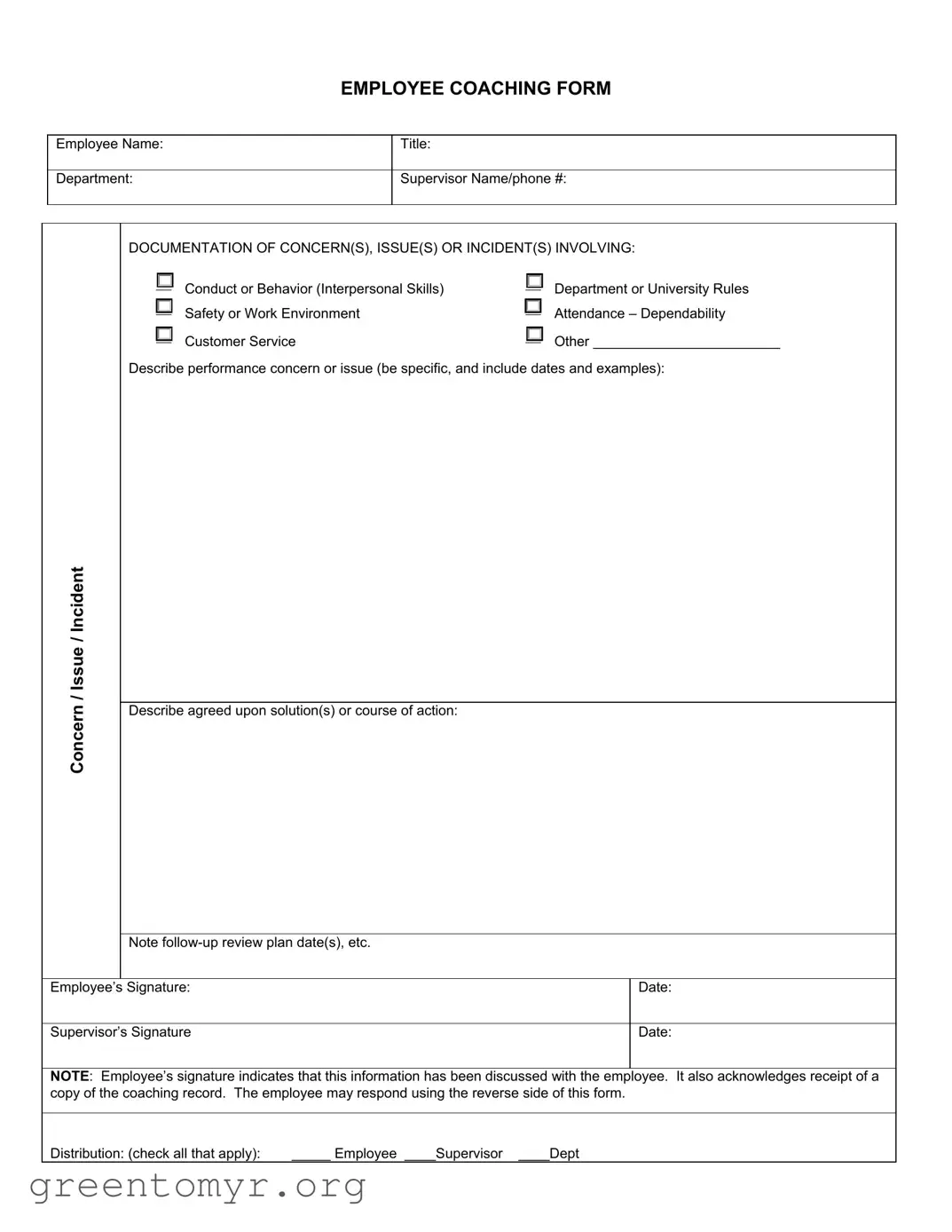
The Employee Coaching form serves as a vital tool in fostering communication between supervisors and employees. It addresses various concerns that may arise in the workplace, including conduct, safety, attendance, and customer service. This form is designed to document specific incidents or behaviors that require attention, ensuring that both parties have a clear understanding of the issues at hand. It includes sections for detailing the performance concern, outlining agreed-upon solutions, and establishing a follow-up plan. The signatures of both the employee and the supervisor confirm that the discussion has taken place and that the employee has received a copy of the record. Additionally, the form allows for employee feedback, promoting a two-way dialogue that is essential for effective coaching. By checking the appropriate distribution boxes, the form ensures that all relevant parties are informed, reinforcing accountability and transparency in the coaching process.

EMPLOYEE COACHING FORM
Employee Name:
Department:
Title:
Supervisor Name/phone #:
CONCERN / ISSUE / INCIDENT
DOCUMENTATION OF CONCERN(S), ISSUE(S) OR INCIDENT(S) INVOLVING:
⎯ Conduct or Behavior (Interpersonal Skills) |
⎯ Department or University Rules |
||
⎯ |
Safety or Work Environment |
⎯ |
Attendance – Dependability |
⎯ |
Customer Service |
⎯ |
Other ________________________ |
Describe performance concern or issue (be specific, and include dates and examples):
Describe agreed upon solution(s) or course of action:
Note
Employee’s Signature:
Supervisor’s Signature
Date:
Date:
NOTE: Employee’s signature indicates that this information has been discussed with the employee. It also acknowledges receipt of a copy of the coaching record. The employee may respond using the reverse side of this form.
Distribution: (check all that apply): |
_____ Employee ____Supervisor ____Dept |
| Fact Name | Description |
|---|---|
| Purpose | The Employee Coaching Form is designed to document performance concerns, incidents, and agreed-upon solutions between the employee and supervisor. |
| Signature Requirement | Both the employee and supervisor must sign the form. The employee's signature confirms that the discussion took place and that they received a copy of the record. |
| Follow-Up Plan | The form includes a section for outlining a follow-up review plan, which ensures accountability and tracking of progress on the discussed issues. |
| Distribution | The completed form is distributed to the employee, supervisor, and department, ensuring all relevant parties are informed. |
Filling out the Employee Coaching form is a straightforward process. By carefully completing each section, you ensure that both the employee and supervisor have a clear understanding of the concerns and agreed-upon actions. This promotes open communication and accountability.
The Employee Coaching form serves as a structured tool for supervisors to document concerns related to an employee's performance or behavior. It helps identify specific issues, such as conduct, attendance, or customer service, and outlines a plan for improvement. By using this form, both the employee and supervisor can engage in a constructive dialogue, ensuring clarity and mutual understanding regarding expectations and solutions.
If you have multiple concerns, it is important to address each one clearly and specifically. In the section for documenting the concern(s), issue(s), or incident(s), list all relevant issues under the appropriate categories. For example:
Be sure to include specific dates and examples for each concern to provide a comprehensive view of the employee's performance.
Once the Employee Coaching form is completed and signed by both the employee and the supervisor, it serves as a record of the discussion and agreed-upon actions. The form should be distributed to all parties involved, including the employee, the supervisor, and the department. The signatures indicate that the employee acknowledges the receipt of the coaching record and has had the opportunity to discuss the contents. Follow-up review dates should also be noted to assess progress and ensure accountability.
Yes, the Employee Coaching form includes a space for the employee to respond to the documented concerns. This is an important aspect of the process, as it allows the employee to express their perspective and provide any additional context or information. Responses can be written on the reverse side of the form. Encouraging this dialogue fosters a more open and supportive work environment.
Filling out the Employee Coaching form can feel like a daunting task. However, avoiding common mistakes can make the process smoother and more effective. Here are seven pitfalls to watch out for when completing this important document.
One frequent mistake is vagueness in descriptions. When detailing the performance concern, it’s essential to be specific. Instead of saying, "The employee has poor attendance," try including exact dates and instances. This clarity helps everyone involved understand the situation better and provides a solid foundation for improvement.
Another common error is neglecting to include agreed-upon solutions. Simply documenting the issue without outlining how it will be addressed can lead to confusion. Clearly stating the course of action not only shows that there is a plan in place but also sets expectations for both the employee and the supervisor.
Omitting the follow-up review plan is also a mistake that can have lasting consequences. Without a scheduled follow-up, it’s easy for both parties to forget about the coaching discussion. Including specific dates for follow-up reviews ensures that the matter remains a priority and allows for ongoing support and assessment.
Some individuals forget to check the appropriate distribution boxes at the bottom of the form. This oversight can lead to miscommunication. By ensuring that all relevant parties receive a copy of the coaching record, everyone stays informed and aligned on the issue at hand.
Another error involves not obtaining signatures. The employee's signature indicates that the discussion has taken place and that they have received a copy of the coaching record. Skipping this step can lead to misunderstandings later on, so it’s crucial to ensure both signatures are obtained.
Additionally, failing to utilize the reverse side of the form for employee responses is a missed opportunity. The employee may have valuable insights or feedback regarding the coaching process. Encouraging them to share their thoughts can foster a more constructive dialogue and promote a healthier work environment.
Finally, rushing through the form can lead to mistakes. Taking the time to carefully fill out each section ensures that the information is accurate and comprehensive. A well-thought-out form reflects professionalism and a commitment to resolving the issue effectively.
The Employee Coaching Form is an essential tool for addressing performance issues and fostering improvement in the workplace. Alongside this form, several other documents can enhance the coaching process and provide a comprehensive framework for employee development. Below are some commonly used forms and documents.
Using these documents in conjunction with the Employee Coaching Form can create a supportive environment for employees. Together, they help clarify expectations and promote continuous improvement, ultimately benefiting both the individual and the organization.
When filling out the Employee Coaching form, it is essential to approach the task with care and attention to detail. Below is a list of things to consider doing and avoiding in the process.
By following these guidelines, the process of completing the Employee Coaching form can be streamlined, fostering better communication and understanding between the employee and supervisor.
Misconceptions about the Employee Coaching form can lead to confusion and mismanagement of employee performance issues. Here are eight common misconceptions:
When using the Employee Coaching form, keep these key takeaways in mind: