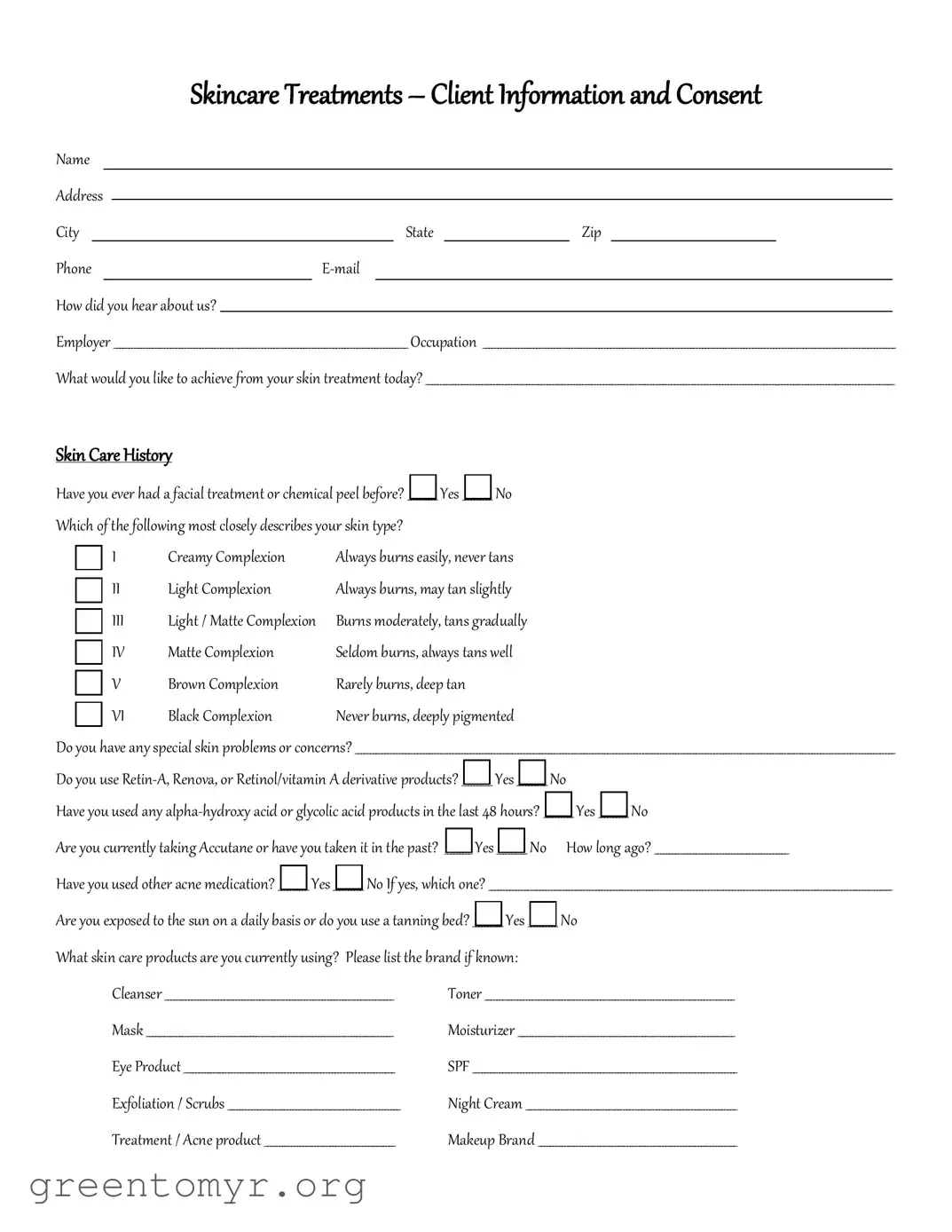
When considering facial treatments, understanding the importance of a Facial Consent form is essential for both the provider and the client. This document serves as a crucial tool to ensure that clients are fully informed about the procedures they are about to undergo. It outlines potential risks and benefits associated with various facial treatments, allowing individuals to make educated decisions regarding their care. Additionally, the form captures vital personal information and medical history, which helps practitioners tailor their services to meet specific needs. By signing the Facial Consent form, clients acknowledge their understanding of the treatment process and provide consent to proceed, thereby fostering a trusting relationship between the client and the service provider. Overall, this form is not just a procedural step; it is a commitment to safety, transparency, and informed choice in the realm of facial aesthetics.

Skincare Treatments – Client Information and Consent
Name
Address
City |
|
|
|
|
State |
|
|
Zip |
|
|
||
Phone |
|
|
|
|
|
|
|
|
||||
How did you hear about us? |
|
|
|
|
|
|
|
|
|
|
||
Employer ___________________________________________________________________________________________________ Occupation |
___________________________________________________________________________________________________________________________________________ |
|||||||||||
What would you like to achieve from your skin treatment today? ______________________________________________________________________________________________________________________________________________________________
Skin Care History
Have you ever had a facial treatment or chemical peel before? __________ Yes __________ No
Which of the following most closely describes your skin type?
I |
Creamy Complexion |
Always burns easily, never tans |
II |
Light Complexion |
Always burns, may tan slightly |
III |
Light / Matte Complexion |
Burns moderately, tans gradually |
IV |
Matte Complexion |
Seldom burns, always tans well |
V |
Brown Complexion |
Rarely burns, deep tan |
VI |
Black Complexion |
Never burns, deeply pigmented |
Do you have any special skin problems or concerns? ______________________________________________________________________________________________________________________________________________________________________________________
Do you use
Have you used any
Are you currently taking Accutane or have you taken it in the past? _________ Yes __________ No How long ago? _____________________________________________
Have you used other acne medication? __________ Yes __________ No If yes, which one? ________________________________________________________________________________________________________________________________________
Are you exposed to the sun on a daily basis or do you use a tanning bed? __________ Yes __________ No
What skin care products are you currently using? Please list the brand if known:
Cleanser _____________________________________________________________________________ |
Toner ____________________________________________________________________________________ |
Mask ___________________________________________________________________________________ |
Moisturizer _________________________________________________________________________ |
Eye Product _______________________________________________________________________ |
SPF _________________________________________________________________________________________ |
Exfoliation / Scrubs __________________________________________________________ |
Night Cream _______________________________________________________________________ |
Treatment / Acne product ____________________________________________ |
Makeup Brand ___________________________________________________________________ |

Please circle any areas of concern you have regarding your skin: |
|
||
|
Breakouts / Acne |
Blackheads / Whiteheads |
Excessive Oil / Shine |
|
Rosacea |
Broken Capillaries |
Redness / Ruddiness |
|
Sun spot / Brown spots |
Uneven Skin Tone |
Sun Damage |
|
Wrinkles / Fine Lines |
Dull / Dry Skin |
Flaky Skin |
|
Dehydrated Skin |
Sensitive Skin |
|
Eyes: |
Dark Circles |
Puffiness |
Fine lines |
Please circle if you have ever had an allergic reaction to any of the following: |
|
||
|
Cosmetics |
Medicine |
Food |
|
Animals |
Sunscreens |
Pollen |
|
AHAs |
Fragrance |
Shellfish |
|
Latex |
Collagen |
Other: ___________________________________________________________________________________________________ |
Have you ever had Botox, Restylane, or other injections? ______________________________________________________________________________________________________________________________________________________________________________
Ladies only:
Are you taking hormonal contraceptives? __________ Yes __________ No
Are you pregnant or trying to become pregnant? __________ Yes __________ No Are you nursing? __________ Yes __________ No
Experiencing any menopause problems? ____________________________________________________________________________________________________________________________________________________________________________________________________________
Are you undergoing any hormone replacement therapy or cancer treatments? ____________________________________________________________________________________________________________________________________
I understand this consent form and have answered each question truthfully. I understand that withholding information from my skin care therapist may result in contraindications or skin irritation from treatments received. The skin care treatments I receive at Belle Waxing and Skincare are voluntary and I release Belle Waxing and Skincare from liability and assume full responsibility thereof.
Signature |
|
Date |
| Fact Name | Description |
|---|---|
| Purpose | The Facial Consent form is used to obtain permission from clients for facial treatments. |
| Informed Consent | This form ensures clients are informed about the procedures and potential risks involved. |
| Client Rights | Clients have the right to ask questions and withdraw consent at any time before treatment. |
| State-Specific Requirements | Some states may have specific laws governing the use of consent forms in cosmetic procedures. |
| Governing Law - California | In California, the Business and Professions Code Section 7310 requires consent for cosmetic procedures. |
| Governing Law - New York | New York law mandates that informed consent must be documented for all medical and cosmetic treatments. |
| Governing Law - Texas | Texas Health and Safety Code Section 145.002 outlines consent requirements for certain cosmetic procedures. |
| Record Keeping | Providers should keep a copy of the signed consent form in the client’s medical records. |
| Revocation of Consent | Clients may revoke their consent verbally or in writing at any time before the procedure begins. |
| Legal Protection | A properly executed consent form can provide legal protection for the provider in case of disputes. |
After receiving the Facial Consent form, the next steps involve carefully filling it out to ensure all necessary information is provided. Completing this form accurately is essential for the process to move forward smoothly.
A Facial Consent Form is a document that clients sign before receiving facial treatments. It ensures that clients are informed about the procedures, potential risks, and aftercare involved. This form helps protect both the client and the service provider by establishing clear communication and understanding.
Signing a Facial Consent Form is crucial for several reasons:
A Facial Consent Form generally includes the following details:
Yes, you can refuse to sign the Facial Consent Form. However, it’s important to understand that without your signature, the service provider may not proceed with the treatment. This is to ensure that both parties are protected and that you are fully informed about what to expect.
If you have any concerns or questions about the treatment, address them with the service provider before signing the form. They are there to help clarify any doubts you may have. Open communication is key to ensuring that you feel comfortable and informed about your facial treatment.
Yes, most reputable service providers require a Facial Consent Form for all facial treatments. This practice helps ensure that clients are aware of the specifics of the treatment and any associated risks. It’s a standard procedure designed to protect everyone involved.
Filling out a Facial Consent form can seem straightforward, but many individuals make common mistakes that can lead to complications. One frequent error is not reading the entire form before signing. It is essential to understand all the terms and conditions. Skimming through the document may result in overlooking important information.
Another mistake is providing incomplete or inaccurate personal information. Details such as name, contact information, and medical history should be filled out carefully. Inaccuracies can lead to misunderstandings about the treatment and its implications.
Some people fail to disclose relevant medical conditions or allergies. This omission can pose serious risks during the facial treatment. It is vital to be transparent about any health issues to ensure safety and effectiveness.
Additionally, individuals sometimes misunderstand the purpose of the consent form. It is not merely a formality; it serves to inform clients about potential risks and benefits. Misinterpretation can lead to unexpected outcomes or dissatisfaction with the treatment.
Another common error involves not asking questions before signing. If there are uncertainties about the procedure or the consent form itself, seeking clarification is important. Professionals are there to help and provide the necessary information.
Many individuals also neglect to check the expiration date of the consent form. Some forms have a limited validity period, and using an outdated form may invalidate the consent. Staying aware of these details can prevent unnecessary complications.
Finally, some people rush through the process, treating it as a mere formality. Taking the time to read, understand, and complete the form thoughtfully is crucial. A careful approach can lead to a more positive experience overall.
When obtaining consent for facial treatments, several other forms and documents may accompany the Facial Consent form. Each serves a specific purpose to ensure clarity, safety, and compliance with legal standards. Here’s a brief overview of these documents:
These documents work together to create a comprehensive approach to client care and legal compliance. Ensuring that all forms are completed accurately helps foster a safe and professional environment for both clients and practitioners.
The Facial Consent form shares similarities with several other documents commonly used in various contexts. Here’s a breakdown of six documents that are comparable:
When it comes to filling out a Facial Consent form, it’s important to approach it with care. Here’s a helpful list of things you should and shouldn’t do to ensure a smooth process.
By following these guidelines, you can ensure that you are well-informed and prepared for your facial treatment. Your comfort and safety should always come first.
When it comes to facial consent forms, there are several misconceptions that can lead to confusion. Understanding these can help individuals feel more informed and secure when providing consent for facial treatments. Here’s a list of common misunderstandings:
By addressing these misconceptions, individuals can make more informed decisions regarding their facial treatments and understand the importance of consent forms in the process.
When filling out and using the Facial Consent form, it is important to keep several key points in mind. These points will help ensure that the process is smooth and clear for everyone involved.
By keeping these takeaways in mind, you can approach the Facial Consent form with confidence and clarity.