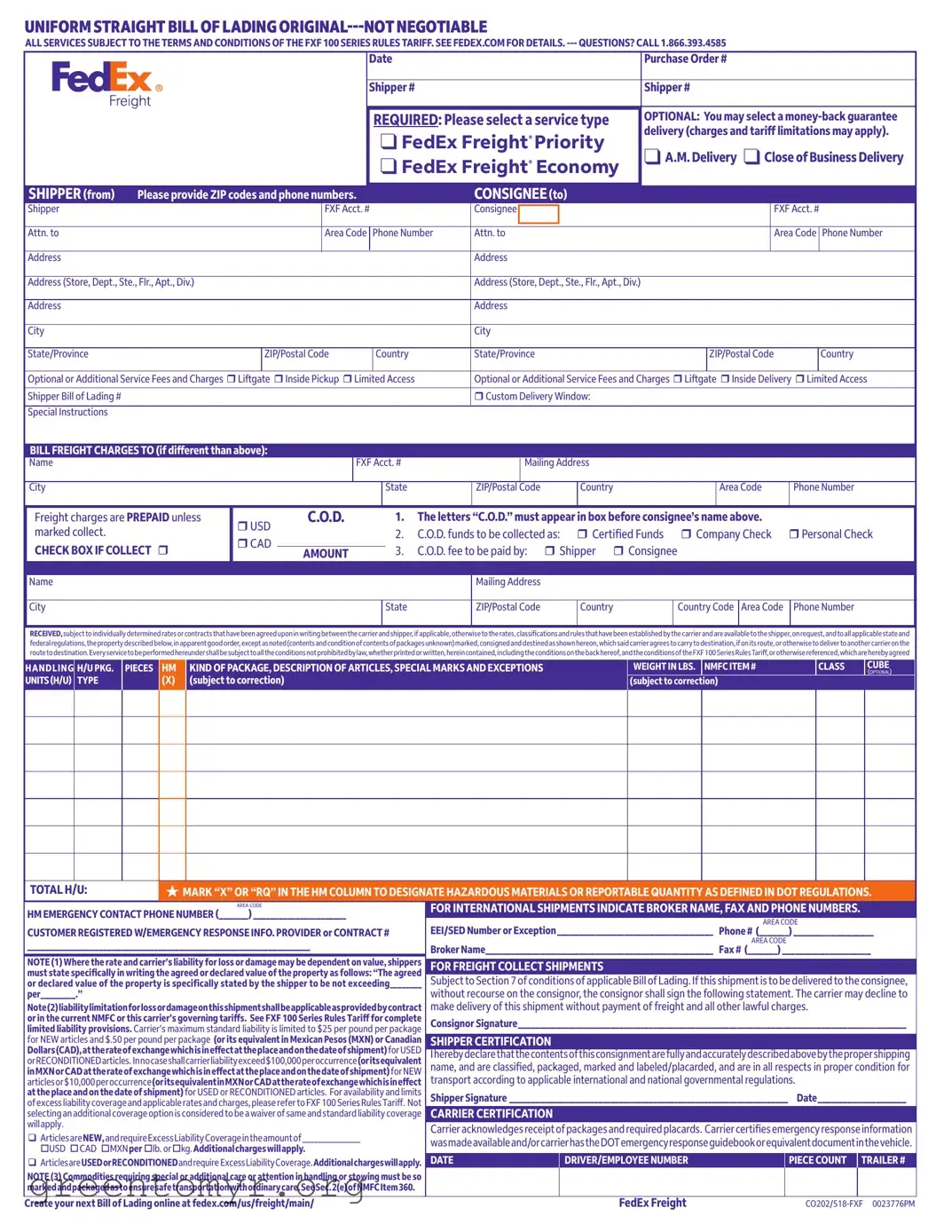
The FedEx Bill of Lading form serves as a crucial document in the shipping process, encapsulating essential information about the shipment being transported. It begins with a declaration that the document is an original, non-negotiable bill of lading, and emphasizes that all services are subject to the terms outlined in the FXF 100 Series Rules Tariff, which can be referenced online. Shippers are required to provide specific details, including service type, shipper and consignee information, and any additional service fees, such as liftgate or inside delivery. The form also addresses freight charges, indicating whether they are prepaid or collected upon delivery, and outlines the necessary protocols for C.O.D. shipments. Notably, the document includes sections for declaring the contents of the shipment, specifying weights, and indicating any hazardous materials involved. Furthermore, it mandates that shippers certify the accuracy of the information provided and understand the limitations of liability for loss or damage, which vary depending on the nature of the goods being shipped. As such, the FedEx Bill of Lading is not just a shipping label; it is a comprehensive agreement that governs the terms of transport and ensures compliance with relevant regulations.
UNIFORM STRAIGHT BILL OF LADING
ALL SERVICES SUBJECT TO THE TERMS AND CONDITIONS OF THE FXF 100 SERIES RULES TARIFF. SEE FEDEX.COM FOR DETAILS.
|
|
|
|
|
|
|
|
|
|
|
|
|
|
|
|
|
|
|
|
|
|
|
|
|
|
|
|
|
|
|
|
|
Date |
|
|
|
|
|
|
|
|
Purchase Order # |
|
|
|
||||||
|
|
|
|
|
|
|
|
|
|
|
|
|
|
|
|
|
|
|
|
|
|
|
|||
|
|
|
|
|
|
|
Shipper # |
|
|
|
|
|
|
|
Shipper # |
|
|
|
|||||||
|
|
|
|
|
|
|
|
|
|
|
|
|
|
|
|
|
|||||||||
|
|
|
|
|
|
|
|
REQUIRED: Please select a service type |
OPTIONAL: You may select a |
||||||||||||||||
|
|
|
|
|
|
|
|
q |
FedEx Freight |
® |
Priority |
delivery (charges and tariff limitations may apply). |
|||||||||||||
|
|
|
|
|
|
|
|
q A.M. Delivery q Close of Business Delivery |
|||||||||||||||||
|
|
|
|
|
|
|
|
|
|
|
|
|
|
|
|||||||||||
|
|
|
|
|
|
|
|
q FedEx Freight® Economy |
|||||||||||||||||
|
|
|
|
|
|
|
|
|
|
|
|
|
|
|
|||||||||||
SHIPPER (from) |
Please provide ZIP codes and phone numbers. |
|
|
|
|
|
|
CONSIGNEE (to) |
|
|
|
|
|
|
|
|
|||||||||
Shipper |
|
|
|
|
FXF Acct. # |
|
|
Consignee |
|
|
|
|
|
|
|
|
|
FXF Acct. # |
|||||||
|
|
|
|
|
|
|
|
|
|
|
|
|
|
||||||||||||
|
|
|
|
|
|
|
|
|
|
|
|
|
|
|
|
|
|
|
|
|
|
|
|
|
|
Attn. to |
|
|
|
|
Area Code |
|
Phone Number |
Attn. to |
|
|
|
|
|
|
|
|
Area Code |
Phone Number |
|||||||
|
|
|
|
|
|
|
|
|
|
|
|
|
|
|
|
|
|
|
|
|
|
|
|
|
|
Address |
|
|
|
|
|
|
|
|
|
|
|
|
Address |
|
|
|
|
|
|
|
|
|
|
|
|
|
|
|
|
|
|
|
|
|
|
|
|
|
|
|
|
|
|
|
|
|
|
||||
Address (Store, Dept., Ste., Flr., Apt., Div.) |
|
|
|
|
|
|
|
|
|
|
|
Address (Store, Dept., Ste., Flr., Apt., Div.) |
|
|
|
|
|
|
|
||||||
|
|
|
|
|
|
|
|
|
|
|
|
|
|
|
|
|
|
|
|
|
|
|
|
|
|
Address |
|
|
|
|
|
|
|
|
|
|
|
|
Address |
|
|
|
|
|
|
|
|
|
|
|
|
|
|
|
|
|
|
|
|
|
|
|
|
|
|
|
|
|
|
|
|
|
|
|
|
|
|
City |
|
|
|
|
|
|
|
|
|
|
|
|
City |
|
|
|
|
|
|
|
|
|
|
|
|
|
|
|
|
|
|
|
|
|
|
|
|
|
|
|
|
|
|
|
|||||||
State/Province |
|
|
ZIP/Postal Code |
|
Country |
|
State/Province |
|
|
ZIP/Postal Code |
|
|
Country |
||||||||||||
|
|
|
|
|
|
|
|
|
|
|
|
|
|
||||||||||||
Optional or Additional Service Fees and Charges rLiftgate rInside Pickup rLimited Access |
|
Optional or Additional Service Fees and Charges rLiftgate rInside Delivery rLimited Access |
|||||||||||||||||||||||
Shipper Bill of Lading # |
|
|
|
|
|
|
|
|
|
|
|
|
rCustom Delivery Window: |
|
|
|
|
|
|
|
|||||
Special Instructions |
|
|
|
|
|
|
|
|
|
|
|
|
|
|
|
|
|
|
|
|
|
|
|
|
|
|
|
|
|
|
|
|
|
|
|
|
|
|
|
|
|
|
|
|
|
|
|
|
|
||
BILL FREIGHT CHARGES TO (if different than above): |
|
|
|
|
|
|
|
|
|
|
|
|
|
|
|
|
|
|
|
|
|
|
|||
Name |
|
|
|
|
|
FXF Acct. # |
|
|
|
Mailing Address |
|
|
|
|
|
|
|
||||||||
|
|
|
|
|
|
|
|
|
|
|
|
|
|
|
|
|
|
|
|
|
|
|
|||
City |
|
|
|
|
|
|
|
|
|
State |
|
ZIP/Postal Code |
Country |
|
|
Area Code |
|
Phone Number |
|||||||
|
|
|
|
|
|
|
|
|
|
|
|
|
|
|
|
|
|||||||||
Freight charges are PREPAID unless |
USD |
C.O.D. |
|
|
1. |
The letters |
“C.O.D.” must appear |
in box before consignee’s name above. |
|
|
|
||||||||||||||
marked collect. |
|
|
|
|
2. |
C.O.D. funds to be collected as: |
Certified Funds Company Check |
Personal Check |
|||||||||||||||||
|
CAD |
|
|
|
|||||||||||||||||||||
CHECK BOX IF COLLECT |
|
|
|
|
|
|
|
|
|
|
|
|
|
|
|
|
|
|
|
|
|
|
|||
AMOUNT |
3. |
C.O.D. fee to be paid by: Shipper Consignee |
|
|
|
||||||||||||||||||||
|
|
|
|
|
|||||||||||||||||||||
REMIT C.O.D. TO (if different than shipper above):
Name |
|
Mailing Address |
|
|
|
|
|
|
|
|
|
|
|
City |
State |
ZIP/Postal Code |
Country |
Country Code |
Area Code |
Phone Number |
|
|
|
|
|
|
|
RECEIVED, subject to individually determined rates or contracts that have been agreed upon in writing between the carrier and shipper, if applicable, otherwise to the rates, classifications and rules that have been established by the carrier and are available to the shipper, on request, and to all applicable state and federal regulations, the property described below, in apparent good order, except as noted (contents and condition of contents of packages unknown) marked, consigned and destined as shown hereon, which said carrier agrees to carry to destination, if on its route, or otherwise to deliver to another carrier on the route to destination. Every service to be performed hereunder shall be subject to all the conditions not prohibited by law, whether printed or written, herein contained, including the conditions on the back hereof, and the conditions of the FXF 100 Series Rules Tariff, or otherwise referenced, which are hereby agreed
|
|
|
|
|
|
|
|
HANDLING H/U PKG. |
PIECES |
HM |
KIND OF PACKAGE, DESCRIPTION OF ARTICLES, SPECIAL MARKS AND EXCEPTIONS |
WEIGHT IN LBS. |
NMFC ITEM # |
CLASS |
CUBE |
(optional) |
|||||||
UNITS (H/U) TYPE |
|
(X) |
(subject to correction) |
(subject to correction) |
|
|
|
|
TOTAL H/U: |
|
H MARK “X” OR “RQ” IN THE HM COLUMN TO DESIGNATE HAZARDOUS MATERIALS OR REPORTABLE QUANTITY AS DEFINED IN DOT REGULATIONS. |
|
||||||
|
|
|
|
FOR INTERNATIONAL SHIPMENTS INDICATE BROKER NAME, FAX AND PHONE NUMBERS. |
|
|||||
|
|
|
area code |
|
|
|
|
|
|
|
|
HM EMERGENCY CONTACT PHONE NUMBER (_______) ______________________ |
|
|
|
|
|
|
|||
EEI/SED Number or Exception______________________________________ |
AREA CODE |
|||||||||
|
CUSTOMER REGISTERED W/EMERGENCY RESPONSE INFO. PROVIDER or CONTRACT # |
Phone # (_______) ___________________ |
||||||||
___________________________________________________________________ |
Broker Name______________________________________________________ |
AREA CODE |
||||||||
Fax # (_______) _____________________ |
||||||||||
|
NOTE (1) Where the rate and carrier’s liability for loss or damage may be dependent on value, shippers |
|
|
|
|
|
|
|||
FOR FREIGHT COLLECT SHIPMENTS |
|
|
|
|
||||||
|
must state specifically in writing the agreed or declared value of the property as follows: “The agreed |
|
|
|
|
|||||
Subject to Section 7 of conditions of applicable Bill of Lading. If this shipment is to be delivered to the consignee, |
||||||||||
|
or declared value of the property is specifically stated by the shipper to be not exceeding________ |
|||||||||
|
per_________.” |
|
|
without recourse on the consignor, the consignor shall sign the following statement. The carrier may decline to |
||||||
|
Note(2)liabilitylimitationforlossordamageonthisshipmentshallbeapplicableasprovidedbycontract |
make delivery of this shipment without payment of freight and all other lawful charges. |
||||||||
|
or in the current NMFC or this carrier’s governing tariffs. See FXF 100 Series Rules Tariff for complete |
Consignor Signature____________________________________________________________________________________________ |
||||||||
|
limited liability provisions. Carrier’s maximum standard liability is limited to $25 per pound per package |
|||||||||
|
for NEW articles and $.50 per pound per package (or its equivalent in Mexican Pesos (MXN) or Canadian |
SHIPPER CERTIFICATION |
|
|
|
|
|
|||
|
Dollars(CAD),attherateofexchangewhichisineffectattheplaceandonthedateofshipment)for USED |
Iherebydeclarethatthecontentsofthisconsignmentarefullyandaccuratelydescribedabovebythepropershipping |
||||||||
|
orRECONDITIONEDarticles. Innocaseshallcarrierliabilityexceed$100,000peroccurrence(oritsequivalent |
name, and are classified, packaged, marked and labeled/placarded, and are in all respects in proper condition for |
||||||||
|
inMXNorCADattherateofexchangewhichisineffectattheplaceandonthedateofshipment) for NEW |
|||||||||
|
articlesor$10,000peroccurrence(oritsequivalentinMXNorCADattherateofexchangewhichisineffect |
transport according to applicable international and national governmental regulations. |
||||||||
|
at the place and on the date of shipment) for USED or RECONDITIONED articles. For availability and limits |
Shipper Signature___________________________________________________________________ Date_____________________ |
||||||||
|
of excess liability coverage and applicable rates and charges, please refer to FXF 100 Series Rules Tariff. Not |
|||||||||
|
selecting an additional coverage option is considered to be a waiver of same and standard liability coverage |
CARRIER CERTIFICATION |
|
|
|
|
|
|||
|
willapply. |
|
|
Carrier acknowledges receipt of packages and required placards. Carrier certifies emergency response information |
||||||
|
ArticlesareNEW,andrequireExcessLiabilityCoverageintheamountof_______________ |
wasmadeavailableand/orcarrierhastheDOTemergencyresponseguidebookorequivalentdocumentinthevehicle. |
||||||||
|
oUSD oCAD oMXNper olb. orokg.Additionalchargeswillapply. |
|||||||||
|
ArticlesareUSEDorRECONDITIONEDandrequire ExcessLiabilityCoverage.Additionalchargeswillapply. |
DATE |
DRIVER/EMPLOYEE NUMBER |
|
PIECE COUNT |
TRAILER # |
||||
|
NOTE (3) Commodities requiring special or additional care or attention in handling or stowing must be so |
|
|
|
|
|
|
|||
|
markedandpackagedastoensuresafetransportationwithordinarycare.SeeSec.2(e)ofNMFCItem360. |
|
|
|
|
|
|
|||
Create your next Bill of Lading online at fedex.com/us/freight/main/ |
|
FedEx Freight |
|
|||||||
| Fact Name | Description |
|---|---|
| Type of Bill | This is a Uniform Straight Bill of Lading, which is not negotiable. |
| Governing Terms | All services are subject to the terms and conditions of the FXF 100 Series Rules Tariff. |
| Contact Information | For questions, call 1.866.393.4585. |
| Service Types | Shippers can select from various service types, including FedEx Freight Priority and Economy. |
| C.O.D. Options | Cash on Delivery (C.O.D.) options are available, including certified funds and checks. |
| Hazardous Materials | Shippers must mark hazardous materials or reportable quantities as defined by DOT regulations. |
| Liability Limitations | Carrier liability is limited to $25 per pound for new articles and $0.50 for used articles. |
| Excess Liability Coverage | Shippers can opt for additional liability coverage, which may incur extra charges. |
| State-Specific Laws | Each state may have specific regulations governing bills of lading; consult local laws for details. |
Filling out the FedEx Bill of Lading form is a crucial step in shipping your freight. This document ensures that all necessary information is clearly communicated to facilitate the shipping process. Follow these steps to complete the form accurately.
Once you have filled out the form, double-check all entries for accuracy. After confirming everything is correct, you can proceed with your shipping process. Make sure to keep a copy for your records.
A FedEx Bill of Lading is a document used in freight shipping that serves as a contract between the shipper and the carrier. It outlines the details of the shipment, including the type of service requested, addresses of the shipper and consignee, and any special instructions or charges. This document is essential for ensuring that the shipment is processed correctly and that all parties understand their responsibilities.
To complete the FedEx Bill of Lading form, you will need to provide the following information:
When filling out the FedEx Bill of Lading, you can select a service type based on your shipment's urgency and delivery needs. Options include:
Each option may have different charges and limitations, so it is advisable to review the terms associated with each service type before making a selection.
Optional or additional service fees may apply for specific services that enhance the shipping experience. Examples include:
These services may incur additional charges, so it is important to indicate any requirements on the Bill of Lading form.
C.O.D., or Cash on Delivery, is a service option that allows the consignee to pay for the shipment upon delivery. If you choose this option, you must specify the payment method (e.g., certified funds, company check, or personal check) and the amount to be collected. Ensure that "C.O.D." is clearly marked in the designated box on the form.
The liability for loss or damage of the shipment is typically limited to specific amounts unless otherwise agreed upon. For new articles, the maximum liability is $25 per pound per package. For used or reconditioned articles, it is $0.50 per pound per package. If a higher declared value is desired, it must be stated explicitly on the Bill of Lading.
If your shipment includes hazardous materials, it is crucial to mark the appropriate box on the form. You must also provide emergency contact information and ensure that the shipment complies with all applicable regulations. Proper labeling and documentation are necessary to facilitate safe transportation.
Yes, you can track your shipment using the tracking number provided on the FedEx Bill of Lading. By visiting the FedEx website or using their mobile app, you can enter the tracking number to receive real-time updates on the shipment's status and location.
If there are discrepancies in the shipment, such as missing items or damage, it is essential to document these issues immediately. Notify FedEx customer service and provide details of the problem. Retaining a copy of the Bill of Lading and any supporting documentation will be helpful in resolving disputes.
For more information about the FedEx Bill of Lading, including terms and conditions, visit the FedEx website at fedex.com. You can also contact FedEx customer service at 1.866.393.4585 for assistance with any specific questions or concerns.
Filling out the FedEx Bill of Lading form can seem straightforward, but many individuals make mistakes that can lead to delays or complications. Here are ten common errors to avoid when completing this essential document.
One frequent mistake is failing to include the complete address for both the shipper and the consignee. Missing details, such as ZIP codes or phone numbers, can cause confusion and delays in delivery. Always double-check that every field is filled out accurately.
Another common oversight is neglecting to select the appropriate service type. Whether it's FedEx Freight Priority or Economy, choosing the right service ensures that your shipment arrives on time. If you’re unsure, take a moment to review the options provided on the form.
Many people also forget to indicate if the shipment requires any additional services, such as liftgate or inside delivery. These services often come with extra fees, so it’s important to specify them upfront to avoid surprises later.
When it comes to C.O.D. shipments, some individuals mistakenly fail to mark the box for collect funds. This can lead to misunderstandings about payment responsibilities. Be sure to clearly indicate how the C.O.D. funds should be collected.
Inaccuracies in the description of the shipment can also create issues. It’s vital to provide a detailed and accurate description of the items being shipped, including their weight and dimensions. This information helps determine shipping costs and ensures proper handling.
Another mistake is not providing the correct emergency contact information. In case of hazardous materials, having the right contact can be crucial for safety. Always include a reliable contact number and ensure that the information is up to date.
People often overlook the signature requirement on the form. A missing signature can render the Bill of Lading invalid. Make sure to sign and date the document before submitting it.
Additionally, some shippers fail to specify the declared value for their shipments. This is important for liability purposes. If you do not declare a value, the carrier’s maximum liability may be limited, which could leave you unprotected in case of loss or damage.
Another common error is not reviewing the terms and conditions outlined in the FXF 100 Series Rules Tariff. Understanding these terms can help you avoid unexpected charges and ensure compliance with shipping regulations.
Finally, many individuals do not take the time to proofread their completed forms. Simple typos or errors can lead to significant problems down the line. A careful review can save you time and frustration.
By being mindful of these common mistakes, you can ensure that your FedEx Bill of Lading form is completed accurately and efficiently. This will help facilitate a smoother shipping process and reduce the likelihood of delays or complications.
The FedEx Bill of Lading form is a crucial document for shipping goods. However, it is often accompanied by other forms and documents that help facilitate the shipping process. Here are four commonly used documents that may accompany the FedEx Bill of Lading:
These documents work together with the FedEx Bill of Lading to ensure a smooth shipping experience. Proper documentation is essential for tracking shipments, managing costs, and complying with legal requirements.
The FedEx Bill of Lading serves as an important document in the shipping process. It is similar to several other documents used in logistics and transportation. Below is a list of eight documents that share similarities with the FedEx Bill of Lading, along with explanations of how they are alike.
Understanding these documents can help ensure that shipments are processed smoothly and efficiently. Each document plays a crucial role in the logistics chain, providing necessary information for both shippers and carriers.
When filling out the FedEx Bill of Lading form, following certain guidelines can help ensure a smooth shipping process. Here are five things you should and shouldn't do:
By adhering to these guidelines, you can help ensure that your shipment is processed efficiently and accurately.
Here are five common misconceptions about the FedEx Bill of Lading form:
When filling out and using the FedEx Bill of Lading form, consider the following key takeaways:
Following these guidelines will help ensure a smooth shipping process and minimize potential issues.