Content Navigation

Creating a strong resume is essential for anyone looking to advance their career. The Fill In The Resume Worksheet form serves as a practical tool to help you organize your professional history and skills. This comprehensive worksheet prompts you to provide key information, including your name, contact details, and a clear career objective. You’ll outline your relevant skills and abilities, ensuring you highlight what makes you a strong candidate. The form encourages you to list your work experience in reverse chronological order, detailing job titles, company names, dates of employment, and specific duties. Education is also a focal point, where you can record your academic achievements, including college, vocational training, and high school details. Additionally, the worksheet allows space for special training and skills, as well as references, which can be crucial for potential employers. By filling out this form, you’ll create a structured and thorough foundation for your resume, making it easier to showcase your qualifications effectively.
Fill In The Resume Worksheet Example

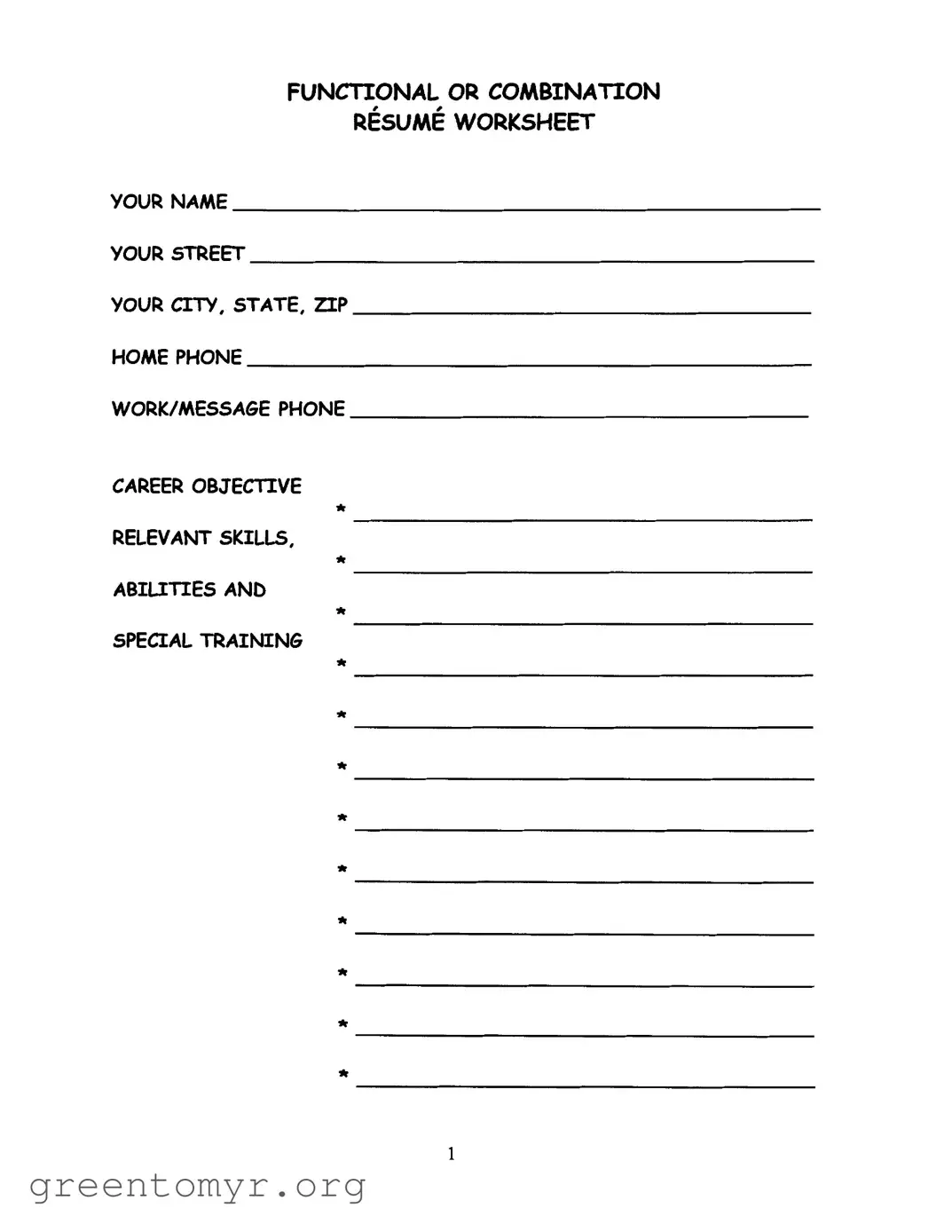
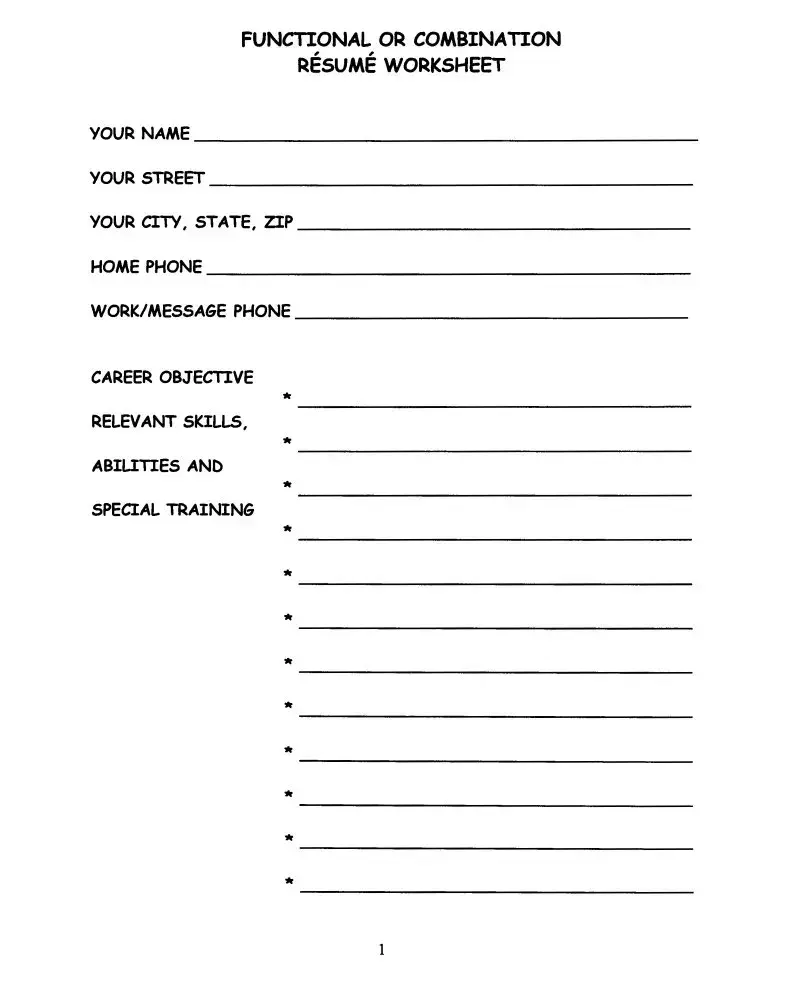
FUNCTIONAL OR COMBINATION

, ,

RESUME WORKSHEET

YOUR NAME ________________________________________

YOUR STREET _______________________________________

YOUR CITY, STATE, ZIP ________________________________

HOME PHONE _______________________________________

WORK/MESSAGE PHONE ________________________________

CAREER OBJECTIVE

*

RELEVANT SKILLS I

*

ABILITIES AND

*

SPECIAL TRAINING

*

*

1
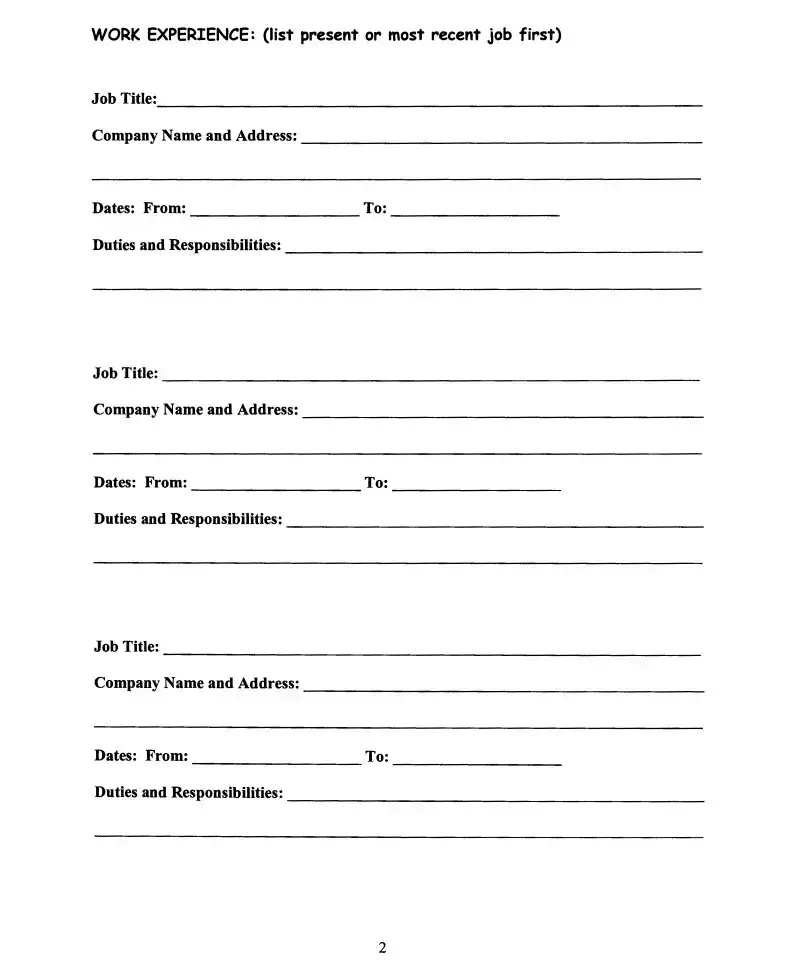
WORK EXPERIENCE: (list present or most recent job first)

Job Title:____________________________

Company Name and Address: ----------------------

Dates: From : --------- To: ---------

Duties and Responsibilities: -----------------------

Job Title: -----------------------------

Company Name and Address: ----------------------

Dates: From: --------- To: ----------

Duties and Responsibilities: -----------------------

Job Title: ----------------------------

Company Name and Address: ----------------------

Dates: From: ----------- To: ---------

Duties and Responsibilities: --------------------------

2

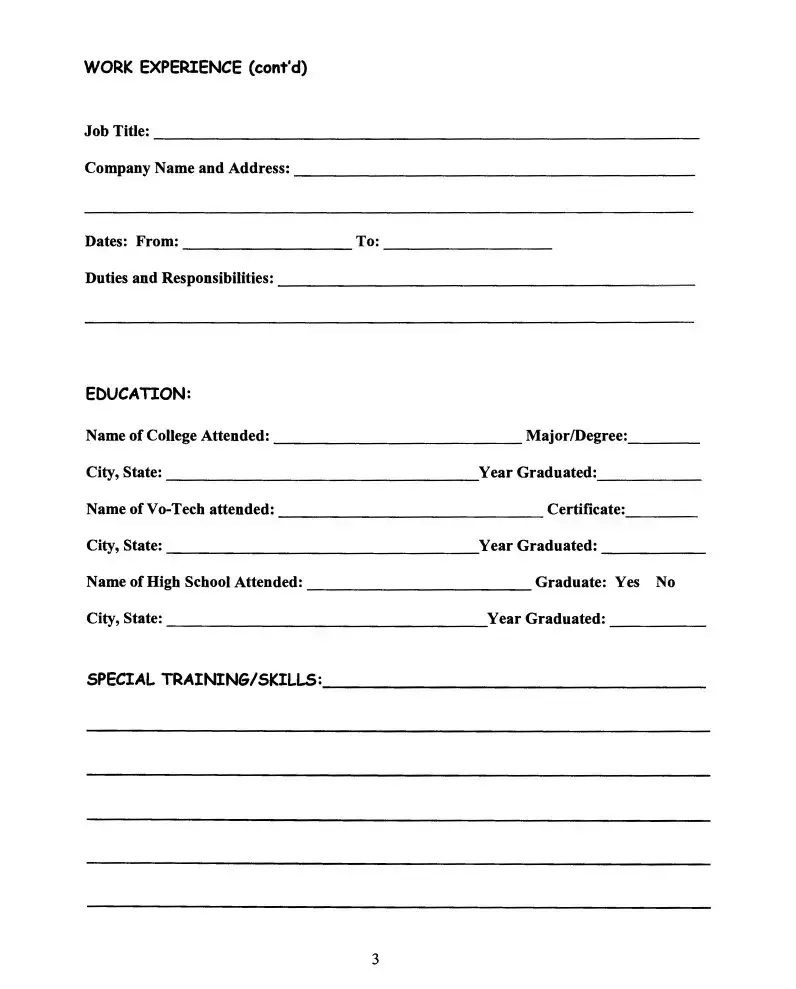
WORK EXPERIENCE (cont'd)

Job Title: --------------------------------------------------------

Company Name and A ddress: ----------------------------------

Dates: From: --------------

To: -----------------

Duties and Responsibilities: --------------------------------------

EDUCATION:

Name of College A ttended: ------------------ Major/Degree:______

City, State:

Year Graduated:_____

Name ofVo-Tech attended:

Certificate:----

City, State:

Year Graduated: ______

Name of High School Attended:

Graduate: Yes No

City, State:

Year Graduated: ______

SPECIAL TRAINING/SKILLS:_________________

3
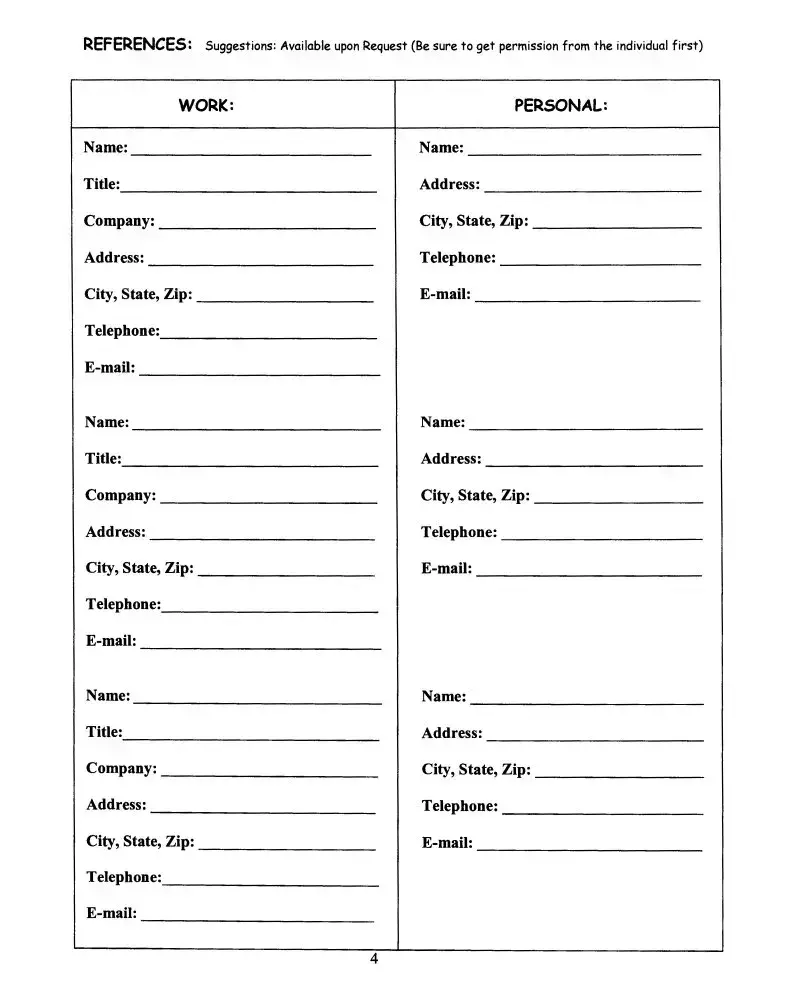
REFERENCES: Suggestions: Available upon Request (Be sure to get permission from the individual first)

WORK:

PERSONAL:

Name:

Name:

Title:

Address:

Company:

City, State, Zip:

Address:

Telephone:

City, State, Zip:

E-mail:

Telephone:


E-mail:


Name:

Name:

Title:

Address:

Company:

City, State, Zip:

Address:

Telephone:

City, State, Zip:

E-mail:

Telephone:


E-mail:


Name:

Name:

Title:

Address:

Company:

City, State, Zip:

Address:

Telephone:

City, State, Zip:

E-mail:

Telephone:


E-mail:


4

File Breakdown

Fact Name Fact Description
Form Purpose The Fill In The Resume Worksheet is designed to help individuals organize their professional and educational background for job applications.
Required Information Users must provide personal details, work experience, education, and references to complete the form effectively.
Career Objective A clear career objective is essential, as it helps potential employers understand the applicant's goals and aspirations.
State-Specific Laws For state-specific forms, applicants should refer to local employment laws, which may vary by state.

Guide to Using Fill In The Resume Worksheet

Completing the Fill In The Resume Worksheet form is an essential step in organizing your professional information. This worksheet will guide you in compiling details about your work experience, education, skills, and references. Following the steps below will help ensure that you provide all necessary information in an orderly manner.

  1. Begin with your personal information: Write your name, street address, city, state, and ZIP code in the designated spaces. Include your home phone number and work/message phone number.
  2. State your career objective: Clearly define what you aim to achieve in your career. This should be a concise statement that reflects your goals.
  3. List your relevant skills: Identify and write down skills that are pertinent to the job you are seeking. This may include technical skills, language proficiency, or interpersonal abilities.
  4. Detail your work experience: Start with your most recent job. For each position, provide the job title, company name and address, dates of employment (from and to), and a brief description of your duties and responsibilities. Continue this for previous positions as needed.
  5. Provide your educational background: Fill in the name of the college you attended, your major or degree, the city and state, and the year you graduated. Repeat this for any vocational training and high school attended.
  6. Include special training or skills: Write down any additional training or skills that are relevant to your career path.
  7. List your references: You may indicate that references are available upon request. However, ensure that you have obtained permission from the individuals you wish to list. Provide their names, titles, addresses, telephone numbers, and email addresses for both work and personal references.

Get Answers on Fill In The Resume Worksheet

What is the purpose of the Fill In The Resume Worksheet form?

The Fill In The Resume Worksheet form is designed to help individuals organize their professional and educational experiences. By filling out this worksheet, you can create a comprehensive overview of your skills, work history, and qualifications. This information serves as a foundation for building a polished resume that highlights your strengths to potential employers.

How should I fill out the work experience section?

In the work experience section, list your jobs in reverse chronological order, starting with your most recent position. For each job, include the following:

  • Job Title
  • Company Name and Address
  • Dates of Employment (From and To)
  • Duties and Responsibilities

Be specific about your responsibilities and achievements in each role. This clarity helps employers understand your contributions and skills.

What should I include in the education section?

In the education section, provide details about your educational background. Include the following:

  1. Name of College or Vo-Tech attended
  2. Major or Degree
  3. City and State of the institution
  4. Year of Graduation
  5. High School attended, indicating if you graduated

Make sure to be accurate with the details, as this information will be verified by potential employers.

What are relevant skills and special training?

Relevant skills refer to specific abilities that pertain to the job you are applying for. This may include technical skills, language proficiency, or soft skills like communication and teamwork. Special training might encompass certifications, workshops, or courses that enhance your qualifications. Including these elements helps to differentiate you from other candidates.

How do I choose references for my resume?

When selecting references, consider individuals who can speak positively about your work ethic, skills, and character. This can include former supervisors, colleagues, or mentors. Always ask for permission before listing someone as a reference. You may also note that references are available upon request, which allows you to maintain control over who is contacted.

Is it necessary to provide personal references?

While professional references are crucial, personal references can also be valuable, especially if you are new to the workforce or changing careers. Personal references can provide insights into your character and interpersonal skills. However, ensure that these individuals can provide a positive perspective and that you have their consent to list them.

Common mistakes

When filling out the Fill In The Resume Worksheet form, individuals often overlook important details. One common mistake is leaving sections blank. Every part of the form is designed to gather specific information. Omitting any section can create gaps in the applicant's profile, potentially raising questions for employers.

Another frequent error involves providing incomplete contact information. It is essential to include a current home phone number and a work/message phone number. If a potential employer cannot reach an applicant, it may hinder job opportunities.

People sometimes fail to clearly define their career objective. A vague or generic objective does not convey the applicant's goals or intentions. A well-defined career objective helps employers understand what the applicant is seeking and how they align with the company's needs.

In the relevant skills and abilities section, applicants may not list all pertinent skills. This section is crucial for showcasing qualifications. Failing to include relevant skills can lead to missed opportunities, especially if those skills are in high demand for the position.

Some individuals neglect to detail their work experience adequately. Listing job titles and companies is not enough. Including specific duties and responsibilities provides context and demonstrates the applicant's capabilities. Employers want to see how past experiences relate to the job at hand.

Another mistake is not listing education in the correct order. The most recent education should be listed first, followed by earlier institutions. This chronological order helps employers quickly assess educational qualifications.

Individuals may also forget to obtain permission from references before listing them. It is important to ensure that references are willing to provide a positive endorsement. This step shows respect and professionalism, which can leave a good impression on potential employers.

Some applicants do not take the time to proofread their completed forms. Typos and grammatical errors can detract from the overall professionalism of the application. A well-proofread document reflects attention to detail and care.

Additionally, people might use inappropriate email addresses. A professional email address is crucial for communication. Using a casual or silly email can create an unprofessional image.

Finally, applicants may not tailor their resumes to specific job applications. Each job may require different skills or experiences to be highlighted. Customizing the resume for each application can significantly increase the chances of being noticed by employers.

Documents used along the form

When preparing to create a resume, several documents can complement the Fill In The Resume Worksheet form. These documents help provide a comprehensive view of a candidate's qualifications, experiences, and skills. Below is a list of commonly used forms and documents that can enhance the resume-building process.

  • Cover Letter: This letter introduces the candidate to potential employers. It highlights the applicant's interest in a specific position and summarizes key qualifications, encouraging the reader to consider the accompanying resume.
  • Reference List: A document containing names and contact information of individuals who can vouch for the candidate's skills and experiences. This list should include both professional and personal references, with their permission obtained beforehand.
  • Transcripts: Academic transcripts provide a record of the candidate's educational achievements. They can be particularly important for recent graduates or those applying for positions that require specific educational qualifications.
  • Certificates: Any relevant certifications or licenses that the candidate has earned should be documented. These can demonstrate specialized skills or knowledge that may be advantageous for the job.
  • Portfolio: For candidates in creative fields, a portfolio showcases work samples. This collection can include designs, writing samples, or projects that exemplify the candidate's abilities and style.
  • Job Descriptions: Collecting job descriptions from previous positions can help tailor the resume to align with the desired job. This ensures that the candidate highlights relevant experiences and skills that match the job requirements.
  • Networking Contacts: A list of professional contacts can be beneficial for job seekers. Networking can lead to job opportunities, and having a list of contacts can facilitate outreach and follow-up communications.

Utilizing these documents alongside the Fill In The Resume Worksheet form can create a well-rounded presentation of qualifications. This comprehensive approach increases the chances of making a strong impression on potential employers.

Similar forms

  • Cover Letter: A cover letter accompanies a resume and introduces the applicant. It highlights key experiences and expresses interest in a specific position.
  • Job Application Form: This form collects similar information as the Fill In The Resume Worksheet. It typically includes personal details, work history, and references but may also require specific answers to job-related questions.
  • Curriculum Vitae (CV): A CV provides a comprehensive overview of an individual’s academic background and work experience. It is more detailed than a resume and often used in academic or research positions.
  • Personal Statement: This document offers insights into an applicant’s motivations, goals, and qualifications. It is often required for graduate school applications and can complement a resume.
  • Reference List: A reference list outlines individuals who can vouch for an applicant’s qualifications. It typically includes names, titles, and contact information, similar to the references section in the Fill In The Resume Worksheet.
  • Portfolio: A portfolio showcases an individual’s work samples and accomplishments. It can be particularly relevant for creative positions, providing tangible evidence of skills and experience.
  • LinkedIn Profile: An online professional profile that summarizes work experience, skills, and education. It serves a similar purpose as a resume but in a digital format, allowing for networking opportunities.

Dos and Don'ts

When filling out the Fill In The Resume Worksheet form, there are several important dos and don’ts to keep in mind. Following these guidelines can help ensure that your resume stands out for the right reasons.

  • Do provide accurate and up-to-date information.
  • Do tailor your career objective to match the job you are applying for.
  • Do highlight relevant skills and experiences that align with the position.
  • Do list your work experience in reverse chronological order, starting with your most recent job.
  • Do include specific duties and responsibilities for each position held.
  • Don’t use vague language; be specific about your accomplishments.
  • Don’t forget to proofread for spelling and grammatical errors.
  • Don’t list references without obtaining their permission first.
  • Don’t include personal information that is not relevant, such as age or marital status.

By adhering to these guidelines, you can create a clear and compelling resume that effectively showcases your qualifications.

Misconceptions

Misconceptions about the Fill In The Resume Worksheet form can lead to confusion and incomplete applications. Here are ten common misunderstandings:

  1. It is only for entry-level positions. Many believe this form is designed solely for new graduates or those with little experience. In reality, it can be used by individuals at any career stage.
  2. Only one job experience section is needed. Some think they can list just one job. However, including multiple work experiences provides a fuller picture of your background.
  3. Education details are optional. Many assume they can skip education sections. This is not advisable, as education can be a key factor for many employers.
  4. References must be included on the form. While references are important, the form suggests stating they are available upon request, allowing you to manage this information better.
  5. It should be filled out in one sitting. Some feel pressured to complete the form in one go. Taking breaks can help ensure accuracy and thoroughness.
  6. Formatting is not important. Many believe that as long as the information is present, formatting doesn’t matter. Clear organization enhances readability and professionalism.
  7. Only job titles are necessary in work experience. Some think they only need to list their job titles. Including duties and responsibilities is crucial for providing context.
  8. Skills can be vague. Many users think general skills are sufficient. Specific skills related to the job you are applying for make a stronger impact.
  9. Personal information is not necessary. Some believe that personal details, like contact information, can be omitted. This information is essential for potential employers to reach you.
  10. It is a one-size-fits-all document. Many assume the form can be used for any job application without tailoring it. Customizing the content for each application is vital for success.

Key takeaways

Using the Fill In The Resume Worksheet form can streamline the process of creating a polished resume. Here are some key takeaways to help you make the most of it:

  • Start with your personal information. Fill in your name, address, and contact numbers at the top. This ensures potential employers can easily reach you.
  • Clarify your career objective. A well-defined career objective can guide the rest of your resume and show employers your professional direction.
  • Highlight relevant skills. Focus on skills that directly relate to the job you are applying for. This makes your application stand out.
  • Detail your work experience. List your most recent job first and provide clear descriptions of your duties and responsibilities. This gives context to your skills.
  • Include your education. Clearly state where you attended school, your major, and when you graduated. Education can be a significant factor in hiring decisions.
  • Don’t forget special training. If you have any certifications or specialized training, list them. This can set you apart from other candidates.
  • Prepare your references. Make sure to have permission from your references before listing them. This shows respect and professionalism.
  • Keep it concise. Aim to be clear and to the point. Employers appreciate resumes that are easy to read and understand.
  • Review and revise. After filling out the worksheet, take the time to review your information. Make sure everything is accurate and free of errors.

By following these takeaways, you can create a strong foundation for your resume that effectively showcases your qualifications and experiences.