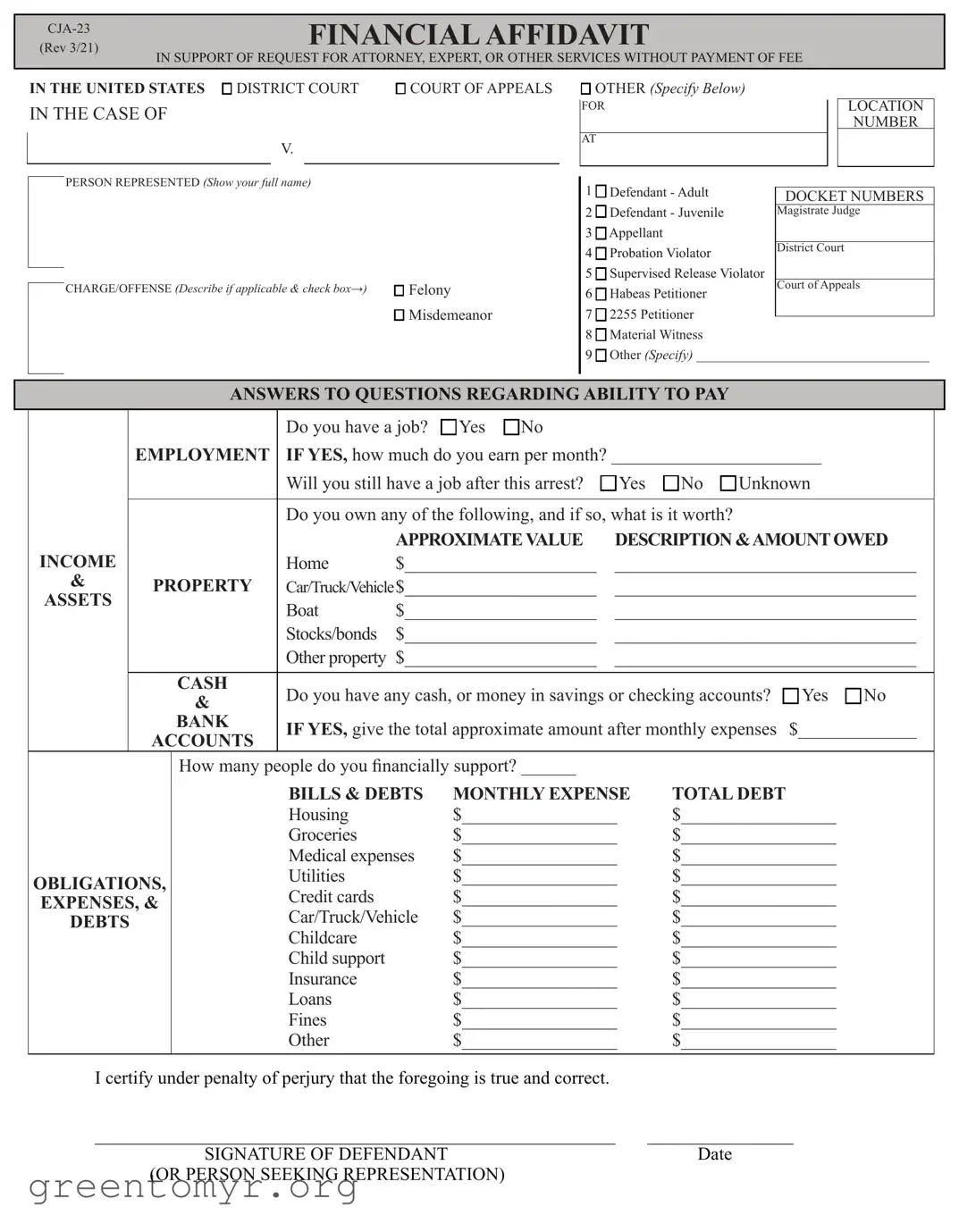
The Financial Affidavit CJA-23 form plays a crucial role in the legal process, particularly for individuals seeking court-appointed representation. This form helps determine a person's eligibility for financial assistance in legal matters. It requires detailed information about income, expenses, assets, and liabilities, ensuring that the court can assess an individual's financial situation accurately. Completing the CJA-23 form is essential for those who cannot afford legal fees, as it provides a clear picture of their financial standing. By filling out this form, individuals can seek the support they need to navigate the complexities of the legal system. Understanding its components and the information required can make the process smoother and less daunting.

FINANCIAL AFFIDAVIT |
|
(Rev 3/21) |
|
|
IN SUPPORT OF REQUEST FOR ATTORNEY, EXPERT, OR OTHER SERVICES WITHOUT PAYMENT OF FEE |
IN THE UNITED STATES |
DISTRICT COURT |
COURT OF APPEALS |
IN THE CASE OF
V.
PERSON REPRESENTED (Show your full name)
CHARGE/OFFENSE (Describe if applicable & check box→) |
Felony |
|
Misdemeanor |
|
OTHER (Specify Below) |
|
|
|
|
|
FOR |
|
|
|
LOCATION |
|
|
|
|
|
NUMBER |
|
|
|
|
|
|
|
AT |
|
|
|
|
|
|
|
|
|
|
|
1 |
Defendant - Adult |
|
|
|
|
|
||||
|
DOCKET NUMBERS |
||||
|
2 |
Defendant - Juvenile |
Magistrate Judge |
||
|
3 |
Appellant |
|
|
|
|
4 |
Probation Violator |
District Court |
||
|
|
|
|
||
|
5 |
Supervised Release Violator |
|
|
|
|
6 |
Habeas Petitioner |
Court of Appeals |
||
|
|
|
|
||
|
7 |
2255 Petitioner |
|
|
|
|
|
|
|
||
|
8 |
Material Witness |
|
|
|
|
9 |
Other (Specify) __________________________________ |
|||
|
|
|
|
|
|
ANSWERS TO QUESTIONS REGARDING ABILITY TO PAY
|
|
|
|
Do you have a job? |
� Yes � No |
|
|
|
|
|
|
EMPLOYMENT |
IF YES, how much do you earn per month? _______________________ |
||||||
|
|
|
|
Will you still have a job after this arrest? |
� Yes |
� No � Unknown |
|||
|
|
|
|
|
|
||||
|
|
|
|
Do you own any of the following, and if so, what is it worth? |
|
||||
INCOME |
|
|
|
|
APPROXIMATEVALUE |
DESCRIPTION &AMOUNTOWED |
|||
|
|
|
Home |
$_____________________ |
_________________________________ |
||||
& |
|
PROPERTY |
Car/Truck/Vehicle$_____________________ |
_________________________________ |
|||||
ASSETS |
|
|
|
Boat |
$_____________________ |
_________________________________ |
|||
|
|
|
|
||||||
|
|
|
|
Stocks/bonds |
$_____________________ |
_________________________________ |
|||
|
|
|
|
Other property $_____________________ |
_________________________________ |
||||
|
|
|
|
|
|
|
|
|
|
|
|
|
CASH |
Do you have any cash, or money in savings or checking accounts? |
� Yes � No |
||||
|
|
& |
|||||||
|
|
|
BANK |
IF YES, give the total approximate amount after monthly expenses |
$_____________ |
||||
|
|
ACCOUNTS |
|||||||
|
|
|
|
|
|
|
|
||
|
|
|
How many people do you financially support? ______ |
|
|
|
|||
|
|
|
|
BILLS & DEBTS |
MONTHLY EXPENSE |
TOTAL DEBT |
|||
|
|
|
|
Housing |
|
$_________________ |
$_________________ |
||
|
|
|
|
Groceries |
|
$_________________ |
$_________________ |
||
|
|
|
|
Medical expenses |
$_________________ |
$_________________ |
|||
OBLIGATIONS, |
|
Utilities |
|
$_________________ |
$_________________ |
||||
|
Credit cards |
|
$_________________ |
$_________________ |
|||||
EXPENSES, & |
|
|
|||||||
DEBTS |
|
|
Car/Truck/Vehicle |
$_________________ |
$_________________ |
||||
|
|
|
|
Childcare |
|
$_________________ |
$_________________ |
||
|
|
|
|
Child support |
|
$_________________ |
$_________________ |
||
|
|
|
|
Insurance |
|
$_________________ |
$_________________ |
||
|
|
|
|
Loans |
|
$_________________ |
$_________________ |
||
|
|
|
|
Fines |
|
$_________________ |
$_________________ |
||
|
|
|
|
Other |
|
$_________________ |
$_________________ |
||
I certify under penalty of perjury that the foregoing is true and correct.
_________________________________________________________ |
________________ |
SIGNATURE OF DEFENDANT |
Date |
(OR PERSON SEEKING REPRESENTATION) |
|
Instructions for CJA Form 23 Financial Affidavit
In every type of proceeding where appointment of counsel is authorized under 18 U.S.C. § 3006A(a) and related statutes, the United States magistrate judge or the court shall advise the person of their right to be represented by counsel and that counsel will be appointed if the person is financially unable to obtain counsel. Unless the person waives representation by counsel, the United States magistrate judge or the court, if satisfied after appropriate inquiry that the person is financially unable to obtain counsel, shall appoint counsel to represent the individual.
Determination of eligibility for representation under the CJA is a judicial function, however the court may designate court employees to obtain or verify the facts relevant to the financial eligibility determination. Employees of law enforcement agencies, including the United States Attorney’s Office, should not participate in the completion of the financial affidavit or seek to obtain information concerning financial eligibility from a person requesting the appointment of counsel. When practicable, employees of the federal public defender office should discuss with the person who indicates that he or she is not financially able to secure representation the right to appointed counsel and, if appointment of counsel seems likely, assist in completion of the financial affidavit.
Counsel must be appointed if the person seeking representation is “financially unable to obtain counsel.” 18 U.S.C. §3006A(b). (While courts often use “indigency”
as a shorthand expression to describe financial eligibility, indigency is not the standard for appointing counsel under the Criminal Justice Act.) In determining
whether a person is “financially unable to obtain counsel,” consideration should be
given to the cost of providing the person and his or her dependents with the necessities of life, the cost of securing pretrial release, asset encumbrance, and the likely cost of retained counsel. The initial determination of eligibility must be made
without regard to the financial ability of the person’s family to retain counsel,
unless their family indicates willingness and ability to do so promptly. Any doubts
about a person’s eligibility should be resolved in the person’s favor; erroneous
determinations of eligibility may be corrected at a later time. For additional guidance, see the Guide to Judiciary Policy, Volume 7A, Guidelines for Administering the CJA and Related Statutes (CJA Guidelines).
The CJA Form 23 is not a required statutory form. It is an administrative tool used to assist the court in appointing counsel. When a colorable claim is asserted that disclosure to the government of a completed CJA 23 would be
court may not adopt an unconditional requirement that the defendant complete the CJA 23 before his application for appointment of counsel will be considered. To do so may place the defendant in the constitutionally untenable position of having to choose between his Sixth Amendment right to counsel and his Fifth Amendment privilege against
Pursuant to Judicial Conference policy, financial affidavits seeking the appointment of counsel should not be included in the public case file and should not be made available to the public at the courthouse or via remote electronic access. If the financial affidavit is docketed it should be filed under seal. See, Guide to Judiciary Policy, Vol. 10, §340, Judicial Conference Policy on Privacy and Public Access to Electronic Case Files (March 2008) and Administrative Office of U.S. Courts Information Bulletin on Revised Judicial Conference Privacy Policy (May 2008).
For questions on the use of this form or instructions, please contact the Defender Services Office, Legal and Policy Division at
| Fact Name | Description |
|---|---|
| Purpose | The CJA-23 form is used to determine a person's eligibility for court-appointed counsel based on their financial situation. |
| Governing Law | This form is governed by the Criminal Justice Act (CJA) of 1964, which provides for the appointment of counsel for defendants who cannot afford an attorney. |
| Eligibility Criteria | Individuals must provide accurate financial information to assess their need for legal representation. |
| Information Required | The form requires details about income, expenses, assets, and liabilities. |
| Submission | The completed CJA-23 form must be submitted to the court along with a request for appointed counsel. |
| Confidentiality | Information provided on the form is kept confidential and used only for determining eligibility. |
| Consequences of Inaccuracy | Providing false information on the form can lead to penalties, including potential criminal charges. |
| Updates | The form may need to be updated if there are significant changes in a person's financial circumstances. |
| State-Specific Variations | Some states may have their own versions of the financial affidavit, following local laws and regulations. |
Filling out the Financial Affidavit CJA-23 form is an important step in your legal process. This form helps establish your financial situation, which can impact various legal decisions. To ensure accuracy and completeness, follow these steps carefully.
After submitting the form, it will be reviewed by the court or relevant authority. Be prepared for any follow-up questions or requests for additional information. Staying organized and responsive will help facilitate the process.
The Financial Affidavit CJA-23 form is a document used in federal court proceedings. It helps determine a person's eligibility for court-appointed counsel based on their financial situation. This form collects information about income, expenses, assets, and liabilities.
Individuals who cannot afford to hire a lawyer for their defense in federal court must complete the CJA-23 form. This includes defendants in criminal cases and parties in certain civil cases seeking representation under the Criminal Justice Act.
The CJA-23 form can be obtained from the website of the Administrative Office of the U.S. Courts or directly from the clerk’s office in the federal court where your case is pending. It is also available in legal aid offices and public law libraries.
The form requires detailed information, including:
The information provided on the CJA-23 form is reviewed by the court to assess your financial need. If the court finds you eligible, it may appoint a lawyer to represent you at no cost. Accurate and complete information is crucial for this determination.
If you do not complete the CJA-23 form, the court may deny your request for a court-appointed attorney. You may be required to represent yourself, which can be challenging in legal proceedings.
Yes, you can update your CJA-23 form if your financial situation changes significantly after submission. It is important to inform the court of any changes that may affect your eligibility for court-appointed counsel.
The completed CJA-23 form should be submitted to the clerk’s office of the federal court handling your case. Make sure to keep a copy for your records and check if there are any specific filing instructions required by the court.
Filling out the Financial Affidavit CJA-23 form can be a daunting task. Many individuals make common mistakes that can lead to delays or complications in their cases. One significant error is failing to provide accurate income information. It’s essential to list all sources of income, including wages, benefits, and any side jobs. Underreporting income can result in a denial of services or assistance.
Another frequent mistake is neglecting to include all necessary expenses. People often forget to mention regular payments such as rent, utilities, or childcare costs. This omission can skew the financial picture presented to the court. Accurate expense reporting is crucial for determining eligibility for assistance.
In addition, some individuals fail to update their financial information. Circumstances can change rapidly, and what was true at the time of filling out the form may no longer be accurate. Regularly reviewing and updating the information ensures that the court has the most current data, which can affect the outcome of a case.
Providing incomplete or unclear documentation is another common issue. Supporting documents, such as pay stubs or bank statements, must be included and clearly labeled. Incomplete submissions can lead to requests for additional information, prolonging the process.
Lastly, many people overlook the importance of signing and dating the form. An unsigned or undated affidavit is considered invalid. It’s a simple step that can easily be forgotten but is essential for the form’s acceptance. Paying attention to these details can help streamline the process and avoid unnecessary complications.
The Financial Affidavit CJA-23 form is an essential document for individuals seeking court-appointed counsel in federal cases. However, it is often accompanied by several other forms and documents that help provide a complete financial picture. Each of these documents plays a crucial role in the assessment of an individual's financial status and eligibility for legal aid. Below is a list of commonly used forms and documents that complement the CJA-23.
Understanding these forms and documents is vital for anyone navigating the legal system. By ensuring that all necessary information is provided, individuals can better advocate for their right to legal representation. Each document plays a unique role in painting a comprehensive picture of one’s financial situation, which is critical in the court's decision-making process.
Filling out the Financial Affidavit CJA-23 form is an important step in ensuring that your financial situation is accurately represented. Here are some guidelines to follow:
By following these guidelines, you can help ensure that your Financial Affidavit CJA-23 form is filled out correctly, which can facilitate the process of receiving assistance or representation.
The Financial Affidavit CJA-23 form is an important document used in federal court proceedings to determine a defendant's eligibility for court-appointed counsel. However, several misconceptions about this form can lead to confusion. Below are nine common misconceptions, along with clarifications for each.
Understanding these misconceptions can help individuals navigate the legal system more effectively and ensure they receive the assistance they need.
When filling out and using the Financial Affidavit CJA-23 form, keep the following key points in mind: