The Fitness For Duty Certification Form plays a crucial role in the workplace, particularly for employees returning from medical leave under the Family and Medical Leave Act (FMLA). This form is designed to ensure that employees are ready to resume their duties after an absence due to illness or injury, whether related to work or not. Before returning to work, an employee must present this certification to their supervisor. The form provides three options for health care providers to indicate the employee's status: a full release with no restrictions, a modified duty option with specific work limitations, or a designation of not released for any type of duty due to ongoing physical or behavioral challenges. Additionally, it is essential for health care providers to be aware of the Genetic Information Nondiscrimination Act (GINA), which prohibits the collection of genetic information during this process. This requirement helps protect the privacy of employees while ensuring that employers receive the necessary medical information to facilitate a safe return to work. Completing and submitting the Fitness For Duty Certification can be done confidentially, ensuring that the employee’s health status is handled with care and respect.

Fitness for Duty Certification
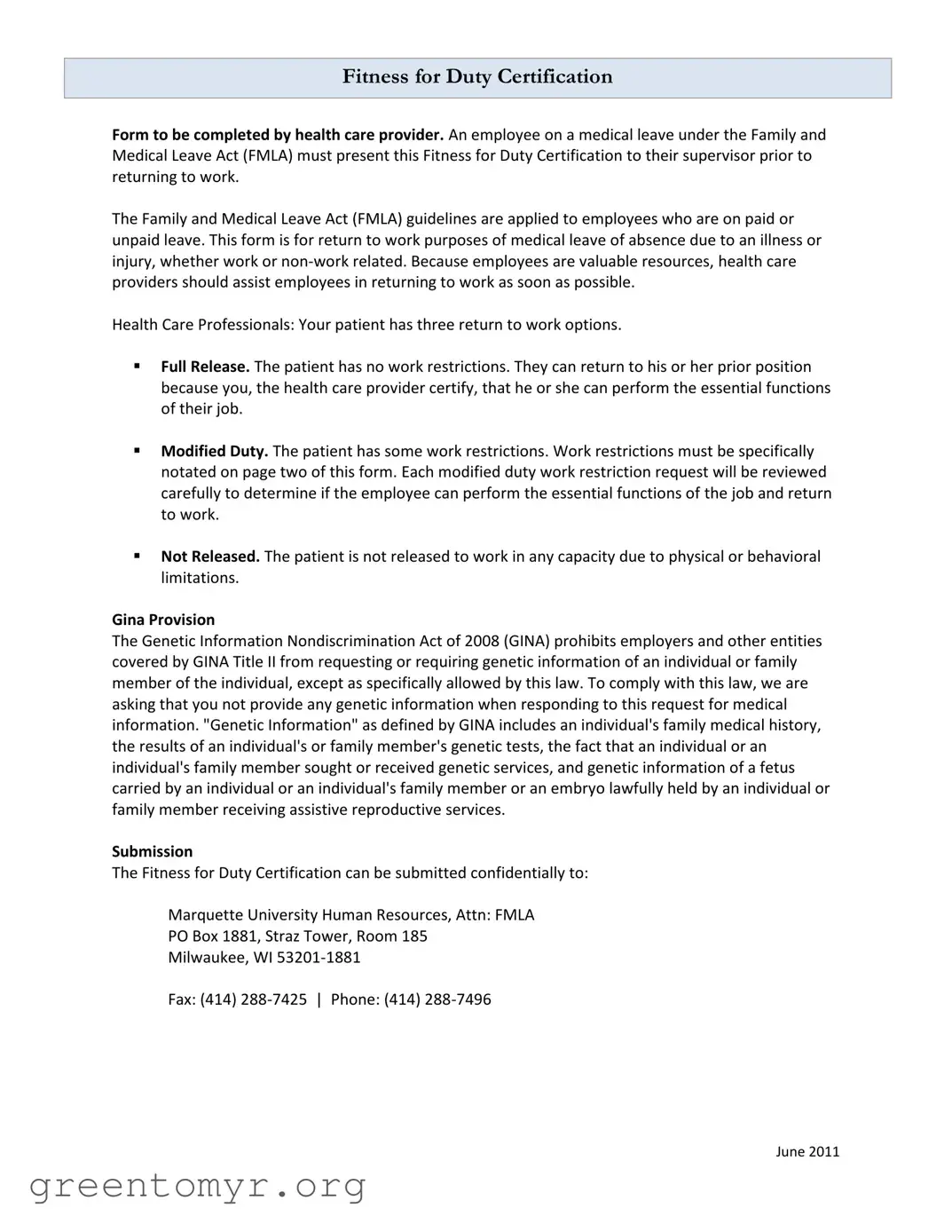
Form to be completed by health care provider. An employee on a medical leave under the Family and Medical Leave Act (FMLA) must present this Fitness for Duty Certification to their supervisor prior to returning to work.
The Family and Medical Leave Act (FMLA) guidelines are applied to employees who are on paid or unpaid leave. This form is for return to work purposes of medical leave of absence due to an illness or injury, whether work or
Health Care Professionals: Your patient has three return to work options.
Full Release. The patient has no work restrictions. They can return to his or her prior position because you, the health care provider certify, that he or she can perform the essential functions of their job.
Modified Duty. The patient has some work restrictions. Work restrictions must be specifically notated on page two of this form. Each modified duty work restriction request will be reviewed carefully to determine if the employee can perform the essential functions of the job and return to work.
Not Released. The patient is not released to work in any capacity due to physical or behavioral limitations.
Gina Provision
The Genetic Information Nondiscrimination Act of 2008 (GINA) prohibits employers and other entities covered by GINA Title II from requesting or requiring genetic information of an individual or family member of the individual, except as specifically allowed by this law. To comply with this law, we are asking that you not provide any genetic information when responding to this request for medical information. "Genetic Information" as defined by GINA includes an individual's family medical history, the results of an individual's or family member's genetic tests, the fact that an individual or an individual's family member sought or received genetic services, and genetic information of a fetus carried by an individual or an individual's family member or an embryo lawfully held by an individual or family member receiving assistive reproductive services.
Submission
The Fitness for Duty Certification can be submitted confidentially to:
Marquette University Human Resources, Attn: FMLA
PO Box 1881, Straz Tower, Room 185
Milwaukee, WI
Fax: (414)
June 2011
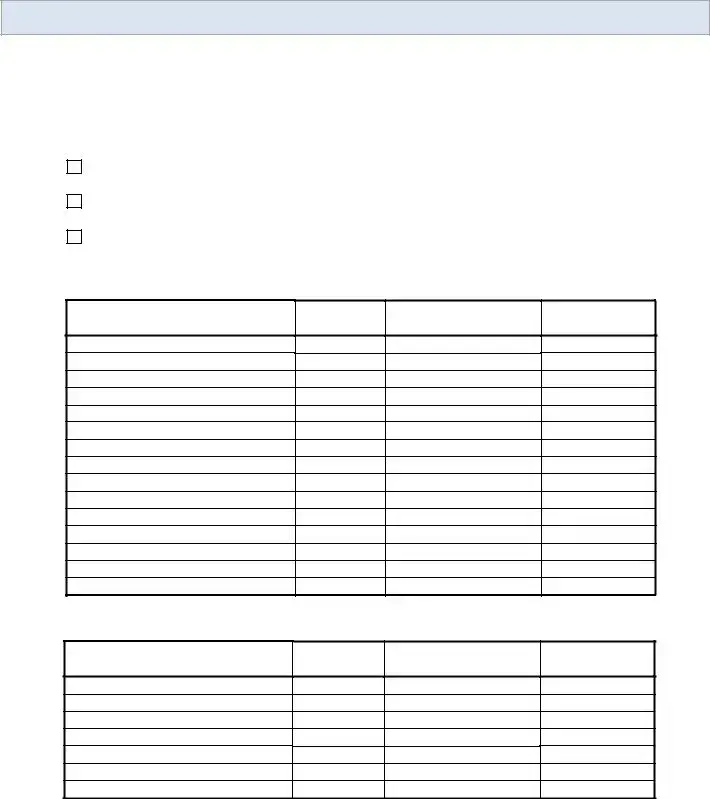
Fitness for Duty Certification
1. |
Employee / Patient |
_____________________________________ |
2. |
Date of Medical Examination |
_____________________________________ |
3.Please check the status of the employee’s release for duty
Full, unrestricted duty effective __________________________
Modified duty effective ________________ and next evaluation date ________________
Not released for any type of duty. Next evaluation date will be ________________
4. Physical Evaluation
Full |
Partial Restrictions |
No Restrictions |
|
Restrictions |
(please specify) |
||
|
Pulling/Pushing, Carrying
Reaching or working above shoulder
Walking
Standing
Stooping
Kneeling
Repeated Bending
Climbing
Operating a motor vehicle
Finger Manipulation (typing)
Pain (frequency, degree, signs)
5. Behavioral Evaluation
Able to |
Other Considerations |
Not Able to |
perform |
(please specify) |
perform |
Understanding
Remembering
Sustained concentration
Decision making
Receiving supervision
Relating to
6.Other Restrictions, Considerations, or Notes
_____________________________________________________________________________________
_____________________________________________________________________________________
I hereby certify that the facts in this document are true and correct.
________________________________ |
________________ |
____________________ |
Printed Name of Health Care Provider |
Date |
Phone Number |
|
|
June 2011 |
| Fact Name | Description |
|---|---|
| Purpose of the Form | The Fitness for Duty form certifies an employee's ability to return to work after medical leave. |
| FMLA Requirement | Employees on medical leave under the Family and Medical Leave Act (FMLA) must present this form before returning to work. |
| Types of Release | Health care providers can issue a full release, modified duty, or not released status for the employee. |
| GINA Compliance | The Genetic Information Nondiscrimination Act (GINA) prohibits the collection of genetic information in this form. |
| Submission Guidelines | The completed form must be submitted confidentially to Marquette University Human Resources. |
| Evaluation Criteria | The form includes sections for physical and behavioral evaluations to assess the employee's readiness to return. |
| State-Specific Laws | Each state may have its own laws governing medical leave and return to work procedures. Check local regulations for compliance. |
Completing the Fitness For Duty form is an important step for employees returning to work after a medical leave. This form must be filled out by a health care provider and submitted to the appropriate supervisor before the employee can resume their duties. Below are the steps to accurately fill out the form.
Once completed, submit the form confidentially to Marquette University Human Resources at the address provided. Ensure that all information is accurate to facilitate a smooth return to work process.
The Fitness for Duty Certification Form is designed to ensure that employees returning from medical leave under the Family and Medical Leave Act (FMLA) are fit to resume their job responsibilities. This form must be completed by a healthcare provider and submitted to the employee's supervisor before the employee can return to work. It helps verify whether the employee can perform the essential functions of their job, ensuring both the employee's well-being and workplace safety.
Healthcare providers have three options when filling out the Fitness for Duty Certification Form:
The completed Fitness for Duty Certification Form should be submitted confidentially to the Human Resources department at Marquette University. The address is:
Alternatively, the form can be faxed to (414) 288-7425 or questions can be directed to (414) 288-7496.
The Genetic Information Nondiscrimination Act (GINA) protects individuals from discrimination based on genetic information. When filling out the Fitness for Duty Certification Form, healthcare providers should avoid including any genetic information about the employee or their family members. This includes family medical history, genetic test results, and any information related to genetic services. Adhering to GINA ensures compliance with the law and protects the privacy of the employee.
Completing the Fitness For Duty Certification Form accurately is crucial for both employees and employers. However, several common mistakes can hinder the process and lead to delays in returning to work. One frequent error is failing to provide complete patient information. When the employee’s name or date of the medical examination is missing, it creates confusion and may result in the form being rejected.
Another mistake involves neglecting to specify the type of release. Health care providers must clearly indicate whether the employee is fit for full duty, modified duty, or not released at all. A vague response can lead to misunderstandings regarding the employee’s work status. Furthermore, if modifications are required, it is essential to detail the specific restrictions on page two of the form. Omitting this information can complicate the return-to-work process.
Additionally, some providers mistakenly include genetic information, which is prohibited under the Genetic Information Nondiscrimination Act (GINA). Providing such information not only violates the law but may also lead to legal complications for both the employee and the employer. It is vital to adhere strictly to the guidelines regarding genetic information.
Another common oversight is not including a next evaluation date. This date is important for both the employee and the employer to understand when a follow-up assessment will occur. Without it, planning for the employee’s return can be challenging. Moreover, providers sometimes fail to sign or date the certification. An unsigned form may be deemed invalid, causing unnecessary delays.
Some health care providers also neglect to check the physical and behavioral evaluation sections thoroughly. Incomplete evaluations can lead to a lack of clarity regarding the employee’s capabilities and limitations. This can hinder the employer's ability to make informed decisions about the employee's return to work.
Finally, there is a tendency to overlook the importance of confidentiality when submitting the form. It is essential to ensure that the form is sent to the correct address and in a manner that protects the employee’s privacy. Missteps in this area can lead to unauthorized disclosures of sensitive information.
By being mindful of these common mistakes, health care providers can facilitate a smoother transition back to work for employees. Attention to detail and adherence to guidelines are key to ensuring that the Fitness For Duty Certification Form is completed accurately and efficiently.
The Fitness For Duty form is an important document that helps ensure employees can safely return to work after a medical leave. Alongside this form, several other documents may be necessary to support the employee's transition back into the workplace. Below is a list of these documents, each described briefly for clarity.
These documents work together to facilitate a smooth and safe return to work for employees after a medical leave. Ensuring that all necessary forms are completed and submitted helps protect both the employee's health and the employer's interests.
When filling out the Fitness For Duty form, it's important to approach the process thoughtfully. Here are seven things you should and shouldn't do to ensure a smooth experience.
By following these guidelines, you can help ensure that the Fitness For Duty form is completed correctly and efficiently. This not only supports the employee's return to work but also upholds compliance with relevant laws.
This form applies to any medical leave, regardless of whether the illness or injury is work-related or not. It is designed for all employees under the Family and Medical Leave Act (FMLA).
Employees must present the Fitness for Duty Certification to their supervisor before returning to work. This requirement ensures that they are fit for their job duties.
Health care providers can issue three types of releases: full release, modified duty, or not released. Each option addresses different levels of work capability.
Under the Genetic Information Nondiscrimination Act (GINA), employers cannot request genetic information. The form explicitly instructs health care providers to avoid including any genetic details.
The form is not limited to permanent conditions. It can also be used for temporary illnesses or injuries, ensuring that employees can safely return to work.
The form can be submitted confidentially to the designated Human Resources department. Privacy is maintained throughout the process to protect the employee's medical information.
Filling out and using the Fitness For Duty form is a critical process for both employees and employers. Here are some key takeaways to keep in mind: