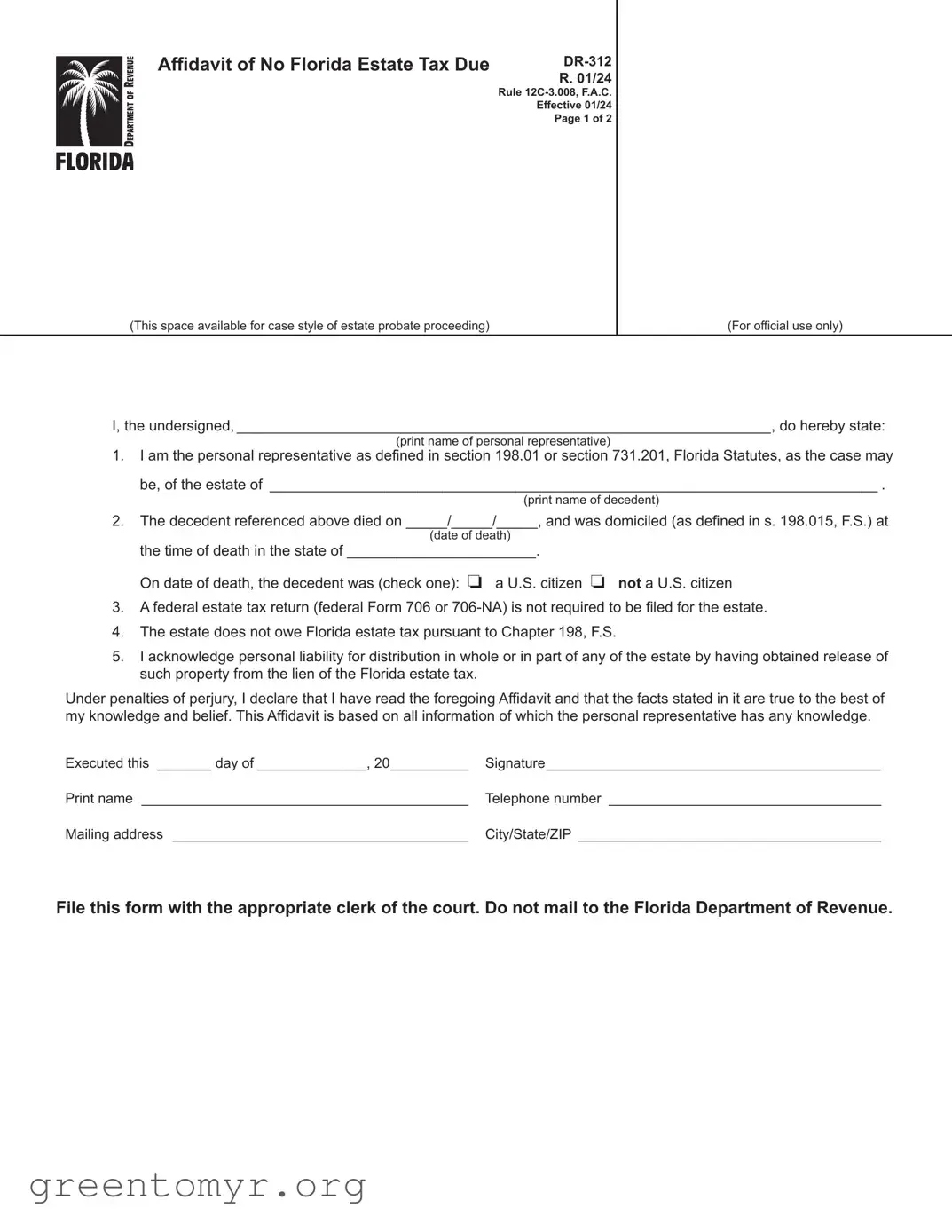
The Florida Form DR-312, known as the Affidavit of No Florida Estate Tax Due, serves a critical function for personal representatives managing estates that do not owe Florida estate tax. This form is essential when a federal estate tax return, specifically Form 706 or 706-NA, is not required. By completing and filing this affidavit, the personal representative asserts that the decedent's estate is exempt from Florida estate taxes as outlined in Chapter 198 of the Florida Statutes. The affidavit requires the personal representative to provide key details, including the decedent's name, date of death, and domicile at the time of death. Additionally, it emphasizes personal liability for the distribution of estate property, ensuring that all parties are aware of their responsibilities. Filing this form with the appropriate clerk of the court effectively removes the estate tax lien imposed by the Florida Department of Revenue, streamlining the probate process. It is important to note that this form cannot be used if a federal estate tax return is necessary, making it crucial for personal representatives to understand when and how to use it properly.

Affidavit of No Florida Estate Tax Due |
|
|
R. 01/24 |
Rule
Effective 01/24
Page 1 of 2
(This space available for case style of estate probate proceeding) |
(For official use only) |
I, the undersigned,__________________________________________________________________, do hereby state:
(print name of personal representative)
1. I am the personal representative as defined in section 198.01 or section 731.201, Florida Statutes, as the case may
be, of the estate of ___________________________________________________________________________ .
(print name of decedent)
2.The decedent referenced above died on _____/_____/_____, and was domiciled (as defined in s. 198.015, F.S.) at
(date of death)
the time of death in the state of _______________________.
On date of death, the decedent was (check one): o a U.S. citizen o not a U.S. citizen
3.A federal estate tax return (federal Form 706 or
4.The estate does not owe Florida estate tax pursuant to Chapter 198, F.S.
5.I acknowledge personal liability for distribution in whole or in part of any of the estate by having obtained release of such property from the lien of the Florida estate tax.
Under penalties of perjury, I declare that I have read the foregoing Affidavit and that the facts stated in it are true to the best of my knowledge and belief. This Affidavit is based on all information of which the personal representative has any knowledge.
Executed this _______ day of ______________, 20__________ |
Signature___________________________________________ |
Print name ___________________________________________ |
Telephone number ____________________________________ |
Mailing address _ ______________________________________ |
City/State/ZIP ________________________________________ |
File this form with the appropriate clerk of the court. Do not mail to the Florida Department of Revenue.

R. 01/24
Page 2 of 2
Instructions for Completing Form
File this form with the appropriate clerk of the court if necessary. Do not mail to the Florida Department of Revenue.
General Information
If Florida estate tax is not due and a federal estate tax return (federal Form 706 or
Form
The
Where to File Form
Form
When to Use Form
Form
July 1, 2023.
NOTE: This form may NOT be used for estates that are required to file federal form 706 or
Federal thresholds for filing federal Form 706 only: (For informational purposes only. Please confirm with Form 706 instructions.)
Date of Death |
Dollar Threshold |
|
for Filing Form 706 |
||
(year) |
||
(value of gross estate) |
||
|
||
2000 and 2001 |
$675,000 |
|
|
|
|
2002 and 2003 |
$1,000,000 |
|
|
|
|
2004 and 2005 |
$1,500,000 |
|
|
|
|
For 2006 and forward |
|
|
go to the IRS website at |
|
|
www.irs.gov to obtain |
|
|
thresholds. |
|
For thresholds for filing federal Form
If an administration proceeding which commenced before July 1, 2023 is pending for an estate, Form
Contact Us
Information and tutorials are available at floridarevenue.com/taxes/education.
Tax forms and brochures are available at floridarevenue.com/forms.
To speak with a Department of Revenue representative, call Taxpayer Services at
Reference Material
Rules are available at flrules.org.
Rule Chapter
Subscribe to Receive Email Alerts from the Department.
Subscribe to receive an email for filing due date reminders, Tax Information Publications (TIPs), or proposed rules. Subscribe today at floridarevenue.com/dor/subscribe.
| Fact Name | Details |
|---|---|
| Purpose | The DR-312 form serves as an Affidavit of No Florida Estate Tax Due, confirming that an estate does not owe Florida estate tax. |
| Governing Laws | This form is governed by Chapter 198 of the Florida Statutes and Rule 12C-3.008 of the Florida Administrative Code. |
| Filing Requirement | The form must be filed with the clerk of the circuit court in the county where the decedent owned property. |
| Eligibility | It is applicable for estates not subject to Florida estate tax and where no federal estate tax return (Form 706 or 706-NA) is required. |
| Liability Acknowledgment | The personal representative acknowledges personal liability for any distributions made from the estate after obtaining the release from the estate tax lien. |
| Official Use | A designated space on the form is reserved for the clerk of the court for official use only. |
To complete the Fl Dr 312 form, follow these steps carefully. This form is essential for personal representatives of estates that are not subject to Florida estate tax. Make sure to gather all necessary information before you begin filling it out.
After completing the form, file it with the appropriate clerk of the circuit court in the county where the decedent owned property. Do not send it to the Florida Department of Revenue.
The FL DR 312 form, known as the Affidavit of No Florida Estate Tax Due, is used to declare that an estate does not owe any Florida estate tax. This form is essential for personal representatives of estates where a federal estate tax return is not required. By filing this form, the personal representative can remove any estate tax lien imposed by the Florida Department of Revenue.
The form can be filed by the personal representative of the estate, as defined in Florida statutes. This includes individuals who are in actual or constructive possession of the decedent’s property. If you are handling the estate and meet this definition, you are eligible to complete and submit the FL DR 312 form.
You should use the FL DR 312 form when the estate is not subject to Florida estate tax under Chapter 198 and a federal estate tax return (Form 706 or 706-NA) is not required. It is important to note that this form cannot be used for estates that do need to file a federal estate tax return. Ensure you check the federal thresholds for filing before proceeding.
The FL DR 312 form must be filed with the clerk of the circuit court in the county or counties where the decedent owned property. Do not send this form to the Florida Department of Revenue. It is crucial that the form is properly recorded in the public records to ensure its validity.
Once you file the FL DR 312 form, it serves as evidence that the estate is not liable for Florida estate tax. This filing will remove any estate tax lien held by the Florida Department of Revenue. You should keep a copy of the filed form for your records, as it may be needed for future reference or in case of any inquiries regarding the estate.
When filling out the Florida Form DR-312, there are several common mistakes that individuals often make. Understanding these pitfalls can help ensure that the form is completed accurately and efficiently.
One frequent error is failing to provide the correct name of the decedent. It is essential to ensure that the name is spelled correctly and matches the legal documents. Any discrepancies can lead to delays or complications in processing the affidavit.
Another mistake is neglecting to indicate the decedent's date of death. This date is critical for establishing the timeline of the estate and determining tax obligations. Omitting this information can result in the form being rejected by the clerk of the court.
People often forget to check the appropriate box regarding the decedent's citizenship status. This detail is important as it affects the estate's tax liability. Not marking this can lead to misunderstandings about the estate's obligations.
Additionally, some individuals fail to acknowledge personal liability for the distribution of the estate. This acknowledgment is a significant part of the affidavit, and neglecting to include it can create legal issues for the personal representative.
Lastly, many submit the form without ensuring it is filed with the correct clerk of the circuit court. Each county has its own clerk, and filing with the wrong office can delay the processing of the affidavit. It is crucial to verify the appropriate location for submission.
When dealing with estate matters in Florida, several forms and documents are commonly used alongside the Fl Dr 312 form. Each of these documents serves a specific purpose and is essential for ensuring compliance with state regulations. Below is a list of related forms that may be necessary in your estate administration process.
Understanding these forms and their purposes is crucial for anyone managing an estate in Florida. Proper documentation helps avoid complications and ensures that all legal requirements are met. Make sure to gather the necessary forms to streamline your estate administration process.
When completing the Fl Dr 312 form, it is essential to follow specific guidelines to ensure accuracy and compliance. Below is a list of things you should and shouldn't do:
Adhering to these guidelines will help facilitate the processing of your form and ensure compliance with state regulations.
Understanding the Fl Dr 312 form can be tricky, especially with the various misconceptions surrounding it. Here are five common misunderstandings that people often have:
By clearing up these misconceptions, individuals can better navigate the complexities of estate management in Florida. Understanding the specific requirements and proper filing procedures can save time and reduce stress during an already challenging time.
When dealing with the Fl Dr 312 form, also known as the Affidavit of No Florida Estate Tax Due, there are several important points to consider:
Understanding these key points can help ensure proper completion and filing of the Fl Dr 312 form, facilitating the estate settlement process.