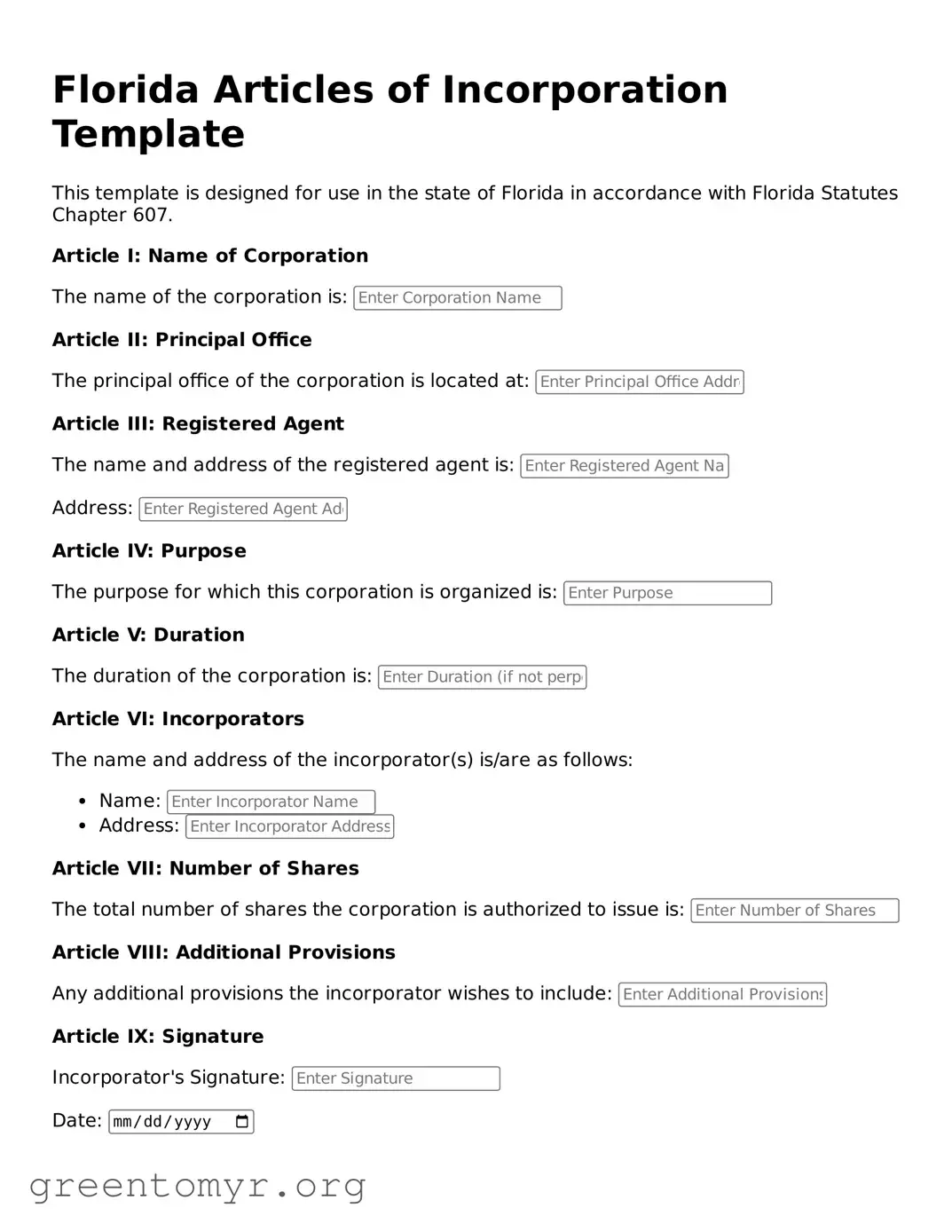
In Florida, the Articles of Incorporation form serves as a foundational document for establishing a corporation within the state. This form outlines essential information about the corporation, including its name, principal office address, and the purpose of its creation. Additionally, it requires details about the registered agent, who is responsible for receiving legal documents on behalf of the corporation. The form also specifies the number of shares the corporation is authorized to issue, which is crucial for potential investors and stakeholders. Furthermore, it may include provisions regarding the management structure and the names and addresses of the initial directors. Completing this form accurately is vital, as it ensures compliance with state regulations and lays the groundwork for the corporation's legal identity and operational framework.
Florida Articles of Incorporation Template
This template is designed for use in the state of Florida in accordance with Florida Statutes Chapter 607.
Article I: Name of Corporation
The name of the corporation is:
Article II: Principal Office
The principal office of the corporation is located at:
Article III: Registered Agent
The name and address of the registered agent is:
Address:
Article IV: Purpose
The purpose for which this corporation is organized is:
Article V: Duration
The duration of the corporation is:
Article VI: Incorporators
The name and address of the incorporator(s) is/are as follows:
Article VII: Number of Shares
The total number of shares the corporation is authorized to issue is:
Article VIII: Additional Provisions
Any additional provisions the incorporator wishes to include:
Article IX: Signature
Incorporator's Signature:
Date:
By completing this document, the undersigned affirms that all information is true and correct.
| Fact Name | Description |
|---|---|
| Purpose | The Florida Articles of Incorporation form is used to officially create a corporation in the state of Florida. |
| Governing Law | This form is governed by the Florida Business Corporation Act, specifically Chapter 607 of the Florida Statutes. |
| Required Information | Key details such as the corporation's name, principal office address, and registered agent must be included in the form. |
| Filing Fee | A filing fee is required when submitting the Articles of Incorporation to the Florida Division of Corporations. |
Once you have gathered all the necessary information, you can begin filling out the Florida Articles of Incorporation form. This document is essential for officially establishing your business entity in the state. After completing the form, you will submit it to the Florida Division of Corporations along with the required filing fee.
The Florida Articles of Incorporation form is a legal document that establishes a corporation in the state of Florida. This form outlines key information about the corporation, such as its name, purpose, and the names and addresses of its directors. Filing this document is a crucial step in the process of forming a corporation.
Any individual or group looking to form a corporation in Florida must file the Articles of Incorporation. This includes businesses of all sizes, from small startups to larger enterprises. It is important to ensure that all necessary information is accurately provided to avoid delays in the incorporation process.
The Articles of Incorporation typically require the following information:
Filing the Articles of Incorporation can be done online or by mail. To file online, visit the Florida Division of Corporations website and follow the instructions for electronic filing. If filing by mail, print the form, complete it, and send it to the appropriate address along with the required filing fee.
The filing fee for the Articles of Incorporation in Florida is generally $70. Additional fees may apply if you choose to expedite the processing or if you are filing for specific types of corporations. It is advisable to check the Florida Division of Corporations website for the most current fee schedule.
The processing time for the Articles of Incorporation can vary. Typically, it takes about 2 to 3 business days for online filings and up to 10 business days for mailed submissions. If expedited processing is requested, the turnaround time can be significantly shorter.
Once the Articles of Incorporation are filed and approved, the corporation is officially formed. The state will issue a Certificate of Incorporation, which serves as proof of the corporation's existence. Following this, the corporation must comply with ongoing requirements, such as holding annual meetings and filing annual reports.
Yes, amendments to the Articles of Incorporation can be made after the initial filing. This may be necessary for various reasons, such as changes in the corporation's name, purpose, or structure. To amend the Articles, a specific form must be completed and filed with the Florida Division of Corporations, along with any applicable fees.
When filling out the Florida Articles of Incorporation form, many people make common mistakes that can lead to delays or rejections. One frequent error is failing to provide the correct name of the corporation. The name must be unique and not similar to any existing business in Florida. It is essential to check the availability of the name before submission.
Another mistake is neglecting to include the required address of the principal office. This address must be a physical location in Florida, not a P.O. Box. Providing an incorrect or incomplete address can cause complications in the future.
Many individuals also overlook the importance of listing the registered agent. The registered agent must be a person or business authorized to conduct business in Florida. If this section is left blank or filled out incorrectly, the application may be rejected.
Additionally, some applicants fail to specify the purpose of the corporation clearly. While a general purpose is acceptable, it is better to be specific. A vague description can raise questions during the review process.
People often forget to include the names and addresses of the incorporators. This information is vital for the processing of the Articles of Incorporation. Omitting this detail can lead to delays or a complete rejection of the application.
Not paying the required filing fee is another common oversight. Each submission must include the correct payment. If the fee is missing or incorrect, the application will not be processed.
Some individuals may also neglect to sign the form. The Articles of Incorporation must be signed by at least one incorporator. An unsigned document is not valid and will be returned for correction.
Finally, failing to keep a copy of the submitted form can lead to difficulties later on. It is essential to maintain records of all filings for future reference. This practice helps in addressing any issues that may arise after incorporation.
When forming a corporation in Florida, the Articles of Incorporation is a crucial document. However, several other forms and documents are often required or recommended to ensure compliance with state regulations and to facilitate smooth operations. Here’s a list of key documents that may accompany the Articles of Incorporation.
Each of these documents plays a vital role in establishing and maintaining a corporation in Florida. Ensuring that all necessary paperwork is completed can help avoid legal issues and promote a successful business operation.
The Articles of Incorporation is a foundational document for establishing a corporation. However, it shares similarities with several other important documents in the business world. Here are four documents that are akin to the Articles of Incorporation:
When filling out the Florida Articles of Incorporation form, it's important to be thorough and accurate. Here are some key dos and don'ts to keep in mind:
When it comes to the Florida Articles of Incorporation form, several misconceptions can lead to confusion for those looking to establish a business. Here are four common misunderstandings:
While the Articles of Incorporation are essential for forming a corporation, they are not the only requirement. Additional documents, such as bylaws, initial reports, and business licenses, may also be necessary depending on the type of business and its location.
Many people believe that legal representation is mandatory for filing. However, individuals can complete and submit the Articles of Incorporation on their own. There are resources available to guide you through the process, making it accessible for those who prefer to handle it themselves.
This is not true. Only corporations need to file Articles of Incorporation. Other business structures, such as sole proprietorships or partnerships, do not require this form. Understanding the right structure for your business is crucial.
Filing the Articles of Incorporation at the right time is important. Delays can lead to penalties or complications in starting your business. It is best to file as soon as you have your business plan in place to ensure a smooth launch.
When filling out and using the Florida Articles of Incorporation form, there are several important points to keep in mind. These takeaways can help ensure a smooth incorporation process.
By keeping these key points in mind, you can navigate the incorporation process more effectively.