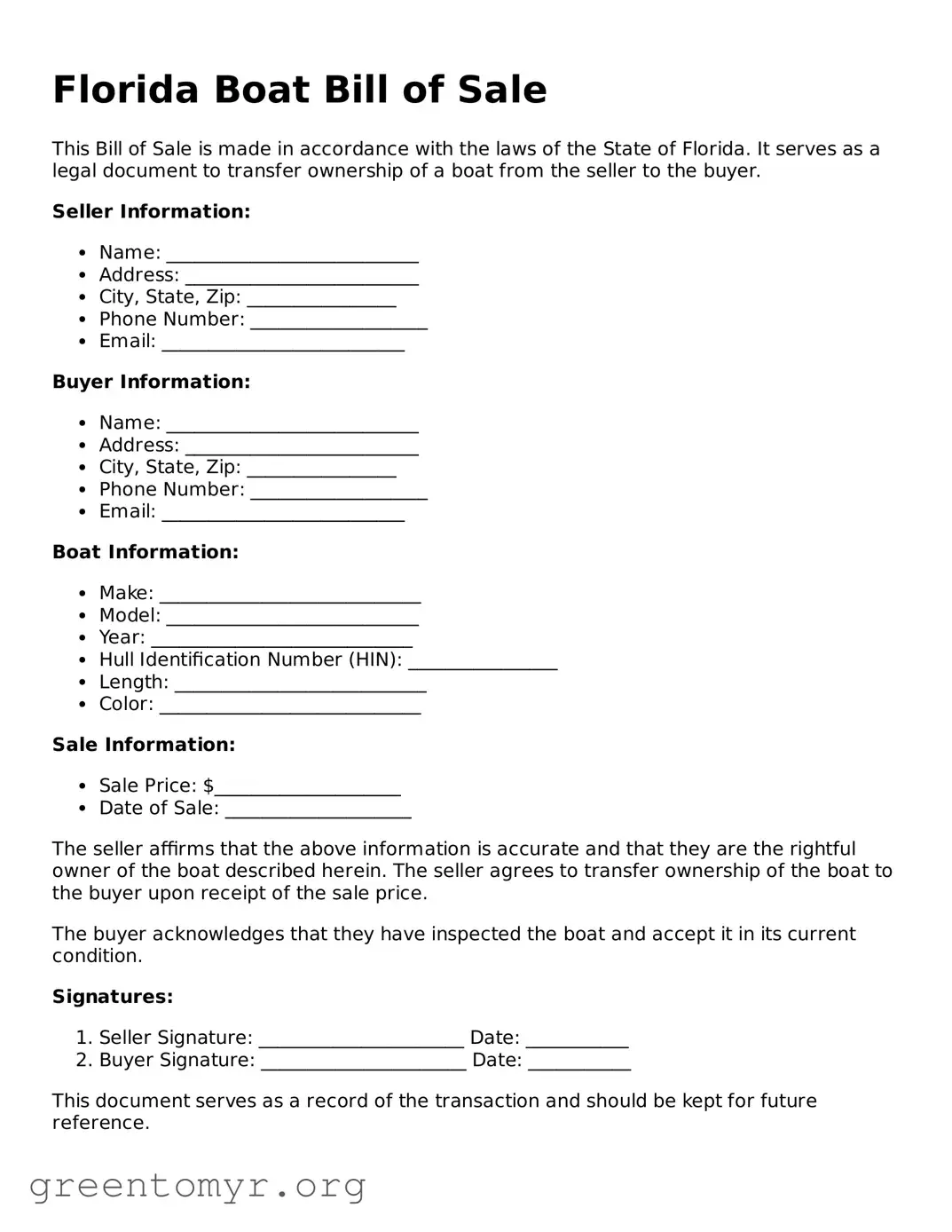
In Florida, the Boat Bill of Sale form serves as a crucial document for individuals involved in the buying and selling of watercraft. This form not only outlines the details of the transaction but also provides legal protection for both the buyer and the seller. Essential elements typically included in the form are the names and addresses of both parties, a description of the boat, including its make, model, and hull identification number, as well as the sale price. Additionally, the document may require the signatures of both parties to validate the agreement. While the form is relatively straightforward, it plays a significant role in ensuring that the transfer of ownership is documented properly, thus minimizing potential disputes in the future. Furthermore, having a completed Bill of Sale is often necessary for registering the boat with the Florida Fish and Wildlife Conservation Commission, making it an indispensable part of the boating experience in the state.
Florida Boat Bill of Sale
This Bill of Sale is made in accordance with the laws of the State of Florida. It serves as a legal document to transfer ownership of a boat from the seller to the buyer.
Seller Information:
Buyer Information:
Boat Information:
Sale Information:
The seller affirms that the above information is accurate and that they are the rightful owner of the boat described herein. The seller agrees to transfer ownership of the boat to the buyer upon receipt of the sale price.
The buyer acknowledges that they have inspected the boat and accept it in its current condition.
Signatures:
This document serves as a record of the transaction and should be kept for future reference.
| Fact Name | Description |
|---|---|
| Purpose | The Florida Boat Bill of Sale serves as a legal document to transfer ownership of a boat from one party to another. |
| Governing Law | This form is governed by Florida Statutes, specifically Chapter 328, which pertains to vessels and their registration. |
| Required Information | Essential details include the names and addresses of both the seller and buyer, the boat's description, and the sale price. |
| Notarization | While notarization is not mandatory, having the document notarized can provide additional legal protection for both parties. |
| Sales Tax | Buyers may be responsible for paying sales tax based on the purchase price when registering the boat with the state. |
| Record Keeping | Both the seller and buyer should retain a copy of the Bill of Sale for their records and future reference. |
| Transfer of Title | The Bill of Sale is often used in conjunction with the boat title transfer process to ensure legal ownership is established. |
| Condition of the Boat | It is advisable to include the condition of the boat in the Bill of Sale, as this can affect liability and future disputes. |
| State-Specific | The Florida Boat Bill of Sale is specific to Florida and may differ from similar documents in other states. |
Once you have the Florida Boat Bill of Sale form, you will need to provide specific information about the transaction. This includes details about the boat, the buyer, and the seller. Follow these steps carefully to ensure the form is filled out correctly.
A Florida Boat Bill of Sale is a legal document that records the transfer of ownership of a boat from one party to another. This form provides essential details about the transaction, including the buyer and seller's information, the boat's specifications, and the sale price. It serves as proof of ownership and can be important for registration and titling purposes.
While Florida law does not require a Bill of Sale for all boat transactions, it is highly recommended. A Bill of Sale can help protect both the buyer and seller by providing a clear record of the transaction. It can also be necessary for registering the boat with the Florida Fish and Wildlife Conservation Commission (FWC) and for obtaining a title if the boat is motorized.
To ensure that the Bill of Sale is comprehensive, it should include the following information:
Including this information helps to clarify the terms of the sale and serves as a useful reference in the future.
Notarization is not a requirement for a Bill of Sale in Florida. However, having the document notarized can add an extra layer of security and authenticity to the transaction. It may also be beneficial if there are any disputes in the future regarding the sale.
Yes, you can use a generic Bill of Sale form for your boat sale, as long as it includes all the necessary information. However, using a specific Florida Boat Bill of Sale template can help ensure that you cover all required details and comply with state regulations. Templates are often available online or through local boating organizations.
After completing the Bill of Sale, both the buyer and seller should retain a copy for their records. The seller should also provide the buyer with any additional documentation, such as the boat's title (if applicable) and maintenance records. The buyer will need to take the Bill of Sale to the local tax collector’s office to register the boat and obtain a title if required.
If there is a lien on the boat, the seller must disclose this information to the buyer. The Bill of Sale should include a statement regarding the lien and how it will be resolved. The buyer may want to ensure that the lien is cleared before completing the purchase, as it can affect their ownership rights.
You can obtain a Florida Boat Bill of Sale form from various sources. Many online legal websites offer free or paid templates. Additionally, local boating organizations, marinas, and even the Florida Fish and Wildlife Conservation Commission may provide forms or guidance. Ensure that any form you use complies with Florida regulations and includes all necessary information.
When completing the Florida Boat Bill of Sale form, individuals often encounter pitfalls that can lead to complications down the line. One common mistake is failing to include all necessary information about the boat. This includes details such as the hull identification number, make, model, year, and any other relevant specifications. Omitting this information can create confusion and may affect the transfer of ownership.
Another frequent error is neglecting to provide accurate buyer and seller information. Each party's full name, address, and contact information must be clearly stated. Incomplete or incorrect details can result in issues with registration or future legal disputes.
Many individuals also overlook the importance of signatures. Both the buyer and seller must sign the document to validate the sale. If either party neglects to sign, the bill of sale may not hold up in court or during registration with the Florida Fish and Wildlife Conservation Commission.
Additionally, some people fail to include the sale price of the boat. This figure is crucial for tax purposes and for establishing the value of the transaction. Leaving this blank can lead to complications when reporting the sale to tax authorities.
Another mistake involves not dating the bill of sale. A date is essential as it marks the official transfer of ownership. Without a date, it may be difficult to determine when the sale took place, which can complicate matters if disputes arise later.
Some individuals also make the error of not providing a clear description of the boat's condition. This description should include any known defects or issues. Failing to disclose such information can lead to misunderstandings and potential legal issues in the future.
Furthermore, people sometimes forget to check local regulations regarding the sale of boats. Each county in Florida may have specific requirements or additional paperwork that must be completed. Ignoring these regulations can result in fines or other legal complications.
Another common oversight is not keeping a copy of the completed bill of sale. Both the buyer and seller should retain a copy for their records. This documentation serves as proof of the transaction and can be crucial if disputes arise later.
Lastly, individuals may rush through the process without thoroughly reviewing the completed form. Taking the time to double-check all entries can prevent many of the issues mentioned above. A careful review ensures that all information is accurate and complete, facilitating a smooth transfer of ownership.
When completing a transaction involving a boat in Florida, several important documents are often utilized alongside the Florida Boat Bill of Sale form. Each of these documents serves a specific purpose and helps ensure that the sale is conducted smoothly and legally.
Utilizing these documents in conjunction with the Florida Boat Bill of Sale form can help facilitate a clear and organized transfer of ownership, protecting the interests of both the buyer and the seller.
When filling out the Florida Boat Bill of Sale form, it is essential to follow specific guidelines to ensure the document is valid and serves its intended purpose. Here is a list of things you should and shouldn't do:
The Florida Boat Bill of Sale form is an important document for anyone involved in buying or selling a boat in the state. However, several misconceptions can lead to confusion. Below are eight common misconceptions regarding this form, along with clarifications to help ensure a smoother transaction.
Many people believe that a verbal agreement is sufficient for a boat sale. However, a written Boat Bill of Sale is crucial as it serves as legal proof of the transaction and protects both parties in case of disputes.
Some think that only the seller's signature is required. In reality, both the buyer and the seller should sign the Boat Bill of Sale to validate the agreement and confirm the transfer of ownership.
Even if a boat is given as a gift, a Boat Bill of Sale is still recommended. It provides documentation of the transfer and can help avoid potential tax implications or disputes in the future.
While many boats do require a title, some smaller vessels may not. It is essential to check the specific requirements for the type of boat being sold to determine if a title is necessary.
While the Boat Bill of Sale is an important document for registering a boat, it is not the only one. Additional paperwork, such as a title or proof of identification, may also be required depending on the situation.
Some believe that notarization is mandatory for the Boat Bill of Sale. However, notarization is not a requirement in Florida, although it can add an extra layer of authenticity to the document.
While signing the form indicates agreement, it does not eliminate the possibility of reversing the sale under certain conditions, such as fraud or misrepresentation. Legal recourse may still be available.
Though it is beneficial to follow a standard format, Florida does not mandate a specific template for the Boat Bill of Sale. As long as it includes essential details about the transaction, it can be considered valid.
Understanding these misconceptions can help buyers and sellers navigate the process of transferring boat ownership more effectively. Clarity around the requirements and implications of the Boat Bill of Sale can lead to smoother transactions and fewer legal complications.
Filling out and using the Florida Boat Bill of Sale form is essential for a smooth transaction when buying or selling a boat. Here are some key takeaways to consider:
By following these guidelines, individuals can ensure a straightforward and legally compliant boat sale process in Florida.