Content Navigation

In Florida, a Cease and Desist Letter serves as an important tool for individuals and businesses seeking to address unwanted actions or behaviors. This formal document typically outlines the specific actions that are objectionable, clearly stating the request for the recipient to stop those actions immediately. It is crucial for the letter to include relevant details, such as the nature of the issue, the parties involved, and any potential consequences if the demands are not met. By using this letter, the sender aims to resolve disputes without resorting to litigation, promoting a more amicable solution. While the Cease and Desist Letter is not a legally binding document, it can serve as a powerful warning and may play a significant role in future legal proceedings. Understanding how to effectively draft and deliver this letter can make a substantial difference in protecting one's rights and interests.

Florida Cease and Desist Letter Example

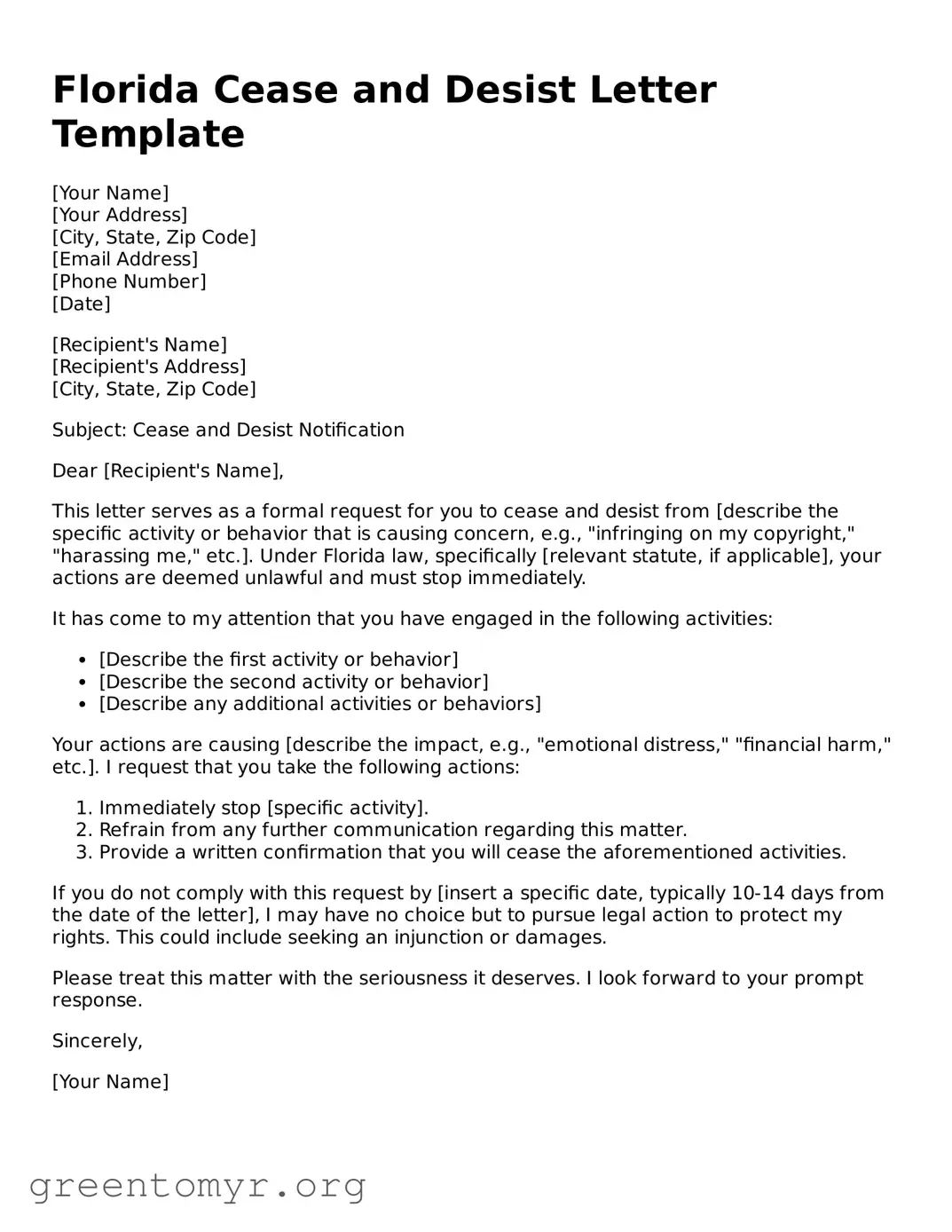
Florida Cease and Desist Letter Template

[Your Name]
[Your Address]
[City, State, Zip Code]
[Email Address]
[Phone Number]
[Date]

[Recipient's Name]
[Recipient's Address]
[City, State, Zip Code]

Subject: Cease and Desist Notification

Dear [Recipient's Name],

This letter serves as a formal request for you to cease and desist from [describe the specific activity or behavior that is causing concern, e.g., "infringing on my copyright," "harassing me," etc.]. Under Florida law, specifically [relevant statute, if applicable], your actions are deemed unlawful and must stop immediately.

It has come to my attention that you have engaged in the following activities:

  • [Describe the first activity or behavior]
  • [Describe the second activity or behavior]
  • [Describe any additional activities or behaviors]

Your actions are causing [describe the impact, e.g., "emotional distress," "financial harm," etc.]. I request that you take the following actions:

  1. Immediately stop [specific activity].
  2. Refrain from any further communication regarding this matter.
  3. Provide a written confirmation that you will cease the aforementioned activities.

If you do not comply with this request by [insert a specific date, typically 10-14 days from the date of the letter], I may have no choice but to pursue legal action to protect my rights. This could include seeking an injunction or damages.

Please treat this matter with the seriousness it deserves. I look forward to your prompt response.

Sincerely,

[Your Name]

PDF Form Features

Fact Name Description
Purpose A Florida Cease and Desist Letter is used to formally request that an individual or entity stop engaging in certain activities that may be harmful or infringing upon rights.
Governing Law The letter is governed by Florida Statutes, particularly under Chapter 501, which deals with unfair and deceptive trade practices.
Format The letter should clearly state the sender's intent, outline the specific actions that need to cease, and include a deadline for compliance.
Legal Standing While a Cease and Desist Letter is not a legally binding document, it can serve as an important step before pursuing legal action.

Guide to Using Florida Cease and Desist Letter

Filling out a Florida Cease and Desist Letter form is a straightforward process that requires attention to detail. After completing the form, you will need to send it to the party you wish to address, ensuring that they understand your request clearly. Below are the steps to help you fill out the form correctly.

  1. Begin by entering your name and address at the top of the form. This information identifies you as the sender.
  2. Next, include the date on which you are filling out the form. This helps establish a timeline for your request.
  3. Below the date, write the name and address of the person or entity you are sending the letter to. Make sure this information is accurate to avoid any delivery issues.
  4. In the opening paragraph, clearly state your intention to send a cease and desist letter. Be direct and concise.
  5. Provide a detailed description of the behavior or action that you want to be stopped. This section should include specific examples to clarify your concerns.
  6. Next, outline the potential consequences if the recipient does not comply with your request. This could include legal action or other measures.
  7. Conclude the letter by requesting a written response from the recipient, confirming that they will cease the specified actions.
  8. Finally, sign the letter and include your printed name below your signature.

Get Answers on Florida Cease and Desist Letter

What is a Cease and Desist Letter?

A Cease and Desist Letter is a formal request to stop certain activities that are believed to infringe on rights or cause harm. It serves as a warning before taking legal action. The letter outlines the issue and requests the recipient to cease the specified behavior.

When should I use a Cease and Desist Letter in Florida?

You should consider using a Cease and Desist Letter in Florida when you believe someone is violating your rights, such as copyright infringement, trademark issues, harassment, or other unlawful activities. It’s often a first step to resolve disputes without going to court.

What should be included in a Cease and Desist Letter?

A well-crafted Cease and Desist Letter should include:

  1. Your name and contact information.
  2. The recipient's name and address.
  3. A clear description of the activity you want to stop.
  4. The legal basis for your request.
  5. A deadline for compliance.
  6. Your intent to take further action if the issue is not resolved.

Is a Cease and Desist Letter legally binding?

No, a Cease and Desist Letter is not legally binding. It is a formal request and serves as a warning. However, it can be an important document if legal action is pursued later. It shows that you attempted to resolve the issue amicably.

How do I deliver a Cease and Desist Letter?

You can deliver a Cease and Desist Letter in several ways:

  • Certified mail with a return receipt requested.
  • Personal delivery to ensure the recipient receives it.
  • Email, if you have prior communication with the recipient.

Choose a method that provides proof of delivery for your records.

What happens if the recipient ignores the letter?

If the recipient ignores the Cease and Desist Letter, you may need to consider further legal action. This could include filing a lawsuit or seeking mediation. Documenting all communications is crucial, as it may be helpful in any future legal proceedings.

Can I write my own Cease and Desist Letter?

Yes, you can write your own Cease and Desist Letter. However, it’s important to ensure that it is clear, concise, and legally sound. If you are unsure, consulting with a legal professional can help you avoid potential pitfalls and strengthen your position.

Common mistakes

Filling out a Florida Cease and Desist Letter form can be a straightforward process, but mistakes can lead to complications. One common error is failing to clearly identify the recipient. Providing the full name and address of the person or entity you are addressing is crucial. Without this information, the letter may not be taken seriously or could be misdirected, causing delays in resolving the issue.

Another frequent mistake involves a lack of specificity regarding the actions being contested. It is essential to detail the behavior or actions that prompted the need for the letter. Vague language can lead to misunderstandings and may not convey the urgency of the situation. Clearly stating what actions you want to stop helps establish the seriousness of your request.

People often overlook the importance of including a deadline for compliance. A cease and desist letter should specify a reasonable time frame within which the recipient must cease the contested actions. Without a deadline, the recipient may not feel compelled to respond promptly, prolonging the issue. Setting a clear timeline can motivate the recipient to take the necessary actions to resolve the matter.

Lastly, many individuals forget to keep a copy of the letter for their records. Documenting all correspondence related to the issue is vital for future reference. If the matter escalates, having a copy of the letter can serve as evidence of your attempts to resolve the situation amicably. Ensuring that you retain a copy can help you track the progress of your request and provide a basis for any further legal actions, if necessary.

Documents used along the form

A Florida Cease and Desist Letter serves as a formal request to stop certain actions or behaviors that are deemed harmful or unlawful. This letter is often accompanied by other documents that can strengthen the case or provide additional context. Below are four common forms and documents that are frequently used alongside a Florida Cease and Desist Letter.

  • Demand Letter: This document outlines the specific grievances and demands of the sender. It is often the precursor to a cease and desist letter, aiming to resolve disputes amicably before escalating to legal action.
  • Affidavit: An affidavit is a sworn statement made under oath, used to provide evidence or support claims made in the cease and desist letter. It can be crucial in demonstrating the legitimacy of the claims presented.
  • Notice of Intent to Sue: This document notifies the recipient of the sender's intention to initiate legal proceedings if the requested actions are not taken. It serves as a formal warning that legal action may follow if the issue is not resolved.
  • Settlement Agreement: A settlement agreement outlines the terms under which both parties agree to resolve the dispute without further legal action. This document can be used to formalize the resolution reached after the cease and desist letter is issued.

Utilizing these documents in conjunction with a Florida Cease and Desist Letter can enhance the effectiveness of the communication and provide a clearer path toward resolution. Each document serves a distinct purpose in the legal process, contributing to a comprehensive approach to dispute resolution.

Similar forms

  • Demand Letter: A demand letter requests that the recipient take specific action, such as paying a debt or ceasing a particular behavior. Like a cease and desist letter, it outlines the sender's grievances and the desired outcome.
  • Notice of Violation: This document informs an individual or organization that they have violated a law or regulation. Similar to a cease and desist letter, it typically demands corrective action to avoid further legal consequences.
  • Settlement Agreement: A settlement agreement outlines the terms under which parties resolve a dispute without going to court. Both documents aim to prevent further legal action, but a settlement agreement is usually more formal and binding.
  • Letter of Intent: A letter of intent expresses a party's intention to enter into a formal agreement. While it does not demand action like a cease and desist letter, it signals a serious intention to negotiate terms and avoid disputes.
  • Notice to Quit: Often used in landlord-tenant situations, this document informs a tenant that they must vacate the premises. It shares similarities with a cease and desist letter in that it demands a specific action to avoid further legal action.
  • Warning Letter: A warning letter alerts an individual or organization to a potential issue or violation. Like a cease and desist letter, it serves as a precursor to more serious legal action if the problem is not addressed.
  • Injunction: An injunction is a court order that requires a person to do or refrain from doing a specific act. Although it is a legal order, it is similar to a cease and desist letter in that both seek to prevent harmful actions.
  • Right of First Refusal Letter: This document gives a party the opportunity to purchase or lease property before the owner considers offers from others. It is similar in that it establishes a formal expectation for action, much like a cease and desist letter establishes expectations for behavior.
  • Legal Complaint: A legal complaint initiates a lawsuit by outlining the plaintiff's claims against the defendant. While it is more formal and detailed than a cease and desist letter, both documents are used to address grievances and seek resolution.

Dos and Don'ts

When filling out a Florida Cease and Desist Letter form, it’s important to approach the task with care. Here’s a list of things you should and shouldn’t do to ensure your letter is effective and legally sound.

  • Do clearly identify the party you are addressing.
  • Do provide a detailed description of the behavior you want to cease.
  • Do include relevant dates and evidence to support your claims.
  • Do use a professional tone throughout the letter.
  • Do specify a reasonable timeframe for compliance.
  • Don't use aggressive or threatening language.
  • Don't make false claims or exaggerate the situation.
  • Don't forget to keep a copy of the letter for your records.
  • Don't overlook the importance of sending the letter via a method that provides proof of delivery.
  • Don't assume that a verbal warning is sufficient; a written letter is usually necessary.

By following these guidelines, you can enhance the effectiveness of your Cease and Desist Letter and help ensure that your concerns are addressed appropriately.

Misconceptions

There are several misconceptions regarding the Florida Cease and Desist Letter form. Understanding these can help clarify its purpose and effectiveness. Here are ten common misconceptions:

  1. A Cease and Desist Letter is a legal document. Many believe that it has the same weight as a court order. In reality, it is a formal request to stop certain behavior, but it does not have legal authority unless filed in court.
  2. Sending a Cease and Desist Letter guarantees compliance. While it may prompt action, there is no guarantee that the recipient will comply. Legal action may still be necessary.
  3. Only lawyers can draft a Cease and Desist Letter. Although legal advice can be beneficial, individuals can draft their own letters. Clarity and specificity are key.
  4. A Cease and Desist Letter must be sent via certified mail. While sending it this way can provide proof of delivery, it is not a requirement. Regular mail or email may also suffice.
  5. Cease and Desist Letters are only for copyright infringement. They can address a variety of issues, including harassment, defamation, and contract violations.
  6. Once a Cease and Desist Letter is sent, the matter is resolved. This is not always true. If the issue persists, further legal action may be necessary.
  7. Receiving a Cease and Desist Letter means you are guilty. It is simply a notification of a complaint. Recipients have the right to respond and defend their actions.
  8. All Cease and Desist Letters are the same. Each letter should be tailored to the specific situation and needs of the sender. A generic letter may not be effective.
  9. A Cease and Desist Letter can be ignored. Ignoring the letter can lead to escalation. It is often wise to respond or seek legal advice.
  10. Cease and Desist Letters are only for businesses. Individuals can also use them to protect their rights and interests in personal matters.

Being informed about these misconceptions can empower individuals to take appropriate action when necessary. Understanding the purpose and limitations of a Cease and Desist Letter is crucial for effective communication and resolution.

Key takeaways

When dealing with disputes or unwanted actions in Florida, a Cease and Desist Letter can be an effective tool. Here are some key takeaways to consider when filling out and using this important document:

  • Understand the Purpose: A Cease and Desist Letter serves as a formal request to stop certain actions or behaviors that are perceived as harmful or unlawful.
  • Identify the Recipient: Clearly specify who the letter is addressed to. This should include their full name and any relevant details to ensure the letter reaches the right person.
  • Be Clear and Concise: State the specific actions that need to stop. Avoid vague language; clarity will help prevent misunderstandings.
  • Include Relevant Details: Provide context for your request. This may involve mentioning dates, incidents, or any previous communications related to the issue.
  • State the Consequences: Explain what actions you will take if the recipient does not comply with the request. This could include legal action or other measures.
  • Keep a Copy: Retain a copy of the letter for your records. This documentation may be useful in future discussions or legal proceedings.

Using a Cease and Desist Letter effectively can help resolve conflicts while protecting your rights. Ensure that you approach the situation with care and consideration.