In the vibrant landscape of Florida real estate, understanding the intricacies of the Florida Deed form is essential for anyone looking to transfer property ownership. This document serves as a critical legal instrument that facilitates the conveyance of real property, ensuring that the transfer is executed smoothly and in accordance with state laws. Among its key features, the Florida Deed form includes essential information such as the names of the parties involved—the grantor, who is the current owner, and the grantee, the new owner—alongside a detailed description of the property being transferred. The form also outlines any relevant conditions or warranties associated with the transfer, which can significantly impact the rights and responsibilities of both parties. Additionally, it typically requires notarization to enhance its legal standing and may need to be recorded with the county clerk’s office to provide public notice of the change in ownership. Understanding these components not only aids in navigating the complexities of property transactions but also helps ensure that all legal requirements are met, thus safeguarding the interests of everyone involved.
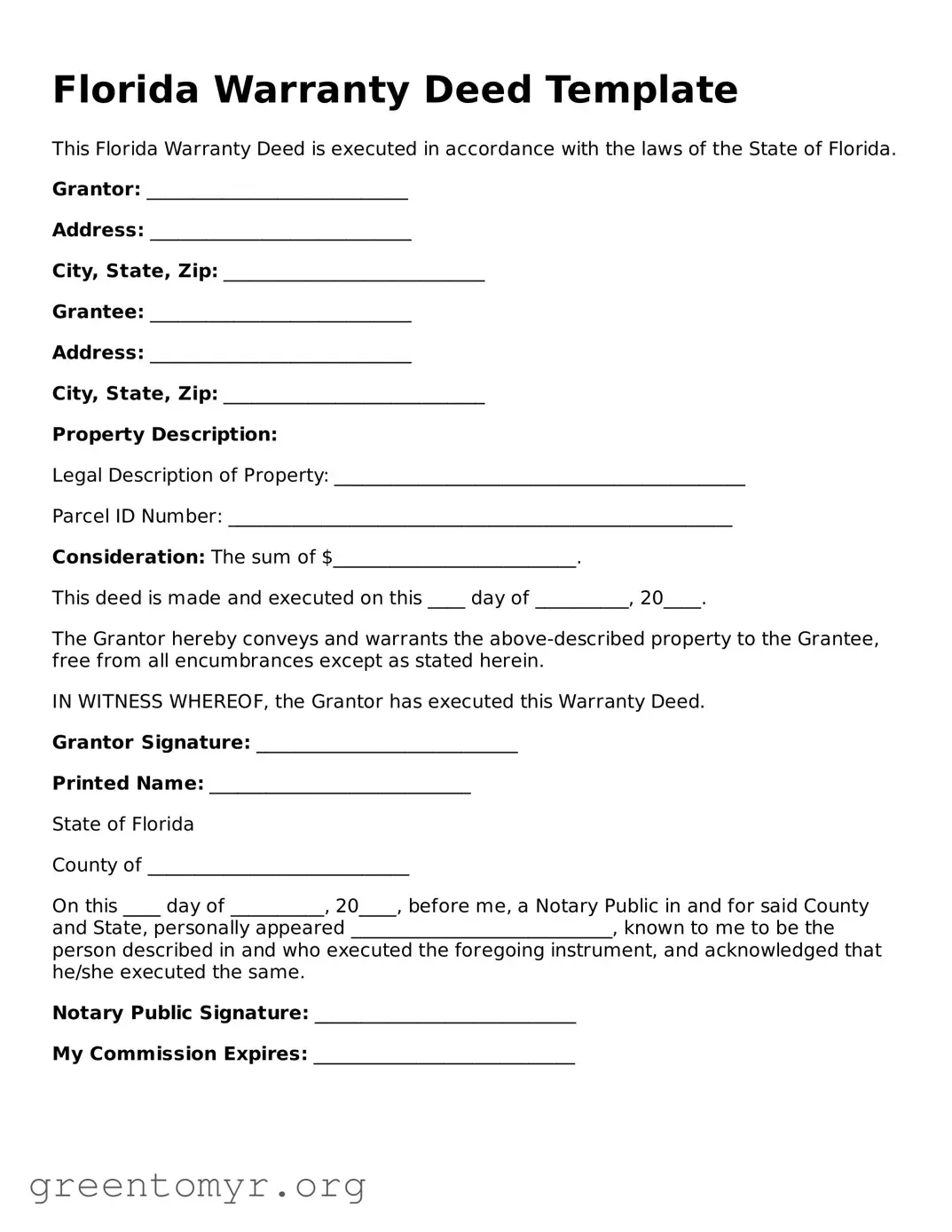
Florida Warranty Deed Template
This Florida Warranty Deed is executed in accordance with the laws of the State of Florida.
Grantor: ____________________________
Address: ____________________________
City, State, Zip: ____________________________
Grantee: ____________________________
Address: ____________________________
City, State, Zip: ____________________________
Property Description:
Legal Description of Property: ____________________________________________
Parcel ID Number: ______________________________________________________
Consideration: The sum of $__________________________.
This deed is made and executed on this ____ day of __________, 20____.
The Grantor hereby conveys and warrants the above-described property to the Grantee, free from all encumbrances except as stated herein.
IN WITNESS WHEREOF, the Grantor has executed this Warranty Deed.
Grantor Signature: ____________________________
Printed Name: ____________________________
State of Florida
County of ____________________________
On this ____ day of __________, 20____, before me, a Notary Public in and for said County and State, personally appeared ____________________________, known to me to be the person described in and who executed the foregoing instrument, and acknowledged that he/she executed the same.
Notary Public Signature: ____________________________
My Commission Expires: ____________________________
| Fact Name | Details |
|---|---|
| Type of Deed | The Florida Deed form can be a Warranty Deed, Quit Claim Deed, or Special Warranty Deed, depending on the needs of the parties involved. |
| Governing Law | Florida Statutes, Chapter 689, governs the creation and execution of deeds in Florida. |
| Signature Requirement | The deed must be signed by the grantor (the person transferring the property) in the presence of a notary public. |
| Recording | To provide public notice, the completed deed should be recorded with the county clerk's office where the property is located. |
Once you have the Florida Deed form in hand, it's essential to complete it accurately to ensure the transfer of property goes smoothly. The information you provide will help establish ownership and protect your rights as a property owner. Follow these steps to fill out the form correctly.
A Florida Deed form is a legal document used to transfer ownership of real property in the state of Florida. It outlines the details of the transaction, including the names of the parties involved, a description of the property, and any conditions related to the transfer. Common types of deeds in Florida include warranty deeds, quitclaim deeds, and special purpose deeds.
Florida recognizes several types of deeds, each serving different purposes:
While it is not legally required to have a lawyer prepare a Florida Deed, consulting with one is advisable. A lawyer can ensure that the deed is correctly drafted, complies with state laws, and meets all necessary legal requirements. This can help prevent future disputes or issues with the property title.
Completing a Florida Deed form involves several steps:
A Florida Deed must be filed with the Clerk of the Circuit Court in the county where the property is located. Filing the deed is essential for it to be legally recognized and to protect the rights of the new property owner.
The cost of filing a Florida Deed varies by county. Typically, there are recording fees based on the number of pages in the deed and the type of document being filed. Additionally, there may be documentary stamp taxes applicable to the transfer of real property. It is advisable to check with the local Clerk's office for specific fee schedules.
Revoking a Florida Deed is not straightforward. Once a deed is executed and recorded, it generally cannot be unilaterally revoked. If a party wishes to transfer property back, a new deed must be executed. In some cases, legal action may be required to challenge the validity of a deed, especially if fraud or coercion is suspected.
If a Florida Deed is not recorded, it may still be valid between the parties involved, but it may not provide protection against claims from third parties. For example, if the property is sold again to another buyer who records their deed, the first buyer may lose their claim to the property. Recording the deed is crucial for establishing legal ownership and protecting against potential disputes.
While there is no strict deadline for filing a Florida Deed, it is advisable to record the deed as soon as possible after the transfer of ownership. Delaying the recording can lead to complications, particularly in situations where the property is sold again or if disputes arise regarding ownership.
Filling out a Florida Deed form can seem straightforward, but many people make common mistakes that can lead to complications down the road. One of the most frequent errors is not providing accurate property descriptions. It's crucial to include a detailed legal description of the property, which goes beyond just the address. Without this, the deed may not be valid, and ownership could be disputed.
Another mistake often made is failing to properly identify the grantor and grantee. The grantor is the person transferring the property, while the grantee is the person receiving it. If names are misspelled or titles are incorrect, it can create confusion and delay the transfer process. Double-checking this information can save time and headaches later on.
People also frequently overlook the importance of signatures. All parties involved must sign the deed for it to be legally binding. If a signature is missing, the deed may be considered incomplete. Additionally, it's essential to have the signatures notarized. This step provides an extra layer of verification and helps prevent fraud.
Another common pitfall is neglecting to consider tax implications. When transferring property, there may be taxes due, such as documentary stamp taxes in Florida. Understanding these obligations can prevent unexpected financial burdens after the deed is filed. Consulting with a tax professional before completing the deed can be a wise move.
Lastly, many individuals forget to file the completed deed with the appropriate county clerk's office. This step is vital because it officially records the transfer of ownership. Without this filing, the deed may not hold up in legal situations, leaving the new owner vulnerable. Always ensure that the deed is filed promptly to protect your rights as a property owner.
When engaging in real estate transactions in Florida, several important documents often accompany the Florida Deed form. Each of these documents serves a specific purpose, ensuring that the transfer of property is legally sound and properly recorded. Below is a list of commonly used forms and documents that one might encounter alongside the Florida Deed.
Understanding these documents is crucial for anyone involved in a real estate transaction in Florida. Each plays a vital role in protecting the interests of the parties and ensuring a smooth transfer of property ownership.
The Deed form serves a unique purpose in property transactions, but it shares similarities with several other important documents. Here’s a look at nine documents that are akin to the Deed form, along with a brief explanation of how they relate:
Understanding these documents can help clarify the property transfer process and ensure that all parties are informed and protected.
When filling out a Florida Deed form, it's essential to follow certain guidelines to ensure the document is completed correctly. Here are some dos and don'ts to keep in mind:
By following these guidelines, you can help ensure that your Florida Deed form is completed accurately and effectively.
When it comes to the Florida Deed form, several misconceptions can lead to confusion. Here’s a breakdown of nine common myths:
Many people believe that all deeds serve the same purpose. In reality, different types of deeds, such as warranty deeds and quitclaim deeds, have distinct functions and levels of protection.
Some think that possessing a deed means they own the property outright. However, a deed is simply a legal document that transfers ownership; the title represents the actual ownership rights.
It's a common belief that a deed can be valid without a notary. In Florida, most deeds must be notarized to be legally recognized.
While attorneys can certainly prepare deeds, many individuals can fill out the forms themselves, provided they understand the requirements and implications.
People often think that once a deed is recorded, it’s set in stone. In fact, deeds can be amended or corrected under certain circumstances.
Some assume that every deed must be recorded to be valid. While recording a deed protects your interest, a deed is still valid even if it isn’t recorded.
Many believe that deeds are solely for transferring ownership. However, they can also be used for other purposes, such as establishing a life estate or creating joint tenancy.
Some individuals think that transferring property via a deed is tax-free. In reality, there may be tax consequences, such as documentary stamp taxes in Florida.
Many people think that signing a deed makes it valid. However, a deed must also be delivered and accepted to be legally effective.
Understanding these misconceptions can help you navigate the complexities of property ownership and transfer in Florida more effectively.
When filling out and using the Florida Deed form, it is essential to understand several key aspects to ensure a smooth process. Here are important takeaways to keep in mind:
By keeping these key points in mind, you can navigate the process of filling out and using the Florida Deed form with confidence.