Content Navigation

In the realm of real estate transactions, particularly in Florida, the Deed in Lieu of Foreclosure form serves as a crucial tool for homeowners facing financial distress. This legal document allows a property owner to voluntarily transfer ownership of their home to the lender in exchange for the cancellation of the mortgage debt. By opting for this route, homeowners can avoid the lengthy and often costly foreclosure process, which can have lasting impacts on their credit scores and financial futures. The form typically outlines essential details, including the property description, the parties involved, and any conditions surrounding the transfer. Furthermore, it may also address the lender's acceptance of the deed, ensuring that all parties understand their rights and obligations moving forward. This alternative not only simplifies the resolution of mortgage default situations but also offers a potential pathway for homeowners to regain stability without the stigma of foreclosure lingering over them.

Florida Deed in Lieu of Foreclosure Example

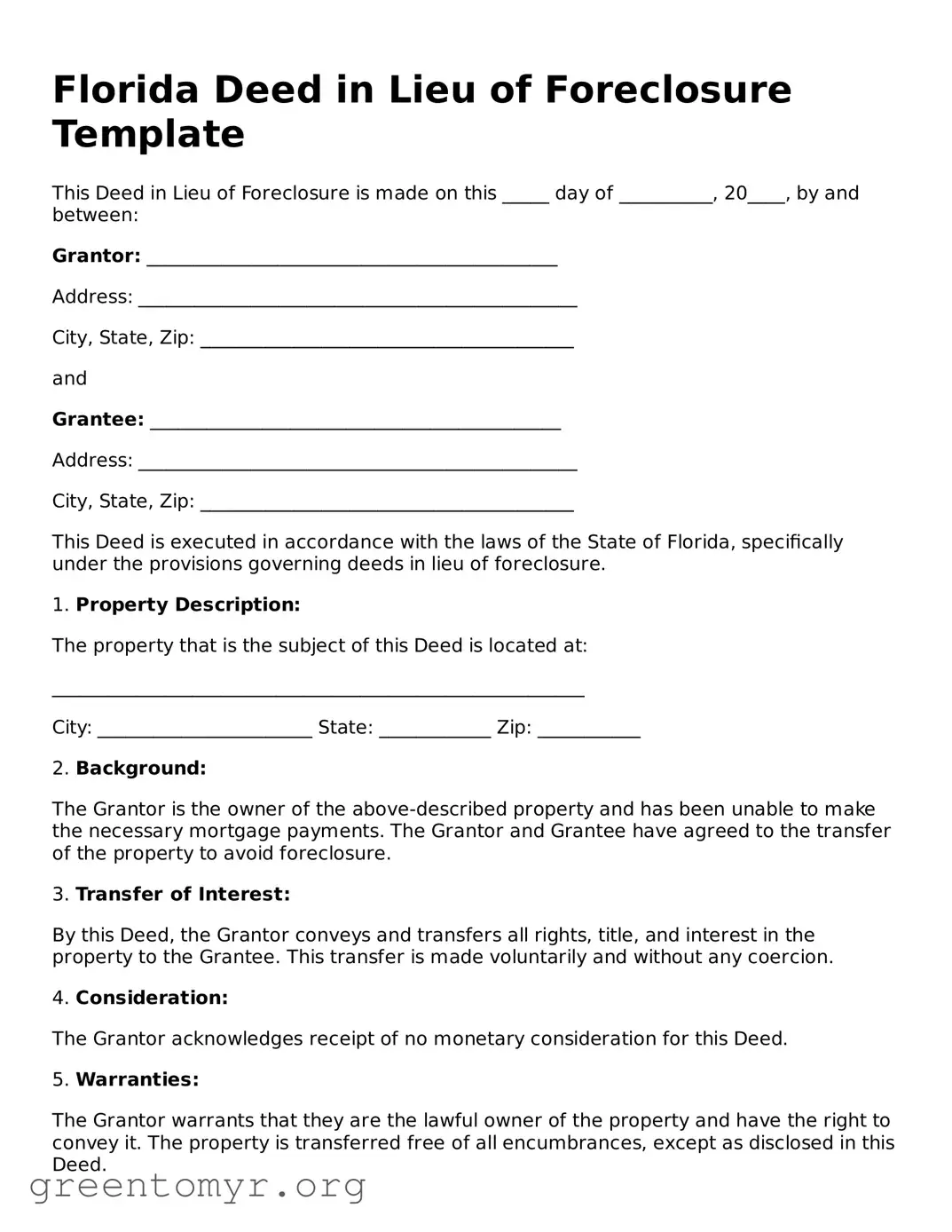
Florida Deed in Lieu of Foreclosure Template

This Deed in Lieu of Foreclosure is made on this _____ day of __________, 20____, by and between:

Grantor: ____________________________________________

Address: _______________________________________________

City, State, Zip: ________________________________________

and

Grantee: ____________________________________________

Address: _______________________________________________

City, State, Zip: ________________________________________

This Deed is executed in accordance with the laws of the State of Florida, specifically under the provisions governing deeds in lieu of foreclosure.

1. Property Description:

The property that is the subject of this Deed is located at:

_________________________________________________________

City: _______________________ State: ____________ Zip: ___________

2. Background:

The Grantor is the owner of the above-described property and has been unable to make the necessary mortgage payments. The Grantor and Grantee have agreed to the transfer of the property to avoid foreclosure.

3. Transfer of Interest:

By this Deed, the Grantor conveys and transfers all rights, title, and interest in the property to the Grantee. This transfer is made voluntarily and without any coercion.

4. Consideration:

The Grantor acknowledges receipt of no monetary consideration for this Deed.

5. Warranties:

The Grantor warrants that they are the lawful owner of the property and have the right to convey it. The property is transferred free of all encumbrances, except as disclosed in this Deed.

6. Governing Law:

This Deed shall be governed by the laws of the State of Florida.

IN WITNESS WHEREOF, the Grantor has executed this Deed as of the day and year first above written.

______________________________

Grantor Signature

______________________________

Print Name

______________________________

Witness Signature

______________________________

Print Name

______________________________

Witness Signature

______________________________

Print Name

State of Florida

County of ______________________

On this _____ day of __________, 20____, before me, a Notary Public, personally appeared ______________________, known to me to be the person described in and who executed the foregoing instrument, and acknowledged that they executed the same for the purposes therein contained.

______________________________

Notary Public

My Commission Expires: ____________

PDF Form Features

Fact Name Description
Definition A deed in lieu of foreclosure is a legal document where a borrower voluntarily transfers property ownership to the lender to avoid foreclosure.
Governing Law The process is governed by Florida Statutes, specifically Chapter 697, which outlines the requirements and implications of deeds in lieu of foreclosure.
Eligibility Homeowners facing financial difficulties may qualify for a deed in lieu of foreclosure, provided they have exhausted other options.
Benefits This option can help borrowers avoid the lengthy and costly foreclosure process, potentially preserving their credit score.
Risks Borrowers may still face tax implications or deficiency judgments if the property value is less than the outstanding mortgage balance.
Process The borrower must formally request the deed in lieu, and the lender must approve the transfer, often requiring specific documentation.

Guide to Using Florida Deed in Lieu of Foreclosure

After you complete the Florida Deed in Lieu of Foreclosure form, it’s important to ensure that all parties involved are aware of the next steps. This may include notifying the lender and possibly arranging for the transfer of property. Make sure to keep copies of all documents for your records.

  1. Begin by obtaining the Florida Deed in Lieu of Foreclosure form from a reliable source.
  2. Fill in the Grantor section with your name and address. This is the person giving up the property.
  3. In the Grantee section, write the name and address of the lender or financial institution receiving the property.
  4. Provide a detailed description of the property being transferred. This should include the address and any legal description required.
  5. Enter the date of the transfer in the designated area.
  6. Sign the form in the presence of a notary public. Make sure to include the date of your signature.
  7. Have the notary public complete their section, which typically includes their signature and seal.
  8. Make copies of the completed form for your records and for the lender.
  9. Submit the signed and notarized form to the lender as instructed.

Get Answers on Florida Deed in Lieu of Foreclosure

What is a Deed in Lieu of Foreclosure?

A Deed in Lieu of Foreclosure is a legal agreement where a homeowner voluntarily transfers the title of their property to the lender. This usually happens when the homeowner is unable to continue making mortgage payments. By doing this, the homeowner can avoid the lengthy foreclosure process. The lender accepts the property in exchange for releasing the homeowner from the mortgage obligation.

What are the benefits of a Deed in Lieu of Foreclosure?

There are several benefits to consider:

  • Quicker resolution: The process is generally faster than foreclosure.
  • Less damage to credit: It may have a less negative impact on your credit score compared to a foreclosure.
  • Relief from debt: Homeowners can walk away without the burden of the mortgage debt.
  • Possibly avoiding legal fees: The homeowner may save on costs associated with a foreclosure process.

What are the requirements to qualify for a Deed in Lieu of Foreclosure?

To qualify, homeowners typically need to meet certain conditions:

  1. The mortgage must be in default or the homeowner must be facing financial hardship.
  2. The homeowner must own the property outright, meaning there are no other liens or claims against it.
  3. The homeowner must be willing to vacate the property.
  4. The lender must agree to the arrangement.

How does the process work?

The process involves several steps:

  1. The homeowner contacts the lender to discuss the option of a Deed in Lieu of Foreclosure.
  2. The lender reviews the homeowner’s financial situation.
  3. If approved, the lender will prepare the necessary documents.
  4. The homeowner signs the deed, transferring ownership to the lender.
  5. The lender then releases the homeowner from the mortgage obligation.

What should homeowners consider before proceeding?

Before moving forward, homeowners should think about the following:

  • Impact on credit: While it may be less damaging than foreclosure, it can still affect credit.
  • Tax implications: There may be tax consequences for forgiven mortgage debt.
  • Future housing: Finding new housing may be necessary, and it’s important to have a plan.
  • Consulting a professional: Speaking with a financial advisor or attorney can provide valuable insights.

Can a homeowner change their mind after signing?

Once the deed is signed and submitted, it is generally difficult to reverse the decision. The transfer of property is typically final. Homeowners should ensure they fully understand the implications before proceeding. Consulting with a legal expert can help clarify any uncertainties.

Common mistakes

Filling out the Florida Deed in Lieu of Foreclosure form can be a complex process, and mistakes can lead to significant consequences. One common error is failing to provide accurate property information. This includes the legal description of the property, which must be precise. If the description is incorrect or incomplete, it may result in delays or even rejection of the deed.

Another mistake is neglecting to include all necessary parties. All individuals who hold an interest in the property must sign the deed. If a co-owner or spouse does not sign, the deed may not be legally binding. It is crucial to ensure that everyone with a legal claim to the property is included in the process.

Additionally, individuals often overlook the importance of understanding the implications of signing the deed. A deed in lieu of foreclosure transfers ownership of the property to the lender, which can have long-term effects on credit scores and future homeownership opportunities. Failing to fully comprehend these consequences can lead to regret after the fact.

Lastly, people sometimes forget to seek legal advice before completing the form. While it is possible to fill out the deed without assistance, consulting with a legal expert can provide clarity and help avoid pitfalls. Legal professionals can offer insights into the process, ensuring that all aspects are handled correctly and that the individual’s rights are protected.

Documents used along the form

A Deed in Lieu of Foreclosure is a significant step in the process of resolving mortgage default issues. To ensure a smooth transaction, several other documents may be required. Below is a list of commonly used forms and documents that accompany the Florida Deed in Lieu of Foreclosure.

  • Loan Modification Agreement: This document outlines the changes to the original loan terms. It may include adjustments to interest rates, payment schedules, or principal amounts to make the mortgage more manageable for the borrower.
  • Notice of Default: This document notifies the borrower that they have failed to meet their mortgage obligations. It serves as a formal warning before further action is taken, such as foreclosure proceedings.
  • Property Inspection Report: This report provides an assessment of the property's condition. It helps both parties understand any repairs or issues that may need to be addressed before the deed transfer.
  • Release of Liability: This document releases the borrower from any further obligations related to the mortgage after the deed transfer. It ensures that the borrower will not be held accountable for any remaining debt.
  • Settlement Statement: Also known as a HUD-1, this document outlines all financial transactions related to the deed transfer. It details any fees, credits, and debits involved in the process.
  • Title Search Report: This report confirms the ownership of the property and checks for any liens or encumbrances. It is crucial for ensuring that the title can be transferred without issues.
  • Affidavit of Title: This sworn statement by the seller confirms their ownership of the property and discloses any known issues that could affect the title. It helps protect the buyer from future claims against the property.

Understanding these documents is essential for both borrowers and lenders. They play a critical role in facilitating a Deed in Lieu of Foreclosure and ensuring that all parties are protected throughout the process.

Similar forms

  • Short Sale Agreement: This document allows a homeowner to sell their property for less than the amount owed on the mortgage. Like a deed in lieu, it helps avoid foreclosure by transferring ownership to a buyer, often with lender approval.
  • Loan Modification Agreement: This modifies the terms of an existing loan to make payments more manageable. While it keeps the homeowner in their property, it serves a similar purpose by preventing foreclosure.
  • Forbearance Agreement: This temporarily pauses or reduces mortgage payments. It offers relief to homeowners facing financial hardship, similar to a deed in lieu, by providing a way to avoid foreclosure.
  • Bankruptcy Filing: Filing for bankruptcy can halt foreclosure proceedings. It provides a legal route to manage debts and can lead to a resolution similar to that achieved with a deed in lieu.
  • Repayment Plan: This outlines a strategy for homeowners to catch up on missed payments. Like a deed in lieu, it aims to help homeowners avoid losing their property through foreclosure.
  • Property Transfer Agreement: This document facilitates the transfer of property ownership, often to settle debts. It shares similarities with a deed in lieu by allowing homeowners to relinquish their property to the lender to avoid foreclosure.

Dos and Don'ts

When filling out the Florida Deed in Lieu of Foreclosure form, it is essential to follow certain guidelines to ensure the process goes smoothly. Here are ten things to keep in mind:

  • Do ensure that you fully understand the implications of signing a deed in lieu of foreclosure.
  • Do provide accurate and complete information about the property.
  • Do consult with a legal professional if you have any questions about the form.
  • Do sign the document in the presence of a notary public.
  • Do keep copies of all documents for your records.
  • Don't rush through the form; take your time to ensure everything is correct.
  • Don't forget to check for any outstanding liens or mortgages on the property.
  • Don't ignore any additional requirements from your lender.
  • Don't assume that submitting the form will automatically relieve you of all obligations.
  • Don't leave any sections of the form blank; complete every part as required.

Misconceptions

The Deed in Lieu of Foreclosure is a legal tool that can help homeowners facing foreclosure. However, several misconceptions surround this process. Here are eight common misunderstandings about the Florida Deed in Lieu of Foreclosure form:

  1. It eliminates all debt automatically. Many believe that signing a Deed in Lieu of Foreclosure wipes out all mortgage debt. In reality, it only transfers ownership of the property back to the lender. Homeowners may still be responsible for other debts associated with the property.
  2. It is the same as a short sale. Some confuse a Deed in Lieu of Foreclosure with a short sale. While both involve the transfer of property to the lender, a short sale occurs when the property is sold for less than the mortgage owed, with the lender's approval. In contrast, a Deed in Lieu involves a direct transfer without a sale.
  3. It is a quick and easy solution. Although a Deed in Lieu may seem straightforward, the process can be lengthy. Lenders often require extensive documentation and may take time to review the homeowner's financial situation before accepting the deed.
  4. It has no impact on credit scores. Many think that a Deed in Lieu of Foreclosure does not affect their credit. However, it can still result in a significant drop in credit scores, similar to a foreclosure, which can impact future borrowing opportunities.
  5. All lenders accept Deeds in Lieu. Not all lenders are willing to accept a Deed in Lieu of Foreclosure. Some may prefer to proceed with foreclosure instead. Homeowners should check with their lender to understand their specific policies.
  6. It absolves homeowners from all legal obligations. Signing a Deed in Lieu does not release homeowners from potential legal obligations. If there are other liens on the property, such as tax liens, those may still need to be addressed.
  7. It is a guaranteed way to avoid foreclosure. While a Deed in Lieu can help some homeowners avoid the foreclosure process, it is not guaranteed. Lenders may deny the request if they believe it is not in their best interest.
  8. It is only available for primary residences. Some think that Deeds in Lieu of Foreclosure are limited to primary residences. In fact, they can also apply to investment properties, although the process may differ based on the lender’s policies.

Understanding these misconceptions can help homeowners make informed decisions when facing financial difficulties. It is crucial to seek professional advice to navigate the complexities of the Deed in Lieu of Foreclosure process effectively.

Key takeaways

Filling out and using the Florida Deed in Lieu of Foreclosure form involves several important considerations. Below are key takeaways to keep in mind:

  • Understanding Purpose: A Deed in Lieu of Foreclosure allows a homeowner to voluntarily transfer ownership of their property to the lender to avoid foreclosure.
  • Eligibility Criteria: Not all homeowners qualify. Factors such as the mortgage type and the lender's policies play a crucial role.
  • Property Condition: The property must typically be in good condition. Lenders may require an inspection before accepting the deed.
  • Documentation Required: Homeowners must provide necessary documentation, including proof of income and financial hardship, to the lender.
  • Impact on Credit: A Deed in Lieu of Foreclosure can still affect credit scores, though it may be less damaging than a foreclosure.
  • Tax Implications: Homeowners should consult a tax professional, as there may be tax consequences related to debt forgiveness.
  • Legal Advice: It is advisable to seek legal counsel to understand the implications and ensure proper completion of the form.