The Florida Do Not Resuscitate Order (DNRO) form plays a crucial role in end-of-life care decisions, allowing individuals to express their wishes regarding resuscitation efforts in case of cardiac or respiratory arrest. This legally recognized document ensures that healthcare providers respect the patient's preferences, preventing unwanted medical interventions. The form must be completed and signed by a qualified physician, affirming that the patient understands the implications of the order. It is essential for patients to discuss their choices with family members and healthcare professionals to ensure clarity and support. In Florida, the DNRO form must be prominently displayed in a way that is easily accessible to medical personnel, typically on the patient's medical record or at their bedside. Understanding the nuances of this form can empower individuals to make informed decisions about their medical care and ensure their values are honored in critical situations.
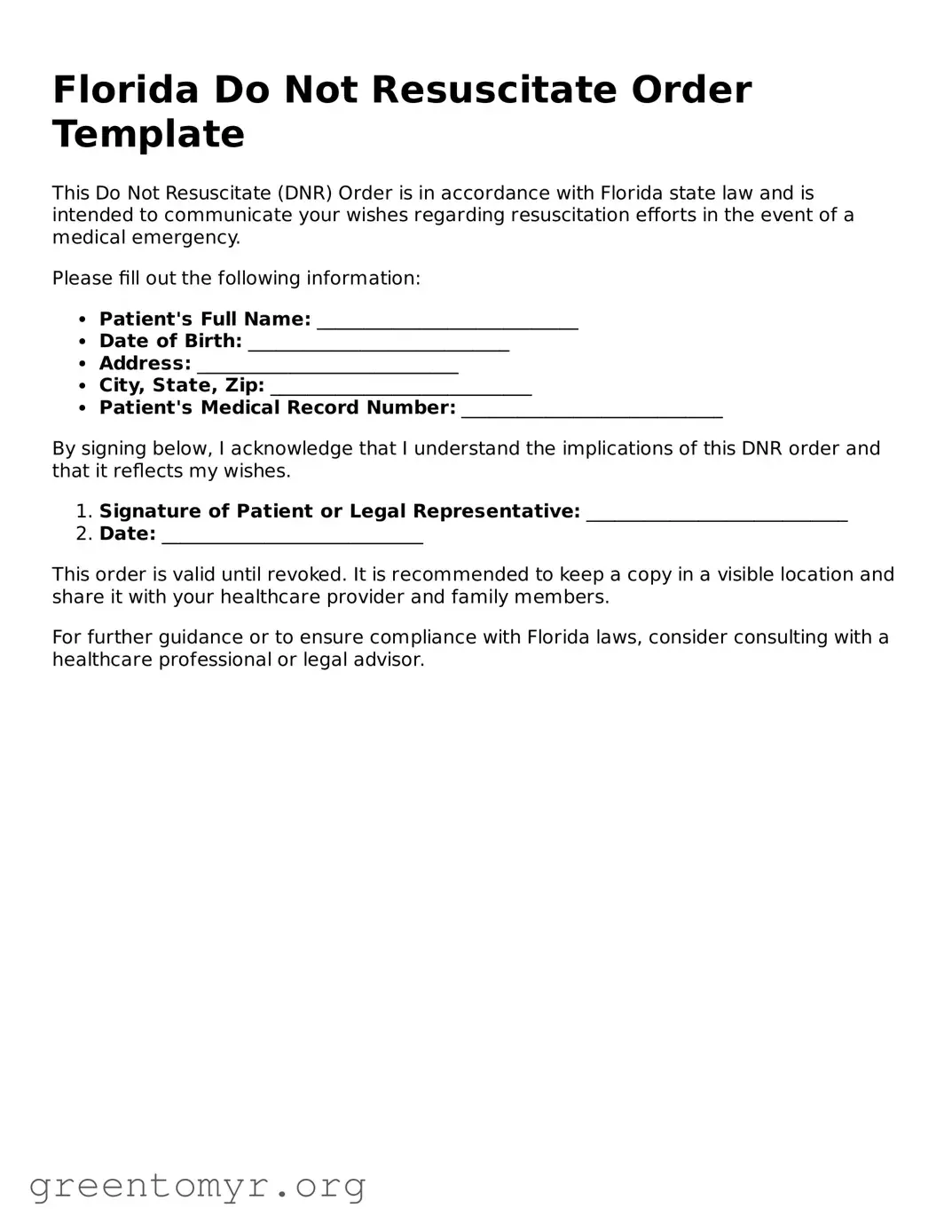
Florida Do Not Resuscitate Order Template
This Do Not Resuscitate (DNR) Order is in accordance with Florida state law and is intended to communicate your wishes regarding resuscitation efforts in the event of a medical emergency.
Please fill out the following information:
By signing below, I acknowledge that I understand the implications of this DNR order and that it reflects my wishes.
This order is valid until revoked. It is recommended to keep a copy in a visible location and share it with your healthcare provider and family members.
For further guidance or to ensure compliance with Florida laws, consider consulting with a healthcare professional or legal advisor.
| Fact Name | Description |
|---|---|
| Definition | A Florida Do Not Resuscitate (DNR) Order is a legal document that instructs medical personnel not to perform cardiopulmonary resuscitation (CPR) in the event of cardiac or respiratory arrest. |
| Governing Law | The Florida DNR Order is governed by Florida Statutes Section 401.45. |
| Eligibility | Any adult, or a parent or legal guardian of a minor, can complete a DNR Order in Florida. |
| Form Availability | The DNR Order form is available online through the Florida Department of Health website and can also be obtained from healthcare providers. |
| Signature Requirement | The form must be signed by the patient or their legal representative, and it requires the signature of a physician. |
| Revocation | A DNR Order can be revoked at any time by the patient or their legal representative, either verbally or in writing. |
| Placement | It is recommended that the DNR Order be placed in a visible location, such as on the refrigerator or in the medical records, to ensure it is easily accessible in emergencies. |
| Emergency Medical Services (EMS) Compliance | Emergency medical personnel are required to comply with a valid DNR Order, provided it is properly completed and signed. |
| Not a Living Will | A DNR Order is not the same as a living will; it specifically addresses resuscitation efforts, whereas a living will covers broader end-of-life care decisions. |
| Statewide Recognition | The Florida DNR Order is recognized statewide, ensuring that it is valid across all healthcare settings within the state. |
Filling out the Florida Do Not Resuscitate Order form is a straightforward process that requires careful attention to detail. After completing the form, you will need to ensure it is signed and witnessed appropriately. This will help ensure your wishes are respected in a medical emergency.
A Florida Do Not Resuscitate Order is a legal document that allows a person to refuse cardiopulmonary resuscitation (CPR) and other life-saving measures in the event of a medical emergency. This order is intended for individuals who have a terminal condition or a serious illness and wish to avoid aggressive medical interventions that may not improve their quality of life.
In Florida, any competent adult can complete a Do Not Resuscitate Order. Additionally, a parent or legal guardian can complete the order for a minor. It is important that the individual understands the implications of the order and discusses it with their healthcare provider.
To create a DNRO, an individual must fill out the official Florida Do Not Resuscitate Order form. This form must be signed by the patient and their physician. The physician's signature confirms that the patient has a terminal condition or a serious illness and understands the consequences of the order.
The completed DNRO should be kept in a place that is easily accessible, such as with the individual’s medical records or in their home. It is advisable to provide copies to family members, caregivers, and healthcare providers to ensure that everyone is aware of the individual's wishes.
Yes, a valid Florida DNRO is recognized in all healthcare settings, including hospitals, nursing homes, and emergency medical services. However, it is crucial that the order is properly completed and signed to be effective.
Yes, a DNRO can be revoked at any time. The individual can verbally express their desire to revoke the order or complete a new DNRO form that indicates a change in their wishes. It is important to inform healthcare providers and family members of any changes to ensure that the correct wishes are followed.
If a DNRO is not available during a medical emergency, healthcare providers will typically perform CPR and other life-saving measures. It is essential to have the DNRO readily accessible to avoid any confusion about the individual’s wishes.
No, a DNRO specifically addresses resuscitation efforts. It does not affect other medical treatments or care options. Individuals can still receive pain management, comfort care, and other necessary medical interventions as needed.
A Florida DNRO form can be obtained from various sources, including healthcare providers, hospitals, and online through the Florida Department of Health website. It is important to ensure that the form used is the official state version to ensure its validity.
Filling out the Florida Do Not Resuscitate Order (DNRO) form can be a straightforward process, but many people make mistakes that can lead to confusion or even legal issues. One common mistake is not clearly indicating the patient's wishes. If the form is filled out but lacks clarity, medical personnel may not fully understand the intent. This can result in unwanted resuscitation efforts.
Another frequent error is failing to sign the form. The DNRO must be signed by the patient or their legal representative. Without a signature, the document holds no legal weight, and healthcare providers may feel obligated to perform resuscitation. Always double-check for a signature before submitting the form.
Not dating the form is also a critical oversight. The date serves as an important reference point. If the form is undated, it could lead to questions about its validity. Healthcare providers need to know when the decision was made to ensure it reflects the patient’s current wishes.
Some people forget to provide the necessary identification information. The DNRO should include details like the patient’s name, date of birth, and address. Omitting this information can lead to complications in identifying the patient and understanding their wishes.
Another mistake involves not discussing the DNRO with family members or healthcare providers. Open communication is vital. If loved ones are unaware of the patient’s wishes, they may struggle to honor them in a critical situation.
Additionally, people sometimes use outdated forms. The Florida Department of Health periodically updates these documents. Always ensure you are using the most current version of the DNRO to avoid issues related to outdated language or requirements.
In some cases, individuals may not understand the implications of the DNRO. It’s crucial to grasp what it means to refuse resuscitation. Misunderstanding this can lead to filling out the form incorrectly or not at all.
Another mistake is neglecting to review the form after completion. Errors can slip through, and it’s essential to double-check for any mistakes before finalizing the document. A thorough review can prevent potential problems down the line.
People also sometimes forget to keep copies of the completed form. It’s important to distribute copies to family members and healthcare providers. This ensures that everyone involved is aware of the patient’s wishes and can act accordingly.
Finally, failing to update the DNRO when circumstances change is a significant mistake. Life events, such as a change in health status or a change in the patient's mind, should prompt a review and possible revision of the DNRO. Keeping the document current is key to ensuring it reflects the patient’s wishes accurately.
The Florida Do Not Resuscitate Order (DNRO) form is an important document that allows individuals to express their wishes regarding resuscitation efforts in case of a medical emergency. Along with this form, there are several other documents that can provide additional clarity and guidance regarding healthcare decisions. Below is a list of commonly used forms that complement the DNRO.
Having these documents in place can provide peace of mind, ensuring that healthcare wishes are respected and followed. It is advisable to review and update these forms regularly to reflect any changes in personal circumstances or preferences.
Living Will: A living will outlines a person's preferences for medical treatment in situations where they cannot communicate their wishes. Like a DNR, it focuses on end-of-life care and decisions regarding life-sustaining treatments.
Durable Power of Attorney for Health Care: This document designates an individual to make medical decisions on behalf of someone else. Similar to a DNR, it ensures that a person's healthcare preferences are respected when they are unable to express them.
Physician Orders for Life-Sustaining Treatment (POLST): POLST is a medical order that specifies a patient's preferences for treatment in emergencies. It is similar to a DNR in that it addresses life-sustaining measures but is more comprehensive in detailing various treatments.
Advance Directive: An advance directive is a broader term that encompasses various documents, including living wills and durable powers of attorney. It provides guidance on a person's healthcare wishes, similar to a DNR.
Do Not Intubate (DNI) Order: A DNI order specifically instructs healthcare providers not to insert a breathing tube if a patient cannot breathe on their own. This is closely related to a DNR, focusing on specific interventions rather than resuscitation.
Comfort Care Order: This document prioritizes comfort measures over aggressive treatment. Like a DNR, it emphasizes the patient's desire to avoid invasive procedures and focuses on quality of life.
Health Care Proxy: A health care proxy allows a person to appoint someone else to make healthcare decisions on their behalf. This document shares similarities with a DNR in that it ensures a person's wishes are honored in critical situations.
When filling out the Florida Do Not Resuscitate Order form, it’s essential to approach the process with care and attention. This document can have significant implications for medical care, so understanding what to do and what to avoid is crucial.
When it comes to the Florida Do Not Resuscitate (DNR) Order, there are several misconceptions that can lead to confusion. Understanding the facts is crucial for making informed decisions about healthcare preferences. Here are seven common misconceptions:
This is a common misunderstanding. A DNR order specifically addresses resuscitation efforts in the event of cardiac arrest. It does not prevent other forms of medical treatment or care.
While many individuals with terminal illnesses choose to have a DNR, it is not limited to them. Anyone can have a DNR order based on their personal health care preferences.
This is incorrect. A DNR order can be revoked or modified at any time by the patient or their designated healthcare proxy.
Healthcare providers are required to honor a DNR order during a medical emergency. However, if a patient is not in a life-threatening situation, other treatments may still be administered.
This is a misconception. While it can be helpful to consult a legal professional, a DNR order can be completed by the patient or their healthcare proxy without legal assistance.
In Florida, a DNR order is valid in any healthcare setting, including at home or in a nursing facility, as long as it is properly executed.
This belief is misleading. A DNR order reflects a person's wishes regarding resuscitation efforts, often to avoid unnecessary suffering and to focus on quality of life.
By clearing up these misconceptions, individuals can better understand the purpose and implications of a Do Not Resuscitate Order, ensuring that their healthcare wishes are respected.
When considering the Florida Do Not Resuscitate (DNR) Order form, it is essential to understand its purpose and implications. Here are key takeaways to keep in mind: