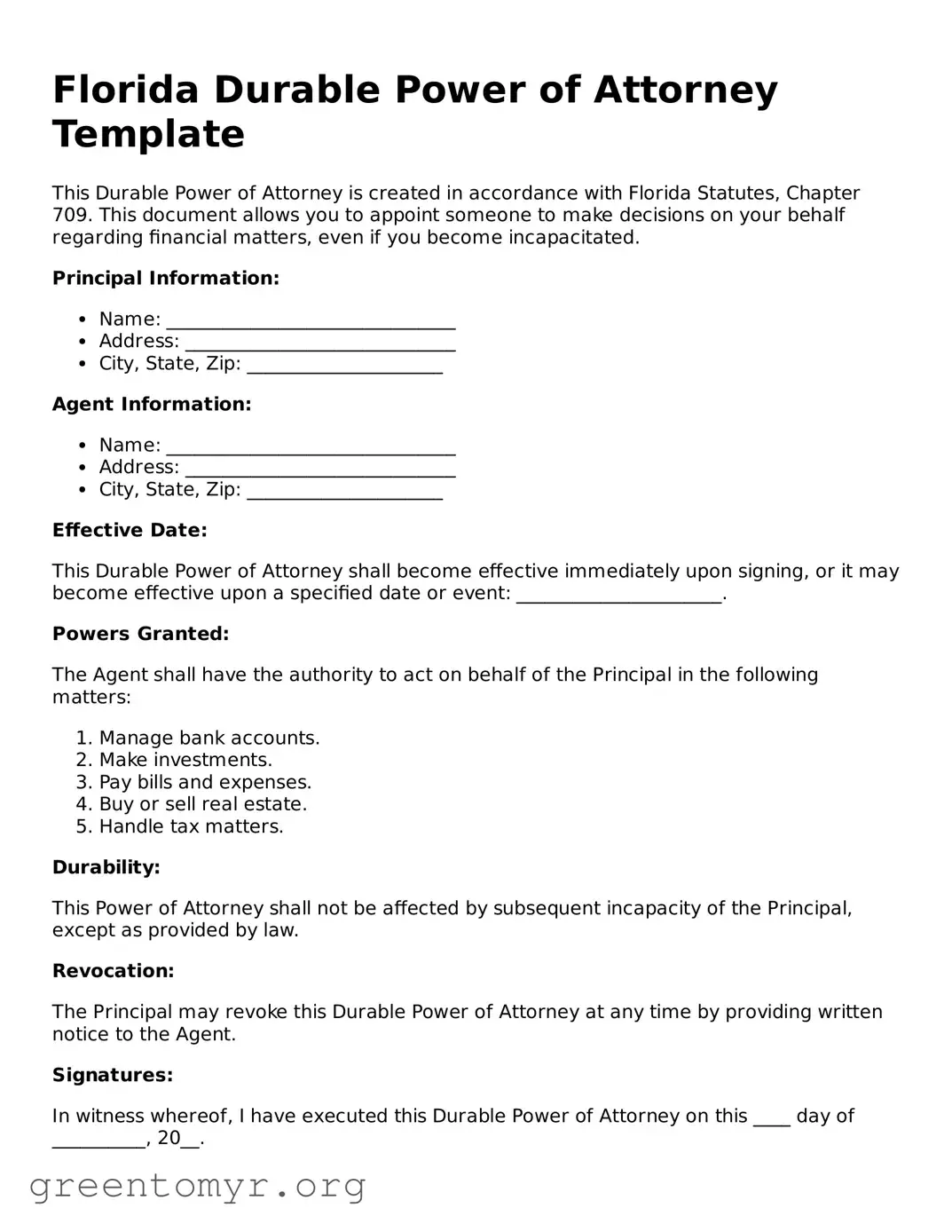
In Florida, a Durable Power of Attorney is a crucial legal tool that allows individuals to appoint someone they trust to manage their financial and legal affairs. This form remains effective even if the person who created it becomes incapacitated, making it a vital part of long-term planning. By designating an agent, you can ensure that your financial matters are handled according to your wishes, whether it’s paying bills, managing investments, or making important decisions on your behalf. The Durable Power of Attorney form outlines the specific powers granted to the agent, which can be broad or limited based on your preferences. It’s important to choose someone who understands your values and will act in your best interests. Additionally, the form must be signed in accordance with Florida law, which includes witnessing and notarization requirements. Understanding these key aspects can help you navigate the process of creating a Durable Power of Attorney, providing peace of mind for both you and your loved ones.
Florida Durable Power of Attorney Template
This Durable Power of Attorney is created in accordance with Florida Statutes, Chapter 709. This document allows you to appoint someone to make decisions on your behalf regarding financial matters, even if you become incapacitated.
Principal Information:
Agent Information:
Effective Date:
This Durable Power of Attorney shall become effective immediately upon signing, or it may become effective upon a specified date or event: ______________________.
Powers Granted:
The Agent shall have the authority to act on behalf of the Principal in the following matters:
Durability:
This Power of Attorney shall not be affected by subsequent incapacity of the Principal, except as provided by law.
Revocation:
The Principal may revoke this Durable Power of Attorney at any time by providing written notice to the Agent.
Signatures:
In witness whereof, I have executed this Durable Power of Attorney on this ____ day of __________, 20__.
Principal Signature: ____________________________
Witness Signature: _____________________________
Witness Signature: _____________________________
Notary Public:
State of Florida
County of _____________________________
On this ____ day of __________, 20__, before me, a Notary Public, personally appeared ____________________________, known to me to be the person described in and who executed the foregoing instrument.
Notary Signature: _____________________________
My Commission Expires: ______________________
| Fact Name | Description |
|---|---|
| Definition | A Durable Power of Attorney allows one person to appoint another to make financial decisions on their behalf, even if they become incapacitated. |
| Governing Law | The Florida Durable Power of Attorney is governed by Florida Statutes, Chapter 709. |
| Durability | This form remains effective even if the principal becomes mentally or physically incapacitated. |
| Revocation | The principal can revoke the Durable Power of Attorney at any time, as long as they are competent to do so. |
| Signing Requirements | The form must be signed by the principal and witnessed by two individuals or notarized for it to be valid. |
After obtaining the Florida Durable Power of Attorney form, you will need to fill it out accurately to ensure it reflects your wishes. Follow the steps below to complete the form properly.
Once the form is completed, keep it in a safe place and provide copies to your agent and any relevant parties. This ensures that your wishes are known and can be followed when necessary.
A Florida Durable Power of Attorney is a legal document that allows an individual, known as the principal, to appoint another person, called the agent or attorney-in-fact, to make decisions on their behalf. This document remains effective even if the principal becomes incapacitated. It is an important tool for managing finances and making health care decisions when the principal is unable to do so.
The powers granted can vary widely, depending on the principal's needs. Common powers include:
It is crucial for the principal to specify which powers they wish to grant to their agent, ensuring clarity and alignment with their wishes.
To create a Durable Power of Attorney in Florida, follow these steps:
It is advisable to consult with a legal professional to ensure that the document meets all legal requirements and accurately reflects your intentions.
Yes, a Durable Power of Attorney can be revoked at any time as long as the principal is competent. To revoke the document, the principal should create a written revocation notice and notify the agent. It is also recommended to inform any institutions or individuals that may have relied on the original document. This action ensures that the agent no longer has authority to act on the principal's behalf.
Filling out a Florida Durable Power of Attorney form can be a straightforward process, but many people make common mistakes that can lead to complications later. One frequent error is not specifying the powers granted. Individuals often assume that general language suffices, but being clear about the specific powers you want to grant is essential. This clarity helps avoid confusion and ensures that your agent can act on your behalf as intended.
Another mistake involves failing to date the document. A Durable Power of Attorney must be dated to be valid. Without a date, the document may be challenged, and its enforceability could be questioned. It's a simple step that many overlook, yet it is crucial for the legality of the form.
Many people also forget to sign the form in front of a notary public. In Florida, notarization is a requirement for the Durable Power of Attorney to be valid. Skipping this step can render the document ineffective, leaving your agent without the authority to act on your behalf when needed.
In addition, individuals often neglect to discuss their decisions with their chosen agent. This oversight can lead to misunderstandings about the agent's responsibilities and the principal's wishes. Open communication ensures that both parties are on the same page and can help prevent disputes later on.
Another common error is not considering alternate agents. Life is unpredictable, and your first choice may not always be available when needed. Failing to name an alternate can create complications if the primary agent is unable or unwilling to serve.
Some people also overlook the importance of reviewing and updating the document regularly. Life changes, such as marriage, divorce, or the birth of a child, can affect your choices. Keeping the Durable Power of Attorney current ensures that it reflects your wishes and circumstances.
Lastly, many individuals do not seek legal advice when filling out the form. While it may seem straightforward, consulting with an attorney can provide valuable insights. A legal expert can help clarify any questions and ensure that the document meets all legal requirements, ultimately protecting your interests.
When creating a Florida Durable Power of Attorney, it's essential to consider additional forms and documents that may complement your estate planning. Each of these documents serves a specific purpose and can help ensure your wishes are honored in various situations. Below is a list of commonly used documents that work well alongside the Durable Power of Attorney.
Considering these documents when establishing your Durable Power of Attorney can provide clarity and ensure that your wishes are followed. Each form plays a vital role in comprehensive planning, helping to protect your interests and those of your loved ones.
The Durable Power of Attorney (DPOA) is a significant legal document that grants someone the authority to make decisions on behalf of another person, particularly in matters related to financial and healthcare decisions. Several other documents serve similar purposes, each with its unique focus and implications. Here are four documents that share similarities with the Durable Power of Attorney:
When filling out the Florida Durable Power of Attorney form, it is essential to approach the task with care and attention. This document grants someone the authority to act on your behalf in financial matters. Here are some important dos and don’ts to keep in mind:
When it comes to the Florida Durable Power of Attorney (DPOA), there are several misconceptions that people often have. Understanding these can help you make informed decisions about your legal and financial matters. Here’s a list of common misconceptions:
By understanding these misconceptions, you can better navigate the complexities of a Durable Power of Attorney in Florida. It’s always wise to consult with a legal professional to ensure your documents are set up correctly and reflect your wishes.
When filling out and using the Florida Durable Power of Attorney form, keep these key takeaways in mind: