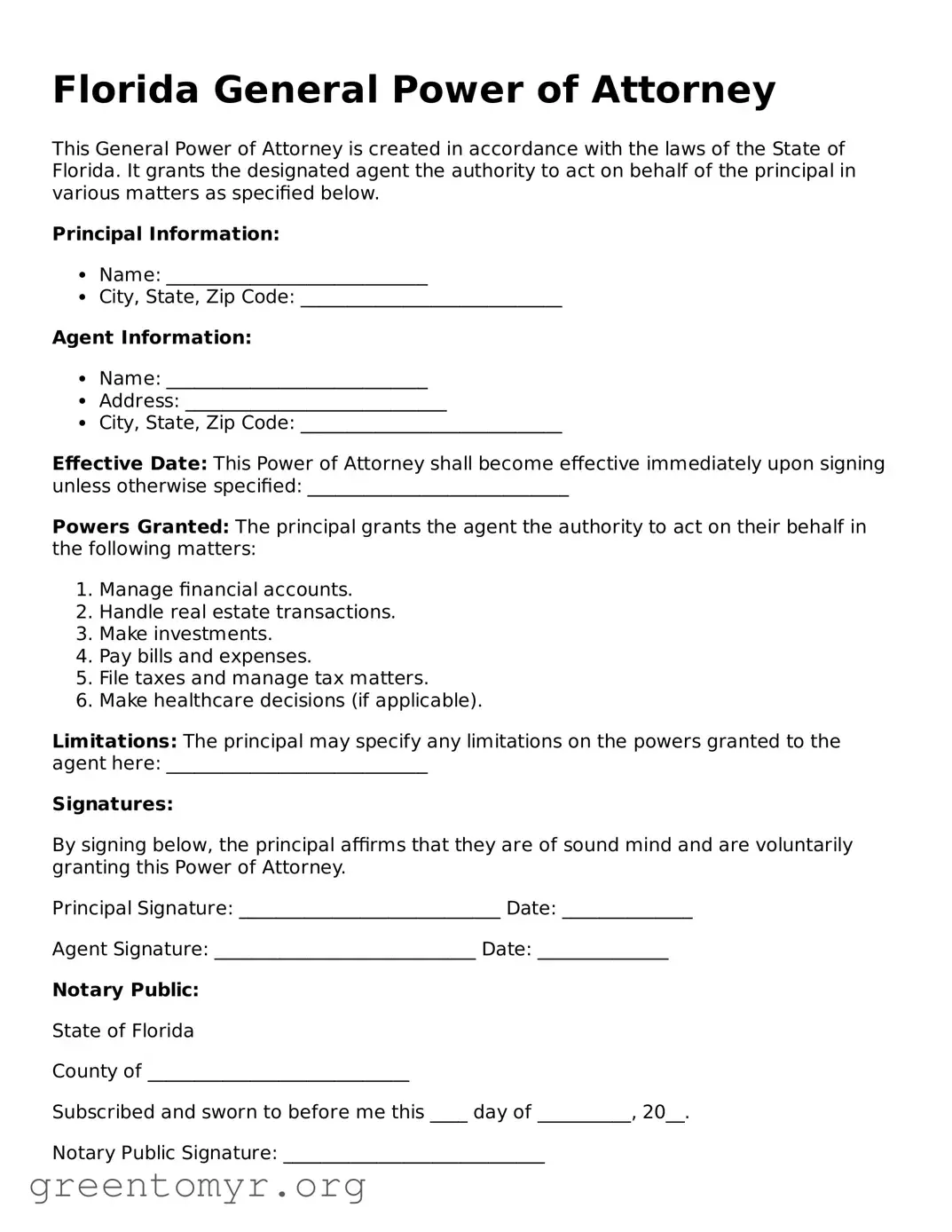
In Florida, the General Power of Attorney form serves as a crucial legal document that allows individuals to designate someone they trust to manage their financial and legal affairs. This form empowers the appointed agent to act on behalf of the principal in various matters, including handling bank transactions, signing contracts, and managing real estate. It is essential for ensuring that personal interests are safeguarded, especially in situations where the principal may become incapacitated or unavailable. The General Power of Attorney can be tailored to fit specific needs, whether for a limited duration or for a broader range of responsibilities. Additionally, it can be revoked or modified at any time, providing flexibility and control to the principal. Understanding the implications and requirements of this form is vital for anyone considering this important step in planning for the future.
Florida General Power of Attorney
This General Power of Attorney is created in accordance with the laws of the State of Florida. It grants the designated agent the authority to act on behalf of the principal in various matters as specified below.
Principal Information:
Agent Information:
Effective Date: This Power of Attorney shall become effective immediately upon signing unless otherwise specified: ____________________________
Powers Granted: The principal grants the agent the authority to act on their behalf in the following matters:
Limitations: The principal may specify any limitations on the powers granted to the agent here: ____________________________
Signatures:
By signing below, the principal affirms that they are of sound mind and are voluntarily granting this Power of Attorney.
Principal Signature: ____________________________ Date: ______________
Agent Signature: ____________________________ Date: ______________
Notary Public:
State of Florida
County of ____________________________
Subscribed and sworn to before me this ____ day of __________, 20__.
Notary Public Signature: ____________________________
My Commission Expires: ______________
| Fact Name | Description |
|---|---|
| Definition | A Florida General Power of Attorney form allows an individual to designate another person to act on their behalf in financial and legal matters. |
| Governing Law | This form is governed by Florida Statutes, Chapter 709, which outlines the powers and limitations of a power of attorney. |
| Durability | The Florida General Power of Attorney can be made durable, meaning it remains effective even if the principal becomes incapacitated. |
| Agent's Authority | The agent can perform a variety of tasks, including managing bank accounts, paying bills, and handling real estate transactions. |
| Revocation | The principal can revoke the power of attorney at any time, provided they are mentally competent to do so. |
| Witness Requirement | The document must be signed in the presence of two witnesses who are not related to the principal or the agent. |
| Notarization | While notarization is not required for the validity of the form, it is recommended to enhance its acceptance by third parties. |
| Limitations | The agent cannot make health care decisions unless specifically granted that authority in a separate health care power of attorney. |
| Expiration | The power of attorney remains in effect until revoked by the principal, or upon the principal's death. |
Filling out the Florida General Power of Attorney form is an important step in designating someone to manage your financial and legal affairs. After completing the form, you will need to ensure it is signed, witnessed, and notarized to be legally valid. Follow the steps below to fill out the form accurately.
Once the form is completed, witnessed, and notarized, it will be ready for use. Keep a copy for your records and provide copies to your agent and any institutions that may need it.
A General Power of Attorney (GPOA) is a legal document that allows one person, known as the principal, to grant another person, called the agent or attorney-in-fact, the authority to make decisions and take actions on their behalf. This authority can cover a wide range of matters, including financial transactions, property management, and legal decisions. It is important to note that a GPOA becomes effective immediately upon signing, unless specified otherwise.
In Florida, any adult who is of sound mind can serve as a principal. This means they are capable of understanding the nature and consequences of their decisions. The agent can also be any adult, but it is advisable to choose someone trustworthy, as they will have significant power over the principal’s affairs. This could be a family member, friend, or a professional, such as an attorney.
The powers granted in a General Power of Attorney can be broad or limited. Common powers include:
It is crucial to clearly outline the specific powers in the document to avoid any confusion later on.
Yes, in Florida, a General Power of Attorney must be signed in the presence of a notary public. This ensures that the document is valid and that the principal is acting voluntarily and understands the implications of their decision. Additionally, it is advisable to have witnesses sign the document, although this is not a legal requirement.
Absolutely. A principal can revoke a General Power of Attorney at any time, as long as they are mentally competent. To revoke the document, the principal should create a written revocation and notify the agent and any institutions or individuals that relied on the GPOA. This helps prevent any future misunderstandings.
If the principal becomes incapacitated, a General Power of Attorney typically ceases to be effective. However, if the principal wishes for the agent to continue making decisions during incapacitation, they should consider a Durable Power of Attorney. A Durable Power of Attorney remains in effect even if the principal is no longer able to make decisions for themselves.
Generally, an agent is not personally liable for decisions made on behalf of the principal, as long as they act within the authority granted and in the best interests of the principal. However, if the agent acts outside their authority, engages in self-dealing, or fails to act in good faith, they may be held accountable for any resulting damages.
A General Power of Attorney executed in Florida is generally recognized in other states, but there may be variations in state laws. It is advisable to check the specific requirements of the state where the GPOA will be used. Additionally, some states have their own forms or requirements that may need to be fulfilled.
Florida General Power of Attorney forms can be obtained from various sources, including legal stationery stores, online legal services, or through an attorney. It is important to ensure that the form complies with Florida law and meets the specific needs of the principal.
Filling out a Florida General Power of Attorney form can be a straightforward process, but many people make critical mistakes that can lead to complications down the road. One common error is failing to specify the powers granted. Without clear language outlining what the agent can and cannot do, there can be confusion and disputes later. It's essential to be as detailed as possible about the authority being granted.
Another mistake is neglecting to date the document. A General Power of Attorney is only valid if it is properly dated. If the form lacks a date, it may be challenged in the future, leading to potential legal issues. Always ensure that you include the date when the form is signed.
People often overlook the need for witnesses or notarization. In Florida, a General Power of Attorney must be signed in the presence of two witnesses and a notary public. Failing to meet these requirements can render the document invalid. Make sure to follow the state's guidelines for execution to ensure the document holds up in court.
Additionally, some individuals forget to communicate their intentions with the agent they are appointing. It’s crucial to discuss the responsibilities and powers you are granting. If the agent is unaware of their role, they may not act in your best interests when the time comes.
Another common error is not considering the potential for revocation. People often assume that a General Power of Attorney remains in effect indefinitely. However, circumstances can change. It’s important to understand how to revoke the power when necessary and to communicate that revocation to all relevant parties.
Lastly, many individuals do not keep copies of the signed document. Once the General Power of Attorney is executed, it’s vital to provide copies to the agent and any financial institutions or healthcare providers that may need it. Keeping track of the document ensures that it can be easily accessed when needed.
When preparing a Florida General Power of Attorney, it is often beneficial to consider additional documents that complement its use. These forms can help clarify intentions, provide additional authority, or address specific needs. Below is a list of commonly used forms and documents that may accompany a General Power of Attorney in Florida.
These documents provide a comprehensive framework for managing personal, financial, and medical decisions. By considering these forms, individuals can ensure that their wishes are respected and that their affairs are managed effectively in various circumstances.
The General Power of Attorney form shares similarities with several other legal documents. Each serves a specific purpose related to authority and decision-making. Here’s a list of eight documents that are similar:
When filling out the Florida General Power of Attorney form, it is essential to approach the task with care. Here are some important dos and don'ts to consider:
When it comes to the Florida General Power of Attorney form, there are several misconceptions that can lead to confusion. Here are five common misunderstandings:
Many people believe that a General Power of Attorney grants unrestricted authority. In reality, the powers can be tailored to fit your specific needs. You can specify what decisions your agent can make on your behalf.
This is a common myth. A General Power of Attorney is only valid while you are alive. Once you pass away, the authority granted to your agent ends, and your estate will be managed according to your will or state laws.
Some people think that once a General Power of Attorney is signed, it cannot be changed or revoked. However, as long as you are mentally competent, you can revoke or modify it at any time.
While notarization is recommended for a General Power of Attorney in Florida, it is not strictly required. However, having it notarized can help ensure that it is accepted by banks and other institutions.
Many people assume that a General Power of Attorney is limited to financial decisions. In fact, it can also cover health care decisions and other personal matters, depending on how you draft it.
Filling out and using the Florida General Power of Attorney form requires careful attention to detail. Here are some key takeaways to consider: