Content Navigation

In Florida, families who choose to homeschool their children must take an important first step by submitting a Homeschool Letter of Intent. This form serves as a formal notification to the local school district that parents are opting to educate their children at home. It is essential to include specific details in this letter, such as the names and ages of the children being homeschooled, as well as the educational curriculum that will be used. Additionally, the form must be submitted within a certain timeframe, typically within 30 days of beginning the homeschooling process. Understanding the requirements and implications of this letter is crucial for parents to ensure compliance with state regulations while providing their children with a tailored educational experience. By taking this step, families set the foundation for their homeschooling journey, paving the way for a personalized learning environment that aligns with their values and educational goals.

Florida Homeschool Letter of Intent Example

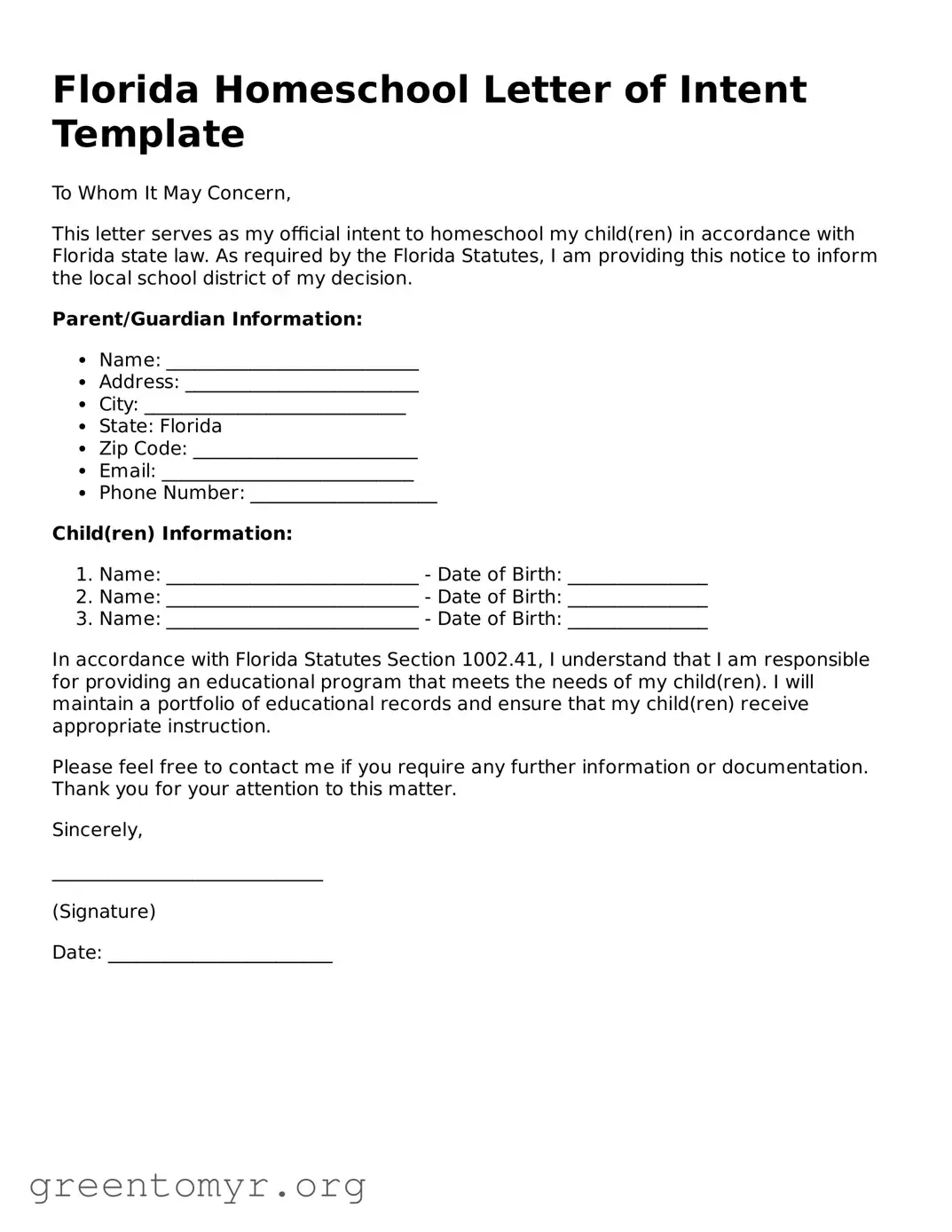
Florida Homeschool Letter of Intent Template

To Whom It May Concern,

This letter serves as my official intent to homeschool my child(ren) in accordance with Florida state law. As required by the Florida Statutes, I am providing this notice to inform the local school district of my decision.

Parent/Guardian Information:

  • Name: ___________________________
  • Address: _________________________
  • City: ____________________________
  • State: Florida
  • Zip Code: ________________________
  • Email: ___________________________
  • Phone Number: ____________________

Child(ren) Information:

  1. Name: ___________________________ - Date of Birth: _______________
  2. Name: ___________________________ - Date of Birth: _______________
  3. Name: ___________________________ - Date of Birth: _______________

In accordance with Florida Statutes Section 1002.41, I understand that I am responsible for providing an educational program that meets the needs of my child(ren). I will maintain a portfolio of educational records and ensure that my child(ren) receive appropriate instruction.

Please feel free to contact me if you require any further information or documentation. Thank you for your attention to this matter.

Sincerely,

_____________________________

(Signature)

Date: ________________________

PDF Form Features

Fact Name Details
Governing Law The Florida Statutes, Section 1002.41 governs homeschooling in Florida.
Purpose The Letter of Intent informs the school district of your intent to homeschool your child.
Submission Timeline It must be submitted within 30 days of beginning your homeschool program.
Required Information The form requires the child's name, age, and address, along with the parent's information.
Format The form can be submitted in paper or electronic format, depending on the school district's preferences.
Annual Requirement Once submitted, the Letter of Intent does not need to be resubmitted each year unless there is a change in the child's status.
Record Keeping Parents must keep a copy of the Letter of Intent for their records.
Compliance Failure to submit the Letter of Intent may result in the child being considered truant.

Guide to Using Florida Homeschool Letter of Intent

Completing the Florida Homeschool Letter of Intent form is a crucial step for families choosing to educate their children at home. Once you have filled out the form, you will need to submit it to the appropriate school district. This initiates the formal process of homeschooling and ensures compliance with state regulations.

  1. Obtain the Florida Homeschool Letter of Intent form. You can find it on your local school district's website or request a copy directly from the district office.
  2. Fill in your name and address at the top of the form. Make sure to provide accurate and current information.
  3. List the names and ages of all children you intend to homeschool. This information is essential for the district's records.
  4. Indicate the educational program you plan to use. You may choose a curriculum, online program, or a combination of methods.
  5. Sign and date the form. Your signature confirms your intent to homeschool your children.
  6. Submit the completed form to your local school district. Check their guidelines for submission methods, whether by mail, email, or in person.

After submission, keep a copy of the form for your records. You may need it for future reference or in case of any inquiries from the school district.

Get Answers on Florida Homeschool Letter of Intent

What is the Florida Homeschool Letter of Intent?

The Florida Homeschool Letter of Intent is a formal document that parents or guardians submit to their local school district to notify them of their intent to homeschool their child. This letter serves as an official declaration that you will be providing educational instruction outside of the traditional school system.

Who needs to submit the Letter of Intent?

Any parent or guardian who wishes to homeschool a child must submit the Letter of Intent. This requirement applies to children who are of compulsory school age in Florida, typically between the ages of 6 and 16. If you plan to homeschool your child during this period, you must file the letter with your school district.

When should I submit the Letter of Intent?

You should submit the Letter of Intent at least 30 days before you begin homeschooling. This gives the school district time to process your application. If you are withdrawing your child from public school, it’s best to submit the letter as soon as you make that decision to avoid any gaps in education.

What information is required in the Letter of Intent?

The Letter of Intent must include the following information:

  • Your name and address
  • Your child's name and age
  • The date you intend to begin homeschooling
  • A statement indicating that you are choosing to homeschool your child

Is there a specific format for the Letter of Intent?

While there is no official form mandated by the state, the letter should be clear and concise. You can write it in a simple format, ensuring that all required information is included. Many families find templates online that can help guide the structure, but you can also create your own.

What happens after I submit the Letter of Intent?

Once you submit the Letter of Intent, the school district will acknowledge receipt of your letter. After that, you are free to begin your homeschooling journey. However, be aware that you will need to comply with Florida's homeschooling laws, which may include submitting an annual evaluation of your child's progress.

Can I change my mind after submitting the Letter of Intent?

Yes, you can change your mind. If you decide to return your child to public school or change your homeschooling approach, you should notify the school district. It's a good idea to keep them informed to ensure a smooth transition, whether you're moving back to traditional schooling or making other educational arrangements.

Common mistakes

Completing the Florida Homeschool Letter of Intent form is a crucial step for parents wishing to educate their children at home. However, several common mistakes can lead to complications. One frequent error is failing to include all required information. The form requests specific details about the child, such as their name and age. Omitting any of these details can result in delays or rejection of the application.

Another common mistake is not submitting the form within the designated timeframe. Florida law requires that the Letter of Intent be filed within 30 days of the start of homeschooling. If parents miss this deadline, they may face penalties or be required to provide additional documentation. Timeliness is essential to ensure compliance with state regulations.

Some parents also overlook the importance of keeping a copy of the submitted form. Not retaining a copy can create challenges later if there are questions about the submission or if proof of intent is needed. It is advisable to maintain thorough records for future reference.

Lastly, misunderstanding the definition of "homeschool" can lead to issues. Some parents may mistakenly believe that the form is only necessary for children who are not enrolled in any school. In reality, the Letter of Intent is required for all children being homeschooled, regardless of their previous school status. Being aware of these nuances can help parents navigate the process more smoothly.

Documents used along the form

When families decide to homeschool in Florida, submitting the Homeschool Letter of Intent is just the first step. Several other forms and documents are often required to ensure compliance with state regulations and to facilitate the homeschooling process. Below are some essential documents that parents may need to consider.

  • Educational Plan: This document outlines the curriculum and educational goals for the school year. It details the subjects to be taught and the methods of instruction, ensuring that the educational needs of the child are met.
  • Portfolio of Student Work: A collection of the student’s work, which may include assignments, tests, and projects. This portfolio serves as a record of the student’s progress and learning outcomes throughout the year.
  • Annual Evaluation: Florida law requires an annual evaluation of the student’s progress. This can be conducted by a certified teacher or through standardized testing. The evaluation helps to assess whether the educational plan is effective and if the student is meeting academic standards.
  • Notice of Termination: If a family decides to discontinue homeschooling, they must submit a Notice of Termination to the local school district. This document formally indicates the end of the homeschooling program and ensures that the child’s educational status is updated.

These documents play a crucial role in the homeschooling journey, providing structure and accountability. By understanding and preparing these forms, families can create a successful educational experience tailored to their child's needs.

Similar forms

  • Withdrawal Letter: This document is used by parents to formally withdraw their child from public or private school. It notifies the school of the decision and outlines the intent to homeschool.
  • Educational Plan: Similar to the Homeschool Letter of Intent, this document details the curriculum and educational goals for the child. It serves as a roadmap for the homeschooling journey.
  • Attendance Record: This document tracks the days and hours of instruction. Like the Homeschool Letter of Intent, it is important for demonstrating compliance with state homeschooling laws.
  • Progress Report: This report summarizes the child's educational achievements over a set period. It can be submitted to authorities, similar to the intent letter, to show ongoing educational progress.
  • Curriculum Outline: This document provides a detailed overview of the subjects and materials to be used. It aligns with the goals stated in the Homeschool Letter of Intent.
  • Portfolio: A collection of a child's work and assessments, this document showcases their progress. It can support the claims made in the Homeschool Letter of Intent regarding educational outcomes.
  • Notification of Intent to Homeschool: In some states, this is a formal notice similar to the Homeschool Letter of Intent. It informs local authorities of the intent to homeschool.
  • Assessment Results: These results reflect the child's performance on standardized tests or evaluations. They can provide evidence of educational effectiveness, similar to the intent letter's purpose.
  • Affidavit of Homeschooling: This is a sworn statement affirming the intent to homeschool. Like the Homeschool Letter of Intent, it serves as a formal declaration of educational choice.

Dos and Don'ts

Filling out the Florida Homeschool Letter of Intent form can be straightforward if you follow some essential guidelines. Here’s a list of things to keep in mind:

  • Do ensure that you include all required information, such as your name, address, and the names of your children.
  • Do submit the form to your local school district office in a timely manner.
  • Do keep a copy of the submitted form for your records.
  • Do check for any specific requirements or additional documentation your district may need.
  • Do sign and date the form before submission.
  • Don't forget to update the form if your circumstances change, such as moving to a new address.
  • Don't submit the form late; be mindful of deadlines to avoid issues.
  • Don't leave any sections blank; incomplete forms may be rejected.
  • Don't assume that verbal submissions are acceptable; always provide a written letter of intent.
  • Don't hesitate to reach out to your local school district if you have questions or need assistance.

Following these guidelines will help ensure a smooth process as you embark on your homeschooling journey in Florida.

Misconceptions

Many individuals hold misconceptions about the Florida Homeschool Letter of Intent form. Understanding the truth behind these beliefs can help parents navigate the homeschooling process more effectively. Below is a list of common misconceptions along with clarifications.

  1. Homeschooling in Florida is illegal without a Letter of Intent. Many people believe that homeschooling is prohibited unless a Letter of Intent is submitted. In reality, while the form is a necessary step for official registration, homeschooling can begin prior to its submission.
  2. All children must follow the same curriculum. Some assume that all homeschooling families must adhere to a standardized curriculum. In fact, parents have the freedom to choose educational materials and methods that best fit their child’s needs.
  3. The Letter of Intent must be submitted annually. There is a common belief that the Letter of Intent must be filed every year. However, once submitted, it remains valid until the family decides to discontinue homeschooling or enroll the child in a traditional school.
  4. Parents must have teaching credentials to homeschool. Many think that only certified teachers can homeschool their children. This is not true; Florida law does not require parents to have formal teaching qualifications.
  5. Submitting the Letter of Intent guarantees state funding. Some believe that filing the Letter of Intent provides access to state funding or resources. In reality, Florida does not offer financial support for homeschooling families.
  6. Homeschooling is only for religious families. A misconception exists that homeschooling is primarily a choice made by religious families. In truth, families from diverse backgrounds and beliefs choose homeschooling for various reasons, including academic flexibility and personalized learning.
  7. Parents cannot change their educational approach once the Letter of Intent is filed. Some think that once the Letter of Intent is submitted, the chosen educational approach cannot be modified. However, families are free to adapt their methods and curriculum as needed throughout the homeschooling journey.
  8. Homeschooling requires extensive paperwork. There is a perception that homeschooling involves a significant amount of bureaucratic paperwork. While some documentation is necessary, the process is generally straightforward and manageable for most families.
  9. Children must be assessed every year. Many believe that annual assessments are mandatory for all homeschoolers. In Florida, assessments are only required for students in certain grades, and families can choose the type of assessment that best suits their situation.

Addressing these misconceptions can empower families to make informed decisions about their homeschooling journey in Florida.

Key takeaways

Filling out and using the Florida Homeschool Letter of Intent form is an important step for families choosing to educate their children at home. Here are some key takeaways to keep in mind:

  • The form must be submitted to your local school district within 30 days of beginning your homeschool program.
  • Include the full names and addresses of all children you intend to homeschool.
  • Provide a clear statement of your intent to homeschool. This can be a simple declaration.
  • Ensure that you sign and date the form before submission. An unsigned form may not be accepted.
  • Keep a copy of the submitted form for your records. This can be helpful for future reference.
  • Be aware that you may need to submit an annual evaluation of your child's progress to the school district.

Understanding these points can help streamline the process and ensure compliance with state regulations.