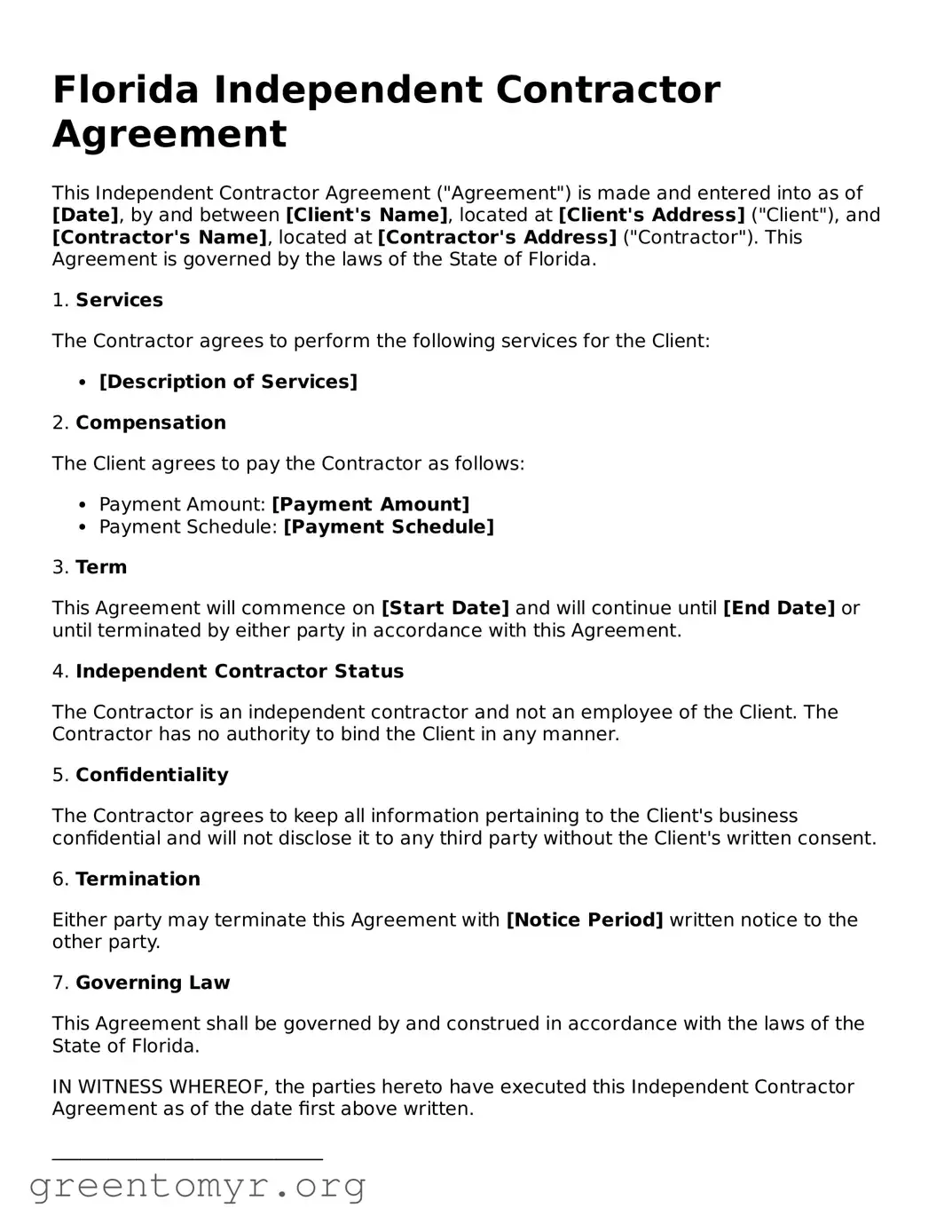
In Florida, the Independent Contractor Agreement form plays a crucial role in defining the relationship between businesses and their independent contractors. This document outlines key terms such as the scope of work, payment details, and the duration of the contract. It also clarifies the contractor's status, ensuring that both parties understand the implications of independent work, including tax responsibilities and liability issues. Additionally, the agreement often includes confidentiality clauses and intellectual property rights, protecting the interests of the hiring party while granting the contractor the freedom to operate independently. A well-structured Independent Contractor Agreement not only fosters clear communication but also minimizes potential disputes, making it an essential tool for businesses and contractors alike.
Florida Independent Contractor Agreement
This Independent Contractor Agreement ("Agreement") is made and entered into as of [Date], by and between [Client's Name], located at [Client's Address] ("Client"), and [Contractor's Name], located at [Contractor's Address] ("Contractor"). This Agreement is governed by the laws of the State of Florida.
1. Services
The Contractor agrees to perform the following services for the Client:
2. Compensation
The Client agrees to pay the Contractor as follows:
3. Term
This Agreement will commence on [Start Date] and will continue until [End Date] or until terminated by either party in accordance with this Agreement.
4. Independent Contractor Status
The Contractor is an independent contractor and not an employee of the Client. The Contractor has no authority to bind the Client in any manner.
5. Confidentiality
The Contractor agrees to keep all information pertaining to the Client's business confidential and will not disclose it to any third party without the Client's written consent.
6. Termination
Either party may terminate this Agreement with [Notice Period] written notice to the other party.
7. Governing Law
This Agreement shall be governed by and construed in accordance with the laws of the State of Florida.
IN WITNESS WHEREOF, the parties hereto have executed this Independent Contractor Agreement as of the date first above written.
_____________________________
[Client's Name]
Client
_____________________________
[Contractor's Name]
Contractor
| Fact Name | Details |
|---|---|
| Definition | The Florida Independent Contractor Agreement outlines the relationship between a contractor and a client, establishing the terms of their work arrangement. |
| Governing Law | This agreement is governed by Florida state law, specifically under the Florida Statutes. |
| Key Components | Essential elements include scope of work, payment terms, and duration of the contract. |
| Independent Status | The agreement clarifies that the contractor operates independently and is not an employee of the client. |
| Liability | Typically, the contractor assumes liability for their own actions while performing contracted work. |
| Termination Clause | A termination clause is often included, detailing how either party can end the agreement. |
| Dispute Resolution | The agreement may specify methods for resolving disputes, such as mediation or arbitration. |
Filling out the Florida Independent Contractor Agreement form is a straightforward process. This form outlines the terms between the contractor and the hiring party. To ensure accuracy and clarity, follow these steps carefully.
A Florida Independent Contractor Agreement is a legal document that outlines the terms and conditions between a business and an independent contractor. It defines the scope of work, payment terms, and other essential details to ensure both parties understand their rights and obligations.
This agreement is crucial for several reasons:
Key elements of a Florida Independent Contractor Agreement typically include:
An Independent Contractor Agreement differs from an employee contract primarily in the nature of the relationship. Independent contractors operate their own businesses and have more control over how they complete their work. Employees, on the other hand, work under the direction of an employer and are entitled to benefits like health insurance and unemployment compensation.
While verbal agreements can be legally binding, having a written agreement is strongly recommended. A written document provides clarity and serves as evidence in case of disputes. It helps ensure that both parties are on the same page regarding the terms of the engagement.
Yes, the agreement can be modified after it is signed, but both parties must agree to the changes. It is best to document any modifications in writing to avoid misunderstandings later. This can be done through an amendment or a new agreement that outlines the changes.
If a dispute arises, the first step is to refer to the terms outlined in the agreement. Many agreements include a dispute resolution clause, which may require mediation or arbitration before pursuing legal action. If necessary, either party may seek legal remedies based on the agreement's terms.
Templates for Florida Independent Contractor Agreements can be found online through legal websites, or you may consult with an attorney for a customized agreement. Ensure that any template you use complies with Florida law and meets your specific needs.
When individuals engage in business relationships as independent contractors in Florida, they often rely on the Florida Independent Contractor Agreement form. However, errors in completing this document can lead to misunderstandings and legal complications. One common mistake is failing to clearly define the scope of work. Without a precise description of the services to be provided, both parties may have different expectations, which can result in disputes down the line.
Another frequent error involves neglecting to specify payment terms. It is essential to outline how much the contractor will be paid, when payments will be made, and the method of payment. Ambiguity in these areas can lead to frustrations and potential financial disagreements. Parties should ensure that the payment structure is explicitly stated to avoid confusion.
Additionally, many individuals overlook the importance of including a termination clause. This clause outlines the conditions under which either party can terminate the agreement. Without it, one party may feel trapped in an unfavorable situation, leading to resentment and conflict. A well-defined termination clause provides clarity and protects both parties' interests.
People also often forget to address liability and insurance requirements. An independent contractor should understand their responsibilities regarding liability for their work. If this aspect is not covered, it may leave one party exposed to unexpected risks. Including insurance requirements can safeguard both the contractor and the client from potential legal issues.
Finally, a common mistake is the failure to sign and date the agreement. An unsigned document may not hold up in court if disputes arise. Both parties must ensure that they have signed and dated the agreement to confirm their acceptance of the terms. This simple step is crucial in establishing a legally binding contract.
When entering into a working relationship with an independent contractor in Florida, several additional forms and documents may be necessary to ensure clarity and compliance. These documents help outline the terms of the agreement, protect both parties, and provide a framework for the work to be done. Below is a list of commonly used forms alongside the Florida Independent Contractor Agreement.
Having these documents prepared and understood can help facilitate a smooth working relationship between the contractor and the hiring party. Each form serves a distinct purpose, ensuring that both parties are protected and that expectations are clearly defined. It is always advisable to review these documents carefully before entering into any agreement.
When filling out the Florida Independent Contractor Agreement form, there are important considerations to keep in mind. Below is a list of ten things you should and shouldn't do to ensure the form is completed correctly.
When it comes to the Florida Independent Contractor Agreement, many people hold misconceptions that can lead to confusion or missteps in business dealings. Here are nine common misconceptions explained:
This is true in many cases, but it’s important to note that some independent contractors may negotiate benefits as part of their agreement. Always clarify what is included in the contract.
While most independent contractors operate as self-employed individuals, some may work through a corporation or LLC. The structure of their business can affect their tax obligations and liabilities.
Although independent contractors have more control over their work, they can still be terminated if they fail to meet the terms of their contract or if the client decides to end the agreement.
While verbal agreements can be legally binding, having a written contract is crucial. It provides clarity and can help prevent disputes down the line.
While independent contractors do pay self-employment taxes, clients may also have certain tax obligations, especially if they misclassify an employee as a contractor.
This is misleading. While independent contractors may not have the same protections as employees, they still have rights under contract law and can seek legal remedies for breaches.
Each agreement can vary significantly based on the nature of the work, the relationship between the parties, and specific terms negotiated. It's essential to tailor the agreement to fit the situation.
This is a common misconception. Independent contractors have the freedom to negotiate their rates and terms, making it essential to discuss expectations upfront.
Contracts can be amended if both parties agree to the changes. It’s important to document any modifications in writing to avoid misunderstandings.
Understanding these misconceptions can help both clients and independent contractors navigate their agreements more effectively. Clear communication and a well-drafted contract are key to a successful working relationship.
When filling out and using the Florida Independent Contractor Agreement form, it is important to keep several key points in mind. Understanding these aspects can help ensure that the agreement is both effective and legally sound.