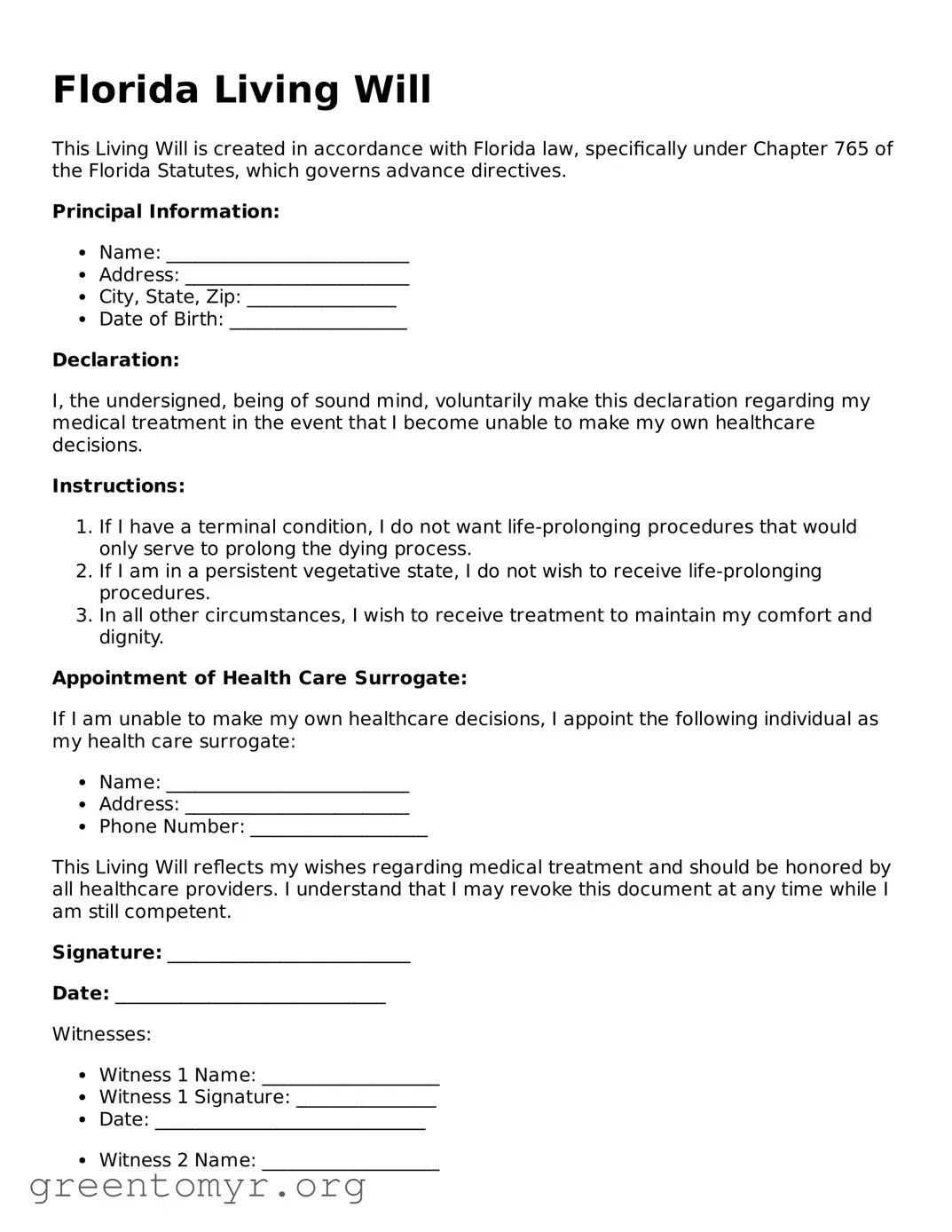
In Florida, the Living Will form plays a crucial role in ensuring that individuals can express their wishes regarding medical treatment in the event they become unable to communicate those wishes themselves. This legal document allows people to outline their preferences for end-of-life care, addressing scenarios such as terminal illness or irreversible coma. By clearly stating whether they wish to receive life-sustaining treatments or prefer to forgo them, individuals can relieve their loved ones from the burden of making difficult decisions during emotionally charged times. The form also emphasizes the importance of having witnesses to validate the document, ensuring that it reflects the individual's true intentions. As a vital part of advance healthcare planning, the Living Will empowers individuals to take control of their medical decisions, fostering peace of mind for both themselves and their families.
Florida Living Will
This Living Will is created in accordance with Florida law, specifically under Chapter 765 of the Florida Statutes, which governs advance directives.
Principal Information:
Declaration:
I, the undersigned, being of sound mind, voluntarily make this declaration regarding my medical treatment in the event that I become unable to make my own healthcare decisions.
Instructions:
Appointment of Health Care Surrogate:
If I am unable to make my own healthcare decisions, I appoint the following individual as my health care surrogate:
This Living Will reflects my wishes regarding medical treatment and should be honored by all healthcare providers. I understand that I may revoke this document at any time while I am still competent.
Signature: __________________________
Date: _____________________________
Witnesses:
This document must be signed in the presence of two witnesses who are not related to me by blood or marriage, and who will not benefit from my estate.
| Fact Name | Details |
|---|---|
| Purpose | The Florida Living Will form allows individuals to express their wishes regarding medical treatment in the event they become unable to communicate their preferences. |
| Governing Law | The form is governed by Florida Statutes, Chapter 765, which outlines the requirements and procedures for advance directives. |
| Requirements | The form must be signed by the individual and witnessed by two adults who are not related to the individual or beneficiaries of their estate. |
| Revocation | Individuals can revoke their Living Will at any time, provided they communicate their decision to healthcare providers and any relevant parties. |
Filling out the Florida Living Will form is an important step in expressing your healthcare wishes. Once completed, this document will need to be signed and witnessed to ensure its validity. Follow these steps carefully to complete the form accurately.
A Florida Living Will is a legal document that allows individuals to express their wishes regarding medical treatment in the event they become unable to communicate their preferences. It specifically addresses end-of-life care and outlines the types of medical interventions an individual does or does not want, such as life-sustaining treatments.
Any competent adult who is at least 18 years old can create a Living Will in Florida. It is essential that the individual understands the implications of the document and can make informed decisions about their medical care.
To create a Living Will in Florida, follow these steps:
Your Living Will should include:
Yes, you can change or revoke your Living Will at any time, as long as you are competent to do so. To revoke the document, you can destroy it, create a new Living Will, or inform your healthcare provider and witnesses of your decision to revoke it. It is advisable to inform those who have copies of your previous Living Will about the changes.
No, a Living Will and a Durable Power of Attorney for Healthcare are distinct documents. A Living Will specifies your wishes regarding medical treatment, while a Durable Power of Attorney for Healthcare designates an individual to make healthcare decisions on your behalf if you are unable to do so. Both documents can work together to ensure your healthcare preferences are honored.
Store your Living Will in a safe but accessible place. Inform your family members, healthcare providers, and any designated healthcare surrogates about its location. Consider keeping a copy in your medical records or with your primary care physician to ensure it is readily available when needed.
Filling out a Florida Living Will form can be a straightforward process, but many people make common mistakes that can lead to confusion or complications later on. One frequent error is not clearly stating their wishes. It's essential to be specific about the types of medical treatments you do or do not want. Vague language can lead to misinterpretation by healthcare providers.
Another mistake is forgetting to date the document. A Living Will should always have a date on it. Without a date, it may be difficult to determine if the form is current or if there are more recent documents that should be considered. This can create unnecessary challenges for your loved ones during a stressful time.
Many individuals also overlook the importance of signing the form in front of witnesses. Florida law requires that your Living Will be signed by two witnesses who are not related to you and who will not benefit from your estate. Failing to have the proper witnesses can render the document invalid.
People often forget to update their Living Will as their circumstances change. Life events, such as marriage, divorce, or changes in health, can impact your preferences. Regularly reviewing and updating your Living Will ensures that it reflects your current wishes.
Another common mistake is not discussing your Living Will with family members. It's crucial that your loved ones understand your wishes. Having open conversations can prevent misunderstandings and ensure that your desires are honored when the time comes.
Some individuals mistakenly assume that a Living Will is the same as a Durable Power of Attorney for Healthcare. While both documents are important, they serve different purposes. A Living Will outlines your medical preferences, while a Durable Power of Attorney designates someone to make decisions on your behalf if you are unable to do so.
People sometimes neglect to consider the language used in the form. Legal terms can be confusing, and using complicated language can lead to misinterpretation. It’s best to use clear and simple terms that accurately convey your wishes.
Finally, failing to keep the Living Will in a safe yet accessible place can be a significant oversight. It’s important to ensure that your healthcare provider and family members know where to find it when needed. Consider giving copies to those who might need to refer to it in an emergency.
When preparing a Florida Living Will, it is important to consider several other documents that can complement your advance care planning. These documents serve to clarify your wishes regarding medical treatment and ensure that your preferences are respected in various situations. Below is a list of commonly used forms that you may find beneficial.
Incorporating these documents into your advance care planning can provide peace of mind for you and your loved ones. Each form plays a unique role in ensuring that your healthcare preferences are understood and respected, allowing you to focus on what truly matters.
A Living Will form is similar to several other documents that deal with health care decisions and end-of-life preferences. Here’s a list of those documents:
When filling out the Florida Living Will form, it's important to ensure that your wishes are clearly expressed and legally recognized. Here are some helpful tips on what to do and what to avoid.
By following these guidelines, you can help ensure that your Living Will reflects your wishes and provides clarity for your healthcare providers and family members.
Understanding the Florida Living Will form is essential for ensuring that your healthcare wishes are honored. However, several misconceptions can lead to confusion. Below are some common misconceptions about the Florida Living Will form, along with clarifications.
A Living Will specifically addresses healthcare decisions, while a Last Will and Testament deals with the distribution of assets after death.
A Living Will can apply to any situation where a person is unable to communicate their wishes regarding medical treatment, not just terminal conditions.
While legal assistance can be helpful, individuals can prepare a Living Will without a lawyer, provided they follow Florida's legal requirements.
You can update or revoke a Living Will at any time, as long as you are mentally competent to do so.
Anyone, regardless of age, can benefit from having a Living Will to ensure their healthcare preferences are respected.
A properly executed Living Will is legally binding in Florida, meaning healthcare providers are required to follow the outlined wishes.
Individuals can have multiple copies of their Living Will, and it's advisable to share them with family members and healthcare providers.
Addressing these misconceptions can help ensure that your healthcare preferences are clearly understood and respected. It is important to take the time to prepare a Living Will that accurately reflects your wishes.
When considering the Florida Living Will form, it is essential to understand its significance and the implications it carries for your healthcare decisions. Here are some key takeaways to keep in mind: