Content Navigation

In the state of Florida, couples facing the challenges of separation often turn to the Marital Separation Agreement form as a crucial tool for navigating their transition. This document serves as a comprehensive outline of the terms that both parties agree upon regarding their separation, addressing various important aspects of their marital relationship. Key components typically include the division of assets and debts, child custody arrangements, and spousal support. By clearly delineating these elements, the agreement aims to reduce conflict and provide a framework for cooperation during what can be an emotionally taxing time. Furthermore, the Marital Separation Agreement can help establish legal rights and responsibilities, ensuring that both parties are on the same page moving forward. Understanding the nuances of this form can significantly aid individuals in making informed decisions that align with their best interests and those of their children.

Florida Marital Separation Agreement Example

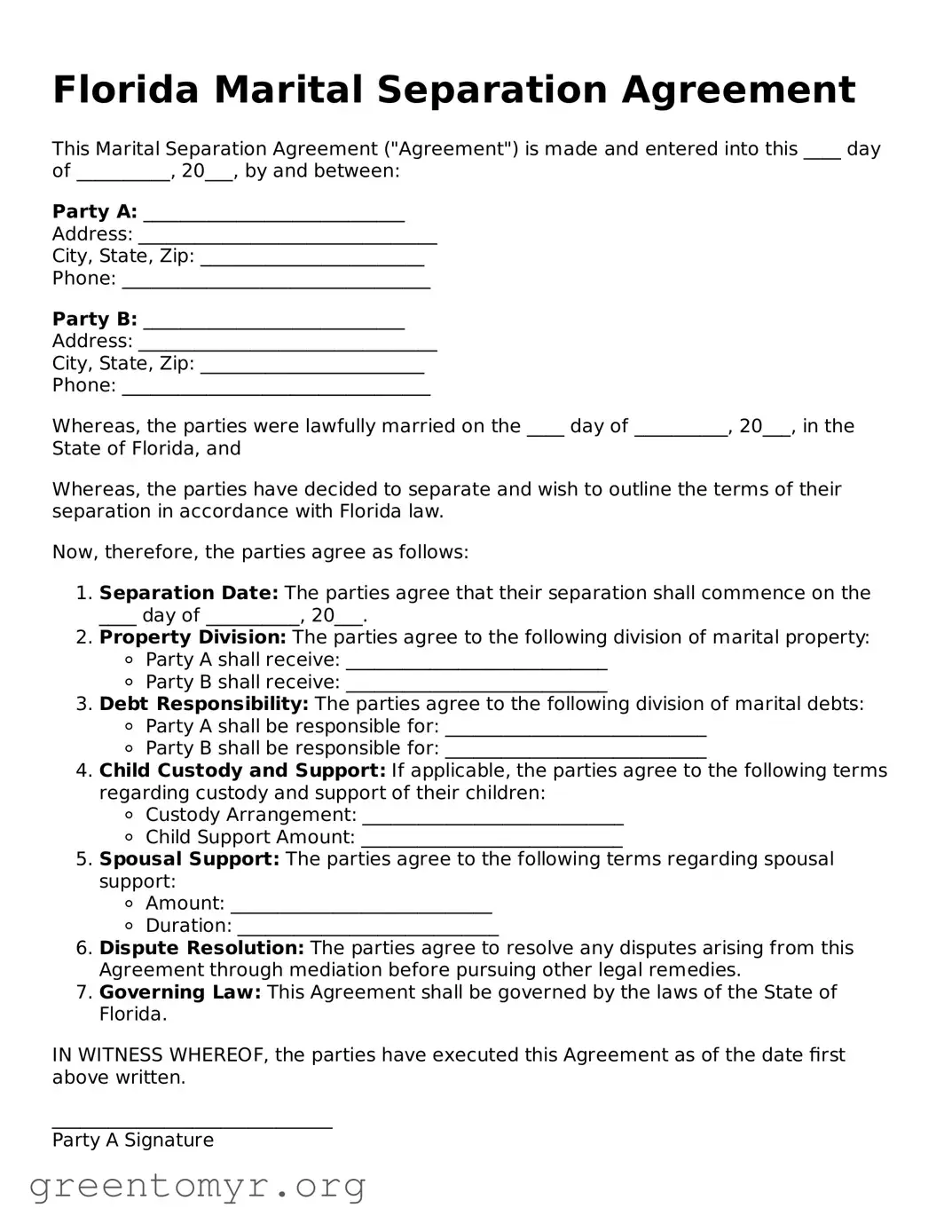
Florida Marital Separation Agreement

This Marital Separation Agreement ("Agreement") is made and entered into this ____ day of __________, 20___, by and between:

Party A: ____________________________
Address: ________________________________
City, State, Zip: ________________________
Phone: _________________________________

Party B: ____________________________
Address: ________________________________
City, State, Zip: ________________________
Phone: _________________________________

Whereas, the parties were lawfully married on the ____ day of __________, 20___, in the State of Florida, and

Whereas, the parties have decided to separate and wish to outline the terms of their separation in accordance with Florida law.

Now, therefore, the parties agree as follows:

  1. Separation Date: The parties agree that their separation shall commence on the ____ day of __________, 20___.
  2. Property Division: The parties agree to the following division of marital property:
    • Party A shall receive: ____________________________
    • Party B shall receive: ____________________________
  3. Debt Responsibility: The parties agree to the following division of marital debts:
    • Party A shall be responsible for: ____________________________
    • Party B shall be responsible for: ____________________________
  4. Child Custody and Support: If applicable, the parties agree to the following terms regarding custody and support of their children:
    • Custody Arrangement: ____________________________
    • Child Support Amount: ____________________________
  5. Spousal Support: The parties agree to the following terms regarding spousal support:
    • Amount: ____________________________
    • Duration: ____________________________
  6. Dispute Resolution: The parties agree to resolve any disputes arising from this Agreement through mediation before pursuing other legal remedies.
  7. Governing Law: This Agreement shall be governed by the laws of the State of Florida.

IN WITNESS WHEREOF, the parties have executed this Agreement as of the date first above written.

______________________________
Party A Signature

______________________________
Party B Signature

______________________________
Witness Signature

______________________________
Witness Signature

PDF Form Features

Fact Name Description
Purpose The Florida Marital Separation Agreement form is used by couples who wish to outline the terms of their separation, including asset division, child custody, and support obligations.
Governing Law This form is governed by Florida Statutes, specifically Chapter 61, which addresses dissolution of marriage and related issues.
Voluntary Agreement Both parties must voluntarily agree to the terms outlined in the agreement. This ensures that both individuals are on the same page regarding their separation.
Legal Effect While the agreement is not a divorce decree, it can be enforceable in court, provided it meets legal standards and is fair to both parties.

Guide to Using Florida Marital Separation Agreement

After gathering the necessary information, it's time to complete the Florida Marital Separation Agreement form. This document is essential for outlining the terms of your separation. Follow these steps carefully to ensure accuracy.

  1. Begin by entering your full name and your spouse's full name at the top of the form.
  2. Provide your current addresses, including street, city, state, and zip code.
  3. Indicate the date of your marriage and the date of separation.
  4. List any children from the marriage, including their names and birth dates.
  5. Detail any property that you and your spouse own together. Include descriptions and values.
  6. Outline any debts that you and your spouse share. Be specific about the amounts and types of debts.
  7. Discuss arrangements for child custody, visitation, and support. Clearly state your preferences and agreements.
  8. Include any alimony or spousal support arrangements, if applicable.
  9. Both parties should sign and date the form at the designated area.
  10. Consider having the form notarized to add an extra layer of validity.

Once completed, review the form for any errors or missing information. Make copies for both parties and keep them in a safe place. This agreement will serve as a reference as you navigate your separation.

Get Answers on Florida Marital Separation Agreement

What is a Florida Marital Separation Agreement?

A Florida Marital Separation Agreement is a legal document that outlines the terms of a couple's separation. This agreement addresses various aspects of the separation, including property division, financial responsibilities, and child custody arrangements. It serves to clarify the rights and obligations of each party during the separation period.

Why should couples use a Marital Separation Agreement?

Couples may choose to use a Marital Separation Agreement for several reasons:

  1. To establish clear terms regarding the division of assets and debts.
  2. To outline child custody and visitation arrangements, ensuring the best interests of the children are prioritized.
  3. To provide a framework for financial support, such as alimony or child support, if applicable.
  4. To minimize conflict and misunderstandings during the separation process.

How is a Marital Separation Agreement created?

Creating a Marital Separation Agreement involves several steps:

  • Both parties should openly discuss their needs and preferences.
  • Gather all necessary financial documents, including income statements, bank accounts, and asset valuations.
  • Draft the agreement, ensuring it covers all relevant issues.
  • Consider consulting with a legal professional to review the document and ensure it complies with Florida laws.
  • Both parties must sign the agreement in the presence of a notary public for it to be legally binding.

Can a Marital Separation Agreement be modified?

Yes, a Marital Separation Agreement can be modified if both parties agree to the changes. It is important to document any modifications in writing and have both parties sign the updated agreement. This ensures that the new terms are clear and legally enforceable. If disagreements arise, mediation or legal intervention may be necessary to resolve conflicts regarding modifications.

Common mistakes

Filling out the Florida Marital Separation Agreement form can be a complex process. Many individuals make common mistakes that can lead to complications down the line. Here are ten mistakes to avoid when completing this important document.

One frequent error is not providing complete information. Each section of the form must be filled out accurately. Omitting details can lead to misunderstandings or disputes later. Ensure that all personal information, including names and addresses, is correct and up-to-date.

Another mistake is failing to specify the date of separation. This date is crucial as it can affect property division and other legal matters. Without it, the agreement may lack clarity, leading to potential conflicts.

Many people overlook the importance of detailing the division of assets and debts. It’s essential to list all marital property and liabilities clearly. Vague descriptions can cause confusion and disputes between parties.

Additionally, individuals often forget to include provisions for child custody and support. If children are involved, addressing their needs in the agreement is vital. Failing to do so can result in future legal challenges.

Some individuals may assume that verbal agreements are sufficient. However, all agreements should be documented in writing. Relying on spoken promises can lead to misunderstandings and unenforceable agreements.

Many people neglect to review the agreement thoroughly before signing. It’s important to read the document carefully to ensure that all terms are understood and agreed upon. Rushing through this step can lead to regrets later.

Another common mistake is not having the agreement notarized. Notarization adds a layer of authenticity to the document, which can be important in legal proceedings. Without it, the agreement may be questioned in court.

Some individuals fail to consider the tax implications of their separation. Understanding how asset division can affect taxes is crucial. Consulting a financial advisor can help clarify these issues.

Another error is not keeping copies of the signed agreement. After signing, it’s essential to retain copies for personal records and future reference. Losing the document can complicate matters later.

Finally, many people underestimate the importance of legal advice. Even if both parties agree on the terms, consulting a lawyer can ensure that the agreement is fair and legally sound. This step can prevent problems in the future.

Documents used along the form

When navigating a marital separation in Florida, several forms and documents may accompany the Marital Separation Agreement. Each serves a unique purpose in outlining the terms of the separation and ensuring that both parties understand their rights and responsibilities. Below is a list of common documents that are often used in conjunction with the Marital Separation Agreement.

  • Parenting Plan: This document outlines the arrangements for child custody and visitation. It details how parents will share responsibilities and make decisions about their children's welfare.
  • Financial Affidavit: A financial affidavit provides a comprehensive overview of each party's financial situation. It includes income, expenses, assets, and liabilities, which can be crucial for equitable distribution.
  • Child Support Guidelines Worksheet: This worksheet helps calculate the appropriate amount of child support based on the parents' incomes and the needs of the child. It ensures that financial support is fair and consistent.
  • Property Settlement Agreement: This document details how marital property will be divided between the parties. It specifies which assets and debts each party will take, preventing future disputes.
  • Quit Claim Deed: If real estate is involved, a quit claim deed transfers ownership of property from one spouse to another. It is essential for clarifying property rights post-separation.
  • Health Insurance Declaration: This form outlines health insurance coverage for the children and any obligations regarding medical expenses. It ensures that both parents understand their responsibilities for health care.
  • Spousal Support Agreement: This document outlines any financial support one spouse may provide to the other after separation. It specifies the amount, duration, and conditions of support.
  • Notice of Intent to Relocate: If one parent plans to move, this notice informs the other parent of the intent to relocate. It is necessary for maintaining communication and addressing custody arrangements.

Understanding these documents is essential for a smooth separation process. Each one plays a critical role in protecting the rights of both parties and ensuring that all aspects of the separation are addressed clearly and fairly.

Similar forms

The Marital Separation Agreement is a crucial document for couples who are separating but not yet divorced. It outlines the terms of the separation, including asset division, child custody, and support obligations. Several other documents serve similar purposes in different contexts. Here are nine documents that share similarities with the Marital Separation Agreement:

  • Separation Agreement: This document is often used interchangeably with the Marital Separation Agreement. It details the terms of separation, including financial responsibilities and child arrangements.
  • Divorce Agreement: Once a couple decides to divorce, this document formalizes the terms previously outlined in the separation agreement, finalizing asset division and custody arrangements.
  • Child Custody Agreement: This document specifically focuses on child custody and visitation rights, ensuring that both parents understand their responsibilities and rights regarding their children.
  • Property Settlement Agreement: Similar to the Marital Separation Agreement, this document specifically addresses the division of property and assets during a separation or divorce.
  • Spousal Support Agreement: This outlines the terms of financial support one spouse may provide to another after separation, ensuring clarity on obligations.
  • Postnuptial Agreement: This document is created after marriage and can include terms related to separation, much like a Marital Separation Agreement, but it is established while the couple is still married.
  • Prenuptial Agreement: Although created before marriage, this document can include provisions for separation, asset division, and support, similar to those found in a Marital Separation Agreement.
  • Collaborative Divorce Agreement: In this process, both parties work together with professionals to reach a separation agreement, which emphasizes mutual cooperation and understanding.
  • Mediation Agreement: This document results from mediation sessions and outlines the agreements reached by both parties regarding their separation, similar to the Marital Separation Agreement.

Understanding these documents can help individuals navigate the complexities of separation and divorce more effectively.

Dos and Don'ts

When filling out the Florida Marital Separation Agreement form, it’s important to approach the process with care. Here are some dos and don’ts to keep in mind:

  • Do read the form thoroughly before starting to fill it out.
  • Do provide accurate and complete information to avoid complications later.
  • Do consult with a legal professional if you have questions about specific terms.
  • Do keep a copy of the completed form for your records.
  • Don’t rush through the form; take your time to ensure accuracy.
  • Don’t leave any sections blank unless instructed to do so.

Following these guidelines can help ensure that the process goes smoothly and that your rights are protected.

Misconceptions

Many people have misconceptions about the Florida Marital Separation Agreement form. Understanding these misconceptions can help individuals make informed decisions during a separation. Here are seven common misconceptions:

  • It is the same as a divorce. A marital separation agreement is not a divorce. It is a legal document that outlines the terms of a separation, but it does not terminate the marriage.
  • It is only for couples with children. While many couples with children use this agreement to address custody and support, it is also suitable for couples without children.
  • It is legally binding in all situations. Although a marital separation agreement is generally enforceable, it may not hold up in court if it is found to be unfair or if one party did not fully disclose their financial situation.
  • It requires court approval. A marital separation agreement does not need court approval to be valid. However, having it reviewed by a court can provide additional legal protection.
  • It cannot be modified. This agreement can be modified if both parties agree to the changes. It is important to document any modifications in writing.
  • It is a permanent solution. A marital separation agreement is not permanent. Couples can choose to reconcile or proceed with divorce at any time.
  • It eliminates the need for legal representation. While it is possible to create this agreement without a lawyer, having legal representation can ensure that both parties’ rights are protected and that the agreement is comprehensive.

Being aware of these misconceptions can help couples navigate their separation more effectively and make choices that align with their best interests.

Key takeaways

When navigating the Florida Marital Separation Agreement form, it’s essential to understand its purpose and implications. Here are some key takeaways to keep in mind:

  • Purpose: This agreement outlines the terms of separation between spouses, including asset division, child custody, and support arrangements.
  • Voluntary Agreement: Both parties must willingly agree to the terms. It's a collaborative process aimed at reducing conflict.
  • Legal Binding: Once signed, the agreement is legally binding, meaning both parties must adhere to its terms unless modified by a court.
  • Clarity is Key: Clearly define all terms related to property, debts, and responsibilities to avoid misunderstandings later.
  • Child Considerations: If children are involved, include detailed arrangements for custody, visitation, and child support.
  • Consultation Recommended: Although not mandatory, consulting with a legal professional can help ensure that your rights are protected.
  • Filing with the Court: While the agreement itself does not require court filing, it can be submitted as part of divorce proceedings for judicial approval.
  • Review Regularly: Life changes may necessitate updates to the agreement. Regularly review and amend it as needed.

By keeping these points in mind, you can navigate the process of creating a Florida Marital Separation Agreement more effectively and with greater confidence.