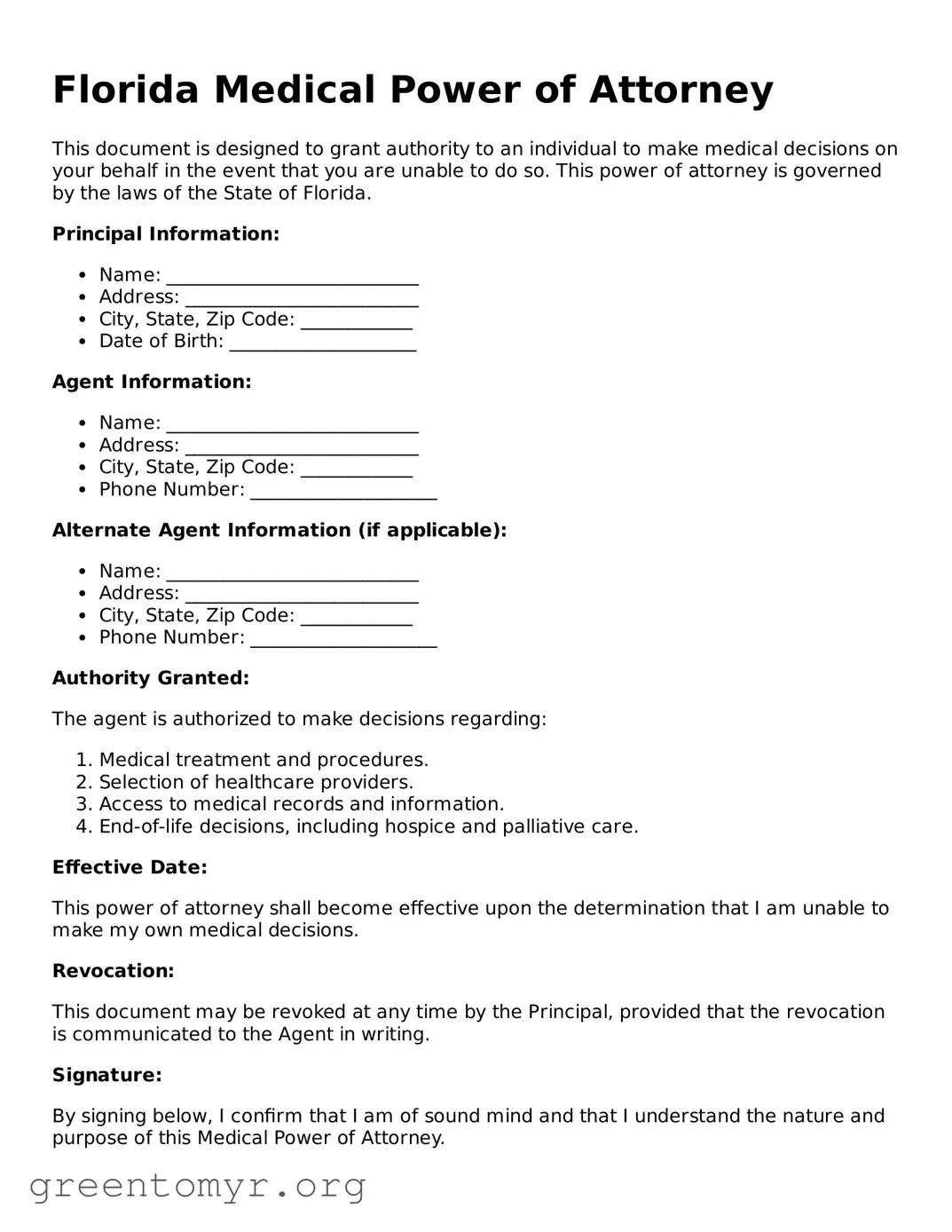
In the state of Florida, a Medical Power of Attorney form serves as a crucial legal document that empowers individuals to make healthcare decisions on behalf of another person when that individual is unable to do so. This form is particularly important for ensuring that a person's medical preferences are respected and upheld, even in times of incapacity. The designated individual, often referred to as the agent or proxy, is entrusted with the authority to make informed choices regarding medical treatment, including life-sustaining measures, based on the principal's wishes. Additionally, the form outlines specific instructions, allowing the principal to communicate their values and desires regarding healthcare in a clear and legally binding manner. It is essential for individuals to consider appointing a trusted agent, as this decision can greatly impact the quality of care received during critical moments. The Florida Medical Power of Attorney form not only facilitates a smoother healthcare process but also provides peace of mind for both the principal and their loved ones, ensuring that personal beliefs and preferences guide medical decisions when it matters most.
Florida Medical Power of Attorney
This document is designed to grant authority to an individual to make medical decisions on your behalf in the event that you are unable to do so. This power of attorney is governed by the laws of the State of Florida.
Principal Information:
Agent Information:
Alternate Agent Information (if applicable):
Authority Granted:
The agent is authorized to make decisions regarding:
Effective Date:
This power of attorney shall become effective upon the determination that I am unable to make my own medical decisions.
Revocation:
This document may be revoked at any time by the Principal, provided that the revocation is communicated to the Agent in writing.
Signature:
By signing below, I confirm that I am of sound mind and that I understand the nature and purpose of this Medical Power of Attorney.
Principal's Signature: ______________________ Date: ____________
Witnesses:
This document must be witnessed by two individuals who are not related to the Principal or the Agent.
Notary Public:
State of Florida
County of _______________
Subscribed and sworn to before me this ____ day of __________, 20__.
Notary Public Signature: ______________________
My Commission Expires: ______________________
| Fact Name | Details |
|---|---|
| Definition | A Florida Medical Power of Attorney allows an individual to appoint someone to make healthcare decisions on their behalf. |
| Governing Law | Florida Statutes, Chapter 765 governs the Medical Power of Attorney in Florida. |
| Principal | The person who creates the Medical Power of Attorney is called the principal. |
| Agent | The individual appointed to make decisions is referred to as the agent or surrogate. |
| Signing Requirements | The form must be signed by the principal in the presence of two witnesses or a notary public. |
| Witnesses | Witnesses cannot be the agent, the principal's spouse, or a blood relative. |
| Effective Date | The Medical Power of Attorney becomes effective when the principal is unable to make their own medical decisions. |
| Revocation | The principal can revoke the Medical Power of Attorney at any time, as long as they are competent. |
| Limitations | The agent's authority is limited to making healthcare decisions and does not extend to financial matters. |
| Health Care Surrogate | The Medical Power of Attorney can also serve as a Health Care Surrogate designation under Florida law. |
Filling out the Florida Medical Power of Attorney form is an important step in ensuring that your healthcare decisions are made according to your wishes. After completing the form, you will need to sign it in the presence of a notary public or two witnesses to make it legally binding. Follow these steps to accurately fill out the form.
A Florida Medical Power of Attorney is a legal document that allows you to designate someone to make medical decisions on your behalf if you become unable to do so. This trusted individual, known as your agent or surrogate, will have the authority to discuss your medical treatment options, consent to procedures, and make healthcare decisions that align with your wishes.
Creating a Medical Power of Attorney in Florida involves several key steps:
Once completed, keep the document in a safe place and provide copies to your agent, healthcare providers, and family members.
Your agent can make a wide range of medical decisions on your behalf, including:
It is crucial to discuss your wishes and preferences with your agent to ensure they understand your values and desires regarding healthcare.
Yes, you can revoke your Medical Power of Attorney at any time, as long as you are of sound mind. To do this, you should:
It is advisable to keep a record of the revocation and provide copies to relevant parties.
If you do not have a Medical Power of Attorney in place and become incapacitated, medical decisions will be made by healthcare providers based on your best interests. In some cases, family members may be consulted, but without a designated agent, there may be disputes or delays in decision-making. Establishing a Medical Power of Attorney ensures that your healthcare preferences are honored and that someone you trust is making decisions for you.
When filling out the Florida Medical Power of Attorney form, many people inadvertently make mistakes that can lead to complications down the line. One common error is failing to specify the powers granted to the agent. It's crucial to clearly outline what decisions your agent can make on your behalf regarding medical treatment. Without this clarity, your agent may face challenges in making the right choices during critical moments.
Another frequent mistake is not properly signing and dating the document. In Florida, the law requires that the form be signed in the presence of two witnesses. If this step is overlooked, the document may not be considered valid. Always ensure that you and your witnesses sign and date the form correctly to avoid any legal issues later.
People also often forget to choose an alternate agent. Life can be unpredictable, and your primary agent may not always be available when needed. By failing to designate an alternate, you risk leaving your medical decisions in limbo if your first choice is unable to act. It’s wise to think ahead and select someone who can step in if necessary.
Lastly, many individuals neglect to review the document after filling it out. Circumstances can change, and so can your preferences regarding medical treatment. Regularly reviewing your Medical Power of Attorney ensures that it accurately reflects your current wishes. Taking the time to revisit this important document can save you and your loved ones from confusion and stress during difficult times.
The Florida Medical Power of Attorney form allows individuals to designate someone to make healthcare decisions on their behalf if they become unable to do so. Several other documents are commonly used in conjunction with this form to ensure comprehensive planning for medical care and personal affairs. Below is a list of these documents, along with brief descriptions of each.
Having these documents in place can provide clarity and direction for healthcare providers and family members during critical times. Each serves a unique purpose, and together they contribute to a comprehensive plan for managing medical and personal decisions.
The Medical Power of Attorney (MPOA) form is an important document that allows someone to make medical decisions on your behalf if you are unable to do so. There are several other documents that share similarities with the MPOA. Here’s a look at seven of them:
Each of these documents plays a unique role in ensuring that your health care wishes are honored, especially when you cannot speak for yourself.
When filling out the Florida Medical Power of Attorney form, it is important to follow certain guidelines to ensure that the document is valid and reflects your wishes. Here are some things you should and shouldn't do:
Many people have misconceptions about the Florida Medical Power of Attorney form. Understanding these misconceptions can help ensure that individuals make informed decisions regarding their medical care. Here are five common misconceptions:
This is not true. A Medical Power of Attorney allows an appointed agent to make medical decisions on behalf of the principal, not just at the end of life, but also in situations where the principal is unable to communicate their wishes.
While both documents deal with medical decisions, they serve different purposes. A Living Will outlines specific wishes regarding end-of-life care, whereas a Medical Power of Attorney designates someone to make decisions when the principal cannot.
This misconception is incorrect. Individuals can revoke or change their Medical Power of Attorney at any time, as long as they are competent to do so. It is important to communicate any changes to the appointed agent and healthcare providers.
This is a common misunderstanding. Anyone, regardless of age, can benefit from having a Medical Power of Attorney. Accidents or sudden illnesses can happen to anyone, making it wise to have this document in place.
While the Florida Medical Power of Attorney is specifically designed for use in Florida, it may be recognized in other states. However, it is advisable to check the laws in the state where medical treatment is being sought to ensure validity.
Understanding these misconceptions can help individuals make better decisions regarding their healthcare and legal rights. It is essential to approach these matters with clarity and awareness.
Filling out and using the Florida Medical Power of Attorney form is an important step in planning for your healthcare decisions. Here are some key takeaways to keep in mind:
By following these guidelines, you can ensure that your healthcare decisions are respected and carried out according to your preferences.