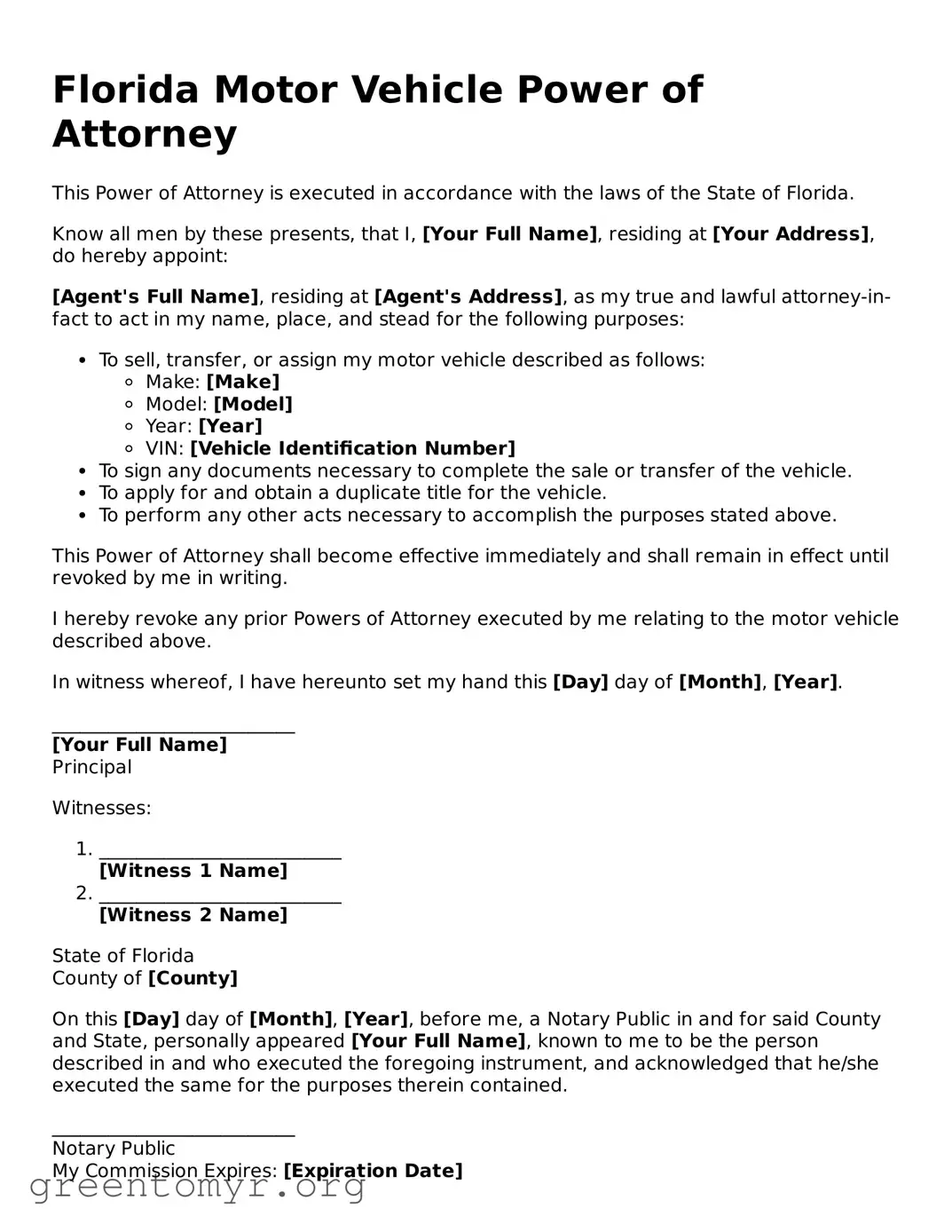
In the realm of vehicle ownership and management, the Florida Motor Vehicle Power of Attorney form serves as a crucial legal instrument that empowers individuals to designate another person to act on their behalf regarding motor vehicle transactions. This form is particularly significant for those who may be unable to attend to their vehicle-related matters due to various reasons, such as health issues or geographical distance. By granting this authority, the vehicle owner can ensure that essential tasks—like title transfers, registration renewals, and the sale of the vehicle—are handled efficiently and in accordance with state regulations. The document typically requires the signatures of both the principal and the agent, thereby establishing a clear and legally binding relationship. Additionally, it is important to note that the powers granted can be tailored to meet specific needs, allowing for flexibility while maintaining compliance with Florida law. Understanding the nuances of this form can greatly simplify the often complex world of vehicle ownership, providing peace of mind to both the principal and the appointed agent.
Florida Motor Vehicle Power of Attorney
This Power of Attorney is executed in accordance with the laws of the State of Florida.
Know all men by these presents, that I, [Your Full Name], residing at [Your Address], do hereby appoint:
[Agent's Full Name], residing at [Agent's Address], as my true and lawful attorney-in-fact to act in my name, place, and stead for the following purposes:
This Power of Attorney shall become effective immediately and shall remain in effect until revoked by me in writing.
I hereby revoke any prior Powers of Attorney executed by me relating to the motor vehicle described above.
In witness whereof, I have hereunto set my hand this [Day] day of [Month], [Year].
__________________________
[Your Full Name]
Principal
Witnesses:
State of Florida
County of [County]
On this [Day] day of [Month], [Year], before me, a Notary Public in and for said County and State, personally appeared [Your Full Name], known to me to be the person described in and who executed the foregoing instrument, and acknowledged that he/she executed the same for the purposes therein contained.
__________________________
Notary Public
My Commission Expires: [Expiration Date]
| Fact Name | Description |
|---|---|
| Definition | The Florida Motor Vehicle Power of Attorney form allows an individual to designate another person to handle motor vehicle-related transactions on their behalf. |
| Governing Law | This form is governed by Florida Statutes, specifically under Chapter 709, which deals with powers of attorney. |
| Usage | Commonly used for transferring vehicle titles, registering vehicles, and obtaining license plates. |
| Notarization | The form typically requires notarization to ensure authenticity and to prevent fraud. |
| Revocation | The principal can revoke the power of attorney at any time, provided they notify the agent and any relevant parties. |
| Agent's Responsibilities | The agent must act in the best interest of the principal and follow the instructions outlined in the form. |
| Duration | The power of attorney remains effective until it is revoked or until the principal becomes incapacitated, unless specified otherwise. |
Filling out the Florida Motor Vehicle Power of Attorney form is an important step in designating someone to handle vehicle-related matters on your behalf. Once the form is completed, you can present it to the appropriate authorities or institutions as needed.
The Florida Motor Vehicle Power of Attorney form is a legal document that allows one person, known as the principal, to grant another person, known as the agent, the authority to act on their behalf regarding motor vehicle transactions. This can include activities such as registering a vehicle, transferring a title, or obtaining a license plate.
Any competent adult can be designated as an agent in the Florida Motor Vehicle Power of Attorney form. This could be a family member, friend, or a professional such as an attorney. It is important that the chosen agent is trustworthy and capable of handling the responsibilities assigned to them.
The form allows the agent to perform various transactions related to motor vehicles, including:
Yes, the Florida Motor Vehicle Power of Attorney form must be signed in the presence of a notary public. Notarization helps verify the identity of the principal and ensures that the document is executed properly. This step adds an extra layer of protection against fraud.
The validity of the Florida Motor Vehicle Power of Attorney form is typically indefinite unless specified otherwise. The principal can revoke the power at any time by providing written notice to the agent and any relevant third parties. It's advisable to keep a record of the revocation for future reference.
The Florida Motor Vehicle Power of Attorney form is specifically designed for use within Florida. If the vehicle is registered in another state, you may need to consult the laws of that state and possibly use a different form. Each state may have its own requirements regarding powers of attorney.
While a Power of Attorney is not strictly necessary for all vehicle transactions, it can be very useful. If the principal is unable to attend to the transaction personally due to illness, absence, or other reasons, having an agent designated through this form ensures that the necessary tasks can still be completed efficiently.
To fill out the Florida Motor Vehicle Power of Attorney form correctly, follow these steps:
Ensure that all information is accurate and complete to avoid any issues during the execution of the power of attorney.
Filling out the Florida Motor Vehicle Power of Attorney form can be a straightforward process, but many individuals make common mistakes that can lead to complications down the line. One frequent error is not providing complete information. The form requires specific details about both the principal (the person granting the power) and the agent (the person receiving the power). Missing names, addresses, or identification numbers can render the document invalid.
Another mistake involves using outdated forms. Laws and requirements can change, and using an old version of the Power of Attorney form may not meet current legal standards. Always ensure that you are using the most recent version available from a reliable source.
People often overlook the importance of signatures. The Power of Attorney form must be signed by the principal. In some cases, individuals mistakenly believe that a witness or notary signature is sufficient. However, without the principal's signature, the document does not hold any legal weight.
Additionally, some individuals fail to specify the powers granted to the agent. The form should clearly outline what actions the agent is allowed to take on behalf of the principal. Vague language can lead to misunderstandings and limit the agent's ability to act effectively.
Another common error is neglecting to date the form. A date is crucial as it indicates when the Power of Attorney becomes effective. Without a date, there could be confusion regarding the validity of the document, especially if the principal's circumstances change over time.
Lastly, many people forget to keep copies of the completed form. After signing, it’s essential to provide copies to the agent and retain one for personal records. This helps ensure that everyone involved has access to the same information and can prevent disputes in the future.
When dealing with the Florida Motor Vehicle Power of Attorney form, there are several other documents that may be necessary or helpful. These forms assist in various aspects of vehicle ownership and transactions. Below is a list of commonly used documents that complement the Power of Attorney form.
Using these documents in conjunction with the Florida Motor Vehicle Power of Attorney form can streamline the process of managing vehicle transactions. Ensuring that all necessary paperwork is completed accurately will help avoid delays and complications.
When filling out the Florida Motor Vehicle Power of Attorney form, it is essential to follow specific guidelines to ensure that the document is valid and serves its intended purpose. Here is a list of things you should and shouldn't do:
Many people have misunderstandings about the Florida Motor Vehicle Power of Attorney form. Here are eight common misconceptions:
Understanding these misconceptions can help ensure that you use the Florida Motor Vehicle Power of Attorney form correctly and effectively.
Filling out and using the Florida Motor Vehicle Power of Attorney form requires attention to detail and understanding of its implications. Here are some key takeaways:
By following these guidelines, individuals can effectively utilize the Florida Motor Vehicle Power of Attorney form to manage vehicle-related matters efficiently.