In the competitive landscape of Florida's job market, many employers seek to protect their business interests through the use of non-compete agreements. These agreements serve as a legal tool designed to prevent employees from engaging in similar work with competitors after leaving a job. The Florida Non-compete Agreement form outlines the specific terms and conditions that govern this arrangement, including the duration of the restriction, the geographical area covered, and the types of activities that are prohibited. Understanding these key components is essential for both employers and employees, as they help clarify expectations and protect sensitive business information. Additionally, the enforceability of such agreements can vary based on factors like reasonableness and the nature of the employment relationship. By familiarizing oneself with the nuances of the Florida Non-compete Agreement form, individuals can navigate the complexities of employment law with greater confidence.
Florida Non-Compete Agreement
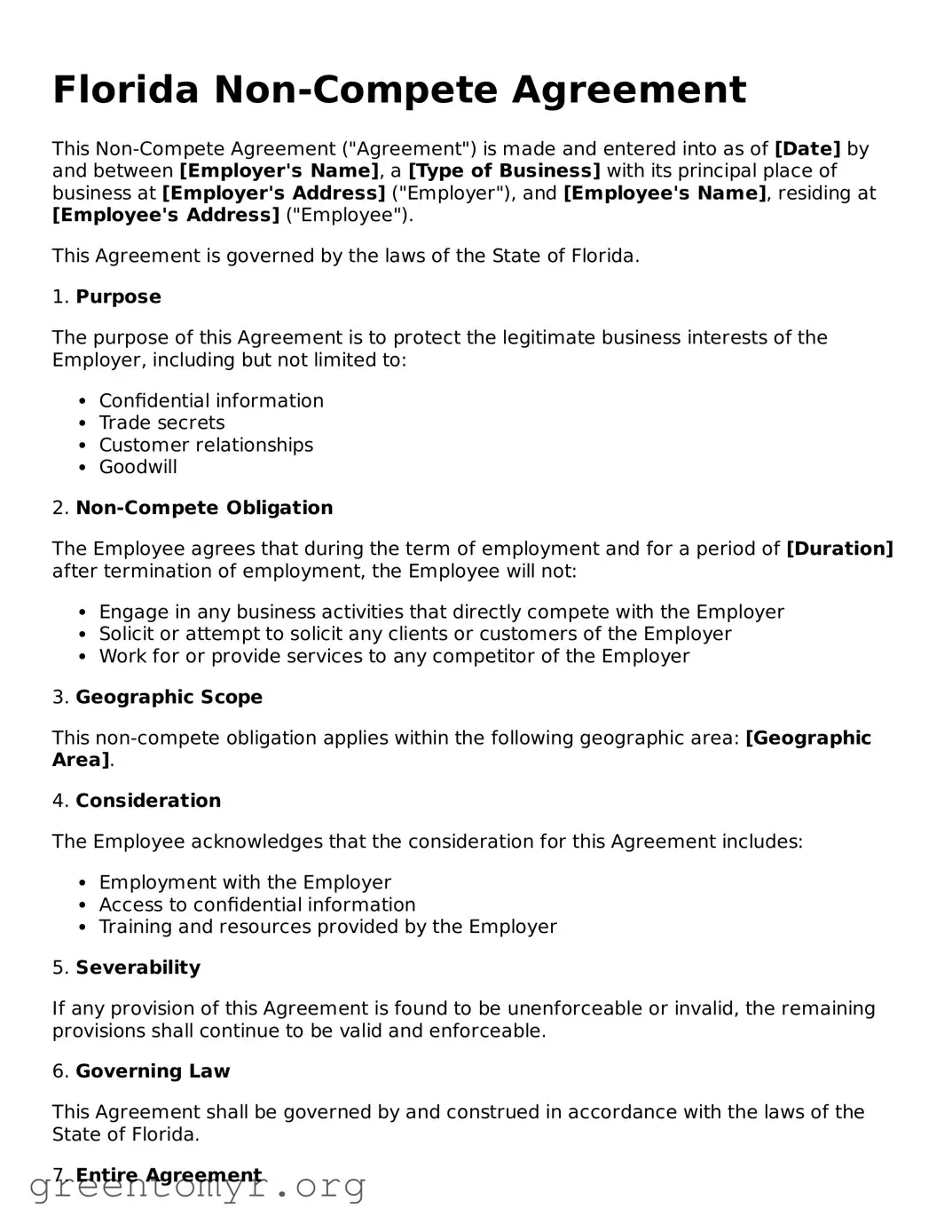
This Non-Compete Agreement ("Agreement") is made and entered into as of [Date] by and between [Employer's Name], a [Type of Business] with its principal place of business at [Employer's Address] ("Employer"), and [Employee's Name], residing at [Employee's Address] ("Employee").
This Agreement is governed by the laws of the State of Florida.
1. Purpose
The purpose of this Agreement is to protect the legitimate business interests of the Employer, including but not limited to:
2. Non-Compete Obligation
The Employee agrees that during the term of employment and for a period of [Duration] after termination of employment, the Employee will not:
3. Geographic Scope
This non-compete obligation applies within the following geographic area: [Geographic Area].
4. Consideration
The Employee acknowledges that the consideration for this Agreement includes:
5. Severability
If any provision of this Agreement is found to be unenforceable or invalid, the remaining provisions shall continue to be valid and enforceable.
6. Governing Law
This Agreement shall be governed by and construed in accordance with the laws of the State of Florida.
7. Entire Agreement
This Agreement constitutes the entire understanding between the parties and supersedes all prior discussions, agreements, or understandings.
IN WITNESS WHEREOF, the parties have executed this Non-Compete Agreement as of the date first above written.
[Employer's Name]
By: ____________________________
Name: [Authorized Signatory]
Title: [Title]
[Employee's Name]
Signature: ____________________________
| Fact Name | Details |
|---|---|
| Definition | A non-compete agreement is a contract that restricts an employee from engaging in business activities that compete with their employer after leaving the company. |
| Governing Law | The Florida Non-Compete Agreement is governed by Florida Statutes, specifically Section 542.335. |
| Enforceability | To be enforceable, the agreement must be reasonable in time, geographic area, and scope of activity. |
| Consideration | For a non-compete agreement to be valid, there must be adequate consideration, such as employment or a promotion. |
| Duration | Typically, non-compete agreements in Florida are limited to a duration of two years, but this can vary based on the specific circumstances. |
Once you have the Florida Non-compete Agreement form in hand, you are ready to begin the process of filling it out. This form is essential for establishing the terms under which one party agrees not to compete with another in a specific business area. Follow the steps below to ensure that you complete the form correctly.
After completing these steps, review the form to ensure all information is accurate and complete. Once finalized, both parties should retain a copy for their records. This will help avoid any misunderstandings in the future.
A Florida Non-compete Agreement is a legal contract that restricts an employee from working for a competitor or starting a competing business for a specified period after leaving their current employer. This agreement aims to protect the employer's business interests, including trade secrets and client relationships.
To be enforceable in Florida, a Non-compete Agreement must include the following key elements:
The duration of a Non-compete Agreement in Florida varies based on the nature of the business and the role of the employee. Generally, agreements lasting up to two years are often considered reasonable. However, longer durations may be justified depending on the circumstances.
Yes, employees can negotiate the terms of a Non-compete Agreement before signing. It's advisable to discuss any concerns or desired changes with the employer. This negotiation can lead to a more balanced agreement that protects both parties' interests.
If an employee violates a Non-compete Agreement, the employer may take legal action. This could include seeking an injunction to prevent further violations and pursuing damages. Courts will evaluate the agreement's reasonableness and the specific circumstances of the case.
Yes, Non-compete Agreements are generally enforceable in Florida, provided they meet the necessary legal requirements. Courts will assess the agreement's reasonableness in terms of time, geography, and the legitimate business interest being protected.
Legitimate business interests may include:
These interests must be clearly stated in the Non-compete Agreement to be enforceable.
Yes, Non-compete Agreements can also apply to independent contractors in Florida. However, the terms must still meet the same legal standards as those for employees. The agreement should clearly outline the restrictions and the legitimate business interests involved.
If you are asked to sign a Non-compete Agreement, consider the following steps:
Taking these steps can help you make an informed decision.
Filling out a Florida Non-compete Agreement can be a daunting task, and many individuals make mistakes that can lead to significant consequences. One common error is failing to clearly define the scope of the non-compete. Without precise language, the agreement may become unenforceable. It is crucial to specify the geographical area and the types of activities that are restricted. A vague description can lead to misunderstandings and disputes down the line.
Another frequent mistake is overlooking the duration of the non-compete clause. Florida law requires that the time period be reasonable. If the duration is too long, a court may deem the agreement invalid. It is essential to strike a balance that protects the employer's interests while allowing the employee to pursue their career without undue hindrance.
People often neglect to consider the consideration, or what the employee receives in exchange for signing the agreement. In Florida, there must be a valid reason for the employee to agree to the non-compete terms. This could be a job offer, a promotion, or access to proprietary information. If this consideration is not clearly articulated, the agreement may lack enforceability.
Many individuals also fail to review the agreement thoroughly before signing. Rushing through the process can lead to misunderstandings about the obligations and restrictions imposed. It is advisable to take the time to read the document carefully and, if necessary, consult with a legal professional. Understanding the terms is crucial to avoid future complications.
Lastly, individuals often do not keep a copy of the signed agreement. This oversight can create challenges if disputes arise later. Having a personal copy ensures that both parties can refer back to the original terms and conditions. It is a simple yet vital step that can save time and effort in the long run.
The Florida Non-compete Agreement is often accompanied by several other forms and documents that help clarify the terms of employment and protect the interests of both the employer and employee. Below is a list of these commonly used documents.
These documents collectively provide a framework for the employer-employee relationship, ensuring that both parties understand their rights and obligations. Properly executed, they can help prevent disputes and protect valuable business interests.
When filling out the Florida Non-compete Agreement form, it is important to approach the process with care. Here are four key actions to take and avoid:
Understanding the Florida Non-compete Agreement is crucial for both employers and employees. However, several misconceptions can lead to confusion. Here are eight common misunderstandings:
Not true. Florida law requires non-compete agreements to be reasonable in time, area, and line of business to be enforceable.
This is incorrect. Employers can choose to require non-compete agreements for certain positions, particularly those with access to sensitive information.
These are different. A non-compete restricts employment opportunities, while a non-disclosure agreement protects confidential information.
This is misleading. A non-compete may limit where and how you can work, but it doesn’t completely eliminate your ability to work in your industry.
This is false. Non-compete agreements can be used for employees at various levels, especially if they have access to trade secrets or proprietary information.
This is not accurate. Non-compete agreements can have expiration dates or may be challenged in court if deemed unreasonable.
This is incorrect. In Florida, employers must provide some form of consideration, such as a job offer or promotion, to make the agreement valid.
This is misleading. Enforcement depends on the laws of the state where the agreement was signed and where the employee is working.
Clarifying these misconceptions can help both employers and employees navigate the complexities of non-compete agreements in Florida.
When filling out and using the Florida Non-compete Agreement form, it's important to keep several key points in mind. Here are the essential takeaways:
By keeping these points in mind, you can create a non-compete agreement that is fair, enforceable, and beneficial for both parties involved.