In the vibrant business landscape of Florida, protecting sensitive information is crucial for companies and individuals alike. A Florida Non-disclosure Agreement (NDA) serves as a vital tool for safeguarding proprietary information, trade secrets, and other confidential data. This legally binding document outlines the terms under which one party agrees not to disclose certain information shared by another party. Typically, an NDA includes key components such as the definition of what constitutes confidential information, the obligations of both parties, the duration of confidentiality, and the consequences of any breach. By establishing clear boundaries and expectations, this agreement fosters trust and encourages open communication, allowing businesses to collaborate and innovate without the fear of their valuable information falling into the wrong hands. Whether you are a startup seeking to protect your innovative ideas or an established company looking to secure client information, understanding the nuances of a Florida Non-disclosure Agreement is essential for navigating the complexities of today’s competitive environment.
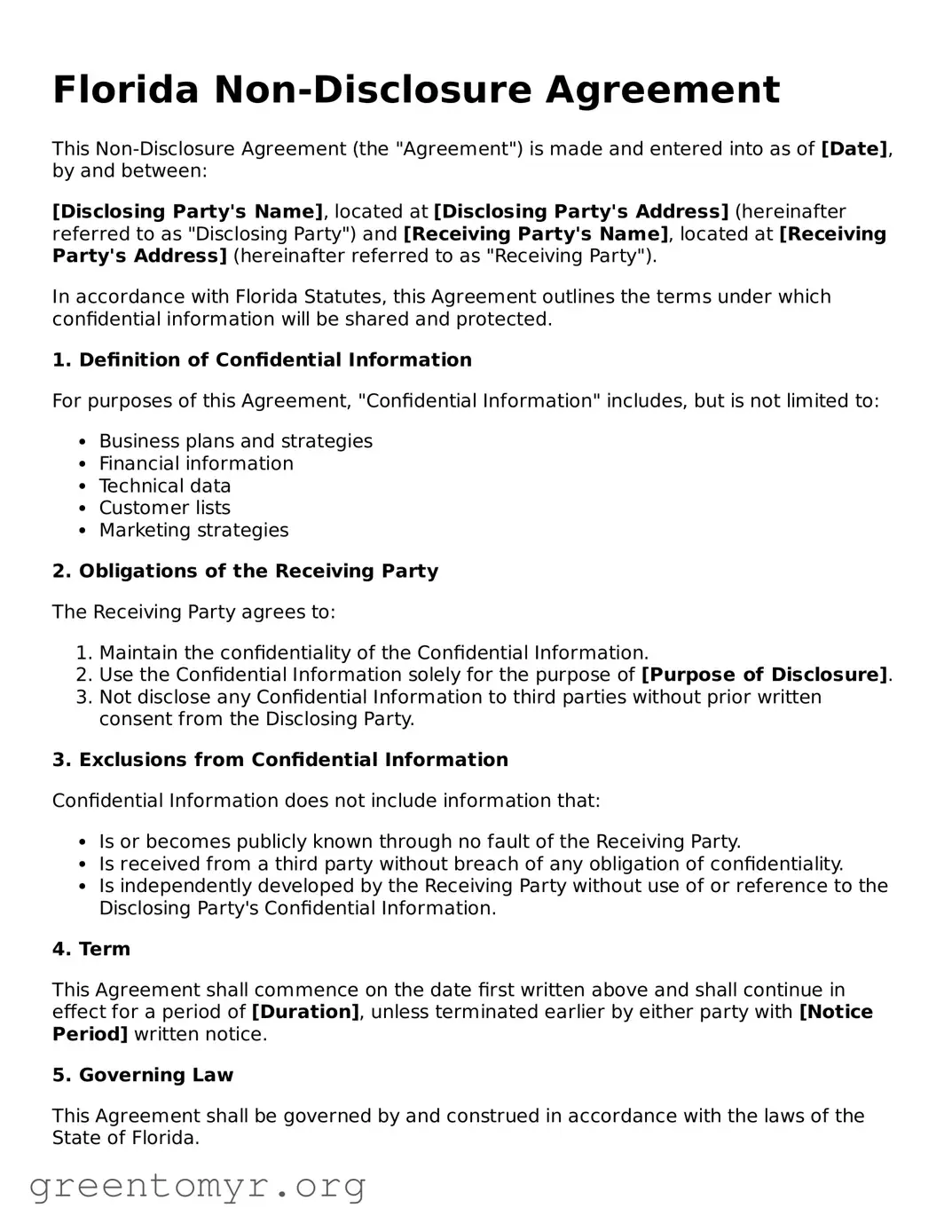
Florida Non-Disclosure Agreement
This Non-Disclosure Agreement (the "Agreement") is made and entered into as of [Date], by and between:
[Disclosing Party's Name], located at [Disclosing Party's Address] (hereinafter referred to as "Disclosing Party") and [Receiving Party's Name], located at [Receiving Party's Address] (hereinafter referred to as "Receiving Party").
In accordance with Florida Statutes, this Agreement outlines the terms under which confidential information will be shared and protected.
1. Definition of Confidential Information
For purposes of this Agreement, "Confidential Information" includes, but is not limited to:
2. Obligations of the Receiving Party
The Receiving Party agrees to:
3. Exclusions from Confidential Information
Confidential Information does not include information that:
4. Term
This Agreement shall commence on the date first written above and shall continue in effect for a period of [Duration], unless terminated earlier by either party with [Notice Period] written notice.
5. Governing Law
This Agreement shall be governed by and construed in accordance with the laws of the State of Florida.
IN WITNESS WHEREOF, the parties hereto have executed this Non-Disclosure Agreement as of the date first above written.
Disclosing Party:
______________________________
[Name]
[Title]
Receiving Party:
______________________________
[Name]
[Title]
| Fact Name | Details |
|---|---|
| Purpose | A Florida Non-disclosure Agreement (NDA) is designed to protect confidential information shared between parties. |
| Governing Law | The NDA is governed by the laws of the State of Florida. |
| Parties Involved | Typically, the agreement involves at least two parties: the disclosing party and the receiving party. |
| Duration of Confidentiality | The duration for which the information remains confidential can be specified within the agreement. |
| Enforcement | If a party breaches the NDA, the other party may seek legal remedies, including injunctions and damages. |
Once you have the Florida Non-disclosure Agreement form in hand, it’s crucial to complete it accurately. This document will help protect sensitive information shared between parties. Follow these steps carefully to ensure everything is filled out correctly.
After completing these steps, review the form to ensure all information is accurate and complete. Once signed, the agreement becomes effective, providing the necessary protection for your confidential information.
A Florida Non-disclosure Agreement is a legal contract that protects confidential information shared between parties. This agreement ensures that sensitive information, such as trade secrets or proprietary data, is not disclosed to unauthorized individuals or entities. By signing an NDA, both parties commit to keeping the shared information confidential.
You should consider using a Florida NDA when:
Generally, an NDA can protect a variety of information, including:
The duration of the confidentiality obligation can vary based on the terms set in the NDA. Typically, the obligation lasts for a specified period, which can range from a few years to indefinitely. It is essential to clearly define this duration in the agreement to avoid misunderstandings later.
Yes, there are common exceptions to confidentiality in NDAs, including:
Yes, you can enforce a Florida NDA if it is properly drafted and signed by both parties. If a party breaches the agreement, the other party may seek legal remedies, which can include monetary damages or injunctive relief. It is advisable to consult with a legal professional to ensure that the NDA meets all necessary legal requirements for enforcement.
While it is possible to find templates and draft an NDA on your own, consulting a lawyer is highly recommended. A legal professional can help tailor the agreement to your specific needs, ensuring that it adequately protects your interests and complies with Florida law.
Yes, an NDA can be modified after it is signed, but both parties must agree to the changes. Modifications should be documented in writing and signed by both parties to ensure clarity and enforceability.
If you suspect a breach of the NDA, it is important to take immediate action. Start by reviewing the agreement to confirm the terms. Then, consider reaching out to the other party to discuss your concerns. If the situation does not resolve, you may need to consult a lawyer to explore your legal options.
When filling out the Florida Non-disclosure Agreement (NDA) form, individuals often overlook critical details that can lead to significant issues down the line. One common mistake is failing to clearly define the confidential information. Without a precise description, it becomes challenging to enforce the agreement. Parties may have different interpretations of what constitutes confidential information, leading to disputes.
Another frequent error is neglecting to specify the duration of the confidentiality obligation. An NDA should clearly state how long the information must remain confidential. Omitting this detail can result in confusion and potential legal complications. Parties may assume different timelines, which can undermine the agreement's effectiveness.
People also tend to forget to include all relevant parties in the agreement. It is essential to ensure that anyone who has access to the confidential information is bound by the NDA. This includes employees, contractors, and any third parties. Failing to do so can expose the disclosing party to risks if sensitive information is leaked.
Additionally, some individuals mistakenly believe that a verbal agreement suffices. A written NDA is crucial for legal enforceability. Relying on informal discussions can lead to misunderstandings and a lack of protection for the disclosing party. Always document the agreement in writing to ensure clarity and legal standing.
Finally, overlooking the governing law can create complications. The NDA should specify which state's laws will govern the agreement. This detail is vital in case of a dispute. Without it, parties may face challenges in determining how to resolve conflicts, leading to increased time and expenses.
When entering into a Non-disclosure Agreement (NDA) in Florida, several other documents may be necessary to ensure comprehensive protection of sensitive information. These documents help clarify the terms of the agreement and outline the responsibilities of each party involved. Below is a list of common forms and documents that are often used alongside an NDA.
Using these documents in conjunction with a Florida Non-disclosure Agreement can provide a more robust framework for protecting confidential information. Each document serves a unique purpose and helps establish clear expectations between parties, ultimately minimizing the risk of data breaches or misuse.
Confidentiality Agreement: Similar to a Non-disclosure Agreement, a confidentiality agreement protects sensitive information shared between parties. It outlines what information must remain confidential and the obligations of each party to maintain that confidentiality.
Non-compete Agreement: This document restricts an individual from engaging in business activities that compete with a former employer or business partner. While it focuses on competition, it often includes clauses about protecting confidential information.
Employment Agreement: An employment agreement may contain confidentiality provisions. It establishes the terms of employment and often includes clauses that protect the employer's proprietary information.
Partnership Agreement: A partnership agreement outlines the terms of a business partnership. It typically includes confidentiality clauses to safeguard sensitive business information shared among partners.
License Agreement: This document allows one party to use another's intellectual property under specific conditions. It often includes provisions to protect confidential information related to the licensed material.
When filling out the Florida Non-disclosure Agreement form, it is important to follow specific guidelines to ensure accuracy and compliance. Here are four key actions to take and avoid:
Misconceptions about the Florida Non-disclosure Agreement (NDA) can lead to misunderstandings regarding its purpose and effectiveness. Here are four common misconceptions:
When considering the Florida Non-disclosure Agreement (NDA) form, it is essential to understand its purpose and implications. Here are some key takeaways that can guide individuals and businesses in effectively utilizing this important legal document.
By understanding these key aspects, individuals and businesses can better navigate the complexities of confidentiality and protect their valuable information in Florida.