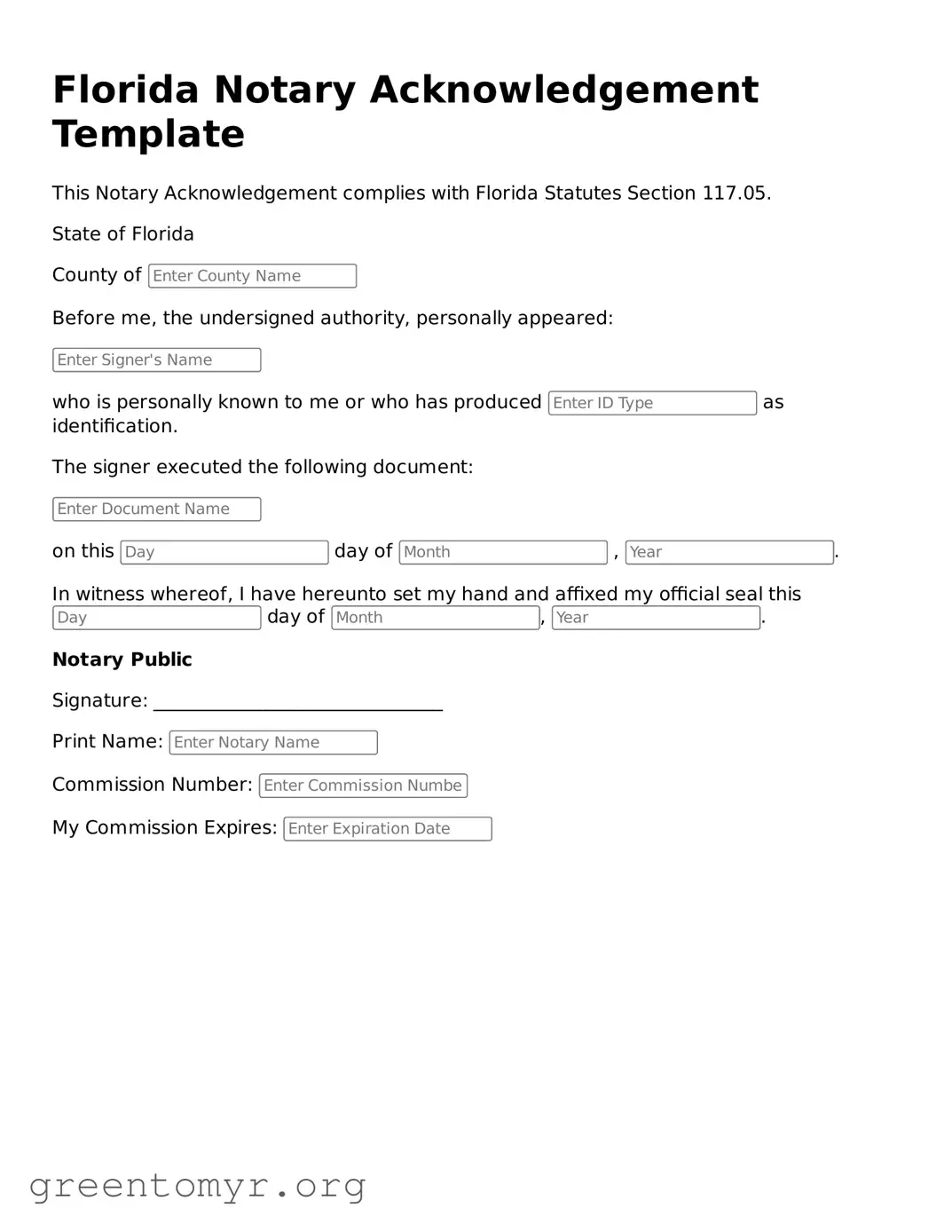
In the state of Florida, the Notary Acknowledgement form serves as a vital tool in the realm of legal documentation, ensuring that signatures on important documents are verified and authenticated. This form plays a crucial role in preventing fraud and upholding the integrity of various transactions, from real estate deals to financial agreements. It outlines the necessary steps for a notary public to confirm the identity of the signer, thereby providing assurance that the individual willingly executed the document. Key elements of the form include the notary's seal, the date of the acknowledgment, and the signer's personal information, all of which contribute to the document's validity. Understanding the significance of the Notary Acknowledgement form is essential for anyone involved in legal processes in Florida, as it not only protects the interests of the parties involved but also ensures compliance with state laws. By grasping the intricacies of this form, individuals can navigate their legal obligations with confidence and clarity.
Florida Notary Acknowledgement Template
This Notary Acknowledgement complies with Florida Statutes Section 117.05.
State of Florida
County of
Before me, the undersigned authority, personally appeared:
who is personally known to me or who has produced as identification.
The signer executed the following document:
on this day of , .
In witness whereof, I have hereunto set my hand and affixed my official seal this day of , .
Notary Public
Signature: _______________________________
Print Name:
Commission Number:
My Commission Expires:
| Fact Name | Description |
|---|---|
| Purpose | The Florida Notary Acknowledgment form is used to verify the identity of the signer and confirm their willingness to sign a document. |
| Governing Law | This form is governed by Florida Statutes, specifically Chapter 117, which outlines the powers and duties of notaries public in Florida. |
| Signature Requirement | The signer must personally appear before the notary and sign the document in their presence. |
| Notary's Role | The notary public must complete the acknowledgment by signing and sealing the document, thereby affirming the identity of the signer. |
| Validity | A properly executed Florida Notary Acknowledgment form is generally valid for use in any legal or official capacity within the state. |
After obtaining the Florida Notary Acknowledgment form, it is essential to fill it out correctly to ensure its validity. Completing the form involves providing specific information accurately. Follow these steps to fill out the form properly.
The Florida Notary Acknowledgement form is a legal document that serves to confirm the identity of a signer and the voluntary nature of their signature. This form is typically used when an individual is signing a document that requires notarization. The notary public verifies the identity of the signer and ensures that they understand the document before they sign it. This process adds a layer of authenticity to the document, making it more credible in legal contexts.
A Notary Acknowledgement is required in various situations, including:
It is important to determine if notarization is necessary for your specific document, as certain documents may have different requirements.
To complete a Florida Notary Acknowledgement form, follow these steps:
Make sure all information is accurate to avoid any issues with the notarization process.
If issues arise with the Notary Acknowledgement, consider the following steps:
Addressing issues promptly can help ensure that your document remains valid and enforceable.
When completing the Florida Notary Acknowledgement form, it is crucial to avoid common mistakes that can lead to delays or invalidations. One frequent error is failing to include the correct date. Notaries must ensure that the date of the acknowledgment matches the date when the notary performs the service. Omitting or misdating can cause complications.
Another common mistake is neglecting to provide the signer's name clearly. The name should match the identification presented. If the name is misspelled or unclear, it can create confusion and potentially invalidate the document.
People often forget to indicate the type of identification used by the signer. It is essential to note whether the signer presented a driver's license, passport, or another form of ID. This information verifies the identity of the individual and is a critical part of the acknowledgment process.
In some instances, individuals mistakenly believe that the notary can fill out the form entirely. However, the signer must personally appear before the notary and provide their signature. The notary's role is to witness this signature, not to complete the form on behalf of the signer.
Another mistake is failing to include the notary's signature and seal. The notary must sign and affix their official seal to the document for it to be valid. Omitting this step can render the acknowledgment incomplete.
People may also overlook the requirement for the notary to complete the venue section. This section indicates where the acknowledgment took place. Not including this information can lead to questions about the legitimacy of the notarization.
Finally, individuals sometimes use outdated versions of the form. Florida law may change, and it is essential to use the most current version of the Notary Acknowledgement form to ensure compliance with state regulations.
The Florida Notary Acknowledgement form is a crucial document used to verify the authenticity of signatures on various legal documents. When utilizing this form, it is often accompanied by other important documents that serve different purposes in the notarization process. Below is a list of commonly used forms that may accompany the Florida Notary Acknowledgement.
Understanding these accompanying documents can streamline the notarization process and ensure that all legal requirements are met. Each form plays a vital role in protecting the interests of all parties involved, making it essential to consider their use alongside the Florida Notary Acknowledgement form.
The Notary Acknowledgment form serves a specific purpose in verifying the identity of individuals signing documents. However, several other documents share similarities in their intent and function. Below are four such documents, each with a brief explanation of how they relate to the Notary Acknowledgment form.
Understanding these documents can help individuals navigate legal processes more effectively. Each serves a unique purpose, yet they all share the common goal of ensuring authenticity and trust in the signing of important documents.
When filling out the Florida Notary Acknowledgment form, it is essential to follow specific guidelines to ensure the document is valid and properly executed. Below is a list of things you should and shouldn't do.
Notary acknowledgments are often misunderstood, leading to confusion among those who need to use them. Here are ten common misconceptions about the Florida Notary Acknowledgment form:
This is false. Notaries in Florida can only notarize documents that are presented to them by the signer in person.
Not every document needs to be notarized. Only specific legal documents, such as deeds or powers of attorney, typically require a notary's acknowledgment.
Notaries do not check the accuracy of the document's content. Their role is to verify the identity of the signer and ensure they are signing voluntarily.
While notaries have discretion, they cannot refuse based on discriminatory reasons. They must follow the law and their own guidelines.
This is not true. A notary can acknowledge a document for anyone, regardless of their residency, as long as the notary is commissioned in Florida.
Notaries are not allowed to give legal advice or interpret documents. Their function is strictly to witness signatures and administer oaths.
Fees can vary. While Florida sets a maximum fee, individual notaries may choose to charge less or more for their services.
This is misleading. While the notarization verifies the signature at that moment, the underlying document can still be amended or replaced afterward.
Florida law requires notaries to maintain a journal of their notarizations, but not all states have this requirement.
These are different. An acknowledgment confirms the identity of the signer, while a jurat involves the signer swearing to the truth of the document's contents.
Understanding these misconceptions can help individuals navigate the notary process more effectively and ensure that their documents are handled properly.
Filling out and using the Florida Notary Acknowledgement form is a straightforward process, but it requires attention to detail. Here are some key takeaways to keep in mind: