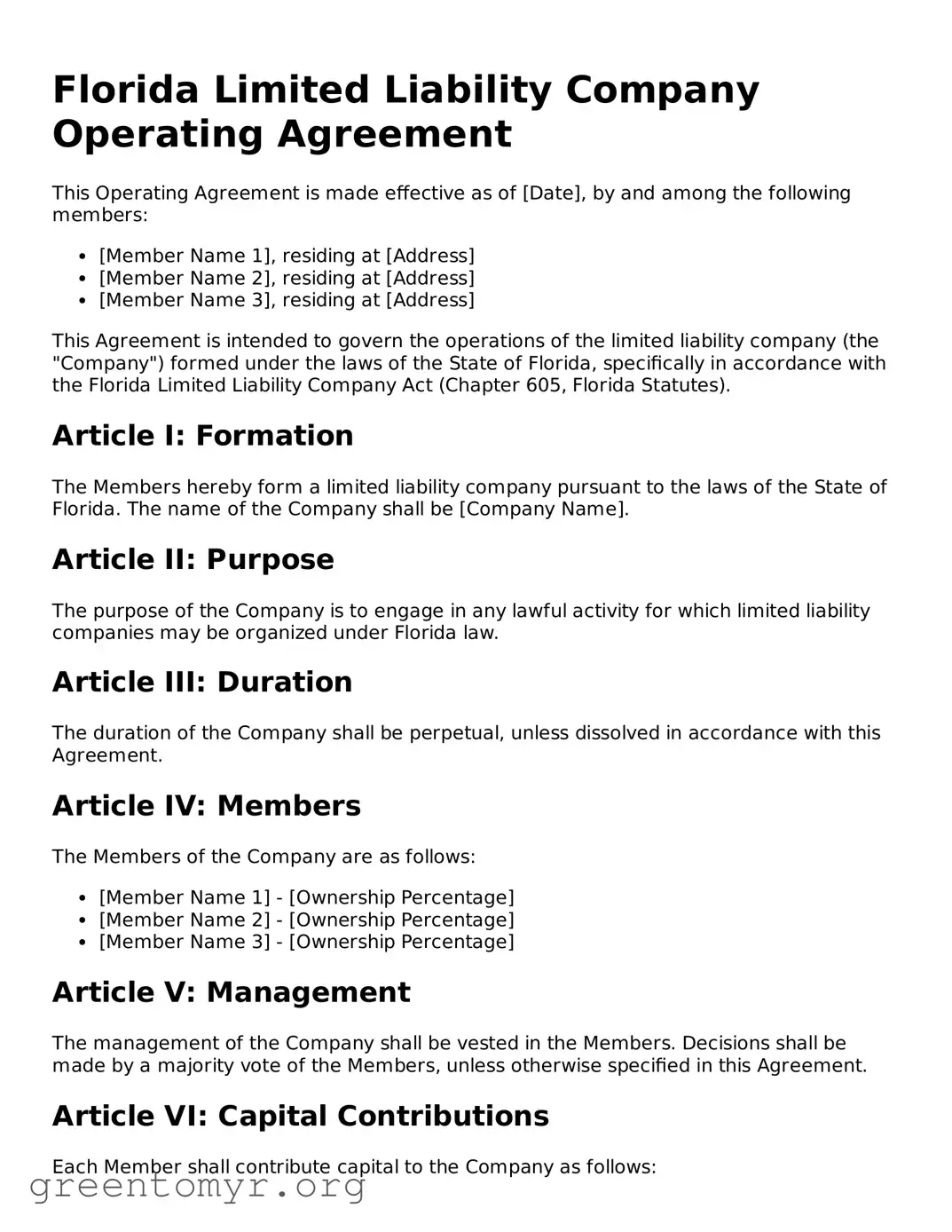
In the vibrant landscape of business formation, particularly in Florida, the Operating Agreement stands as a crucial document for limited liability companies (LLCs). This form outlines the internal workings of the LLC, detailing the rights, responsibilities, and obligations of its members. It serves not only as a roadmap for decision-making and management but also as a protective shield, safeguarding personal assets from business liabilities. Key components of the Operating Agreement include provisions for profit distribution, member roles, and procedures for adding or removing members. Furthermore, it addresses the management structure, whether member-managed or manager-managed, and lays out the process for resolving disputes among members. By establishing clear guidelines, the Operating Agreement fosters transparency and helps prevent misunderstandings, ultimately contributing to the LLC's long-term success.
Florida Limited Liability Company Operating Agreement
This Operating Agreement is made effective as of [Date], by and among the following members:
This Agreement is intended to govern the operations of the limited liability company (the "Company") formed under the laws of the State of Florida, specifically in accordance with the Florida Limited Liability Company Act (Chapter 605, Florida Statutes).
Article I: Formation
The Members hereby form a limited liability company pursuant to the laws of the State of Florida. The name of the Company shall be [Company Name].
Article II: Purpose
The purpose of the Company is to engage in any lawful activity for which limited liability companies may be organized under Florida law.
Article III: Duration
The duration of the Company shall be perpetual, unless dissolved in accordance with this Agreement.
Article IV: Members
The Members of the Company are as follows:
Article V: Management
The management of the Company shall be vested in the Members. Decisions shall be made by a majority vote of the Members, unless otherwise specified in this Agreement.
Article VI: Capital Contributions
Each Member shall contribute capital to the Company as follows:
Article VII: Distributions
Distributions of profits and losses shall be allocated to the Members in proportion to their ownership percentages.
Article VIII: Indemnification
The Company shall indemnify each Member to the fullest extent permitted by Florida law against any loss or liability incurred in connection with the Company.
Article IX: Amendments
This Agreement may be amended only by a written agreement signed by all Members.
Article X: Governing Law
This Agreement shall be governed by and construed in accordance with the laws of the State of Florida.
IN WITNESS WHEREOF, the Members have executed this Operating Agreement as of the date first above written.
______________________________
[Member Name 1]
______________________________
[Member Name 2]
______________________________
[Member Name 3]
| Fact Name | Details |
|---|---|
| Definition | The Florida Operating Agreement outlines the management structure and operational procedures of a limited liability company (LLC). |
| Governing Law | This document is governed by the Florida Limited Liability Company Act, specifically Chapter 605 of the Florida Statutes. |
| Purpose | The agreement serves to define the rights and responsibilities of members, as well as the distribution of profits and losses. |
| Member Information | It typically includes details about the members, such as names, addresses, and ownership percentages. |
| Management Structure | The agreement can specify whether the LLC will be member-managed or manager-managed. |
| Amendments | Provisions for amending the agreement can be included, outlining how changes can be made in the future. |
| Dispute Resolution | It may contain clauses regarding how disputes among members will be resolved, such as through mediation or arbitration. |
| Duration | The agreement can specify the duration of the LLC, whether it is perpetual or for a defined term. |
| Compliance | Filing the Operating Agreement is not mandatory in Florida, but it is recommended for legal protection and clarity. |
Completing the Florida Operating Agreement form requires careful attention to detail. After filling out the form, you will need to ensure that all members of the LLC review and sign the document to make it official. This step is crucial for establishing the framework of your business operations.
A Florida Operating Agreement is a legal document that outlines the management structure and operating procedures of a Limited Liability Company (LLC) in Florida. It serves as an internal guideline for the members of the LLC, detailing how the business will be run and how decisions will be made. While it is not required by law, having an Operating Agreement is highly recommended to prevent misunderstandings among members.
An Operating Agreement is crucial for several reasons:
All members of an LLC should participate in creating the Operating Agreement. This includes both managing members and non-managing members. Collaboration ensures that everyone’s interests and expectations are considered. In single-member LLCs, the sole owner should still draft an Operating Agreement to establish clear guidelines for the operation of the business.
A comprehensive Florida Operating Agreement typically includes the following elements:
No, an Operating Agreement does not need to be filed with the state of Florida. It is an internal document meant for the members of the LLC. However, it is advisable to keep a copy of the agreement in your business records, as it may be required for banking purposes or legal disputes.
Yes, the Operating Agreement can be amended. The process for amending the agreement should be outlined within the document itself. Typically, amendments require the consent of a certain percentage of members, depending on what is specified in the agreement. This flexibility allows the LLC to adapt to changing circumstances or member needs.
If an LLC does not have an Operating Agreement, the default rules set by Florida law will apply. These rules may not align with the members’ intentions or expectations, leading to potential conflicts. Without a clear framework, resolving disputes can become more complicated and costly. Therefore, having an Operating Agreement is highly beneficial for maintaining harmony among members.
When it comes to establishing a limited liability company (LLC) in Florida, the Operating Agreement is a crucial document. However, many individuals make common mistakes while filling out this form, which can lead to confusion and potential legal issues down the line. Understanding these pitfalls can help ensure a smoother process.
One frequent mistake is failing to include all members of the LLC. It’s essential to list every member involved in the business. Omitting a member not only creates ambiguity but can also complicate decision-making and profit distribution later. Everyone’s role should be clearly defined to avoid misunderstandings.
Another common error is not specifying the management structure. Whether the LLC will be managed by its members or appointed managers should be clearly stated. This distinction affects how decisions are made and who has authority within the company. Clarity in this area helps prevent disputes among members.
Some individuals neglect to outline the financial arrangements in the Operating Agreement. This includes how profits and losses will be shared, as well as how contributions will be made. Failing to address these financial details can lead to disagreements and dissatisfaction among members in the future.
Additionally, many people overlook the importance of including a buy-sell agreement. This provision outlines what happens if a member wants to leave the LLC or if a member passes away. Without this clause, the remaining members may face significant challenges in maintaining the business or bringing in new members.
Another mistake is ignoring state laws and regulations. Each state has specific requirements for Operating Agreements. It’s vital to ensure that the document complies with Florida’s laws. Ignoring these regulations can result in the agreement being deemed invalid or unenforceable.
Some individuals also make the error of failing to update the agreement as the business evolves. Life events, changes in membership, or shifts in business strategy may necessitate revisions. Keeping the Operating Agreement current is essential to reflect the true nature of the LLC.
Moreover, many people do not seek legal advice when drafting their Operating Agreement. While templates and online resources can be helpful, they may not cover all the nuances of individual situations. Consulting with a legal professional can provide tailored guidance and help avoid costly mistakes.
Another oversight is not addressing dispute resolution. Outlining how disputes will be handled, whether through mediation, arbitration, or litigation, can save time and money. Having a clear process in place helps members navigate conflicts more effectively.
Finally, some individuals make the mistake of failing to sign and date the agreement. An unsigned Operating Agreement lacks legal validity. All members should review the document thoroughly and ensure it is signed and dated to confirm their agreement and commitment.
By being aware of these common mistakes, individuals can take proactive steps to create a comprehensive and effective Operating Agreement for their Florida LLC. This foundational document not only protects the interests of all members but also sets the stage for a successful business venture.
When forming a limited liability company (LLC) in Florida, the Operating Agreement is a crucial document that outlines the management structure and operational guidelines of the business. However, it is often accompanied by several other important forms and documents that help establish the LLC’s legal standing and operational framework. Below is a list of these essential documents.
In summary, while the Florida Operating Agreement is a vital part of establishing an LLC, it is complemented by various other documents that together create a solid foundation for the business. Each of these forms plays a unique role in ensuring that the LLC operates smoothly and in compliance with state laws.
When filling out the Florida Operating Agreement form, it's crucial to pay attention to detail. Here’s a list of things you should and shouldn’t do:
Completing the form accurately can prevent future disputes and ensure smooth operations for your business. Be diligent and proactive.
When dealing with the Florida Operating Agreement form, misunderstandings can arise. Here are nine common misconceptions that many people have:
While it is highly recommended for LLCs in Florida to have an Operating Agreement, it is not legally required. However, having one can help clarify the management structure and protect members' rights.
This is not true. The Operating Agreement is an internal document and does not need to be filed with the Florida Department of State. It is kept among the members of the LLC.
While it is best practice for all members to sign, it is not a legal requirement. However, having all signatures can help prevent disputes later on.
This is a misconception. Single-member LLCs can also benefit from having an Operating Agreement. It helps establish the entity's separate legal status and can clarify management procedures.
This is incorrect. The Operating Agreement can be amended as needed, provided that the process for amendments is outlined within the document itself.
Complexity is not necessary. The Operating Agreement should be tailored to the specific needs of the LLC and can be as simple or detailed as the members choose.
Relying on verbal agreements can lead to misunderstandings and disputes. A written Operating Agreement provides clear documentation of the terms agreed upon by the members.
While legal protection is a key benefit, Operating Agreements also serve to outline the operational procedures and responsibilities of members, fostering better communication and collaboration.
This is a misconception. Each Operating Agreement should be customized to fit the unique structure and needs of the LLC. Generic templates may not address specific situations or preferences.
Understanding these misconceptions can help you navigate the complexities of the Florida Operating Agreement form with greater confidence. It's important to approach this document thoughtfully to ensure it meets the needs of your LLC.
When filling out and using the Florida Operating Agreement form, keep these key takeaways in mind: