In the vibrant landscape of personal finance and legal authority, the Florida Power of Attorney (POA) form stands as a vital tool for individuals seeking to delegate decision-making powers to trusted agents. This document empowers someone—often a family member or close friend—to act on your behalf in various matters, ranging from financial transactions to healthcare decisions. Understanding the nuances of this form is essential, as it encompasses several key components, including the designation of the agent, the scope of authority granted, and specific instructions tailored to your unique needs. Whether you are planning for the unexpected or simply wish to ensure that your wishes are honored in times of need, the Florida POA form offers flexibility and security. Additionally, it can be tailored to be durable, meaning it remains effective even if you become incapacitated, or it can be limited to specific tasks or timeframes, allowing for precise control over your affairs. Navigating this essential document requires careful consideration of your circumstances and the implications of granting authority to another individual, making it imperative to approach the process with clarity and foresight.
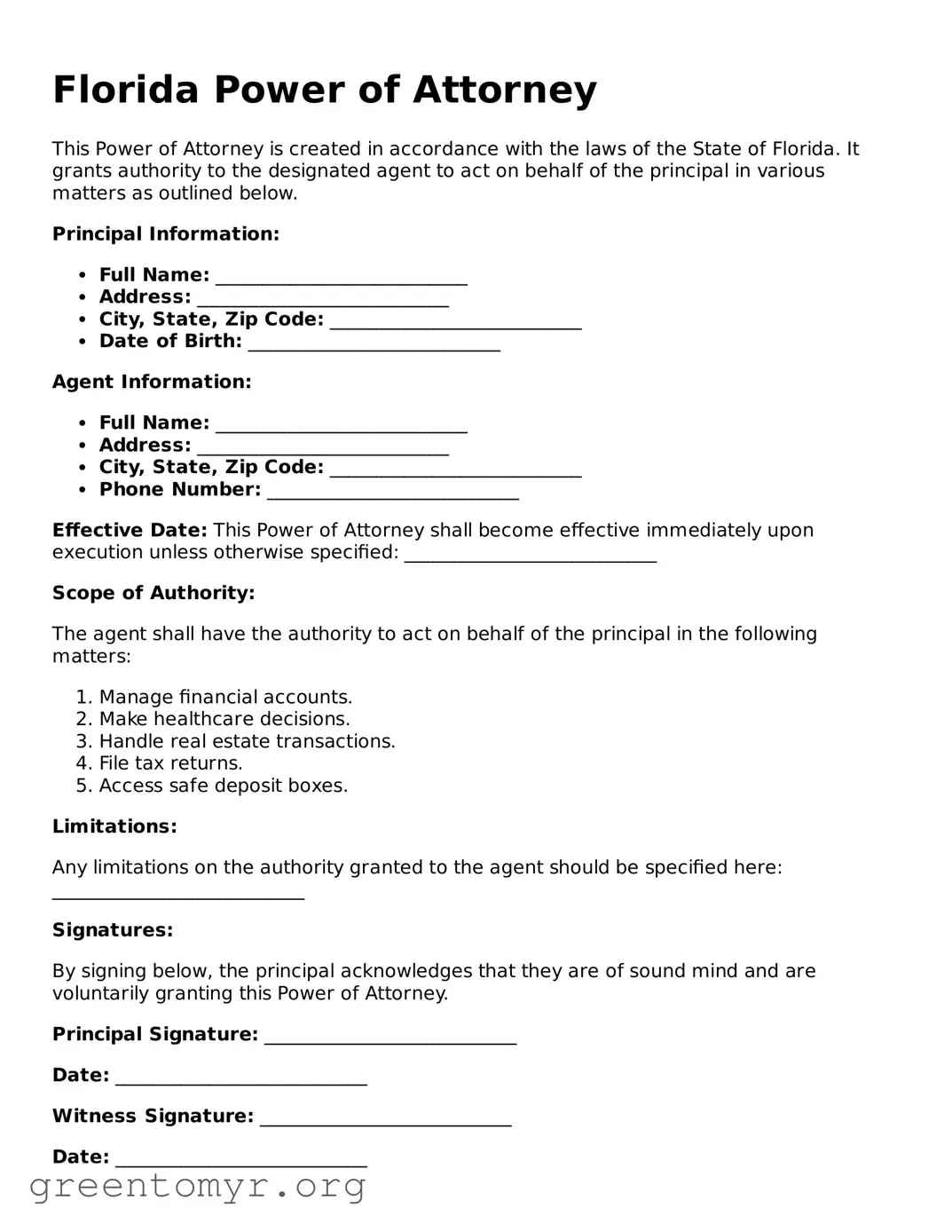
Florida Power of Attorney
This Power of Attorney is created in accordance with the laws of the State of Florida. It grants authority to the designated agent to act on behalf of the principal in various matters as outlined below.
Principal Information:
Agent Information:
Effective Date: This Power of Attorney shall become effective immediately upon execution unless otherwise specified: ___________________________
Scope of Authority:
The agent shall have the authority to act on behalf of the principal in the following matters:
Limitations:
Any limitations on the authority granted to the agent should be specified here: ___________________________
Signatures:
By signing below, the principal acknowledges that they are of sound mind and are voluntarily granting this Power of Attorney.
Principal Signature: ___________________________
Date: ___________________________
Witness Signature: ___________________________
Date: ___________________________
Notary Public:
State of Florida, County of ______________
Subscribed and sworn to before me this ____ day of __________, 20__.
Notary Signature: ___________________________
My Commission Expires: ___________________________
| Fact Name | Description |
|---|---|
| Definition | A Florida Power of Attorney form allows an individual (the principal) to grant authority to another person (the agent) to make decisions on their behalf. |
| Governing Law | The Florida Power of Attorney is governed by Florida Statutes, Chapter 709. |
| Durability | This form can be made durable, meaning it remains effective even if the principal becomes incapacitated. |
| Revocation | The principal can revoke the Power of Attorney at any time, as long as they are mentally competent. |
Filling out a Florida Power of Attorney form can seem daunting, but with careful attention to detail, you can complete it smoothly. Once you have filled out the form, it will need to be signed and witnessed according to Florida law. This ensures that your intentions are clear and legally recognized.
A Florida Power of Attorney is a legal document that allows one person (the principal) to authorize another person (the agent or attorney-in-fact) to act on their behalf in financial or legal matters. This can include managing bank accounts, signing documents, and making decisions about investments.
Any adult who is mentally competent can create a Power of Attorney in Florida. This means that the individual must understand the implications of granting authority to another person. It’s crucial to choose someone trustworthy, as they will have significant control over your affairs.
The powers granted can vary widely. They may include:
Additionally, the principal can specify limitations or conditions on the powers granted to the agent.
While it is not legally required to have a lawyer draft your Power of Attorney, consulting one is highly recommended. A legal professional can ensure that the document meets all state requirements and accurately reflects your wishes, helping to avoid potential disputes in the future.
Yes, a durable Power of Attorney remains valid even if the principal becomes incapacitated. This feature is what distinguishes a durable Power of Attorney from a regular one. It is essential to specify that the Power of Attorney is durable when creating the document to ensure it remains effective during periods of incapacity.
Yes, a principal can revoke a Power of Attorney at any time, as long as they are mentally competent. To revoke, the principal should create a written revocation document and notify the agent and any relevant institutions. It’s advisable to keep a copy of the revocation for your records.
To ensure recognition, it is important to provide a copy of the Power of Attorney to the institutions where the agent will be acting. Some institutions may have their own forms or specific requirements, so it’s wise to check with them beforehand. Keep in mind that certain entities may require the document to be notarized.
If you do not have a Power of Attorney and become incapacitated, a court may need to appoint a guardian to manage your affairs. This process can be lengthy, costly, and may not align with your preferences. Establishing a Power of Attorney allows you to choose someone you trust to make decisions on your behalf, providing peace of mind.
Filling out a Florida Power of Attorney form can be straightforward, but many individuals make common mistakes that can lead to complications. One frequent error is failing to specify the powers granted. The form allows for broad or limited powers, and not clearly defining these can lead to misunderstandings later.
Another mistake is neglecting to date the document. A Power of Attorney that is not dated may be considered invalid, which can create issues when the agent attempts to act on behalf of the principal.
Many people overlook the requirement for witnesses and notarization. In Florida, a Power of Attorney must be signed in the presence of two witnesses and a notary public. Skipping this step can render the document unenforceable.
Additionally, some individuals forget to provide the full legal names of both the principal and the agent. Using nicknames or incomplete names can lead to confusion and potential legal challenges.
Another common oversight is failing to indicate when the Power of Attorney becomes effective. It is crucial to specify whether the authority is effective immediately, upon a certain event, or if it is durable, meaning it remains in effect if the principal becomes incapacitated.
Some people do not review the document thoroughly before signing. It is essential to read the entire form to ensure that all information is accurate and that the powers granted align with the principal's intentions.
Another mistake involves not discussing the Power of Attorney with the chosen agent. Clear communication about expectations and responsibilities can help prevent misunderstandings and ensure that the agent acts in the principal's best interest.
People often forget to keep copies of the signed document. Maintaining copies is important for both the principal and the agent, as it provides a reference for the powers granted and can help avoid disputes.
Lastly, individuals sometimes neglect to update the Power of Attorney when circumstances change. Life events, such as marriage, divorce, or the death of a chosen agent, may necessitate revisions to the document to reflect current wishes.
When establishing a Power of Attorney (POA) in Florida, it’s often beneficial to consider additional documents that can complement or enhance the effectiveness of the POA. These documents serve various purposes, from ensuring medical decisions are made according to your wishes to providing clear instructions for your estate. Below is a list of common forms and documents that are frequently used alongside the Florida Power of Attorney form.
Incorporating these documents alongside your Florida Power of Attorney can help ensure that your wishes are respected and that your affairs are managed smoothly in times of need. Each document serves a specific purpose, contributing to a comprehensive plan for your health, finances, and legacy.
The Power of Attorney (POA) form is a vital legal document that grants one person the authority to act on behalf of another. While it serves a specific purpose, several other documents share similar functions or intentions. Below is a list of eight documents that have comparable characteristics to a Power of Attorney.
When filling out the Florida Power of Attorney form, it is important to follow certain guidelines to ensure the document is valid and effective. Here are six key things to do and avoid:
Understanding the Florida Power of Attorney form is crucial for anyone considering this legal document. However, several misconceptions can lead to confusion. Here are nine common misunderstandings:
By clarifying these misconceptions, individuals can make informed decisions about using a Florida Power of Attorney form effectively.
When filling out and using the Florida Power of Attorney form, it is essential to keep several key points in mind: