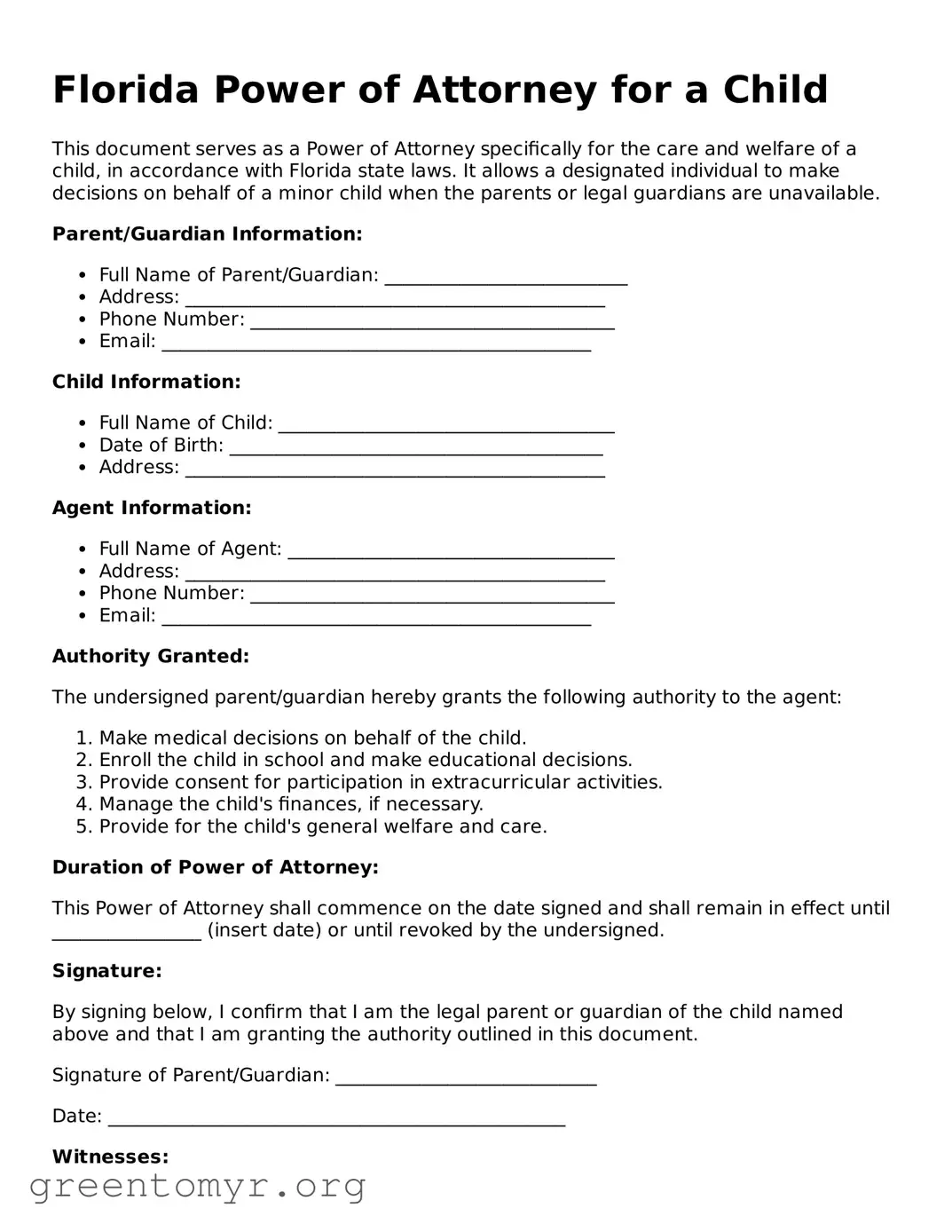
The Florida Power of Attorney for a Child form serves as a crucial legal document that allows a parent or legal guardian to designate another individual to make decisions on behalf of their child. This form is particularly useful in situations where the parent or guardian may be temporarily unavailable, such as during travel or medical emergencies. By completing this document, parents can grant authority for various responsibilities, including medical care, educational decisions, and general welfare matters. It is important to note that the form must be signed in the presence of a notary public to ensure its validity. Additionally, parents should be aware that the designated agent’s authority can be limited to specific tasks or time frames, providing flexibility based on the family's needs. Understanding the nuances of this form can help ensure that a child's best interests are prioritized when parents are unable to be present.
Florida Power of Attorney for a Child
This document serves as a Power of Attorney specifically for the care and welfare of a child, in accordance with Florida state laws. It allows a designated individual to make decisions on behalf of a minor child when the parents or legal guardians are unavailable.
Parent/Guardian Information:
Child Information:
Agent Information:
Authority Granted:
The undersigned parent/guardian hereby grants the following authority to the agent:
Duration of Power of Attorney:
This Power of Attorney shall commence on the date signed and shall remain in effect until ________________ (insert date) or until revoked by the undersigned.
Signature:
By signing below, I confirm that I am the legal parent or guardian of the child named above and that I am granting the authority outlined in this document.
Signature of Parent/Guardian: ____________________________
Date: _________________________________________________
Witnesses:
Two witnesses are required for this document to be valid.
Notary Public:
This document should be notarized to ensure its legality.
State of Florida, County of ________________
Subscribed and sworn before me this ______ day of __________, 20__.
Notary Public Signature: ________________________________
My Commission Expires: ________________________________
| Fact Name | Description |
|---|---|
| Definition | A Florida Power of Attorney for a Child form allows a parent or legal guardian to designate another individual to make decisions on behalf of their child. |
| Governing Law | This form is governed by Florida Statutes, Chapter 709, which outlines the laws regarding powers of attorney. |
| Purpose | The form is primarily used for temporary guardianship or to authorize another person to care for the child during the parent's absence. |
| Duration | The authority granted through this form can be limited to a specific time frame or until revoked by the parent or guardian. |
| Signatories | The form must be signed by the parent or legal guardian granting the power of attorney, and it may require witnesses or notarization. |
| Limitations | This power of attorney does not allow the designated individual to make decisions regarding the child's education or medical care unless specified. |
| Revocation | A parent or guardian can revoke the power of attorney at any time by providing written notice to the designated individual. |
| Emergency Situations | In emergencies, this form can facilitate quicker decision-making for the child's welfare when the parent is unavailable. |
| Eligibility | Any parent or legal guardian of a child under the age of 18 can complete this form to grant temporary authority. |
| Availability | The Florida Power of Attorney for a Child form can typically be found online or obtained from legal aid organizations. |
Filling out the Florida Power of Attorney for a Child form is a straightforward process. This document allows a parent or legal guardian to grant someone else the authority to make decisions on behalf of their child. Follow these steps carefully to complete the form correctly.
Once you have completed these steps, the form will be ready for use. Make sure to keep a copy for your records and provide copies to anyone involved in the child's care or decision-making process.
A Florida Power of Attorney for a Child is a legal document that allows a parent or legal guardian to delegate authority to another adult to make decisions on behalf of their child. This can include decisions related to education, healthcare, and general welfare. It is particularly useful when parents are unavailable due to travel, work commitments, or other reasons.
Any responsible adult can be appointed as an agent in the Power of Attorney for a Child. This could be a relative, family friend, or trusted neighbor. It is important to choose someone who is reliable and can act in the best interest of the child.
The Power of Attorney for a Child in Florida is generally valid until the specified end date mentioned in the document or until the parent or guardian revokes it. If no end date is specified, it may remain in effect until the child turns 18 years old. Always check the document for specific terms.
The agent can make a variety of decisions, including:
However, the extent of the authority granted should be clearly defined in the Power of Attorney document.
Yes, the Florida Power of Attorney for a Child must be signed in the presence of a notary public to be legally valid. This helps ensure that the document is executed properly and can be recognized by institutions such as schools and healthcare providers.
Yes, a parent or legal guardian can revoke the Power of Attorney at any time. To do so, a written notice of revocation should be provided to the agent and any relevant institutions. It is advisable to keep a copy of the revocation for personal records.
Filling out the Florida Power of Attorney for a Child form can be a straightforward process, but many people make common mistakes that can lead to complications. One frequent error is not providing complete information about the child. It's crucial to include the child's full name, date of birth, and any other identifying details to ensure clarity and avoid confusion.
Another mistake often seen is failing to specify the powers being granted. The form allows for a range of responsibilities, from medical decisions to educational choices. Not clearly outlining these powers can lead to misunderstandings later on. Be explicit about what the designated agent can and cannot do.
Many individuals also overlook the importance of signatures. Both the parent or guardian and the agent must sign the document. Neglecting to obtain the necessary signatures can render the form invalid. Always double-check that all required parties have signed before submitting the form.
Additionally, some people forget to have the form notarized. In Florida, notarization is typically required for the Power of Attorney to be legally binding. Skipping this step can lead to complications if the document is challenged or questioned.
Another common error is using outdated forms. Laws and regulations can change, and it's essential to use the most current version of the Power of Attorney for a Child form. Using an outdated form may result in it being rejected or not recognized.
Moreover, many individuals fail to communicate with the designated agent about their responsibilities. It’s vital to have a discussion with the person you are appointing to ensure they understand the role and are willing to accept it. Lack of communication can lead to confusion and potential conflicts.
People also sometimes neglect to keep copies of the completed form. After filling out the Power of Attorney, it’s important to retain copies for personal records. This can help in situations where proof of authority is needed.
Lastly, some individuals may not review the form thoroughly before submission. It’s easy to overlook small details, but taking the time to carefully review the document can prevent future issues. Ensure all information is accurate and complete to avoid any delays or complications.
When creating a Florida Power of Attorney for a Child, several other forms and documents may also be useful. These documents can help clarify responsibilities and ensure that the child's needs are met in various situations. Below is a list of commonly used forms that complement the Power of Attorney for a Child.
Each of these forms plays a crucial role in ensuring that the child's welfare is prioritized. It is important to consider which documents may be necessary based on individual circumstances and to ensure that all forms are properly completed and signed.
When filling out the Florida Power of Attorney for a Child form, there are some important things to keep in mind. Here’s a helpful list of what you should and shouldn’t do.
Many parents and guardians have questions about the Florida Power of Attorney for a Child form. Misunderstandings can lead to unnecessary complications. Here are six common misconceptions:
Understanding these misconceptions is crucial for making informed decisions about your child's care. Ensure that you have the correct information before proceeding.
Filling out and using the Florida Power of Attorney for a Child form can be straightforward, but it’s essential to understand its key components. Here are some important takeaways to consider:
Understanding these points can help ensure that the Power of Attorney for a Child form is filled out correctly and serves its intended purpose effectively.