When couples in Florida decide to get married, they often consider the importance of protecting their assets and clarifying their financial responsibilities through a prenuptial agreement. This legal document serves as a proactive measure, outlining how assets will be divided in the event of a divorce or separation. The Florida Prenuptial Agreement form typically includes key elements such as the identification of both parties, a detailed list of each individual's assets and debts, and the terms regarding property division and spousal support. Additionally, the form allows for the inclusion of provisions related to the management of future income and expenses, ensuring that both partners have a clear understanding of their financial rights and obligations. By addressing these important aspects before marriage, couples can foster open communication and reduce the potential for conflict later on. Understanding the nuances of the Florida Prenuptial Agreement form is essential for anyone considering this important step in their relationship.
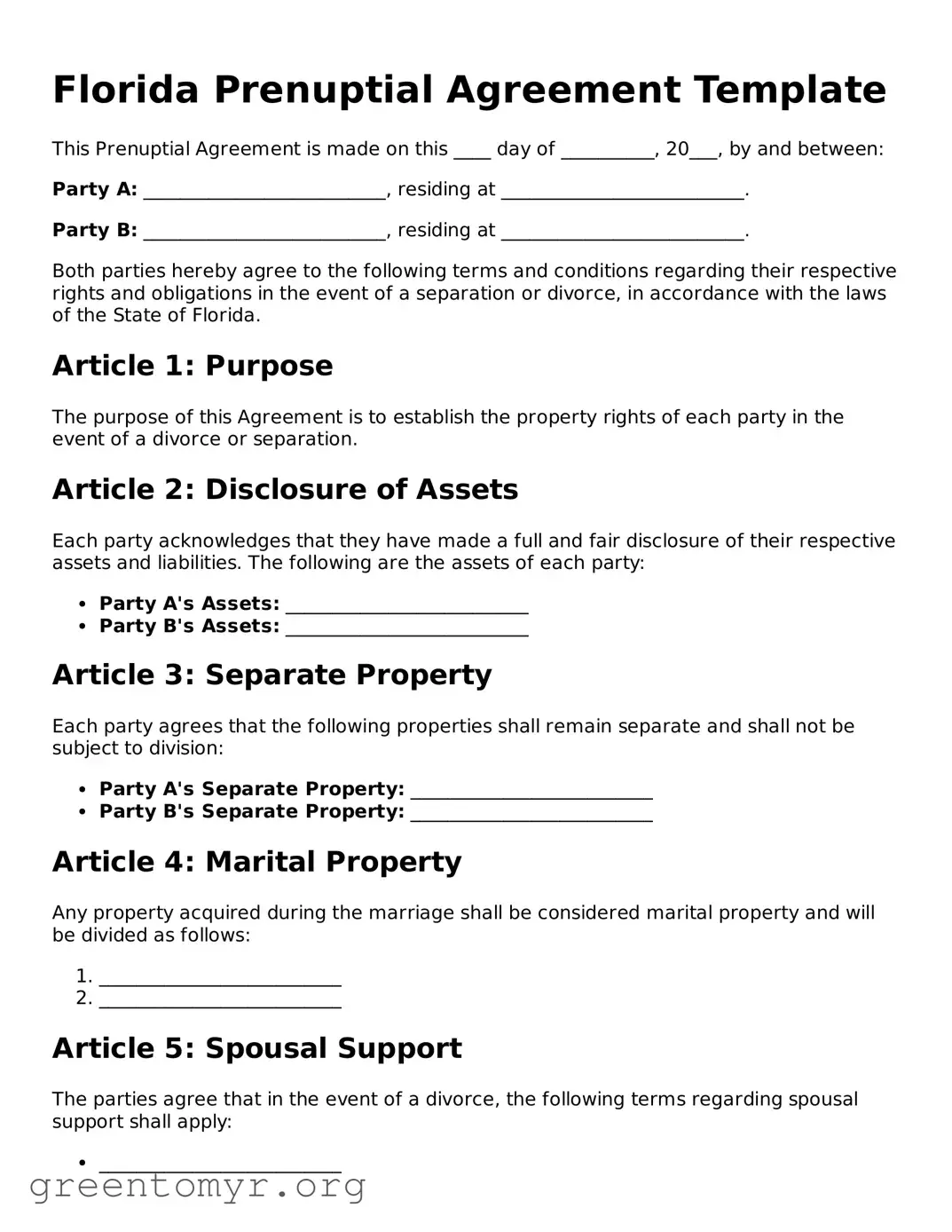
Florida Prenuptial Agreement Template
This Prenuptial Agreement is made on this ____ day of __________, 20___, by and between:
Party A: __________________________, residing at __________________________.
Party B: __________________________, residing at __________________________.
Both parties hereby agree to the following terms and conditions regarding their respective rights and obligations in the event of a separation or divorce, in accordance with the laws of the State of Florida.
Article 1: Purpose
The purpose of this Agreement is to establish the property rights of each party in the event of a divorce or separation.
Article 2: Disclosure of Assets
Each party acknowledges that they have made a full and fair disclosure of their respective assets and liabilities. The following are the assets of each party:
Article 3: Separate Property
Each party agrees that the following properties shall remain separate and shall not be subject to division:
Article 4: Marital Property
Any property acquired during the marriage shall be considered marital property and will be divided as follows:
Article 5: Spousal Support
The parties agree that in the event of a divorce, the following terms regarding spousal support shall apply:
Article 6: Governing Law
This Agreement shall be governed by and construed in accordance with the laws of the State of Florida.
Article 7: Amendments
This Agreement may only be amended in writing, signed by both parties.
Article 8: Signatures
By signing below, both parties acknowledge that they have read and understood this Prenuptial Agreement and agree to its terms.
Party A Signature: __________________________ Date: __________
Party B Signature: __________________________ Date: __________
Witness Signature: __________________________ Date: __________
Witness Signature: __________________________ Date: __________
| Fact Name | Description |
|---|---|
| Governing Law | The Florida Prenuptial Agreement is governed by Florida Statutes, Chapter 61.079. |
| Requirements | Both parties must voluntarily sign the agreement, and it should be in writing to be enforceable. |
| Full Disclosure | Each party must provide a fair and reasonable disclosure of their financial obligations and assets. |
| Enforceability | The agreement may be challenged in court if it is deemed unconscionable or if there was fraud or duress. |
Completing a Florida Prenuptial Agreement form involves several important steps to ensure that both parties' interests are protected. After filling out the form, each party will typically review the document with legal counsel before signing, ensuring that both understand their rights and obligations.
A Florida Prenuptial Agreement, often called a prenup, is a legal document that couples create before getting married. This agreement outlines how assets, debts, and other financial matters will be handled in the event of a divorce or separation. It helps clarify expectations and can protect individual interests.
Many couples find that a prenup provides peace of mind. Here are some reasons to consider one:
A prenup can cover various financial aspects, including:
However, it cannot dictate child custody or child support arrangements, as those matters are determined based on the best interests of the child.
While it's not legally required for both parties to have separate legal representation, it's highly recommended. Having independent legal advice ensures that both individuals fully understand their rights and obligations. This can also help prevent potential claims of coercion or unfairness in the agreement.
To create a valid prenup in Florida, follow these steps:
It’s important to do this well in advance of the wedding to avoid any claims of duress.
Yes, a prenuptial agreement can be modified or revoked after marriage. Both parties must agree to the changes, and it’s best to put these changes in writing and have them notarized to ensure clarity and legality.
If you choose not to create a prenup, Florida law will dictate how your assets and debts are divided in the event of a divorce. This could lead to outcomes that may not align with your expectations. It’s wise to consider the implications of not having an agreement.
Finding a lawyer who specializes in family law is essential. You can:
Schedule consultations to discuss your needs and see if the lawyer is a good fit for you.
Filling out a Florida Prenuptial Agreement form can be a straightforward process, but many people make common mistakes that can lead to complications down the line. One frequent error is not fully disclosing assets and debts. It’s essential to provide a complete picture of your financial situation. Omitting important information can lead to disputes later, potentially invalidating the agreement.
Another mistake is using vague or ambiguous language. Clarity is crucial in legal documents. If terms are not clearly defined, it can create confusion and lead to different interpretations. This might result in legal battles that could have been avoided with precise wording.
People often forget to consider future changes in circumstances. A prenuptial agreement should not only address current assets but also anticipate changes, such as career advancements or the birth of children. Failing to include provisions for these possibilities can render the agreement less effective as life evolves.
Lastly, many individuals neglect the importance of having independent legal representation. Each party should have their own attorney review the agreement. This ensures that both sides understand their rights and obligations. Without this step, one party may later claim they were pressured into signing, which could jeopardize the agreement’s validity.
A Florida Prenuptial Agreement is a crucial document for couples considering marriage, as it outlines the distribution of assets and responsibilities in the event of a divorce. However, several other forms and documents may complement this agreement to ensure a comprehensive understanding of each party's rights and obligations. Below is a list of commonly used documents alongside the Florida Prenuptial Agreement.
These documents serve as essential tools for couples to navigate their financial and legal responsibilities effectively. By understanding and utilizing these forms, individuals can create a more secure foundation for their marriage.
A Prenuptial Agreement is a legal document that outlines the terms of a couple's financial and personal arrangements before marriage. Several other documents serve similar purposes in different contexts. Here’s a list of nine documents that share similarities with a Prenuptial Agreement:
Each of these documents serves to clarify and protect the interests of individuals in various relationships, much like a prenuptial agreement does for engaged couples.
When filling out the Florida Prenuptial Agreement form, it is crucial to approach the process with care. Here are seven important guidelines to follow and avoid:
Following these guidelines can help ensure that your prenuptial agreement is valid and reflective of both parties' intentions.
Many people have misunderstandings about prenuptial agreements in Florida. Here are ten common misconceptions, along with clarifications.
This is not true. Anyone can benefit from a prenuptial agreement, regardless of their financial status. It helps clarify financial rights and responsibilities.
While they do outline what happens in case of divorce, they can also address financial matters during the marriage, providing clarity and preventing disputes.
Each agreement is unique and should reflect the specific needs and circumstances of the couple involved. Customization is key.
When properly drafted and executed, prenuptial agreements are legally binding and enforceable in Florida courts.
Couples can modify their prenuptial agreement at any time, as long as both parties agree to the changes and follow the proper legal procedures.
They can serve as a financial planning tool, helping couples understand their assets and liabilities before marriage.
Many individuals entering second or subsequent marriages choose to create prenuptial agreements to protect their assets and address potential complexities.
In reality, discussing a prenuptial agreement can foster open communication about finances, which is essential for a healthy relationship.
Florida law restricts certain topics in prenuptial agreements, such as child custody and child support, which must be determined based on the child’s best interests.
It’s best to start the process well in advance of the wedding. Rushed agreements may be challenged in court for lack of proper consideration or fairness.
Filling out and using the Florida Prenuptial Agreement form can be straightforward if you keep a few key points in mind. Here are some important takeaways:
By keeping these points in mind, couples can better navigate the process of creating a prenuptial agreement that meets their needs.