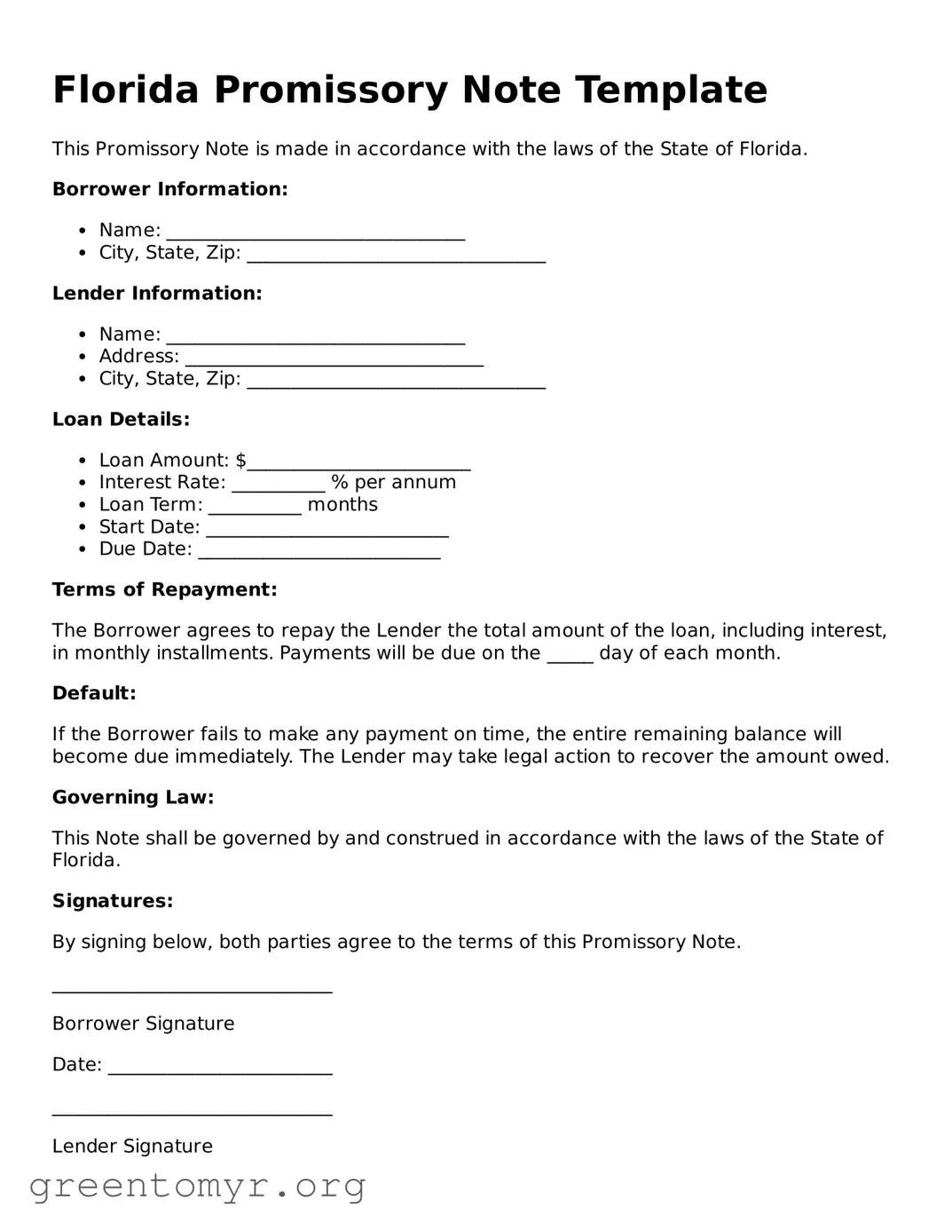
The Florida Promissory Note form serves as a crucial financial document in various lending situations, allowing individuals or businesses to formalize a loan agreement. This form outlines the borrower's promise to repay a specified amount of money to the lender, including details such as the interest rate, repayment schedule, and any applicable penalties for late payments. It is designed to protect both parties by clearly stating the terms of the loan, ensuring that the expectations are understood and legally enforceable. Additionally, the form may include provisions for prepayment and default, which can help mitigate potential disputes down the line. Whether used for personal loans, business financing, or real estate transactions, the Florida Promissory Note is an essential tool for establishing clear financial obligations and fostering trust between lenders and borrowers.
Florida Promissory Note Template
This Promissory Note is made in accordance with the laws of the State of Florida.
Borrower Information:
Lender Information:
Loan Details:
Terms of Repayment:
The Borrower agrees to repay the Lender the total amount of the loan, including interest, in monthly installments. Payments will be due on the _____ day of each month.
Default:
If the Borrower fails to make any payment on time, the entire remaining balance will become due immediately. The Lender may take legal action to recover the amount owed.
Governing Law:
This Note shall be governed by and construed in accordance with the laws of the State of Florida.
Signatures:
By signing below, both parties agree to the terms of this Promissory Note.
______________________________
Borrower Signature
Date: ________________________
______________________________
Lender Signature
Date: ________________________
| Fact Name | Description |
|---|---|
| Definition | A Florida Promissory Note is a written promise to pay a specific amount of money to a designated person or entity at a specified time. |
| Governing Law | The Florida Promissory Note is governed by the Florida Statutes, specifically Chapter 673, which pertains to negotiable instruments. |
| Key Elements | Essential components include the amount owed, interest rate (if applicable), payment terms, and signatures of the parties involved. |
| Enforceability | For a promissory note to be enforceable, it must be clear, complete, and signed by the borrower. |
| Types of Notes | There are various types of promissory notes, including secured and unsecured notes, each with different implications for repayment and collateral. |
After you have gathered all necessary information, you will be ready to fill out the Florida Promissory Note form. Make sure to complete the form accurately to ensure clarity and avoid any potential issues in the future.
Once you have completed the form, make sure to keep a copy for your records. It is important to provide the other party with their signed copy as well.
A Florida Promissory Note is a written promise to pay a specific amount of money to a lender at a designated time or on demand. It outlines the terms of the loan, including the interest rate, payment schedule, and any consequences for late payments or default.
Promissory Notes are commonly used by individuals, businesses, and financial institutions. They can be used in various situations, such as personal loans between friends or family, business loans, or real estate transactions.
A typical Florida Promissory Note includes:
Yes, a properly executed Promissory Note is a legally binding document. Once signed, both parties are obligated to adhere to its terms. If the borrower fails to make payments, the lender can take legal action to recover the owed amount.
While it is not required to have a lawyer draft a Promissory Note, it can be beneficial. A legal professional can ensure that the document complies with Florida laws and accurately reflects the intentions of both parties.
Yes, a Promissory Note can be modified if both the borrower and lender agree to the changes. It’s best to document any modifications in writing and have both parties sign the revised terms to avoid future disputes.
If the borrower defaults, the lender may take several actions, such as:
Each situation is unique, and the lender's response may vary based on the circumstances and the terms of the note.
Templates for Florida Promissory Notes can be found online through legal websites, or you can consult with a lawyer for a customized document. It’s important to ensure that any template used complies with Florida laws and meets your specific needs.
When filling out the Florida Promissory Note form, many individuals make common mistakes that can lead to confusion or legal complications. One of the most frequent errors is failing to include all necessary details about the borrower and lender. It is crucial to provide complete names, addresses, and contact information for both parties. Omitting this information can result in difficulties in enforcing the note later on.
Another common mistake is not specifying the loan amount clearly. The amount should be written both in numbers and words to avoid any ambiguity. If the figures do not match, it may create disputes regarding the actual loan amount. Always double-check that these details are accurate and consistent.
People often overlook the importance of stating the interest rate. Without this information, the terms of repayment can become unclear. It is essential to indicate whether the interest is fixed or variable and to specify the exact rate. This clarity helps prevent misunderstandings in the future.
Additionally, many individuals forget to include the repayment schedule. The Promissory Note should outline when payments are due and the duration of the loan. If the schedule is not clearly defined, it may lead to missed payments and potential legal issues.
Another mistake occurs when individuals fail to sign the document. A Promissory Note must be signed by both the borrower and the lender to be legally binding. Without these signatures, the note may not hold up in court, leaving the lender without recourse if the borrower defaults.
People sometimes neglect to consider the consequences of defaulting on the loan. The Promissory Note should include a clause that outlines what happens if the borrower fails to make payments. This clause can protect the lender's interests and provide clear steps for resolving any issues that may arise.
Lastly, individuals often do not keep a copy of the signed Promissory Note. It is essential for both parties to retain a copy for their records. This document serves as proof of the loan agreement and can be crucial if disputes occur in the future. Keeping organized records will facilitate smoother transactions and communications.
When dealing with a Florida Promissory Note, several other documents may come into play to ensure a complete understanding of the loan agreement. Each of these documents serves a specific purpose and can help clarify the terms and conditions of the loan. Below is a list of commonly used forms that accompany a Promissory Note.
Using these documents in conjunction with the Florida Promissory Note can provide clarity and protection for both parties involved in the loan. Understanding each form's role can help ensure a smoother transaction and reduce potential misunderstandings down the line.
When filling out the Florida Promissory Note form, attention to detail is crucial. Here are some important do's and don'ts to consider:
Understanding the Florida Promissory Note form is essential for anyone involved in lending or borrowing money in the state. However, several misconceptions can lead to confusion. Below is a list of common misunderstandings about this form, along with explanations to clarify each point.
By understanding these misconceptions, individuals can better navigate the process of creating and using a Florida Promissory Note. Clarity in these agreements can help protect the interests of both lenders and borrowers.
When filling out and using the Florida Promissory Note form, consider the following key takeaways:
Filling out the Florida Promissory Note form accurately is essential for protecting the interests of both parties involved in the loan agreement.