Content Navigation

The Florida Quitclaim Deed form serves as a crucial tool for property owners looking to transfer their interests in real estate without the complexities often associated with other types of deeds. This straightforward document allows the grantor, or the person transferring the property, to convey their rights to the grantee, the recipient, with minimal fuss. Unlike warranty deeds, which provide guarantees about the title's validity, a quitclaim deed offers no such assurances. This means that the grantee receives whatever interest the grantor has, if any, without any warranties. It is particularly useful in situations such as transferring property between family members, clearing up title issues, or during divorce settlements. Additionally, while the form itself is simple, it is important to ensure that it is filled out correctly and recorded with the appropriate county office to protect the interests of both parties involved. Understanding the implications and proper use of a quitclaim deed can help individuals navigate their property transactions with greater confidence.

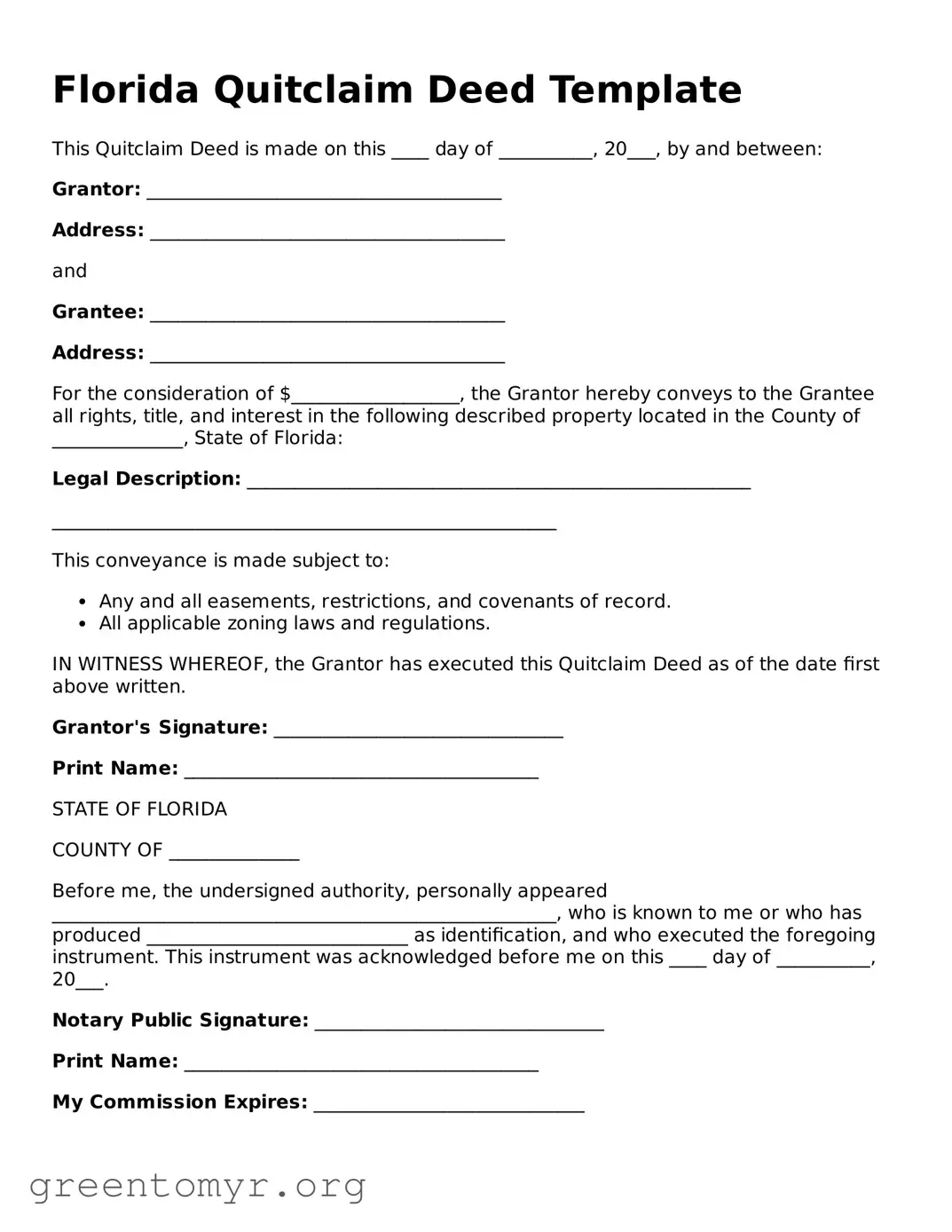
Florida Quitclaim Deed Example

Florida Quitclaim Deed Template

This Quitclaim Deed is made on this ____ day of __________, 20___, by and between:

Grantor: ______________________________________

Address: ______________________________________

and

Grantee: ______________________________________

Address: ______________________________________

For the consideration of $__________________, the Grantor hereby conveys to the Grantee all rights, title, and interest in the following described property located in the County of ______________, State of Florida:

Legal Description: ______________________________________________________

______________________________________________________

This conveyance is made subject to:

  • Any and all easements, restrictions, and covenants of record.
  • All applicable zoning laws and regulations.

IN WITNESS WHEREOF, the Grantor has executed this Quitclaim Deed as of the date first above written.

Grantor's Signature: _______________________________

Print Name: ______________________________________

STATE OF FLORIDA

COUNTY OF ______________

Before me, the undersigned authority, personally appeared ______________________________________________________, who is known to me or who has produced ____________________________ as identification, and who executed the foregoing instrument. This instrument was acknowledged before me on this ____ day of __________, 20___.

Notary Public Signature: _______________________________

Print Name: ______________________________________

My Commission Expires: _____________________________

PDF Form Features

Fact Name Description
Definition A Florida Quitclaim Deed transfers ownership of property without guaranteeing the title's validity.
Governing Law The Florida Quitclaim Deed is governed by Florida Statutes, Chapter 689.
Use Cases This deed is commonly used between family members or in divorce settlements.
No Warranty It does not provide any warranties about the property’s title. The buyer takes on any risks.
Execution Requirements The deed must be signed by the grantor and notarized to be valid.
Recording While not required, recording the deed with the county clerk is advisable for public notice.
Consideration Consideration is not required, but a nominal amount is often included for validity.
Tax Implications Transfer taxes may apply depending on the property's value and local regulations.
Revocation A quitclaim deed cannot be revoked once it has been executed and recorded.
Legal Advice Consulting a legal professional is recommended to understand implications fully.

Guide to Using Florida Quitclaim Deed

After completing the Florida Quitclaim Deed form, the next step involves submitting it to the appropriate county office for recording. This will ensure that the transfer of property is officially recognized. It is advisable to keep a copy of the recorded deed for your records.

  1. Begin by obtaining the Florida Quitclaim Deed form. This can be found online or at a local office supply store.
  2. Enter the name of the grantor (the person transferring the property) at the top of the form.
  3. Provide the name of the grantee (the person receiving the property) in the designated section.
  4. Fill in the property description. This includes the address and legal description of the property being transferred.
  5. Include the consideration amount, which is the value exchanged for the property. This may be a nominal amount, such as $10.
  6. Sign the form in the presence of a notary public. The notary will need to witness your signature.
  7. Have the grantee sign the form, if required, in the presence of a notary.
  8. Make copies of the completed and notarized deed for your records.
  9. Submit the original Quitclaim Deed to the county clerk’s office where the property is located for recording.

Get Answers on Florida Quitclaim Deed

What is a Florida Quitclaim Deed?

A Florida Quitclaim Deed is a legal document used to transfer ownership of real estate from one party to another without any warranties or guarantees. This type of deed is often used among family members or in situations where the parties know each other well. It effectively relinquishes any claim the grantor has to the property, but it does not guarantee that the grantor has clear title to the property.

When should I use a Quitclaim Deed?

Quitclaim Deeds are commonly used in various situations, including:

  • Transferring property between family members, such as parents to children.
  • Divorce settlements, where one spouse transfers their interest in a property to the other.
  • Adding or removing a name from the property title.
  • Transferring property into a trust or business entity.

What information is required to complete a Quitclaim Deed?

To complete a Quitclaim Deed in Florida, you will need the following information:

  1. The names and addresses of the grantor (the person transferring the property) and the grantee (the person receiving the property).
  2. A legal description of the property being transferred.
  3. The county where the property is located.
  4. The date of the transfer.

Do I need to have the Quitclaim Deed notarized?

Yes, in Florida, a Quitclaim Deed must be signed in the presence of a notary public. The notary will verify the identity of the signers and witness the signing of the document. This step is essential to ensure the deed is legally valid and can be recorded with the county clerk's office.

How do I record a Quitclaim Deed in Florida?

To record a Quitclaim Deed in Florida, follow these steps:

  1. After the deed is signed and notarized, make copies for your records.
  2. Visit the local county clerk's office where the property is located.
  3. Submit the original Quitclaim Deed along with any required fees for recording.
  4. Request a stamped copy of the recorded deed for your records.

Are there any tax implications when using a Quitclaim Deed?

While a Quitclaim Deed itself does not trigger taxes, there may be tax implications based on the circumstances of the transfer. For example, transferring property as a gift may have gift tax consequences. Additionally, if the property is sold or transferred for consideration, it may be subject to documentary stamp taxes. It is advisable to consult a tax professional for specific guidance related to your situation.

Common mistakes

Filling out a Florida Quitclaim Deed form can seem straightforward, but many people make critical mistakes that can lead to complications. One common error is failing to include the correct legal description of the property. This description must be precise and can often be found in the property’s original deed. Without this information, the deed may not be enforceable, and ownership could remain unclear.

Another frequent mistake is not having the deed properly notarized. In Florida, a Quitclaim Deed must be signed in front of a notary public to be valid. If the signature is not notarized, the deed may not be accepted by the county clerk’s office. This oversight can delay the transfer of property and create legal issues down the line.

Many people also overlook the importance of including all necessary parties in the deed. If there are multiple owners or if the property was inherited, all relevant parties must be named in the Quitclaim Deed. Failing to do so can result in disputes over ownership and may complicate future transactions.

Finally, individuals often neglect to check for outstanding liens or mortgages on the property before executing the deed. A Quitclaim Deed does not clear any existing debts associated with the property. If the property has liens, the new owner may be responsible for them. It’s crucial to conduct a title search to ensure a clear title before proceeding.

Documents used along the form

When dealing with property transfers in Florida, a Quitclaim Deed is often a key document. However, it is typically accompanied by several other forms and documents that help clarify ownership and ensure a smooth transaction. Here’s a list of some commonly used documents alongside the Quitclaim Deed.

  • Warranty Deed: This document guarantees that the seller holds clear title to the property and has the right to sell it. It offers more protection to the buyer compared to a Quitclaim Deed.
  • Title Search Report: A report that reveals the history of ownership and any liens or encumbrances on the property. This helps buyers confirm that the seller has the right to transfer ownership.
  • Property Appraisal: An assessment of the property’s market value, often required by lenders before approving a mortgage. This ensures that the buyer is not overpaying for the property.
  • Affidavit of Identity: A sworn statement verifying the identity of the parties involved in the transaction. This can help prevent fraud and ensure that the correct individuals are signing the deed.
  • Transfer Tax Form: A form used to calculate and report any taxes due on the transfer of property. In Florida, this tax is typically based on the sale price of the property.
  • Closing Statement: A detailed account of all financial transactions related to the sale, including costs, fees, and adjustments. This document is crucial for both buyers and sellers to understand their financial obligations.
  • Homeowners Association (HOA) Documents: If the property is part of an HOA, these documents outline the rules, regulations, and fees associated with the community. Buyers should review these to ensure compliance and understand their responsibilities.
  • Power of Attorney: A legal document allowing one person to act on behalf of another in legal matters. This can be particularly useful if one party cannot be present during the closing process.

Each of these documents plays a vital role in the property transfer process. By understanding their purpose and importance, individuals can navigate real estate transactions more confidently and effectively.

Similar forms

  • Warranty Deed: This document transfers ownership of real estate and guarantees that the grantor holds clear title to the property. Unlike a quitclaim deed, a warranty deed offers protection to the buyer against any future claims on the property.
  • Grant Deed: Similar to a warranty deed, a grant deed conveys property ownership. It assures the grantee that the property has not been sold to anyone else and that there are no undisclosed encumbrances. However, it does not provide the same level of protection as a warranty deed.
  • Deed of Trust: This document is used in real estate transactions to secure a loan. It involves three parties: the borrower, the lender, and a trustee. While it does not transfer ownership outright, it allows the lender to take possession of the property if the borrower defaults on the loan.
  • Bill of Sale: This document is used to transfer ownership of personal property rather than real estate. It serves as proof of sale and outlines the terms of the transaction. Unlike a quitclaim deed, a bill of sale does not deal with real property but focuses on tangible goods.

Dos and Don'ts

When filling out a Florida Quitclaim Deed form, it is important to approach the task carefully. Here is a list of things you should and shouldn't do:

  • Do ensure that all names are spelled correctly.
  • Do include the correct legal description of the property.
  • Do sign the document in the presence of a notary public.
  • Do check for any applicable state or county fees for filing.
  • Do keep a copy of the completed deed for your records.
  • Don't leave any required fields blank.
  • Don't use outdated forms; always use the latest version.
  • Don't forget to date the document.
  • Don't assume that a Quitclaim Deed is the same as a Warranty Deed.

By following these guidelines, you can help ensure that your Quitclaim Deed is completed accurately and effectively.

Misconceptions

When it comes to the Florida Quitclaim Deed form, there are several misconceptions that can lead to confusion. Understanding these can help clarify its purpose and use. Below are ten common misconceptions:

  1. Quitclaim deeds transfer ownership without guarantees. Many believe that a quitclaim deed provides a guarantee of clear title. In reality, it only transfers whatever interest the grantor has, if any.
  2. Quitclaim deeds are only for transferring property between family members. While often used in family transactions, quitclaim deeds can be used in various situations, including sales and transfers between strangers.
  3. Using a quitclaim deed eliminates the need for a title search. Some think that because quitclaim deeds do not guarantee clear title, a title search is unnecessary. However, it is still wise to conduct a title search to uncover any potential issues.
  4. Quitclaim deeds are only valid if notarized. While notarization is important, the deed must also be properly executed and recorded to be effective.
  5. All quitclaim deeds must be filed with the county clerk. This is a common belief, but while it is advisable to file the deed for public record, it is not a legal requirement in all cases.
  6. Quitclaim deeds are only used for residential properties. This form can be used for any type of real estate, including commercial properties and vacant land.
  7. Once a quitclaim deed is signed, it cannot be revoked. Some think that signing a quitclaim deed is final. However, it can be revoked or challenged in certain circumstances.
  8. Quitclaim deeds are complicated legal documents. Many people assume that these forms are complex. In fact, they are relatively straightforward and easy to understand.
  9. Quitclaim deeds do not require any specific language. While the form can be simple, it must include certain elements to be legally valid, such as the names of the parties and a description of the property.
  10. Using a quitclaim deed avoids taxes. Some believe that using a quitclaim deed means they can avoid property taxes. However, tax implications can still apply, depending on the circumstances of the transfer.

Understanding these misconceptions can help individuals make informed decisions when considering the use of a quitclaim deed in Florida.

Key takeaways

Here are some important points to consider when filling out and using the Florida Quitclaim Deed form:

  • Understand the Purpose: A Quitclaim Deed transfers ownership interest in property without guaranteeing the title's validity. It’s often used between family members or in divorce settlements.
  • Gather Necessary Information: Before filling out the form, collect all required details, including the names of the grantor (the person giving up the interest) and the grantee (the person receiving the interest), along with the property description.
  • Complete the Form Accurately: Fill in all sections of the Quitclaim Deed carefully. Any errors or omissions can lead to complications in the transfer process.
  • Sign in the Presence of a Notary: The deed must be signed by the grantor in front of a notary public. This step is crucial for the document to be legally binding.
  • File with the County Clerk: After notarization, submit the Quitclaim Deed to the county clerk’s office where the property is located. This ensures the transfer is recorded officially.
  • Keep Copies for Your Records: Always retain copies of the completed Quitclaim Deed for your personal records. This can be important for future reference or legal matters.