In Florida, the Release of Liability form serves as a crucial document designed to protect businesses and individuals from legal claims arising from injuries or damages that may occur during activities or events. This form outlines the understanding between the parties involved, where one party agrees to relinquish their right to sue the other for any potential risks associated with the activity. By signing this document, participants acknowledge the inherent risks and voluntarily accept them, which can significantly limit liability for the provider of the activity. It is important to note that while the form can provide legal protection, it must be drafted clearly and comprehensively to be enforceable. Specific details such as the nature of the activity, potential risks, and the parties involved should be included to ensure clarity and mutual understanding. Additionally, proper execution of the form, including signatures and dates, is essential for its validity. Understanding these key elements can help individuals and businesses navigate the complexities of liability and ensure a safer environment for all participants.
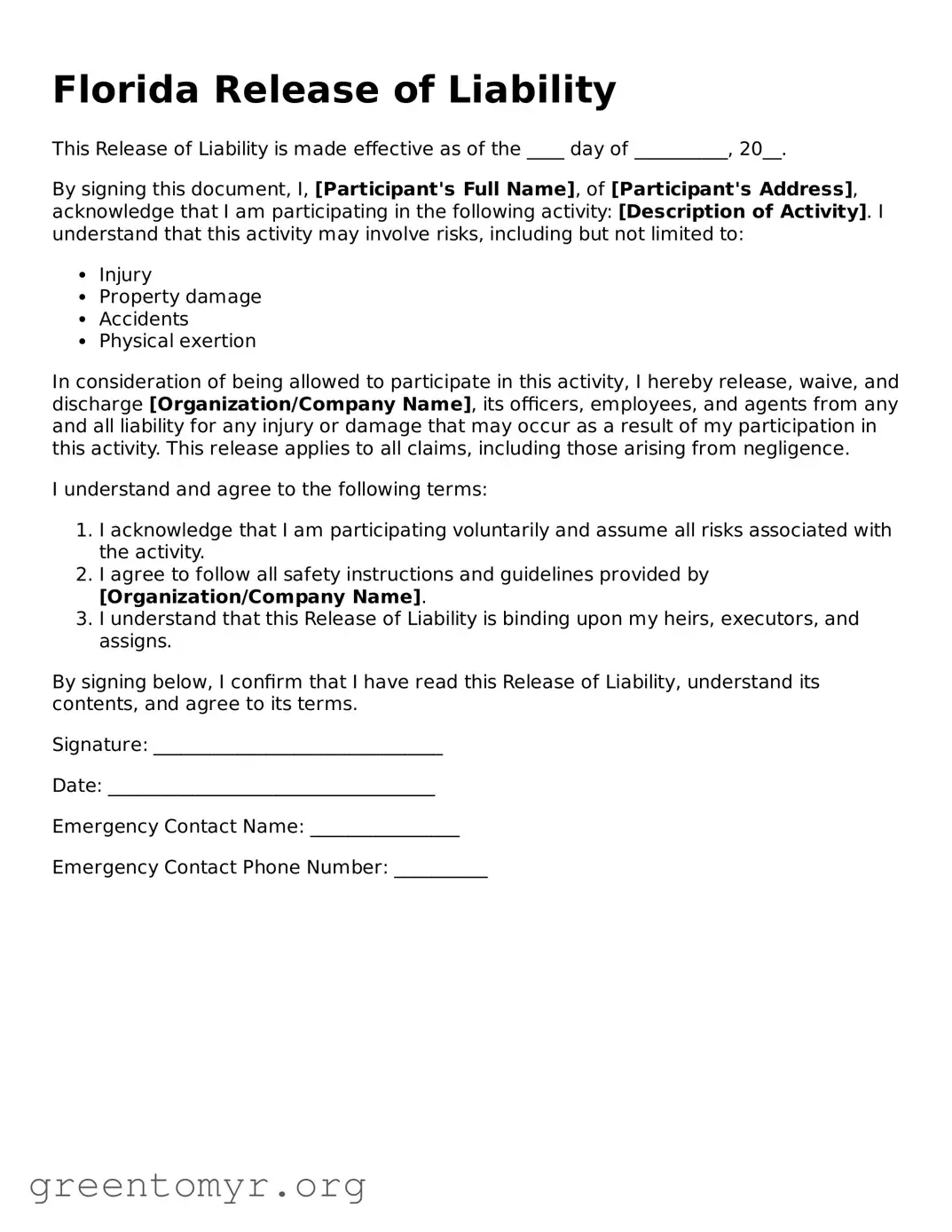
Florida Release of Liability
This Release of Liability is made effective as of the ____ day of __________, 20__.
By signing this document, I, [Participant's Full Name], of [Participant's Address], acknowledge that I am participating in the following activity: [Description of Activity]. I understand that this activity may involve risks, including but not limited to:
In consideration of being allowed to participate in this activity, I hereby release, waive, and discharge [Organization/Company Name], its officers, employees, and agents from any and all liability for any injury or damage that may occur as a result of my participation in this activity. This release applies to all claims, including those arising from negligence.
I understand and agree to the following terms:
By signing below, I confirm that I have read this Release of Liability, understand its contents, and agree to its terms.
Signature: _______________________________
Date: ___________________________________
Emergency Contact Name: ________________
Emergency Contact Phone Number: __________
| Fact Name | Description |
|---|---|
| Purpose | The Florida Release of Liability form is designed to protect businesses and individuals from legal claims arising from injuries or damages that occur during an activity. |
| Voluntary Participation | Participants must voluntarily agree to the terms of the release, indicating their understanding and acceptance of the risks involved. |
| Governing Law | This form is governed by Florida law, particularly under the principles of contract law and liability waivers. |
| Clarity and Specificity | The language used in the form should be clear and specific to ensure that participants fully understand what rights they are relinquishing. |
| Age Requirement | Individuals signing the form must be at least 18 years old, or a parent or guardian must sign on behalf of minors. |
| Enforceability | For the release to be enforceable, it must be signed willingly and without coercion, and it should not violate public policy. |
| Scope of Release | The form typically covers a wide range of activities and potential risks, but it cannot absolve parties from gross negligence or willful misconduct. |
Filling out the Florida Release of Liability form is an important step in ensuring that all parties involved understand their rights and responsibilities. This process requires careful attention to detail. Once the form is completed, it will be ready for submission, allowing for the next steps in your engagement or activity.
A Florida Release of Liability form is a legal document that allows one party to waive their right to sue another party for potential injuries or damages that may occur during a specific activity or event. This form is often used in recreational activities, sports, or events where there is a risk of injury.
This form is typically used by organizations, businesses, or individuals who conduct activities that could result in injury. Examples include sports leagues, recreational facilities, and event organizers. Participants in these activities may also be asked to sign this form to acknowledge the risks involved.
A comprehensive Release of Liability form generally includes the following components:
Yes, a Release of Liability form can be legally binding in Florida, provided it meets certain legal requirements. The form must be clear, specific, and voluntarily signed by all parties. However, there are limitations. For instance, it may not be enforceable if it attempts to waive liability for gross negligence or intentional misconduct.
Minors cannot legally sign contracts, including a Release of Liability form. Instead, a parent or legal guardian must sign on behalf of the minor. This signature acknowledges the risks and waives liability for activities involving the minor.
If an individual is injured after signing a Release of Liability form, the enforceability of the form will depend on the circumstances surrounding the injury and the specifics of the form. Courts may consider factors such as whether the injury was due to negligence or if the risks were adequately communicated.
Once signed, a Release of Liability form is generally considered binding. However, it may be possible to revoke it under certain conditions, such as a mutual agreement between the parties involved or if the activity is significantly altered. It is advisable to consult with a legal professional in such cases.
Florida law does not have a specific statute governing Release of Liability forms, but general contract law principles apply. Courts in Florida will evaluate these forms based on contract enforceability, public policy considerations, and the nature of the activity involved.
To ensure effectiveness, consider the following steps:
Florida Release of Liability forms can be obtained from various sources, including legal websites, law firms, or online document services. It is essential to ensure that the form is tailored to your specific needs and complies with Florida law.
When filling out the Florida Release of Liability form, individuals often overlook critical details that can lead to complications down the road. One common mistake is failing to read the entire document thoroughly. Many people skim through the text, missing important clauses that outline their rights and responsibilities. This lack of attention can result in unintended waivers of rights.
Another frequent error is not providing accurate personal information. Names, addresses, and contact details must be correct to ensure that the form is legally binding. A simple typo can create confusion and potentially invalidate the release. Always double-check this information before submission.
People also tend to neglect the date on the form. Omitting the date or entering an incorrect one can cause issues, especially if a dispute arises later. It is essential to record the date accurately to establish when the agreement was made.
Additionally, some individuals fail to understand the scope of the release. They may sign the form without realizing what activities or risks they are waiving their rights against. It is crucial to comprehend the implications of the release fully. Ignorance of what is being waived can lead to significant legal challenges.
Another mistake is not having witnesses or notarization when required. Certain situations may necessitate a witness signature or notary public to validate the release. Skipping this step can weaken the document's enforceability.
People often forget to specify the parties involved in the agreement. Clearly identifying the parties helps avoid ambiguity and ensures that all involved understand their roles and responsibilities. Leaving this out can lead to disputes about who is protected under the release.
Some individuals may also fail to consider the consequences of signing the release. They might not fully grasp that by signing, they are giving up their right to sue for injuries or damages that may occur during the specified activities. This lack of understanding can lead to regret after an incident occurs.
Furthermore, individuals sometimes neglect to keep a copy of the signed form for their records. Having a personal copy is vital for reference in case any issues arise later. Without it, proving the terms of the agreement can become challenging.
Lastly, failing to consult with a legal expert can be a significant oversight. Legal advice can provide clarity on the implications of the release and ensure that the form is filled out correctly. Consulting with a professional can help avoid many of the pitfalls associated with this important document.
The Florida Release of Liability form is often used in various situations to protect individuals and organizations from legal claims. Along with this form, several other documents may be necessary to ensure comprehensive protection and clarity. Here are five common forms that are frequently used in conjunction with the Release of Liability.
Using these documents alongside the Florida Release of Liability form can help clarify responsibilities and protect all parties involved. Each form serves a specific purpose and contributes to a safer environment for activities and events.
Waiver of Liability: Similar to a Release of Liability form, a Waiver of Liability is a document in which an individual relinquishes their right to sue for injuries or damages that may occur during an activity. Both documents aim to protect the party offering the activity from legal claims.
Indemnity Agreement: An Indemnity Agreement requires one party to compensate another for harm or loss. Like a Release of Liability, it shifts the risk from one party to another, ensuring that the indemnifying party assumes responsibility for certain liabilities.
Assumption of Risk Form: This form acknowledges that participants understand the risks associated with an activity. It is similar to a Release of Liability in that it informs participants about potential dangers and seeks to limit the liability of the organizer.
Consent Form: A Consent Form is often used in medical or research settings to ensure that individuals are aware of and agree to the procedures they will undergo. Like a Release of Liability, it seeks to protect the provider from legal claims related to consent issues.
Service Agreement: A Service Agreement outlines the terms of a service being provided. It may include clauses that limit liability, similar to a Release of Liability, ensuring that the service provider is not held responsible for certain outcomes.
Contractual Liability Clause: This clause is often included in contracts to define the extent of liability for each party. It serves a similar purpose as a Release of Liability by establishing boundaries for legal responsibility in case of an incident.
Non-Disclosure Agreement (NDA): While primarily focused on confidentiality, an NDA may also include provisions that limit liability regarding the use of disclosed information. This aspect aligns with the protective nature of a Release of Liability.
Release of Claims Form: This document allows individuals to release any claims they may have against another party. It functions similarly to a Release of Liability by preventing future legal actions related to specified claims.
Parental Consent Form: Often used in activities involving minors, a Parental Consent Form seeks permission from a parent or guardian. It may include language that limits liability, akin to a Release of Liability, by ensuring that parents acknowledge risks.
Settlement Agreement: A Settlement Agreement resolves disputes and often includes terms that release one or more parties from future claims. This document shares similarities with a Release of Liability in its goal of limiting legal exposure.
When filling out the Florida Release of Liability form, it's important to follow certain guidelines to ensure the document is valid and serves its intended purpose. Here’s a list of things you should and shouldn't do:
By following these guidelines, you can help ensure that your Release of Liability form is completed correctly and effectively protects your interests.
Many people have misunderstandings about the Florida Release of Liability form. Here are five common misconceptions, along with clarifications to help you understand its purpose and limitations.
Misconception 1: A Release of Liability form completely protects a business from all legal claims.
This is not true. While the form can limit liability for certain activities, it does not provide blanket immunity. If a business is found to be grossly negligent or engages in willful misconduct, the form may not hold up in court.
Misconception 2: Signing the form means you cannot sue under any circumstances.
This is misleading. Signing the form generally means you agree not to hold the business liable for specific risks associated with an activity. However, it does not prevent you from pursuing legal action if the business acts irresponsibly or fails to meet safety standards.
Misconception 3: A Release of Liability form is only necessary for high-risk activities.
While these forms are commonly used in high-risk situations, they can also be beneficial for lower-risk activities. Any business that wants to clarify liability should consider using one, regardless of the perceived risk level.
Misconception 4: The form is legally binding in all situations.
This is not always the case. Courts may not enforce a Release of Liability if it is deemed unconscionable or if the language is unclear. The enforceability can also depend on the specific circumstances surrounding the signing of the form.
Misconception 5: You can create your own Release of Liability form without legal guidance.
While it is possible to draft your own form, it is advisable to seek legal guidance. A poorly written form may not provide the intended protection and could lead to misunderstandings or legal challenges later on.
Filling out and using the Florida Release of Liability form is important for protecting yourself and your interests. Here are some key takeaways to keep in mind:
By following these guidelines, you can effectively use the Florida Release of Liability form to safeguard your interests.