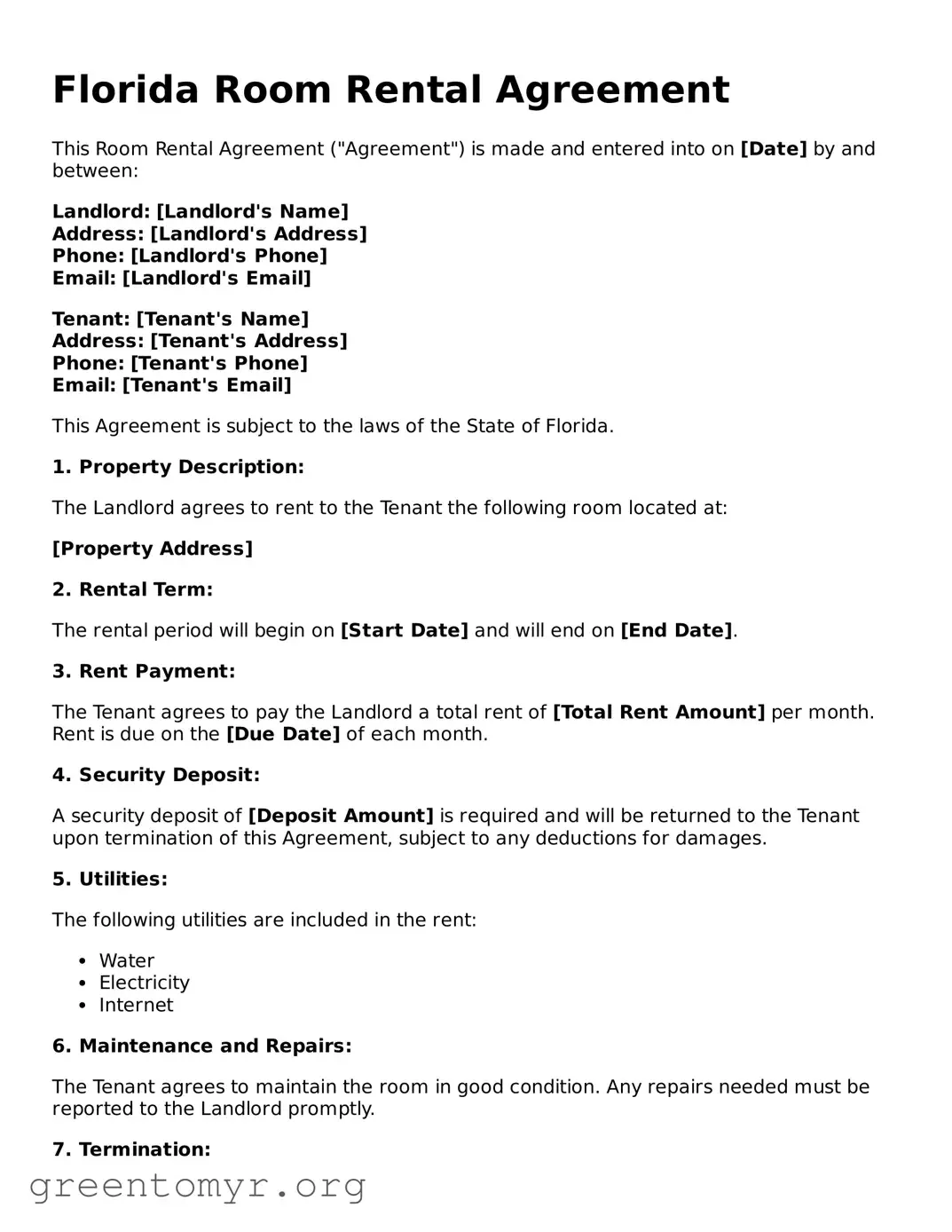
When renting a room in Florida, having a clear and comprehensive Room Rental Agreement is essential for both landlords and tenants. This important document outlines the terms of the rental arrangement, ensuring that both parties understand their rights and responsibilities. Key aspects typically covered in the agreement include the rental amount, payment due dates, security deposits, and the duration of the lease. Additionally, it often details rules regarding maintenance, utilities, and any restrictions on property use. By establishing these guidelines, the Room Rental Agreement fosters a transparent relationship, minimizing the potential for misunderstandings or disputes down the line. Understanding this form is crucial for anyone involved in a room rental situation in Florida, as it lays the groundwork for a successful and harmonious living arrangement.
Florida Room Rental Agreement
This Room Rental Agreement ("Agreement") is made and entered into on [Date] by and between:
Landlord: [Landlord's Name]
Address: [Landlord's Address]
Phone: [Landlord's Phone]
Email: [Landlord's Email]
Tenant: [Tenant's Name]
Address: [Tenant's Address]
Phone: [Tenant's Phone]
Email: [Tenant's Email]
This Agreement is subject to the laws of the State of Florida.
1. Property Description:
The Landlord agrees to rent to the Tenant the following room located at:
[Property Address]
2. Rental Term:
The rental period will begin on [Start Date] and will end on [End Date].
3. Rent Payment:
The Tenant agrees to pay the Landlord a total rent of [Total Rent Amount] per month. Rent is due on the [Due Date] of each month.
4. Security Deposit:
A security deposit of [Deposit Amount] is required and will be returned to the Tenant upon termination of this Agreement, subject to any deductions for damages.
5. Utilities:
The following utilities are included in the rent:
6. Maintenance and Repairs:
The Tenant agrees to maintain the room in good condition. Any repairs needed must be reported to the Landlord promptly.
7. Termination:
Either party may terminate this Agreement with [Notice Period] written notice.
8. Governing Law:
This Agreement shall be governed by the laws of the State of Florida.
By signing below, both parties agree to the terms outlined in this Room Rental Agreement.
Landlord Signature: ___________________________ Date: _______________
Tenant Signature: ___________________________ Date: _______________
| Fact Name | Description |
|---|---|
| Purpose | The Florida Room Rental Agreement form outlines the terms and conditions for renting a room in Florida. |
| Governing Law | This agreement is governed by Florida state laws, particularly the Florida Residential Landlord and Tenant Act. |
| Parties Involved | The agreement typically involves a landlord and a tenant, each with specific rights and responsibilities. |
| Duration | The rental agreement specifies the duration of the lease, which can be short-term or long-term. |
| Rent Amount | The form clearly states the rent amount due, including payment methods and due dates. |
| Security Deposit | A security deposit is often required, and the agreement details the amount and conditions for its return. |
| Maintenance Responsibilities | The agreement outlines who is responsible for maintenance and repairs during the rental period. |
| Termination Conditions | Conditions under which the agreement can be terminated by either party are clearly defined. |
| Utilities | Information regarding which utilities are included in the rent and which are the tenant's responsibility is provided. |
| Signatures | Both parties must sign the agreement to make it legally binding, indicating their acceptance of the terms. |
Filling out the Florida Room Rental Agreement form is an important step in securing your rental. Follow the instructions carefully to ensure all necessary information is provided accurately.
Once you have completed the form, review it to ensure all information is correct. This will help avoid any issues in the rental process.
A Florida Room Rental Agreement is a legal document that outlines the terms and conditions for renting a room in Florida. This agreement protects both the landlord and tenant by clearly defining the rights and responsibilities of each party. It typically includes details such as rental amount, duration of the lease, security deposit, and rules regarding the use of the property.
The Room Rental Agreement should contain several key elements to ensure clarity and legal compliance. Important components include:
The security deposit is typically collected at the beginning of the rental period. It serves as a financial safeguard for the landlord against potential damages or unpaid rent. According to Florida law, landlords must return the security deposit within 15 days after the tenant vacates the property, unless there are valid deductions. If deductions are made, the landlord must provide an itemized list of those deductions.
Yes, the Room Rental Agreement can be modified after it has been signed, but both parties must agree to any changes. Modifications should be documented in writing and signed by both the landlord and tenant to avoid any disputes later on. Verbal agreements are generally not enforceable, so it’s best to keep everything in writing.
If a tenant breaks the lease, the landlord may have the right to seek damages. This could include retaining the security deposit or pursuing additional compensation for lost rent until a new tenant is found. However, the specific consequences depend on the terms outlined in the rental agreement and Florida law. Tenants should review the agreement carefully and consider discussing their situation with a legal professional if they are unable to fulfill their lease obligations.
Filling out a Florida Room Rental Agreement form can seem straightforward, but many people make common mistakes that can lead to misunderstandings or legal issues down the line. One frequent error is neglecting to include all the necessary personal information. Renters and landlords alike should ensure that their full names, addresses, and contact details are accurately listed. Missing this information can create confusion and make communication difficult.
Another mistake often made is not specifying the rental term clearly. Whether it’s a month-to-month arrangement or a fixed-term lease, clarity is essential. If the rental term is ambiguous, it can lead to disputes regarding when the agreement starts and ends. Always be precise about the dates to avoid any potential conflicts.
People sometimes forget to detail the rent amount and payment schedule. It's important to state how much rent is due, when it is due, and the accepted payment methods. Leaving this information vague can result in misunderstandings about payment expectations, which could lead to late fees or eviction notices.
Additionally, many individuals overlook the importance of outlining security deposits. The agreement should specify the amount of the security deposit, the conditions under which it may be withheld, and the timeline for its return after the lease ends. Without this clarity, disputes can arise regarding the return of funds.
Another common oversight involves the rules and responsibilities concerning maintenance and repairs. Both parties should agree on who is responsible for maintaining the property and handling repairs. If this is not clearly defined, it can lead to frustration and disagreements later on.
Some renters and landlords forget to include terms regarding pets. If pets are allowed, the agreement should specify any associated fees or rules. Conversely, if pets are prohibited, this should be clearly stated to avoid future issues.
People also sometimes neglect to address what happens in the event of a breach of contract. It’s crucial to outline the steps that will be taken if either party fails to meet their obligations. Without this information, resolving disputes can become complicated and stressful.
Another mistake is failing to include signatures and dates. Both parties must sign the agreement to make it legally binding. Forgetting this step can render the entire document ineffective, leaving both parties unprotected.
Lastly, many individuals do not read the entire agreement thoroughly before signing. Taking the time to review the entire document ensures that all terms are understood and agreed upon. Skimming through the agreement can lead to overlooking important clauses that could affect both parties in the future.
The Florida Room Rental Agreement form is often accompanied by various other documents that help clarify the terms of the rental and protect the interests of both the landlord and tenant. Below is a list of commonly used forms and documents in conjunction with the Room Rental Agreement.
These documents, when used alongside the Florida Room Rental Agreement, contribute to a clearer understanding of the rental relationship and help ensure that both parties are aware of their rights and responsibilities.
Lease Agreement: A lease agreement outlines the terms and conditions under which a tenant rents property from a landlord. Like a room rental agreement, it specifies the rental amount, duration of the lease, and responsibilities of both parties.
Sublease Agreement: A sublease agreement allows a tenant to rent out a portion or all of their rented space to another person. Similar to a room rental agreement, it includes details about the rent, duration, and obligations of the subtenant.
Rental Application: A rental application is used by landlords to screen potential tenants. It collects personal information and rental history. This document serves as a precursor to a room rental agreement, as it helps determine if the applicant qualifies for rental.
Move-In Checklist: A move-in checklist is used to document the condition of the rental property before a tenant moves in. Like a room rental agreement, it protects both parties by providing a record of the property's state at the start of the tenancy.
Security Deposit Agreement: A security deposit agreement details the terms regarding the security deposit collected from the tenant. This document is similar to a room rental agreement, as it outlines the amount, conditions for return, and reasons for possible deductions.
When filling out the Florida Room Rental Agreement form, it's important to be careful and thorough. Here are some dos and don'ts to keep in mind:
Many people have misunderstandings about the Florida Room Rental Agreement form. Here are seven common misconceptions:
This is incorrect. The Florida Room Rental Agreement is specific to certain types of rentals and may not be suitable for every situation. Always check the details to ensure it fits your needs.
Changes to the agreement require mutual consent from both parties. Modifying the terms without agreement can lead to disputes.
A signature from both the landlord and tenant is necessary for the agreement to be legally binding. Without signatures, the agreement may not hold up in court.
While many terms can be negotiated, some aspects of the agreement are fixed by law or property policies. It's important to understand what can and cannot be changed.
This is a misconception. The agreement is designed to protect both parties by outlining rights and responsibilities clearly.
Verbal agreements can lead to misunderstandings. Having a written agreement is crucial for clarity and legal protection.
Ignoring the terms of the agreement can lead to legal consequences. It is important to address any issues according to the procedures outlined in the document.
Understanding these misconceptions can help both landlords and tenants navigate their rental agreements more effectively.
When navigating the Florida Room Rental Agreement form, several key considerations can help ensure a smooth rental experience. Below are essential takeaways to keep in mind:
By keeping these key points in mind, both landlords and tenants can navigate the Florida Room Rental Agreement with greater confidence and clarity.