Content Navigation

The Florida Self-Proving Affidavit is an important legal document that plays a crucial role in the estate planning process. Designed to simplify the probate process, this form allows a testator’s will to be validated without the need for witnesses to testify in court. By including a self-proving affidavit, individuals can save time and reduce complications for their loved ones during an already challenging time. The affidavit must be signed by the testator, as well as by two witnesses, in the presence of a notary public. This ensures that the will is executed properly and that the testator’s intentions are clearly documented. Additionally, the form contains specific language that affirms the testator's capacity and willingness to create the will, reinforcing its legitimacy. Understanding the significance of the Self-Proving Affidavit can help individuals make informed decisions about their estate planning needs.

Florida Self-Proving Affidavit Example

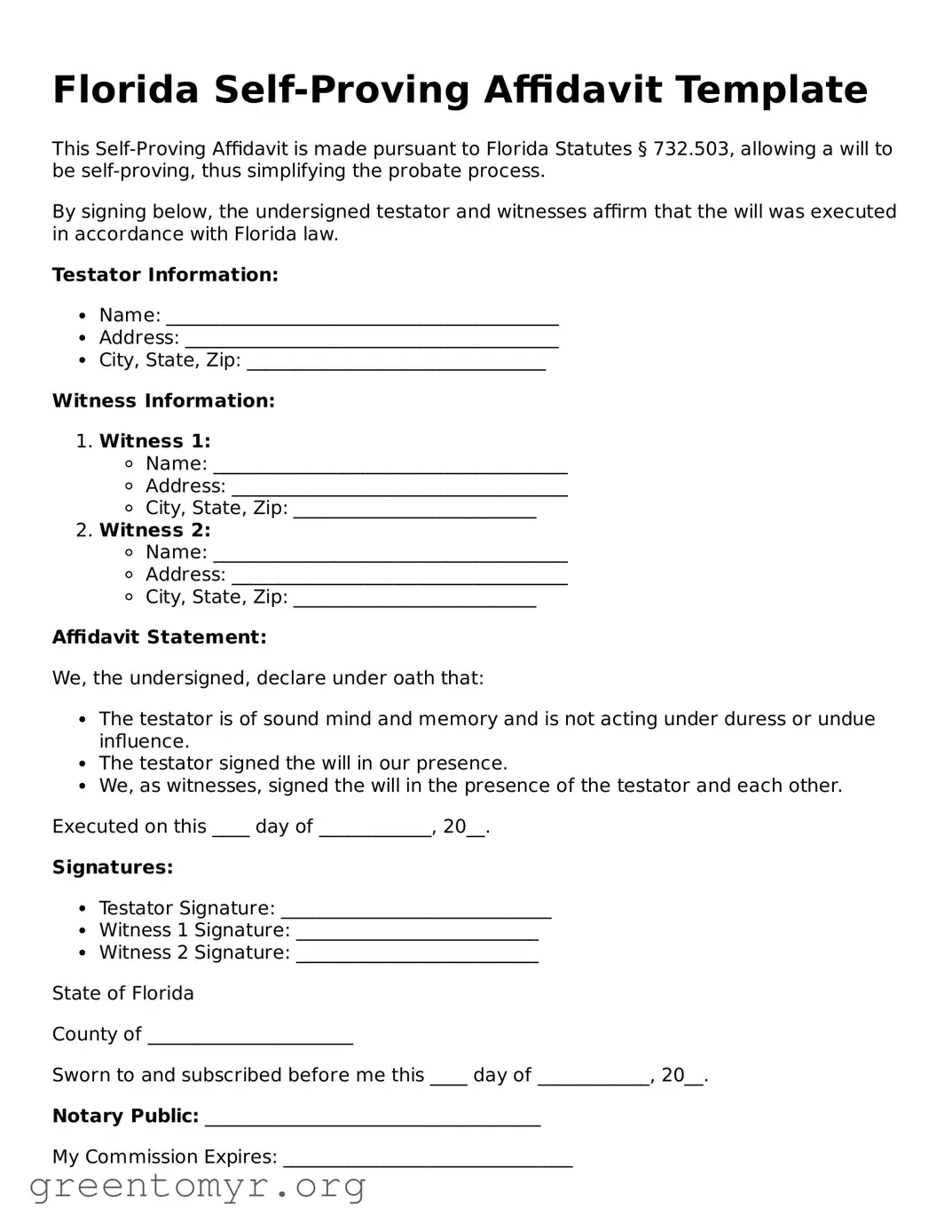
Florida Self-Proving Affidavit Template

This Self-Proving Affidavit is made pursuant to Florida Statutes § 732.503, allowing a will to be self-proving, thus simplifying the probate process.

By signing below, the undersigned testator and witnesses affirm that the will was executed in accordance with Florida law.

Testator Information:

  • Name: __________________________________________
  • Address: ________________________________________
  • City, State, Zip: ________________________________

Witness Information:

  1. Witness 1:
    • Name: ______________________________________
    • Address: ____________________________________
    • City, State, Zip: __________________________
  2. Witness 2:
    • Name: ______________________________________
    • Address: ____________________________________
    • City, State, Zip: __________________________

Affidavit Statement:

We, the undersigned, declare under oath that:

  • The testator is of sound mind and memory and is not acting under duress or undue influence.
  • The testator signed the will in our presence.
  • We, as witnesses, signed the will in the presence of the testator and each other.

Executed on this ____ day of ____________, 20__.

Signatures:

  • Testator Signature: _____________________________
  • Witness 1 Signature: __________________________
  • Witness 2 Signature: __________________________

State of Florida

County of ______________________

Sworn to and subscribed before me this ____ day of ____________, 20__.

Notary Public: ____________________________________

My Commission Expires: _______________________________

PDF Form Features

Fact Name Description
Definition A Florida Self-Proving Affidavit is a legal document that allows a will to be validated without the need for witnesses to testify in court.
Governing Law This affidavit is governed by Florida Statutes Section 732.503.
Purpose The primary purpose is to simplify the probate process by eliminating the need for witnesses during the validation of a will.
Requirements To be valid, the affidavit must be signed by the testator and two witnesses in the presence of a notary public.
Benefits Using a self-proving affidavit can expedite probate proceedings and reduce potential disputes over the will.
Revocation A self-proving affidavit can be revoked if the testator creates a new will or modifies the existing one without including the affidavit.

Guide to Using Florida Self-Proving Affidavit

After completing the Florida Self-Proving Affidavit form, the next steps involve ensuring that it is properly signed and witnessed. This will help confirm the validity of the document and its acceptance in legal proceedings.

  1. Obtain the Florida Self-Proving Affidavit form. You can find it online or through legal resources.
  2. Fill in the name of the testator (the person making the will) at the top of the form.
  3. Enter the date on which the affidavit is being executed.
  4. Provide the names and addresses of the witnesses. Ensure that you have at least two witnesses, as required by Florida law.
  5. Have the testator sign the affidavit in the presence of the witnesses.
  6. After the testator signs, the witnesses should also sign the affidavit, acknowledging their presence during the signing.
  7. Include the notary public's information. The notary must witness the signatures of both the testator and the witnesses.
  8. Have the notary public sign and stamp the affidavit to complete the process.

Get Answers on Florida Self-Proving Affidavit

What is a Florida Self-Proving Affidavit?

A Florida Self-Proving Affidavit is a legal document that allows a testator's will to be validated without requiring the witnesses to appear in court after the testator's death. This affidavit is typically signed at the same time as the will, ensuring that the will can be accepted as valid by the probate court without additional testimony.

Who can create a Self-Proving Affidavit?

Any person who is at least 18 years old and of sound mind can create a Self-Proving Affidavit. This usually includes the testator (the person making the will) and the witnesses who observe the signing of the will. The affidavit must be signed in the presence of a notary public to be valid.

What are the benefits of using a Self-Proving Affidavit?

Using a Self-Proving Affidavit offers several advantages:

  • It simplifies the probate process by eliminating the need for witnesses to testify.
  • It helps prevent disputes regarding the validity of the will.
  • The affidavit serves as strong evidence of the testator's intentions.

How do I complete a Self-Proving Affidavit?

To complete a Self-Proving Affidavit in Florida, follow these steps:

  1. Ensure that the will is signed by the testator and witnessed by at least two individuals.
  2. Prepare the Self-Proving Affidavit, which should include the testator's declaration and the witnesses' signatures.
  3. Have all parties sign the affidavit in the presence of a notary public.

Is a Self-Proving Affidavit required for a will in Florida?

No, a Self-Proving Affidavit is not required for a will to be valid in Florida. However, including one can significantly streamline the probate process and reduce potential complications.

Can I use a Self-Proving Affidavit if my will was created in another state?

If your will was created in another state, you may still be able to use a Self-Proving Affidavit in Florida. However, it is important to ensure that the will complies with Florida laws and that the affidavit is executed properly according to Florida statutes.

What happens if the witnesses are unavailable at the time of probate?

If the witnesses are unavailable, a Self-Proving Affidavit can help avoid the need for them to testify in court. The affidavit serves as evidence of the will's validity, provided it was properly executed. This can expedite the probate process and reduce the likelihood of disputes.

Can I revoke a Self-Proving Affidavit?

Yes, a Self-Proving Affidavit can be revoked. If the testator wishes to change their will or revoke the affidavit, they must create a new will or a revocation document. It is important to follow proper legal procedures to ensure that the revocation is valid.

Where can I find a Florida Self-Proving Affidavit form?

A Florida Self-Proving Affidavit form can be found online through legal resources, law firms, or state government websites. It is advisable to use a form that complies with Florida laws to ensure its validity.

Common mistakes

Filling out a Florida Self-Proving Affidavit form can be a straightforward process, but mistakes are common. One frequent error is failing to include the date of execution. This date is crucial because it establishes when the will was signed and witnessed. Without it, there could be confusion regarding the validity of the will, especially if multiple versions exist. It is essential to ensure that this detail is accurate and clearly noted.

Another mistake often made is neglecting to have the affidavit signed by the appropriate witnesses. In Florida, the law requires that the will be signed in the presence of at least two witnesses. If the affidavit lacks these signatures, it may not be considered valid. This oversight can lead to significant legal challenges down the road, so it is vital to ensure all necessary parties are present and sign the document correctly.

People also sometimes forget to include their own signatures on the affidavit. While it may seem obvious, it is a critical step that cannot be overlooked. The absence of a signature from the testator can render the entire affidavit ineffective. Each person involved must understand their role in the signing process to avoid this pitfall.

Additionally, many individuals fail to provide the correct information about the witnesses. The affidavit should include the full names and addresses of the witnesses. Omitting this information can create complications if the validity of the will is ever questioned. Accurate details help to establish the credibility of the witnesses and support the authenticity of the document.

Lastly, some people overlook the importance of having the affidavit notarized. While notarization is not strictly required for the affidavit to be valid, it adds an extra layer of authenticity. A notary public can help confirm the identities of those signing the document and ensure that the process follows legal standards. Skipping this step may not invalidate the affidavit, but it can lead to unnecessary complications in the future.

Documents used along the form

When preparing a will in Florida, the Self-Proving Affidavit is a valuable tool that simplifies the probate process. However, there are several other forms and documents that often accompany it. Each of these documents serves a specific purpose in ensuring that the will is valid and that the wishes of the deceased are honored.

  • Last Will and Testament: This document outlines the deceased's wishes regarding the distribution of their assets and the care of any dependents. It is the primary document that the Self-Proving Affidavit supports.
  • Witness Affidavit: This form is signed by witnesses to the will, confirming that they observed the testator sign the will and that they understood its content.
  • Durable Power of Attorney: This document grants someone the authority to make financial and legal decisions on behalf of the individual if they become incapacitated.
  • Health Care Surrogate Designation: This form allows an individual to appoint someone to make medical decisions on their behalf if they are unable to do so.
  • Living Will: This document outlines an individual's wishes regarding medical treatment in situations where they are unable to communicate their preferences.
  • Trust Documents: These legal documents establish a trust, which can help manage assets during the individual's lifetime and dictate their distribution after death.
  • Declaration of Pre-Need Guardian: This document allows an individual to designate a guardian for themselves in the event of future incapacity.
  • Affidavit of Heirship: This form is used to establish the heirs of a deceased person, particularly when there is no will.
  • Petition for Probate: This document initiates the probate process, formally requesting the court to validate the will and appoint a personal representative.
  • Notice of Administration: This document informs interested parties about the probate proceedings and their rights regarding the estate.

Understanding these forms can help ensure a smoother process during what can be a challenging time. Proper documentation is crucial for protecting the rights and wishes of all parties involved.

Similar forms

The Self-Proving Affidavit form serves a specific purpose in the estate planning process, particularly in validating a will. However, there are several other documents that share similarities with it. Here are five such documents:

  • Will: A will outlines how a person's assets will be distributed after their death. Like a Self-Proving Affidavit, it must be executed properly to be valid and effective.
  • Power of Attorney: This document allows someone to make decisions on behalf of another person. Both documents require signatures and witnesses to ensure their legitimacy.
  • Living Will: A living will provides instructions about medical treatment preferences in case a person becomes incapacitated. Similar to a Self-Proving Affidavit, it must be clear and properly executed to be enforceable.
  • Trust Agreement: A trust agreement outlines how assets are managed during a person's lifetime and after their death. It shares the need for formal execution and may also require witnesses.
  • Codicil: A codicil is an amendment to an existing will. Like a Self-Proving Affidavit, it must be signed and witnessed to be legally binding, ensuring that the original intentions are upheld.

Dos and Don'ts

When filling out the Florida Self-Proving Affidavit form, it's essential to approach the task with care. This document serves a crucial role in the estate planning process, helping to validate a will. Here are some important dos and don'ts to keep in mind:

  • Do ensure that the will is properly executed before signing the affidavit.
  • Do have the affidavit signed in the presence of a notary public.
  • Do include the names and addresses of the witnesses in the affidavit.
  • Do verify that all parties involved understand the document they are signing.
  • Don't rush the process; take your time to ensure accuracy.
  • Don't forget to keep a copy of the signed affidavit with the original will.
  • Don't leave out any required information, as this could invalidate the affidavit.
  • Don't sign the affidavit unless you are in the presence of the notary and witnesses.
  • Don't assume that the affidavit will be accepted without proper notarization.

By following these guidelines, individuals can help ensure that their Florida Self-Proving Affidavit is completed correctly, providing peace of mind in the estate planning process.

Misconceptions

Understanding the Florida Self-Proving Affidavit form is essential for anyone involved in estate planning or managing a will. However, several misconceptions can lead to confusion. Below is a list of common misunderstandings about this important legal document.

  • It is not necessary if there are witnesses. Some people believe that having witnesses to a will eliminates the need for a Self-Proving Affidavit. While witnesses are important, the affidavit adds an extra layer of validation that can simplify the probate process.
  • It can be signed after the will is executed. Many think they can complete the Self-Proving Affidavit at any time. However, it must be signed at the same time as the will to ensure its validity.
  • Only lawyers can prepare a Self-Proving Affidavit. This is not true. Individuals can prepare the affidavit themselves, provided they understand the requirements and follow the correct procedures.
  • It is only for complex estates. Some assume that the Self-Proving Affidavit is only necessary for large or complicated estates. In reality, it can benefit any estate by making the probate process smoother.
  • All states have the same rules regarding Self-Proving Affidavits. This misconception overlooks the fact that each state has its own laws and requirements. Florida has specific guidelines that must be followed.
  • It can be used for any type of document. The Self-Proving Affidavit is specifically designed for wills. Using it for other documents can lead to legal complications.
  • It guarantees that the will will not be contested. While a Self-Proving Affidavit can strengthen a will's validity, it does not provide absolute protection against challenges.
  • Witnesses are not needed if there is a Self-Proving Affidavit. This is incorrect. Witnesses are still required to sign the will alongside the affidavit to ensure its legitimacy.
  • It can be completed by anyone, regardless of relationship. While it is true that a Self-Proving Affidavit can be signed by individuals who are not related to the testator, it is often advisable to have disinterested witnesses to avoid potential conflicts.
  • It is a one-time document. Some people believe that once a Self-Proving Affidavit is executed, it never needs to be updated. However, if the will changes, the affidavit should be updated accordingly.

By clarifying these misconceptions, individuals can better navigate the process of estate planning and ensure that their wishes are honored. Understanding the role of the Self-Proving Affidavit can lead to a more efficient probate process, providing peace of mind for everyone involved.

Key takeaways

When dealing with the Florida Self-Proving Affidavit form, there are several important points to keep in mind. This form is essential for streamlining the probate process. Here are key takeaways to consider:

  • The Self-Proving Affidavit allows a will to be validated without the need for witnesses to appear in court.
  • It must be signed by the testator (the person making the will) and two witnesses.
  • The form should be executed at the same time as the will to ensure its effectiveness.
  • It is advisable to have the affidavit notarized to enhance its credibility.
  • The affidavit confirms that the testator was of sound mind and not under duress when signing the will.
  • Using this affidavit can expedite the probate process, saving time and resources for the estate.
  • Ensure that all information is accurate and complete to avoid potential legal issues later.

Understanding these aspects can significantly aid in the proper use of the Florida Self-Proving Affidavit form, ensuring that the wishes of the testator are honored efficiently.