In Florida, managing the affairs of a deceased loved one can be a daunting task, especially when navigating the complexities of estate administration. However, for smaller estates, the Florida Small Estate Affidavit offers a streamlined process that simplifies the transfer of assets without the need for formal probate. This form is particularly beneficial for estates valued at $75,000 or less, excluding homestead property. By using this affidavit, heirs can assert their rights to the decedent's assets, allowing for a more efficient resolution. The form requires specific information, such as the names and addresses of the heirs, a description of the decedent's property, and an affirmation that the estate qualifies under Florida law. Additionally, it must be signed under oath and filed with the appropriate court, making it an essential tool for those looking to settle small estates quickly and effectively. Understanding the nuances of this affidavit can save time and reduce stress during an already challenging period.
Florida Small Estate Affidavit Template
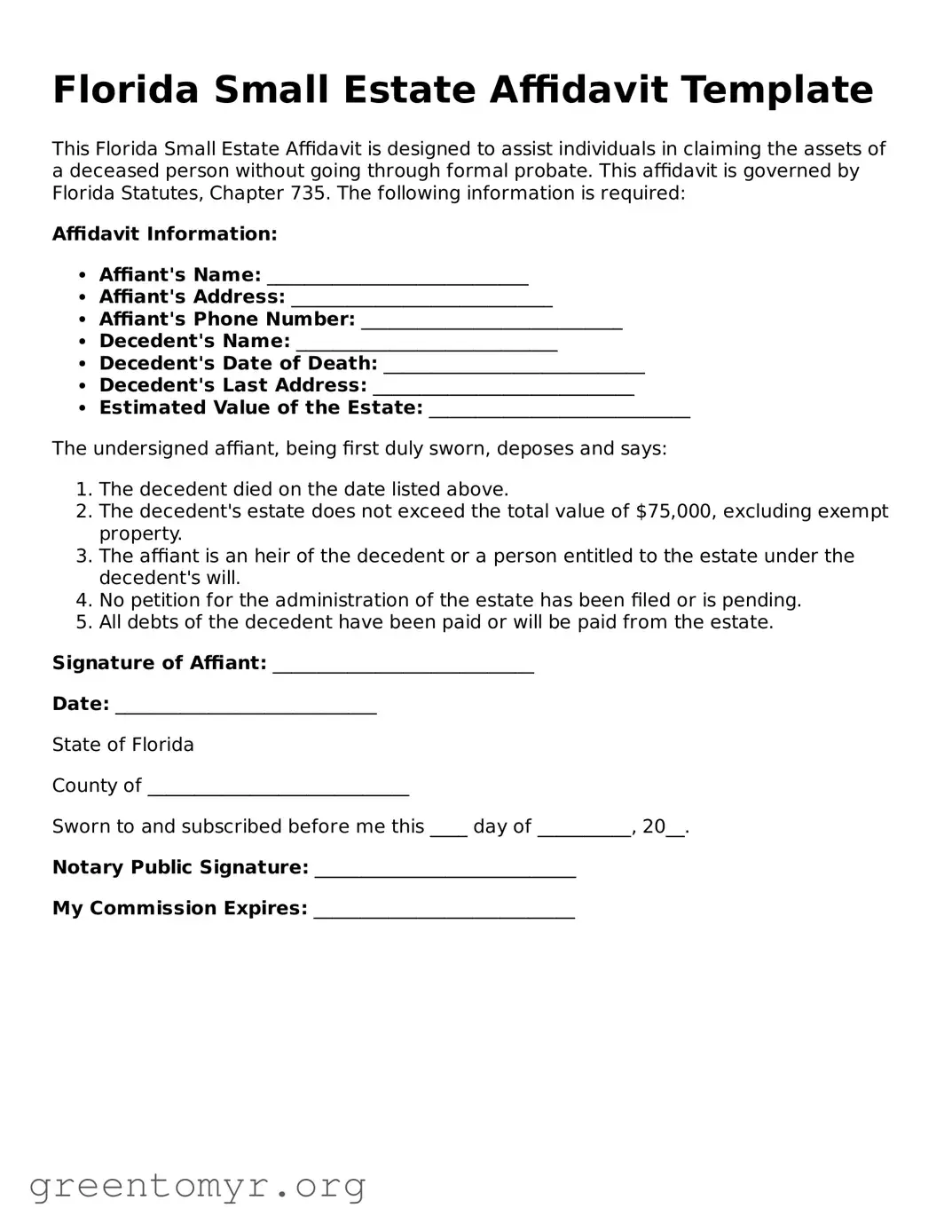
This Florida Small Estate Affidavit is designed to assist individuals in claiming the assets of a deceased person without going through formal probate. This affidavit is governed by Florida Statutes, Chapter 735. The following information is required:
Affidavit Information:
The undersigned affiant, being first duly sworn, deposes and says:
Signature of Affiant: ____________________________
Date: ____________________________
State of Florida
County of ____________________________
Sworn to and subscribed before me this ____ day of __________, 20__.
Notary Public Signature: ____________________________
My Commission Expires: ____________________________
| Fact Name | Description |
|---|---|
| Purpose | The Florida Small Estate Affidavit allows heirs to claim assets of a deceased person without going through formal probate if the estate's value is below a certain threshold. |
| Governing Law | This form is governed by Florida Statutes, specifically Section 735.201 through 735.206. |
| Eligibility | To use this affidavit, the total value of the estate must not exceed $75,000, excluding exempt property. |
| Filing Requirements | The affidavit must be signed by the heirs and filed with the appropriate court to transfer assets without probate. |
Filling out the Florida Small Estate Affidavit form is a crucial step for those dealing with the estate of a deceased individual who left behind limited assets. Once completed, this form allows you to initiate the process of transferring the decedent's property without the need for formal probate proceedings. Below are the steps to effectively fill out this form.
A Florida Small Estate Affidavit is a legal document that allows heirs to claim assets of a deceased person without going through the full probate process. This is typically used when the total value of the estate is below a certain threshold, which is currently set at $75,000, excluding exempt property.
Generally, any individual who is an heir or a beneficiary of the deceased person can use the Small Estate Affidavit. This includes spouses, children, parents, and siblings. However, it’s important to note that all heirs must agree to use this method.
Eligible assets typically include:
However, certain assets like life insurance policies and retirement accounts may pass directly to beneficiaries and are not included in the estate total.
To complete a Small Estate Affidavit, you will need to:
Once the Small Estate Affidavit is submitted, the county clerk will review it. If everything is in order, you will receive a certified copy of the affidavit. This document can then be used to access the deceased’s assets, such as transferring ownership of property or withdrawing funds from bank accounts.
Yes, there may be fees for filing the affidavit with the county clerk. These fees can vary by county, so it’s a good idea to check with your local clerk’s office for specific amounts. Additionally, there may be costs for notarization and any other documents you need to file.
Yes, you can still use a Small Estate Affidavit if the deceased left a will. However, the will must not require formal probate proceedings. If the will is straightforward and all heirs agree, the Small Estate Affidavit can be a quick and efficient way to settle the estate.
If there are disputes among heirs, using a Small Estate Affidavit may not be advisable. Disagreements can complicate the process and may require formal probate proceedings instead. It’s best to seek legal advice if conflicts arise to ensure everyone’s rights are respected.
When filling out the Florida Small Estate Affidavit form, many individuals make common mistakes that can delay the process or lead to complications. One of the most frequent errors is not providing accurate information about the deceased. It’s essential to ensure that the name, date of birth, and date of death are correct. Even a small typo can cause significant issues down the line.
Another mistake occurs when people fail to include all relevant assets in the affidavit. This form is intended for estates with a total value of $100,000 or less, excluding certain types of property. Omitting assets can lead to legal challenges and may invalidate the affidavit. Always double-check that all assets are listed to avoid complications.
Some individuals neglect to have the affidavit notarized. The Florida Small Estate Affidavit must be signed in front of a notary public to be legally binding. Skipping this step can render the affidavit ineffective, causing further delays in settling the estate.
Inaccurate valuations of assets are another common pitfall. When estimating the value of property, it’s crucial to use fair market value. Underestimating or overestimating can lead to problems with the estate's administration. Take the time to assess the value carefully.
Additionally, people often forget to include the names and addresses of all heirs. The affidavit requires a complete list of heirs who are entitled to the estate. Failing to provide this information can lead to disputes among family members and may require further legal intervention.
Some individuals also overlook the need for supporting documentation. While the affidavit itself is a critical document, it may need to be accompanied by other paperwork, such as death certificates or proof of asset ownership. Ensuring that all necessary documents are included can streamline the process.
Another mistake is assuming that the Small Estate Affidavit can be used for all types of estates. This form is only applicable under specific conditions, such as when the estate does not exceed the value limit and when certain types of property are involved. Understanding these limitations is vital for a smooth process.
Lastly, many people do not seek legal advice when needed. While the Small Estate Affidavit is designed to be user-friendly, consulting with a legal professional can help clarify any uncertainties. This step can save time and prevent errors that may complicate the estate settlement process.
When dealing with the Florida Small Estate Affidavit, several other forms and documents may be necessary to ensure a smooth process. These documents assist in clarifying ownership, verifying debts, and facilitating the transfer of assets. Below is a list of commonly used forms that complement the Small Estate Affidavit.
Utilizing these documents alongside the Florida Small Estate Affidavit can streamline the process of settling an estate. Each form plays a vital role in ensuring that all legal requirements are met and that the wishes of the deceased are honored.
When filling out the Florida Small Estate Affidavit form, it's essential to follow specific guidelines to ensure a smooth process. Here’s a list of things to do and avoid:
The Florida Small Estate Affidavit is a useful tool for settling the estates of individuals who have passed away, especially when the estate is relatively small. However, there are several misconceptions surrounding this form that can lead to confusion. Here are ten common misunderstandings:
This is incorrect. While the limit for personal property is $10,000, the total value can include other assets, such as real estate, which may allow for a higher threshold.
Not all assets are eligible. Certain assets, like those held in trust or jointly owned properties, may not be included in the affidavit process.
Filing the affidavit does not guarantee that all debts and claims against the estate have been resolved. It is still necessary to address these obligations.
Only certain individuals, typically those who are beneficiaries or heirs, can file this affidavit. It is important to ensure that the filer has the legal standing to do so.
This is a misconception. The affidavit is meant for estates without a will or when the will does not cover all assets. It does not replace the need for a will.
This is not true. Interested parties may still contest the affidavit if they believe they have a valid claim to the estate or if proper procedures were not followed.
Actually, the Small Estate Affidavit is typically presented to financial institutions or other entities holding the deceased's assets, not necessarily filed with the court.
This is misleading. Supporting documents, such as a death certificate and proof of the decedent’s assets, are often required to accompany the affidavit.
Each state has its own laws and procedures regarding small estates. Florida’s process may differ significantly from those in other states.
While it may seem straightforward, complications can arise, and the process may take longer than anticipated, especially if disputes arise.
Understanding these misconceptions can help individuals navigate the process of settling a small estate more effectively. It is always advisable to seek guidance from a knowledgeable professional when dealing with estate matters.
Filling out and using the Florida Small Estate Affidavit form can be straightforward if you keep a few key points in mind. Here are some essential takeaways:
Understanding these points can help ensure a smoother process when dealing with a small estate in Florida.