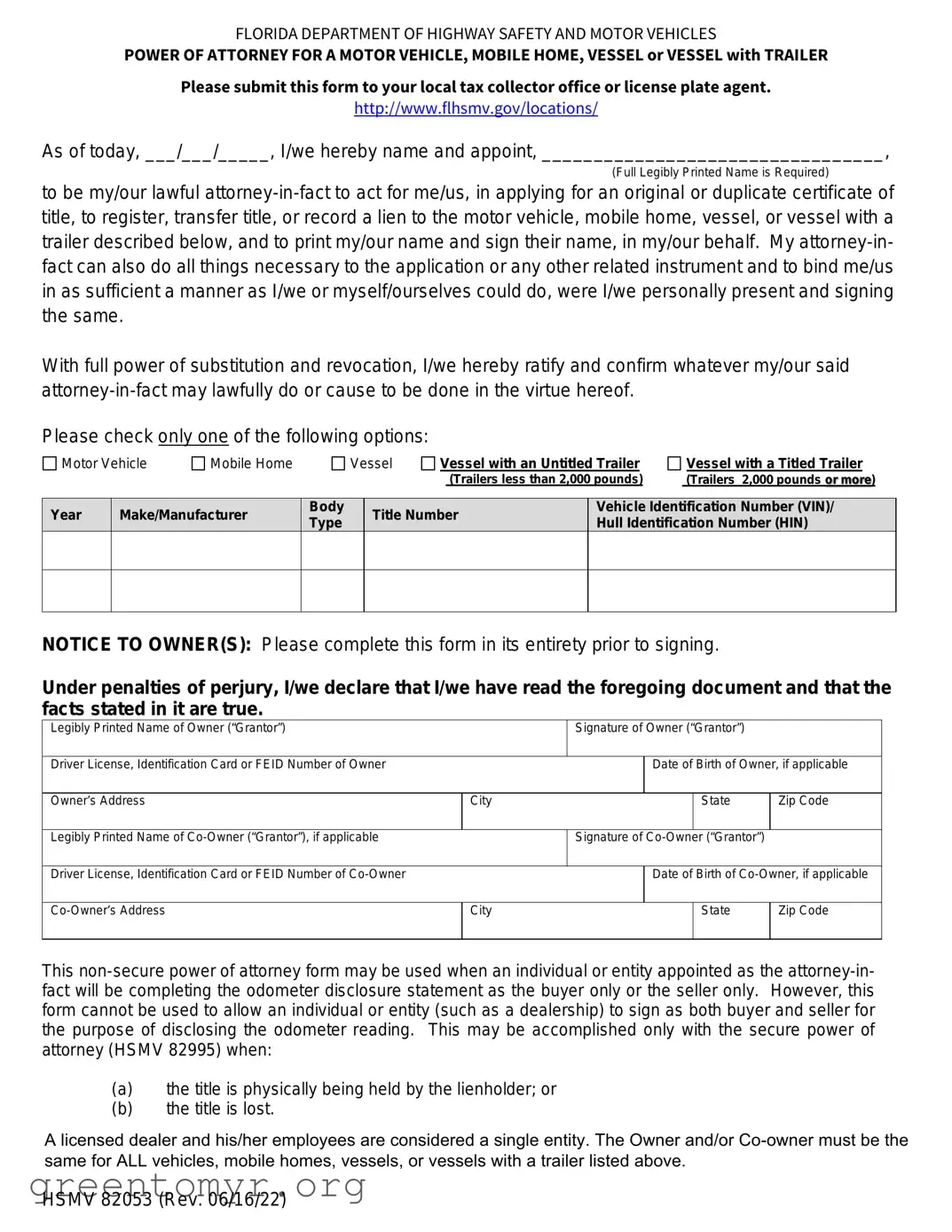
The Florida Vehicle Power of Attorney (POA) form 82053 serves as a crucial tool for vehicle owners who need to delegate their authority to another individual for specific tasks related to their vehicle. This form allows the designated agent to perform various actions, such as transferring ownership, registering the vehicle, or signing documents on behalf of the owner. By utilizing this form, vehicle owners can ensure that their interests are protected while they may be unavailable to handle these responsibilities themselves. The POA can be particularly useful in situations where the owner is out of state, incapacitated, or simply prefers to have someone else manage their vehicle affairs. It’s important to understand the scope of authority granted, as this form can be tailored to meet the specific needs of the vehicle owner, allowing for a flexible approach to vehicle management. Additionally, the form must be completed and signed in accordance with Florida law to be valid, ensuring that all parties involved are protected during the transaction process.

FLORIDA DEPARTMENT OF HIGHWAY SAFETY AND MOTOR VEHICLES
POWER OF ATTORNEY FOR A MOTOR VEHICLE, MOBILE HOME, VESSEL or VESSEL with TRAILER
Please submit this form to your local tax collector office or license plate agent.
http://www.flhsmv.gov/locations/
As of today, ___/___/_____, I/we hereby name and appoint, _________________________________,
(Full Legibly Printed Name is Required)
to be my/our lawful
With full power of substitution and revocation, I/we hereby ratify and confirm whatever my/our said
Please check only one of the following options:
Motor Vehicle |
Mobile Home |
Vessel |
Vessel with an Untitled Trailer |
Vessel with a Titled Trailer |
|
|
|
(Trailers less than 2,000 pounds) |
(Trailers 2,000 pounds or more) |
Year
Make/Manufacturer
Body
Type
Title Number
Vehicle Identification Number (VIN)/
Hull Identification Number (HIN)
NOTICE TO OWNER(S): Please complete this form in its entirety prior to signing.
Under penalties of perjury, I/we declare that I/we have read the foregoing document and that the facts stated in it are true.
Legibly Printed Name of Owner (“Grantor”) |
|
Signature of Owner (“Grantor”) |
|
||
|
|
|
|
|
|
Driver License, Identification Card or FEID Number of Owner |
|
|
Date of Birth of Owner, if applicable |
||
|
|
|
|
|
|
Owner’s Address |
City |
|
|
State |
Zip Code |
|
|
|
|
|
|
Legibly Printed Name of |
|
Signature of |
|
||
|
|
|
|
||
Driver License, Identification Card or FEID Number of |
|
|
Date of Birth of |
||
|
|
|
|
|
|
City |
|
|
State |
Zip Code |
|
|
|
|
|
|
|
This
(a)the title is physically being held by the lienholder; or
(b)the title is lost.
A licensed dealer and his/her employees are considered a single entity. The Owner and/or
HSMV 82053 (Rev. 06/16/22)
| Fact Name | Details |
|---|---|
| Form Title | Florida Vehicle Power of Attorney (POA) Form 82053 |
| Purpose | This form allows a designated person to act on behalf of the vehicle owner for specific transactions. |
| Governing Law | Florida Statutes, Chapter 319 (Motor Vehicle Title Law) |
| Who Can Use It | Any vehicle owner in Florida who needs someone else to handle vehicle-related matters. |
| Common Uses | It is often used for title transfers, registration renewals, and obtaining duplicate titles. |
| Signature Requirement | The vehicle owner must sign the form in the presence of a notary public. |
| Validity | The form remains valid until the vehicle owner revokes it or the task is completed. |
Filling out the Florida Vehicle POA form 82053 is a straightforward process that requires careful attention to detail. Completing this form accurately is essential for ensuring a smooth transaction regarding vehicle ownership or representation. Follow these steps to fill out the form correctly.
After completing the form, review all entries for accuracy. Once verified, submit the form to the appropriate authority or keep it with the necessary documents for future reference. Ensure that both the owner and the agent retain copies of the completed form for their records.
The Florida Vehicle Power of Attorney (POA) form 82053 allows an individual to authorize another person to act on their behalf regarding vehicle-related matters. This can include tasks such as registering a vehicle, transferring ownership, or obtaining a title.
Any vehicle owner in Florida can use this form. It is particularly useful for individuals who may be unable to handle vehicle transactions themselves due to being out of state, having health issues, or other reasons that prevent them from being present.
To complete the form, you will need to provide:
Filling out the form is straightforward. Begin by entering the required personal information for both the principal and the agent. Next, specify the vehicle details and clearly state the powers you wish to grant. Finally, both parties must sign the form, and it is advisable to have it notarized to ensure its validity.
While notarization is not strictly required, it is highly recommended. Having the form notarized adds an extra layer of authenticity and can help prevent disputes over its validity.
Yes, the Florida Vehicle POA can be revoked at any time by the principal. To do this, the principal should provide written notice to the agent and, if possible, notify any third parties who may have relied on the POA.
The validity of the form typically lasts until the specified tasks are completed or until the principal revokes it. It is advisable to indicate a specific expiration date if the powers are intended to be temporary.
If an agent acts outside the authority granted or in a way that harms the principal’s interests, the principal may have legal recourse. This can include revoking the POA and potentially pursuing legal action against the agent for any damages incurred.
The form can be obtained from various sources, including the Florida Department of Highway Safety and Motor Vehicles website, legal document websites, or local tax collector’s offices. It is important to ensure that you are using the most current version of the form.
There may be fees associated with processing vehicle transactions that the agent undertakes on behalf of the principal. These fees vary depending on the specific actions taken, such as title transfers or registrations. Always check with the local tax collector's office for the most accurate fee information.
Filling out the Florida Vehicle Power of Attorney (POA) form 82053 can seem straightforward, but many individuals make critical mistakes that can lead to delays or complications. Understanding these common errors is essential for ensuring that your vehicle transactions proceed smoothly.
One frequent mistake is failing to provide accurate and complete information. When filling out the form, it's vital to double-check that all names, addresses, and vehicle details are correct. Omitting even a single digit from a VIN or misspelling a name can cause significant issues down the line. Always take the time to verify that every detail is precise.
Another common error is not properly signing the document. The Florida Vehicle POA form requires signatures from both the principal and the agent. If either signature is missing or not executed correctly, the form may be deemed invalid. Ensure that both parties sign in the designated areas and consider having the signatures notarized to add an extra layer of authenticity.
Some individuals overlook the importance of specifying the powers granted. The form allows you to define what authority you are giving to the agent. Failing to be clear about these powers can lead to misunderstandings or misuse. Take a moment to carefully consider what actions you want your agent to be able to perform on your behalf.
Additionally, many people neglect to date the form. A date is crucial as it establishes when the authority begins. Without a date, there could be confusion about the validity of the POA, especially if it is challenged later. Always remember to include the date to avoid any potential disputes.
Lastly, individuals often forget to keep a copy of the completed form. Once the POA is filled out and signed, it’s essential to retain a copy for your records. This can serve as a reference if any questions arise regarding the authority granted. Keeping a copy not only protects you but also ensures that your agent has the necessary documentation when acting on your behalf.
The Florida Vehicle Power of Attorney (POA) form 82053 allows an individual to designate another person to act on their behalf regarding vehicle-related matters. When using this form, you may also need to consider additional documents that can facilitate the process. Below is a list of forms and documents commonly associated with the Florida Vehicle POA form.
By understanding these additional documents, you can ensure a smooth process when dealing with vehicle transactions in Florida. Having the right paperwork ready will help you navigate the requirements efficiently.
The Florida Vehicle Power of Attorney (POA) form 82053 allows individuals to designate someone else to act on their behalf in matters related to vehicle transactions. Several other documents serve similar purposes in various contexts. Here are eight documents that share similarities with the Florida Vehicle POA form 82053:
Each of these documents facilitates the delegation of authority or the transfer of rights in various contexts, much like the Florida Vehicle POA form 82053 does for vehicle-related matters.
When filling out the Florida Vehicle Power of Attorney (POA) form 82053, it is important to follow specific guidelines to ensure accuracy and compliance. Here is a list of things you should and shouldn't do:
When dealing with the Florida Vehicle Power of Attorney (POA) form 82053, several misconceptions can arise. Understanding these can help ensure the process goes smoothly and that you are fully informed.
While many people associate a POA with selling a vehicle, it can also be used for other purposes. For instance, it allows someone to register, title, or transfer ownership of a vehicle on your behalf. This flexibility is crucial for various situations.
This is not true. Granting a POA allows someone to act on your behalf, but it does not relinquish your ownership or control over the vehicle. You can revoke the POA at any time, provided you follow the proper procedures.
While notarization can add an extra layer of authenticity, it is not always a requirement for the Florida Vehicle POA form 82053. However, having the document notarized may help in certain situations, especially when dealing with third parties.
The Florida Vehicle POA form is specific to vehicle-related transactions. It is essential to ensure that the form you are using meets your particular needs. Customizing the form or seeking legal advice may be beneficial in complex situations.
The Florida Vehicle Power of Attorney (POA) form 82053 allows a person to authorize another individual to act on their behalf regarding vehicle-related matters. Here are some key takeaways to consider when filling out and using this form: