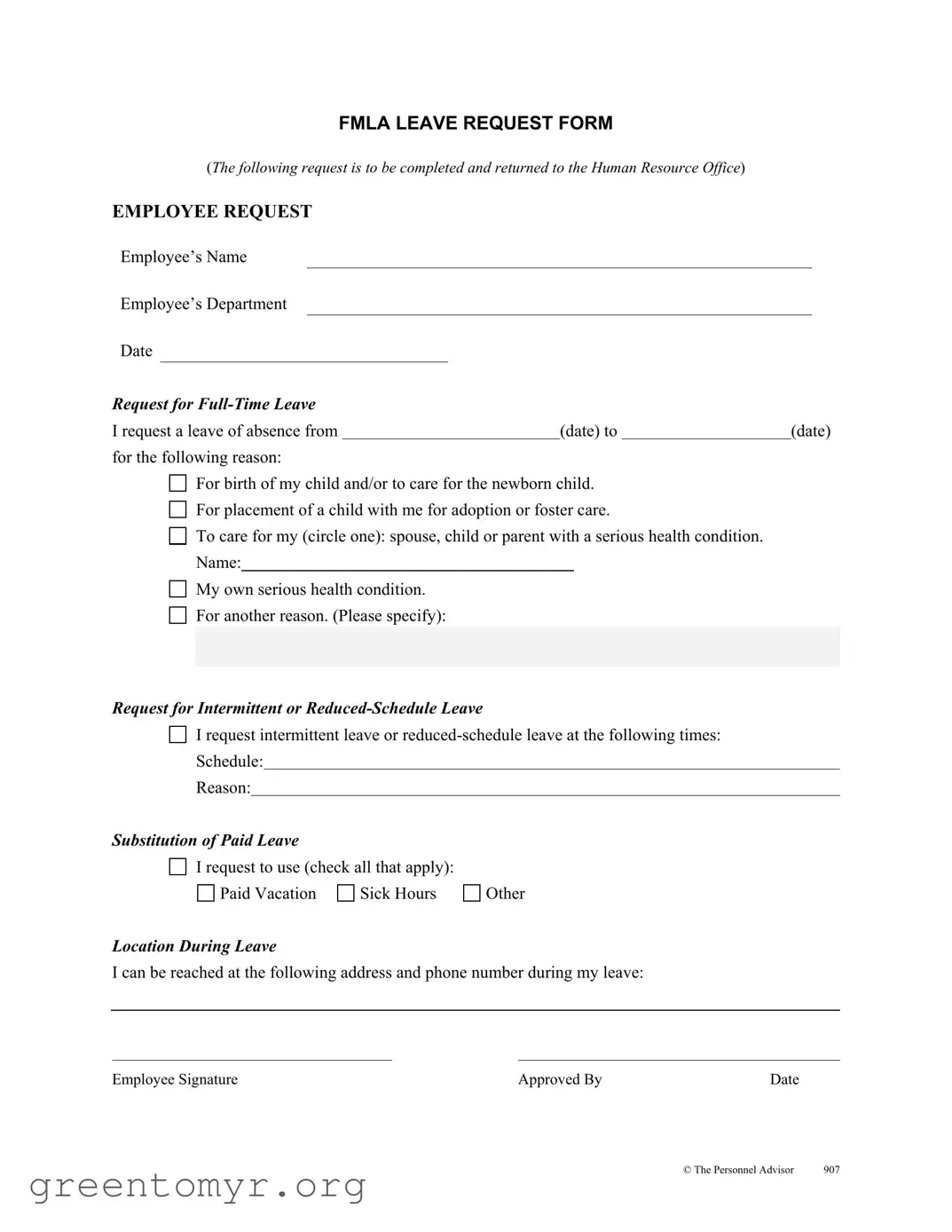
The Family and Medical Leave Act (FMLA) Leave Request Form serves as a vital tool for employees seeking time off for specific family and medical reasons. This form must be completed and submitted to the Human Resource Office to initiate the leave process. Employees can request full-time leave for various reasons, such as the birth or adoption of a child, caring for a family member with a serious health condition, or addressing their own serious health issues. The form allows for flexibility, offering options for intermittent or reduced-schedule leave, accommodating the diverse needs of employees. Additionally, it provides a section for employees to indicate their preference for using paid leave, such as vacation or sick hours, during their absence. To ensure effective communication, employees are required to provide their contact information for the duration of their leave. Completing this form accurately is essential for both the employee and the employer, as it sets the foundation for a smooth leave process while adhering to federal regulations.
FMLA LEAVE REQUEST FORM
(The following request is to be completed and returned to the Human Resource Office)
EMPLOYEE REQUEST
Employee’s Name
Employee’s Department
Date
Request for |
|
|
I request a leave of absence from |
(date) to |
(date) |
for the following reason:
For birth of my child and/or to care for the newborn child.
For placement of a child with me for adoption or foster care.
To care for my (circle one): spouse, child or parent with a serious health condition. Name:
My own serious health condition.
For another reason. (Please specify):
Request for Intermittent or
I request intermittent leave or
Schedule:
Reason:
Substitution of Paid Leave
I request to use (check all that apply):
Paid Vacation |
Sick Hours |
Location During Leave |
|
Other
I can be reached at the following address and phone number during my leave:
Employee Signature |
Approved By |
Date |
© The Personnel Advisor |
907 |
| Fact Name | Description |
|---|---|
| Purpose of the Form | The FMLA Leave Request Form is designed for employees to formally request leave under the Family and Medical Leave Act (FMLA). |
| Eligibility | Employees may be eligible for FMLA leave if they have worked for their employer for at least 12 months and have logged at least 1,250 hours in the past year. |
| Reasons for Leave | Leave can be requested for various reasons, including the birth of a child, adoption, caring for a family member with a serious health condition, or the employee's own serious health condition. |
| Intermittent Leave | Employees can request intermittent or reduced-schedule leave, allowing them to take leave in smaller increments rather than all at once. |
| Paid Leave Substitution | Employees may choose to use paid vacation or sick hours during their leave, as indicated on the form. |
| Contact Information | Employees must provide their contact information to ensure they can be reached during their leave period. |
| Approval Process | The form must be signed by the employee and approved by the designated authority within the Human Resource Office. |
| State-Specific Laws | Each state may have specific laws governing FMLA leave, which should be referenced in conjunction with the federal law. |
Once you have the FMLA Leave form, it's important to fill it out accurately. This ensures that your request is processed smoothly. Follow the steps below to complete the form correctly.
The FMLA Leave Form is a document that employees use to formally request leave under the Family and Medical Leave Act (FMLA). This law allows eligible employees to take time off for specific family and medical reasons while ensuring job protection. The form must be completed and submitted to the Human Resource Office for approval.
To be eligible for FMLA leave, an employee must meet certain criteria. Generally, you must have worked for your employer for at least 12 months, have logged at least 1,250 hours of work in the past year, and work at a location where the company employs 50 or more employees within a 75-mile radius. Additionally, the leave must be for qualifying reasons such as the birth of a child, adoption, or caring for a seriously ill family member.
Employees can request leave for several reasons, including:
Yes, you can request intermittent leave or a reduced schedule. This means you can take leave in separate blocks of time rather than all at once. On the FMLA Leave Form, you will need to specify the schedule and reason for the intermittent leave. This flexibility can be beneficial for managing ongoing medical treatments or caregiving responsibilities.
If you wish to use paid leave, such as vacation or sick hours, you can indicate this on the FMLA Leave Form. Check all applicable options on the form to ensure your employer knows which paid leave you want to use during your FMLA leave. This can help maintain your income while you are away from work.
When completing the FMLA Leave Form, you will need to provide the following information:
After you submit the FMLA Leave Form to your Human Resource Office, they will review your request. If approved, you will receive confirmation of your leave. It's important to keep communication open with your HR department during this process, especially if you have any questions or need to make adjustments to your leave.
Yes, your job is protected while you are on FMLA leave. Employers are required to reinstate you to the same or an equivalent position upon your return. However, it’s essential to follow the proper procedures for requesting leave to ensure your rights are protected. Make sure to keep documentation of your request and any communications with your employer.
Filling out the FMLA Leave Request Form is a crucial step for employees needing time off for specific family or medical reasons. However, many individuals make common mistakes that can delay the approval process or even result in denial of their leave request. Understanding these pitfalls can help ensure a smoother experience.
One common mistake is failing to provide complete and accurate dates for the requested leave. When employees do not specify the exact start and end dates, it can lead to confusion and delays. It is essential to double-check the dates and ensure they align with the reason for the leave. Incomplete information can cause the Human Resource Office to require additional clarification, prolonging the process unnecessarily.
Another frequent error involves neglecting to specify the reason for the leave. The form includes options such as caring for a newborn or addressing a serious health condition, but some employees fail to check the appropriate box or provide details in the "other" section. This oversight can create ambiguity about the leave's purpose, making it harder for HR to process the request correctly. Clear communication is vital in this situation.
Additionally, many people overlook the section about substituting paid leave. Employees often forget to check the boxes for using vacation or sick hours during their leave. This can lead to misunderstandings regarding compensation during the leave period. By clearly indicating which paid leave options are being utilized, employees can help ensure that their financial needs are met while they are away.
Lastly, providing incomplete contact information during the leave can cause issues. Employees should ensure that their address and phone number are clearly stated so that HR can reach them if necessary. This is especially important for any follow-up questions or clarifications that may arise during the leave period. By taking the time to fill out this information accurately, employees can facilitate better communication with their employer.
The Family and Medical Leave Act (FMLA) provides employees with the right to take leave for specific family and medical reasons. When submitting an FMLA leave request, several other forms and documents may accompany the primary FMLA Leave form. Each of these documents serves a specific purpose in the process of requesting and managing leave. Below is a list of commonly used forms related to FMLA leave.
Understanding these documents can help employees navigate the FMLA leave process more effectively. Each form plays a critical role in ensuring compliance with the law and protecting the rights of both employees and employers. Familiarity with these documents will facilitate a smoother experience for all parties involved.
The FMLA Leave form shares similarities with several other important documents related to employee leave and benefits. Below are five documents that are comparable to the FMLA Leave form:
When filling out the FMLA Leave form, it’s important to ensure that the process goes smoothly. Here’s a list of things to keep in mind:
By following these guidelines, you can help ensure that your FMLA leave request is processed efficiently and effectively.
Here are seven common misconceptions about the FMLA Leave form, along with clarifications to help you understand the process better.
Understanding these misconceptions can help you navigate the FMLA process more effectively. Always check with your HR department if you have questions about your specific situation.
When filling out and using the FMLA Leave form, consider the following key points: