When you decide to donate goods to Goodwill, you not only clear out your space but also play a vital role in supporting individuals in your community. The For Goodwill Donated Goods form serves as a crucial record of your generous contributions. This form allows you to list the items you have donated, such as bags of clothing, boxes of housewares, or even furniture and electronics. It’s important to keep this receipt for your records, especially for tax purposes, as it serves as proof of your tax-deductible donation. Goodwill emphasizes that no goods or services were exchanged for your donation, reinforcing the charitable nature of your act. By donating, you help fund programs that empower people facing challenges to gain meaningful employment, which in turn strengthens the community. With Goodwill, your items are given a second chance at life, whether they are sold in thrift stores, online, or at the Goodwill Outlet, where they are purchased by the pound. This not only maximizes the value of your donation but also contributes to reducing waste in landfills. Every contribution matters, and through your generosity, you are helping individuals gain the skills and confidence they need to thrive in the workforce.
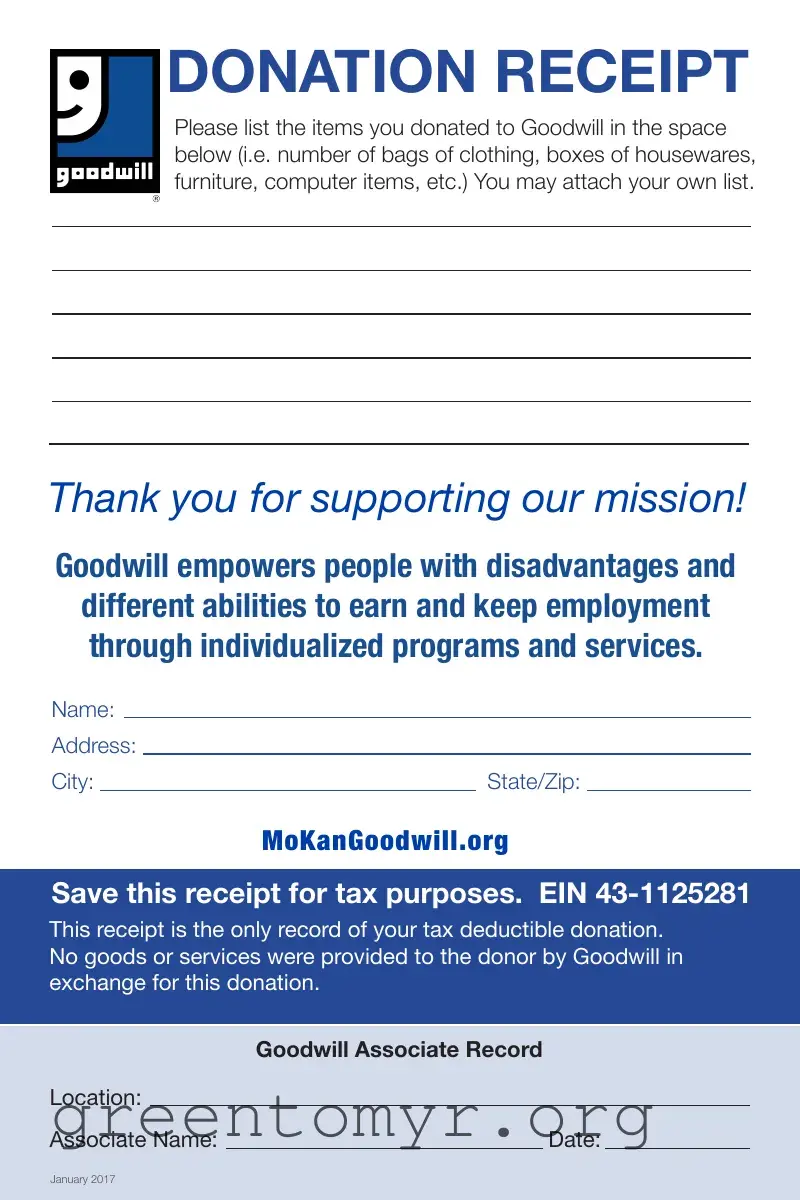
DONATION RECEIPT
Please list the items you donated to Goodwill in the space below (i.e. number of bags of clothing, boxes of housewares, furniture, computer items, etc.) You may attach your own list.
Thank you for supporting our mission!
Goodwill empowers people with disadvantages and different abilities to earn and keep employment through individualized programs and services.
Name:
Address:
City:State/Zip:
MoKanGoodwill.org
Save this receipt for tax purposes. EIN
This receipt is the only record of your tax deductible donation. No goods or services were provided to the donor by Goodwill in exchange for this donation.
|
Goodwill Associate Record |
Location: |
|
Associate Name: |
Date: |
January 2017

Goodwill spends 90¢ of every dollar on programs & services for local job seekers.
When you donate to Goodwill, your stuff gets a second chance in another person’s life instead of laying in a landfill.
High quality & unique items sell in our thrift stores & online at mokangoodwill.org/shoponline.
Unsold items get one last chance at the Goodwill Outlet in Kansas City. Here, amazing deals are purchased by the pound.
What remains is recycled or salvaged. This gets the most value out of every donation – and keeps items out of landfills.
Your donation funds programs and services for local job seekers to get the skills and confidence they need to find competitive employment.
Employment is more than a paycheck. It’s a resounding victory for the individual, for their family and for the community. When jobs thrive,
communities thrive.
MoKanGoodwill.org
| Fact Name | Description |
|---|---|
| Donation Purpose | The form serves as a receipt for tax-deductible donations made to Goodwill, supporting their mission to empower individuals with disadvantages and different abilities. |
| Record Keeping | Donors must keep this receipt for tax purposes, as it is the only record of the donation made. |
| Tax Information | No goods or services were provided in exchange for the donation, ensuring it qualifies as a tax-deductible contribution. |
| Goodwill's Commitment | Goodwill allocates 90¢ of every dollar to programs and services for local job seekers, demonstrating their commitment to community support. |
| Environmental Impact | Donations are reused or recycled, minimizing landfill waste and maximizing the value of each contribution. |
Filling out the For Goodwill Donated Goods form is straightforward. This form serves as a record of your donation, which you can use for tax purposes. Follow the steps below to ensure that you complete the form correctly.
The For Goodwill Donated Goods form serves as a receipt for your donations. It provides a space for you to list the items you donated, such as bags of clothing, boxes of housewares, or furniture. This receipt is crucial for tax purposes, as it confirms your contribution to Goodwill and can be used to claim a tax deduction. Remember to keep this receipt safe, as it is the only record of your tax-deductible donation.
When filling out the donation receipt, start by listing the items you are donating. You can specify the number of bags or boxes and describe the contents. For example, you might write "3 bags of clothing" or "2 boxes of kitchenware." If you prefer, you can attach your own detailed list of items instead. Ensure that your name, address, and the date of the donation are clearly indicated on the form to help with record-keeping.
Your donated items play a vital role in supporting Goodwill's mission. They are sold in thrift stores or online at mokangoodwill.org/shoponline. High-quality and unique items often find new homes, while unsold items get a second chance at the Goodwill Outlet in Kansas City, where they are sold by weight. Any remaining items are either recycled or salvaged, ensuring that they do not end up in landfills. This process maximizes the value of your donation and contributes to environmental sustainability.
Your donation directly supports local job seekers by funding programs and services that help them gain skills and confidence for competitive employment. Goodwill invests 90 cents of every dollar received into these initiatives. By donating, you are not only giving your items a second life but also empowering individuals and strengthening the community. Employment is more than just a paycheck; it represents growth and opportunity for individuals and their families.
Filling out the For Goodwill Donated Goods form can seem straightforward, but many people make common mistakes that can lead to complications later. One frequent error is failing to list all donated items clearly. Donors often underestimate the importance of providing a detailed account of their contributions. Without a complete list, it becomes challenging for Goodwill to acknowledge the full extent of your generosity.
Another mistake is neglecting to include the donor's name and address. This information is crucial for Goodwill to issue a proper receipt for tax purposes. If these details are missing, the receipt may not be valid, and you could miss out on potential tax deductions.
Some donors forget to save their receipt after completing the form. This receipt serves as the only record of your tax-deductible donation. Losing it means you may not be able to claim your donation on your taxes, which could result in lost savings.
Additionally, people sometimes overlook the importance of the date on the form. Not providing the correct date can create confusion regarding when the donation was made. This is especially important if you are trying to match your donation to a specific tax year.
Another common error is not keeping a personal copy of the donation list. While you may attach your own list of items, it is wise to retain a copy for your records. This practice helps ensure you have a reference in case of any questions or discrepancies in the future.
Some donors also fail to understand the significance of the EIN number provided on the receipt. This number is essential for your tax records. Not referencing it properly could lead to issues when filing your taxes.
Moreover, people sometimes write vague descriptions of their donated items. Instead of simply stating "clothes," it is better to specify the number of bags or types of clothing. This level of detail not only helps Goodwill but also assists you in claiming accurate deductions.
Another mistake involves ignoring the instructions regarding the donation's value. Donors may not provide an estimated value for their items, which can be important for tax purposes. Providing a reasonable estimate can help substantiate your donation when filing taxes.
Lastly, some individuals rush through the form without reviewing it for accuracy. Taking a moment to double-check your entries can prevent many of these common mistakes. A thorough review ensures that all information is correct and complete, which ultimately benefits both you and Goodwill.
The For Goodwill Donated Goods form is an essential document for individuals who wish to make charitable contributions. However, several other forms and documents can complement this receipt to ensure proper record-keeping and tax deductions. Below is a list of these documents, along with brief descriptions of their purposes.
Utilizing these forms and documents alongside the For Goodwill Donated Goods form can enhance the donation experience. Proper documentation ensures that donors receive the maximum tax benefits while supporting Goodwill's mission of empowering individuals through employment opportunities.
The For Goodwill Donated Goods form is similar to several other documents that serve similar purposes in charitable donations. Here’s a list of those documents:
Each of these documents plays a role in ensuring that donations are properly recorded, acknowledged, and can be used for tax purposes. They contribute to transparency and accountability in charitable giving.
When filling out the For Goodwill Donated Goods form, there are several important guidelines to follow. Adhering to these will ensure a smooth process and help maximize the benefits of your donation.
Following these guidelines will help ensure that your donation is processed efficiently and that you receive the appropriate recognition for your generosity.
Many people have questions about the For Goodwill Donated Goods form, leading to several misconceptions. Understanding the truth can help you navigate the donation process more effectively. Here are five common misconceptions:
By clearing up these misconceptions, you can feel more confident in your donations and their impact on the community. Your contributions truly matter and support important programs for local job seekers.
Here are some key takeaways about filling out and using the For Goodwill Donated Goods form: