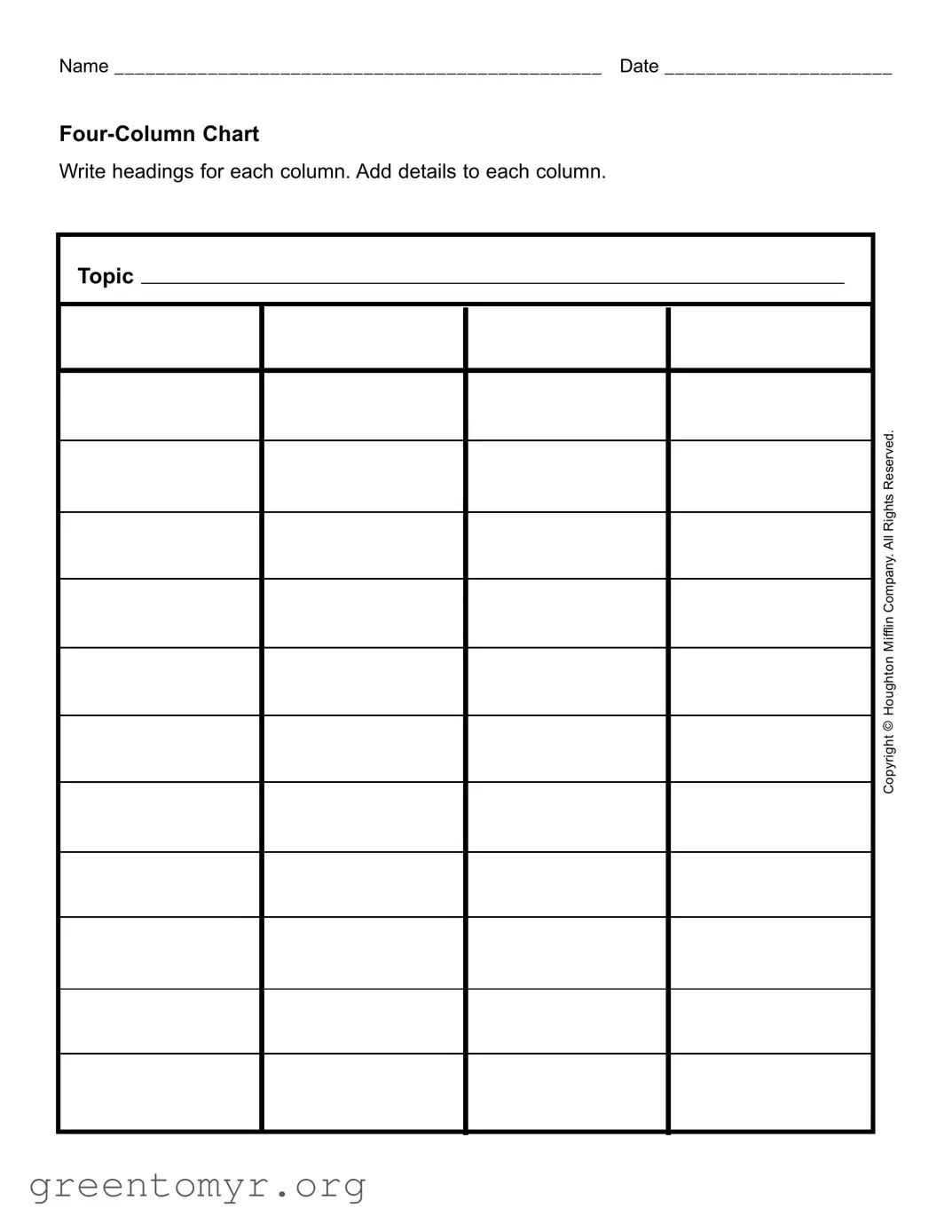
The Four Column Chart form serves as a structured tool designed to facilitate organized note-taking and information analysis. This form typically includes space for a name and date, ensuring that users can easily track their entries. Each of the four columns is intended for specific headings that guide the user in categorizing information effectively. By prompting the user to add details under each heading, the form promotes clarity and coherence in presenting data. The design encourages a systematic approach to information management, making it particularly useful for students, professionals, and anyone looking to streamline their thought processes. The Four Column Chart can be applied in various contexts, from academic settings to business environments, enhancing productivity and comprehension. The Mifflin Company has rights to this material, and it is copyrighted by Houghton, ensuring that the form remains a valuable resource for those seeking to organize their ideas efficiently.
Name _______________________________________________ Date ______________________
Write headings for each column. Add details to each column.
Topic |
Mifflin Company.All Rights Reserved. |
Houghton |
Copyright © |
| Fact Name | Description | State-Specific Law | Additional Notes |
|---|---|---|---|
| Purpose | The Four Column Chart is used to organize and compare information across four categories. | N/A | It helps in visualizing data for better understanding. |
| Structure | It consists of four columns that can be filled with relevant data. | N/A | Each column can represent a different aspect of the topic being analyzed. |
| Usage | Commonly used in educational settings for assignments and presentations. | N/A | It can also be utilized in business for project management. |
| Adaptability | The chart can be customized to fit various topics and fields. | N/A | Flexibility allows for tailored applications in different scenarios. |
| Visual Appeal | Using colors and formatting can enhance readability. | N/A | Visual elements can aid in retaining information. |
| Collaboration | It can be used in group settings to facilitate discussion and brainstorming. | N/A | Encourages teamwork and shared understanding of topics. |
| Legal Context | May be used in legal studies to compare case laws or statutes. | Varies by state; consult local laws. | Ensure adherence to specific legal requirements in your jurisdiction. |
| Educational Tool | Teachers often use it to assess student comprehension. | N/A | Can serve as a study guide for exams or projects. |
| Digital Format | Many software applications support creating Four Column Charts. | N/A | Digital formats can allow for easy sharing and editing. |
| Limitations | May oversimplify complex topics if not used carefully. | N/A | Users should ensure comprehensive analysis beyond the chart. |
Filling out the Four Column Chart form requires careful attention to detail. This process will help organize your thoughts and ensure that all necessary information is captured clearly. Follow the steps outlined below to complete the form effectively.
The Four Column Chart form is designed to help individuals organize information systematically. It encourages clarity by allowing users to categorize details under specific headings. This method can be particularly useful for brainstorming, project planning, or summarizing key points. By breaking down complex information into four distinct columns, users can easily compare and analyze data.
To complete the Four Column Chart form, follow these steps:
Yes, the Four Column Chart form is versatile and can be used for various topics. Whether you are analyzing a business, summarizing a book, or planning a project, this format can adapt to your needs. Simply change the headings and the content in each column to suit the specific subject matter you are addressing.
While there is no strict format, it is essential to maintain clarity and organization. Here are a few tips:
By following these guidelines, you can create an effective Four Column Chart that serves your purpose well.
Filling out the Four Column Chart form can seem straightforward, but many individuals encounter common pitfalls that can lead to confusion and incomplete submissions. One frequent mistake is neglecting to include a clear and concise heading for each column. Without proper headings, the information provided can become muddled, making it difficult for readers to grasp the intended message. Clarity is key, and headings serve as signposts for the data that follows.
Another common error involves insufficient detail in the columns. Participants often underestimate the importance of thoroughness. Each column should be populated with relevant information that fully addresses the topic at hand. Leaving columns sparsely filled can lead to ambiguity and a lack of understanding about the subject matter being discussed.
People also frequently misinterpret the purpose of the Four Column Chart. This form is designed to organize information logically. Yet, some individuals treat it as a free-form document, mixing unrelated ideas in the same column. This approach can dilute the effectiveness of the chart, making it challenging for others to discern the connections between different pieces of information.
Another mistake arises from the failure to maintain consistency in formatting. Inconsistent font sizes, styles, or colors can distract from the content itself. A well-organized chart not only looks professional but also enhances readability. It’s essential to choose a uniform style that aligns with the purpose of the chart.
Additionally, individuals often overlook the importance of proofreading their entries. Spelling and grammatical errors can undermine the credibility of the information presented. A quick review can catch these mistakes, ensuring that the content is polished and professional.
Time management can also play a role in the completion of the form. Rushing through the process often leads to mistakes, such as skipping columns or providing incomplete information. Taking the time to thoughtfully fill out each section will yield a more comprehensive and useful chart.
Some people may also forget to consider their audience when filling out the form. Understanding who will be reading the chart can influence the level of detail and the type of language used. Tailoring the content to the audience ensures that it resonates and communicates effectively.
Another frequent oversight is failing to review the instructions or guidelines provided for the form. Sometimes, specific requirements or expectations are outlined that can help guide the completion process. Ignoring these instructions can lead to errors that might have been easily avoided.
Lastly, individuals may not seek feedback from others before finalizing their chart. A fresh set of eyes can catch mistakes that the original creator might have missed. Engaging peers or mentors in the review process can enhance the quality of the submission significantly.
The Four Column Chart form is a valuable tool for organizing information in a clear and structured manner. However, it is often accompanied by several other forms and documents that facilitate various aspects of project management, reporting, and analysis. Below is a list of commonly used documents that work alongside the Four Column Chart form, each serving a specific purpose.
Utilizing these documents in conjunction with the Four Column Chart form enhances communication and organization within a project. Each document plays a unique role, contributing to a well-rounded approach to project management and collaboration.
The Four Column Chart form serves as a versatile tool for organizing information. Several other documents share similar characteristics, primarily in their structured approach to data presentation. Below is a list of documents that exhibit similarities to the Four Column Chart form:
When filling out the Four Column Chart form, it's essential to approach the task with care. Here are some key points to consider:
By following these guidelines, you can ensure that your Four Column Chart form is filled out correctly and effectively. Take your time, and double-check your work to avoid any mistakes.
The Four Column Chart form is a useful tool for organizing information, but several misconceptions exist about its use and purpose. Here are five common misunderstandings:
The Four Column Chart form is a useful tool for organizing information clearly and effectively. Here are some key takeaways to consider when filling out and utilizing this form:
By following these key takeaways, you can maximize the effectiveness of the Four Column Chart form in your projects and discussions.