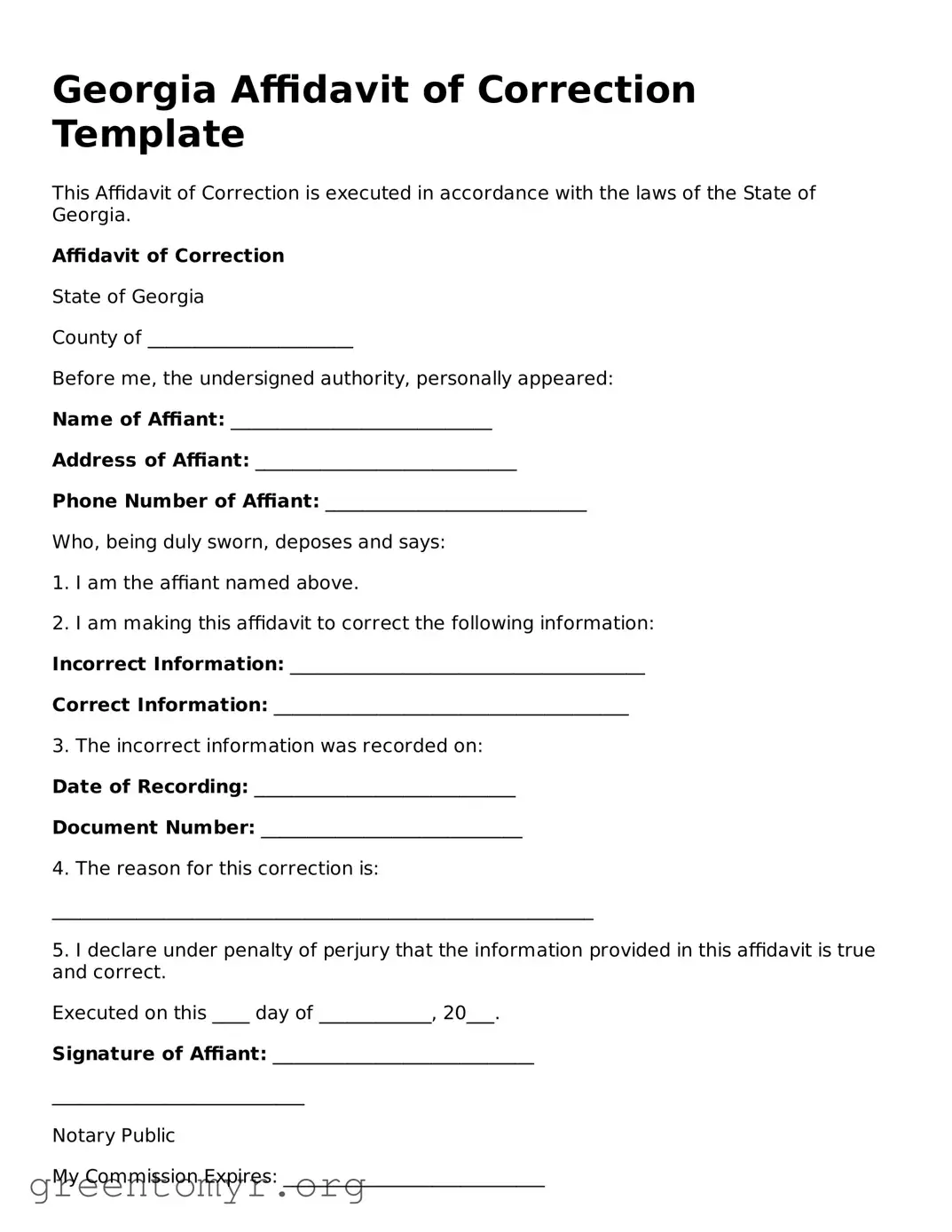
In the state of Georgia, the Affidavit of Correction serves as a crucial tool for individuals and businesses seeking to amend errors in public records. This form addresses inaccuracies that may arise in various documents, such as deeds, mortgages, or other legal filings. When mistakes occur—whether due to typographical errors, incorrect names, or misstatements of fact—this affidavit provides a straightforward process for rectifying those errors. By submitting this form, the parties involved can ensure that the official records reflect accurate information, which is essential for legal clarity and property rights. The form typically requires the details of the original document, a clear explanation of the error, and the correct information that should replace it. Completing the Affidavit of Correction not only helps maintain the integrity of public records but also protects the interests of those affected by the inaccuracies. Understanding the requirements and implications of this form is vital for anyone navigating the complexities of Georgia's legal landscape.
Georgia Affidavit of Correction Template
This Affidavit of Correction is executed in accordance with the laws of the State of Georgia.
Affidavit of Correction
State of Georgia
County of ______________________
Before me, the undersigned authority, personally appeared:
Name of Affiant: ____________________________
Address of Affiant: ____________________________
Phone Number of Affiant: ____________________________
Who, being duly sworn, deposes and says:
1. I am the affiant named above.
2. I am making this affidavit to correct the following information:
Incorrect Information: ______________________________________
Correct Information: ______________________________________
3. The incorrect information was recorded on:
Date of Recording: ____________________________
Document Number: ____________________________
4. The reason for this correction is:
__________________________________________________________
5. I declare under penalty of perjury that the information provided in this affidavit is true and correct.
Executed on this ____ day of ____________, 20___.
Signature of Affiant: ____________________________
___________________________
Notary Public
My Commission Expires: ____________________________
| Fact Name | Description |
|---|---|
| Purpose | The Georgia Affidavit of Correction is used to correct errors in public records, such as property deeds or other official documents. |
| Governing Law | This form is governed by Georgia law, specifically O.C.G.A. § 15-6-67. |
| Eligibility | Any individual or entity that has filed a document with an error may use this affidavit to correct the record. |
| Required Information | The affidavit must include the original document details, the nature of the error, and the correct information. |
| Signature Requirement | The affidavit must be signed by the person making the correction or their authorized representative. |
| Filing Process | After completing the affidavit, it must be filed with the appropriate county clerk’s office where the original document was recorded. |
| Notarization | The affidavit typically requires notarization to verify the identity of the signer. |
| Effect on Original Document | Filing the affidavit does not erase the original document; it serves as a formal correction to the record. |
After obtaining the Georgia Affidavit of Correction form, you will need to fill it out accurately to ensure the necessary corrections are made. Follow these steps carefully to complete the form.
The Georgia Affidavit of Correction is a legal document used to correct errors in previously filed documents, such as deeds, liens, or other official records. This form allows individuals to clarify inaccuracies without the need for extensive legal proceedings. It serves to ensure that public records accurately reflect the intended information.
Any individual or entity that has a vested interest in the document being corrected can file an Affidavit of Correction. This includes property owners, lienholders, or anyone who has been affected by the inaccuracies in the records. It is important that the person filing the affidavit has the authority to do so and that they provide accurate details about the correction needed.
The Affidavit of Correction can address a variety of errors, including:
It is essential that the corrections made are clear and specific to avoid further confusion.
Completing the form involves several key steps:
Ensure that all information is accurate and complete to facilitate a smooth correction process.
Yes, there may be a filing fee when submitting the Affidavit of Correction. The fee can vary by county, so it is advisable to check with the local clerk’s office for the exact amount. Payment methods may also differ, so confirm acceptable payment options before filing.
Once the affidavit is filed, the clerk’s office will review the document to ensure it meets all requirements. If approved, the correction will be officially recorded, and the public records will be updated accordingly. It is wise to keep a copy of the filed affidavit for personal records. In some cases, it may be beneficial to notify any parties affected by the correction to maintain transparency.
Filling out the Georgia Affidavit of Correction form can be a straightforward process, but many people stumble along the way. One common mistake is failing to provide accurate information. It's crucial to double-check names, addresses, and other details. Errors in this information can lead to delays or even rejection of the form.
Another frequent error is neglecting to sign the affidavit. A signature is not just a formality; it validates the document. Without it, the affidavit lacks legal standing. Additionally, some individuals forget to date the document. A missing date can raise questions about the timing of the correction and may complicate matters further.
Many people also overlook the importance of including the correct case number. If the affidavit pertains to a specific legal matter, the case number is essential for proper identification. Omitting this detail can result in confusion and hinder the processing of the affidavit.
Providing insufficient details about the correction is another common pitfall. The affidavit should clearly state what needs to be corrected and why. Vague language can lead to misunderstandings and may require further clarification later.
Some individuals fail to include necessary supporting documents. Depending on the nature of the correction, additional documentation may be required to substantiate the claims made in the affidavit. Not including these can slow down the process significantly.
In some cases, people submit the affidavit without consulting legal counsel. While it's not mandatory to have a lawyer, seeking professional advice can help ensure that the form is filled out correctly and complies with all legal requirements.
Another mistake is not making copies of the completed affidavit. Keeping a copy for personal records is essential. This can be invaluable if any questions arise later about the submission.
Many individuals also underestimate the importance of following the specific submission guidelines. Each county may have its own rules regarding how and where to submit the affidavit. Ignoring these can lead to unnecessary complications.
Lastly, some people fail to follow up after submission. It’s important to check on the status of the affidavit to ensure it has been processed correctly. A proactive approach can help address any issues promptly.
By avoiding these common mistakes, you can help ensure that your Georgia Affidavit of Correction is completed and submitted successfully. Taking the time to review each step can save you from future headaches.
When dealing with the Georgia Affidavit of Correction form, there are several other documents that may be useful in the process. These documents help clarify or amend records and ensure that all information is accurate and up to date. Below is a list of commonly used forms alongside the Affidavit of Correction.
Using these forms in conjunction with the Georgia Affidavit of Correction can streamline the process of making necessary adjustments to official records. Each document plays a unique role in ensuring accuracy and clarity in legal matters.
The Affidavit of Correction form serves a specific purpose in legal and administrative processes, primarily to correct errors in official documents. Several other documents share similarities with it, often functioning to amend, clarify, or rectify information. Here are eight documents that are similar to the Affidavit of Correction:
Understanding these documents can be crucial for anyone navigating legal processes, as they each play a role in ensuring accuracy and clarity in official records.
When filling out the Georgia Affidavit of Correction form, it is essential to follow certain guidelines to ensure the process goes smoothly. Below is a list of things you should and shouldn't do.
Following these guidelines can help prevent delays and ensure that your affidavit is processed correctly. If you have any questions, consider seeking assistance from a qualified professional.
The Georgia Affidavit of Correction form is often misunderstood. Here are ten common misconceptions about this important document.
This form is specifically designed for correcting clerical errors, not substantive mistakes. It cannot be used to change the underlying facts of a document.
Only the person who executed the original document or their legal representative can file this affidavit.
Notarization is a necessary step. The affidavit must be signed in front of a notary public to be valid.
This is incorrect. An Affidavit of Correction is meant to clarify or correct existing documents, not replace them.
This form is limited to certain documents, such as deeds and mortgages. It cannot be used for all legal documents.
While the affidavit serves to correct public records, it does not guarantee that all parties will accept the correction without question.
Timeliness is crucial. Corrections should be made as soon as the error is discovered to avoid complications.
While the form itself is straightforward, the process may involve additional steps, such as notifying affected parties.
Even after filing, there may be grounds for a challenge, especially if the correction affects third parties.
This form can apply to various legal documents, not just those related to real estate.
Understanding these misconceptions is crucial for anyone considering filing an Affidavit of Correction in Georgia. Proper knowledge will help ensure the process is handled correctly and efficiently.
Filling out and using the Georgia Affidavit of Correction form can be a straightforward process if you keep a few key points in mind. Here are some essential takeaways to consider:
By following these guidelines, you can navigate the process of using the Georgia Affidavit of Correction form with greater confidence and clarity.