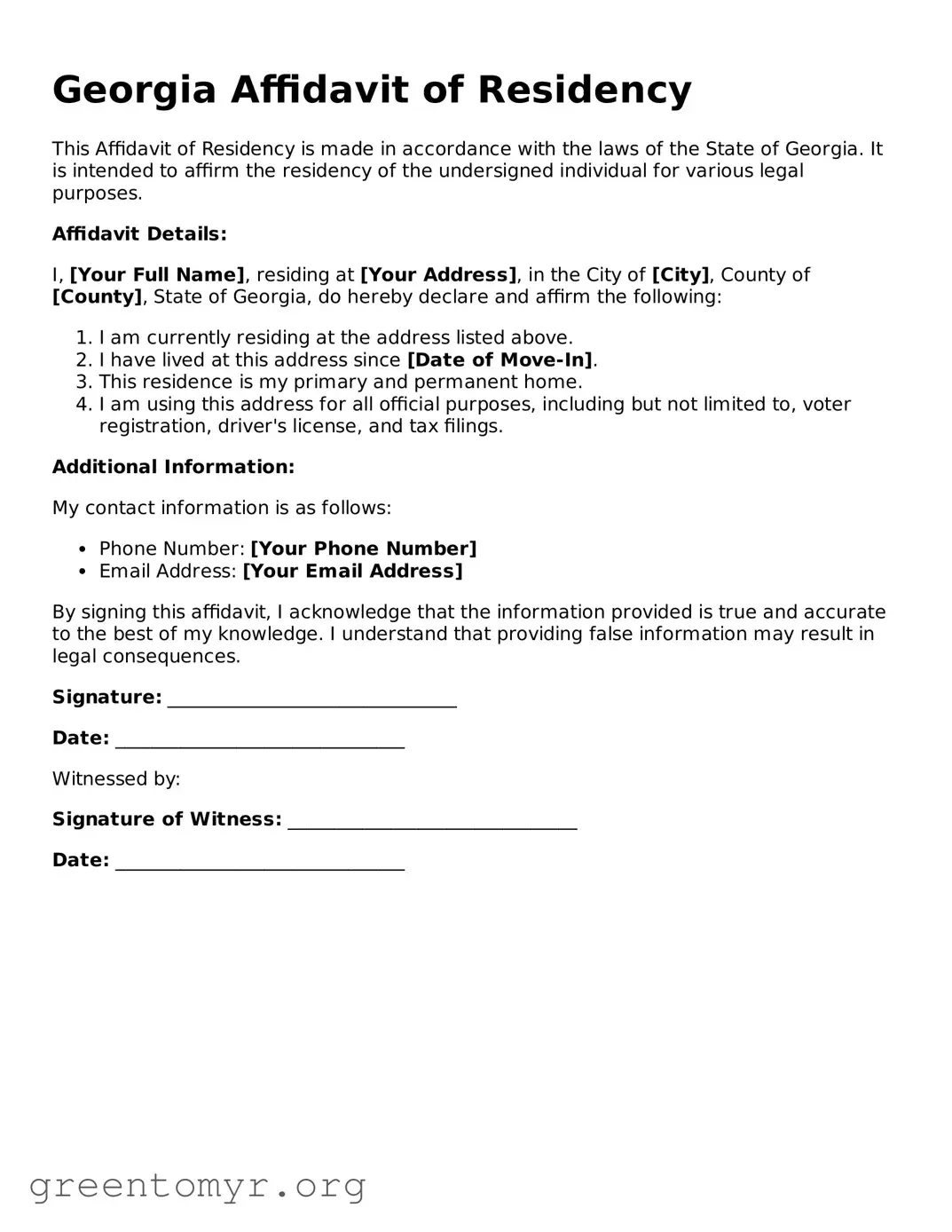
The Georgia Affidavit of Residency form plays a crucial role in various legal and administrative processes, ensuring that individuals can verify their residency status when required. This form is often utilized for purposes such as enrolling children in school, obtaining a driver's license, or applying for public assistance programs. By providing a sworn statement regarding one’s place of residence, it serves as a reliable document that can affirm a person's living situation. The affidavit typically requires essential information, including the individual's name, address, and the duration of residency at that location. It may also necessitate the signatures of witnesses or a notary public, adding an extra layer of authenticity to the claim. Understanding the nuances of this form is vital for anyone navigating the complexities of residency verification in Georgia, as it can significantly impact access to services and legal rights.
Georgia Affidavit of Residency
This Affidavit of Residency is made in accordance with the laws of the State of Georgia. It is intended to affirm the residency of the undersigned individual for various legal purposes.
Affidavit Details:
I, [Your Full Name], residing at [Your Address], in the City of [City], County of [County], State of Georgia, do hereby declare and affirm the following:
Additional Information:
My contact information is as follows:
By signing this affidavit, I acknowledge that the information provided is true and accurate to the best of my knowledge. I understand that providing false information may result in legal consequences.
Signature: _______________________________
Date: _______________________________
Witnessed by:
Signature of Witness: _______________________________
Date: _______________________________
| Fact Name | Description |
|---|---|
| Purpose | The Georgia Affidavit of Residency form is used to verify an individual's residency in Georgia for various legal purposes. |
| Governing Law | This form is governed by Georgia law, specifically O.C.G.A. § 16-10-20, which addresses false statements and affidavits. |
| Who Uses It | Individuals may use this form when applying for government services, enrolling in schools, or for other official matters requiring proof of residency. |
| Signature Requirement | The form must be signed in the presence of a notary public to ensure its authenticity and legal validity. |
| Validity | Once completed and notarized, the affidavit is valid until the residency status changes or until it is revoked by the individual. |
Filling out the Georgia Affidavit of Residency form is a straightforward process that requires careful attention to detail. Once completed, this form will be submitted to the appropriate authority, allowing you to verify your residency status in Georgia.
The Georgia Affidavit of Residency form is a legal document used to verify a person's residency in the state of Georgia. This form is often required for various purposes, such as enrolling a child in school, obtaining a driver's license, or applying for certain government benefits. It serves as a sworn statement affirming that the individual resides at a specified address within Georgia.
Typically, the Affidavit of Residency is needed by individuals who need to prove their residence for specific legal or administrative reasons. This may include:
In general, if you need to demonstrate your residency for any official purpose, this form may be necessary.
Completing the Georgia Affidavit of Residency form is straightforward. Follow these steps:
Make sure all information is accurate to avoid any issues with your application or request.
Yes, notarization is typically required for the Georgia Affidavit of Residency form. This step adds a layer of authenticity to the document, confirming that you have sworn to the information provided. Notaries are available at banks, law offices, and some government offices. Be sure to bring a valid ID when you go for notarization.
If you do not have a permanent address, you can still complete the Affidavit of Residency by providing a temporary address where you currently reside. Additionally, you may need to include a statement explaining your situation. This can help clarify your residency status for the entity requesting the affidavit.
The submission process for the Affidavit of Residency depends on the purpose for which you are using it. Common submission locations include:
Always check with the specific organization to ensure you follow their submission guidelines.
When completing the Georgia Affidavit of Residency form, many individuals encounter common pitfalls that can lead to delays or complications. One frequent mistake is not providing accurate personal information. It is essential to ensure that your name, address, and other details are correct and match official documents. Errors in this area can cause confusion and may require you to resubmit the form.
Another common error is failing to sign the form. The affidavit requires a signature to verify the information provided. Without a signature, the form may be considered incomplete. Always double-check that you have signed the document before submission.
People often overlook the need for a witness or notary. Depending on the requirements, some affidavits must be signed in the presence of a witness or a notary public. Neglecting this step can render the affidavit invalid. It is wise to confirm the specific requirements for your situation.
In addition, individuals sometimes do not date the affidavit. Including the date is crucial, as it establishes when the information was provided. An undated affidavit may raise questions about its validity.
Many applicants fail to provide supporting documentation. The affidavit may require additional proof of residency, such as utility bills or lease agreements. Omitting these documents can lead to delays in processing your application.
Another mistake is using incorrect or outdated forms. Always ensure you have the latest version of the Affidavit of Residency form. Using an old form may result in rejection or additional requests for information.
Some individuals do not review the entire form before submission. Skimming through the document can lead to missed errors or incomplete sections. Taking the time to carefully review the form can help catch mistakes before they become issues.
Finally, misunderstanding the purpose of the affidavit can lead to errors. It is important to understand what the affidavit is used for and the specific requirements related to it. This understanding will help ensure that all necessary information is accurately provided.
The Georgia Affidavit of Residency form serves as a crucial document for verifying an individual's residency in the state. Often, it is accompanied by other forms and documents that help establish residency or provide additional information. Below is a list of commonly used documents that may accompany the Affidavit of Residency.
When gathering these documents, ensure they are current and accurately reflect your residency status. Proper documentation can make the process smoother and help avoid potential issues with residency verification.
When filling out the Georgia Affidavit of Residency form, it is important to follow specific guidelines to ensure accuracy and compliance. Here are some key do's and don'ts:
The Georgia Affidavit of Residency form is often misunderstood. Here are six common misconceptions about this important document.
Many believe that the affidavit is exclusively for students. In reality, it can be used by anyone needing to prove their residency in Georgia, including adults and families.
Some think that notarization is a requirement for the affidavit. While notarization can add credibility, it is not mandatory for all uses of the form.
This form is often associated with voter registration, but it serves various purposes. It can also be used for obtaining a driver's license or enrolling in schools.
Many individuals feel overwhelmed by the form. However, it is relatively straightforward and can be completed with basic information about residency.
Some people think they need to provide proof of income when submitting the affidavit. This is not true; the form focuses solely on residency.
Many assume that submitting the affidavit is a one-time task. In fact, individuals may need to submit it multiple times if their residency changes.
Understanding these misconceptions can help individuals navigate the process more effectively. Clarity about the Georgia Affidavit of Residency form ensures that everyone can fulfill their residency requirements with confidence.
Filling out and using the Georgia Affidavit of Residency form is an important process for individuals seeking to establish residency in the state. Here are some key takeaways to consider:
Understanding these key points can help ensure a smooth process when filling out and using the Georgia Affidavit of Residency form.