Content Navigation

The Georgia Affidavit of Service form plays a crucial role in the legal process by providing a formal record that a legal document has been delivered to the intended recipient. This form is essential for ensuring that all parties involved in a legal proceeding are properly notified, which is a fundamental principle of due process. When a document, such as a summons or complaint, is served, the Affidavit of Service serves as proof that the service was executed in accordance with the law. It typically includes key details such as the date and time of service, the method used for delivery, and information about the individual who performed the service. Furthermore, this affidavit is signed under oath, adding a layer of authenticity and reliability to the process. Understanding the components and requirements of the Georgia Affidavit of Service is vital for anyone involved in legal matters, as it helps to ensure that the proceedings can move forward without unnecessary delays or complications.

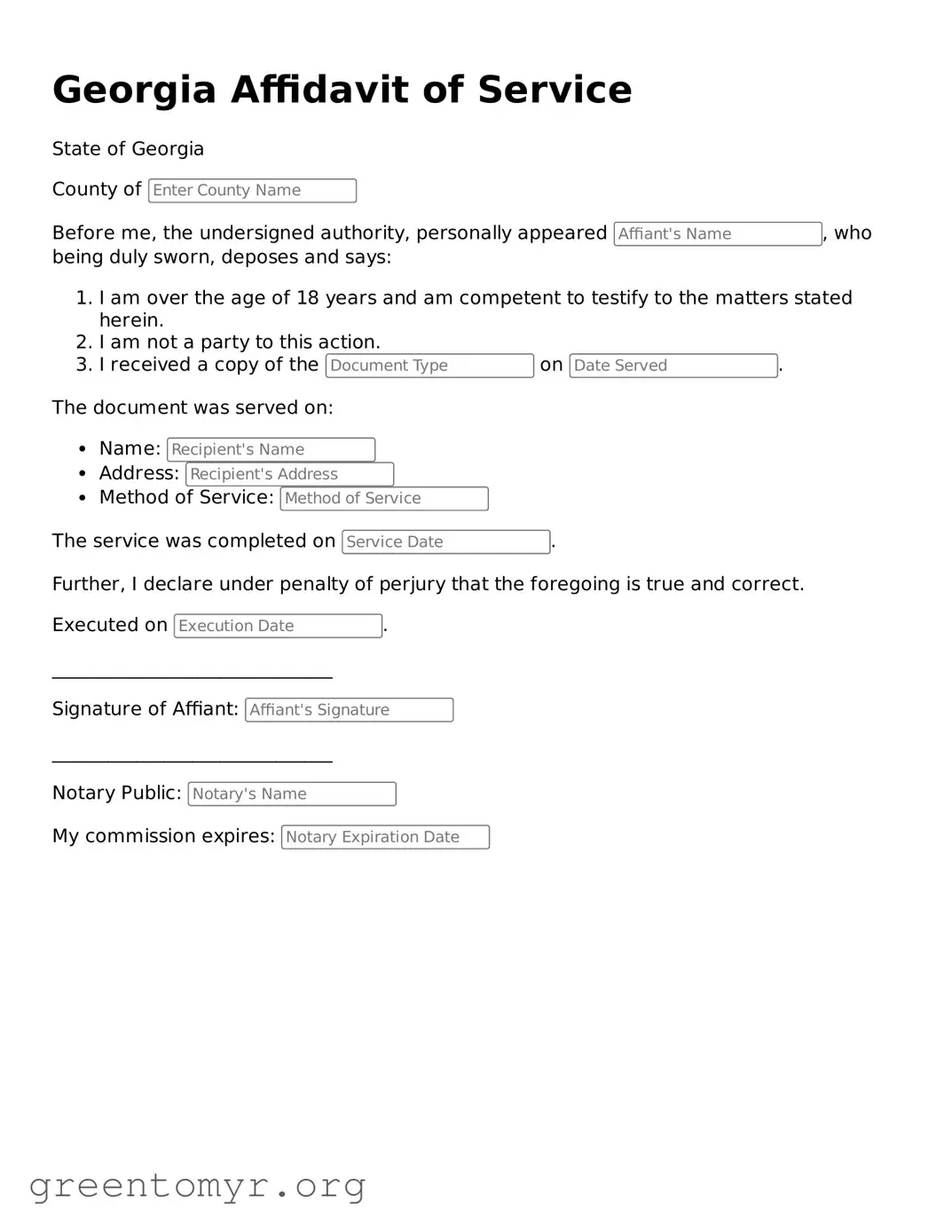
Georgia Affidavit of Service Example

Georgia Affidavit of Service

State of Georgia

County of

Before me, the undersigned authority, personally appeared , who being duly sworn, deposes and says:

  1. I am over the age of 18 years and am competent to testify to the matters stated herein.
  2. I am not a party to this action.
  3. I received a copy of the on .

The document was served on:

  • Name:
  • Address:
  • Method of Service:

The service was completed on .

Further, I declare under penalty of perjury that the foregoing is true and correct.

Executed on .

______________________________

Signature of Affiant:

______________________________

Notary Public:

My commission expires:

PDF Form Features

Fact Name Description
Purpose The Georgia Affidavit of Service form is used to provide proof that legal documents have been delivered to the appropriate parties in a legal proceeding.
Governing Law This form is governed by the Official Code of Georgia Annotated (O.C.G.A.) § 9-11-4, which outlines the requirements for service of process in Georgia.
Who Can Serve In Georgia, any person who is at least 18 years old and not a party to the case may serve the documents and complete the affidavit.
Filing Requirement After the affidavit is completed, it must be filed with the court to demonstrate that service has been properly executed.

Guide to Using Georgia Affidavit of Service

After obtaining the Georgia Affidavit of Service form, you will need to fill it out accurately. This process is essential for ensuring that the service of process is legally recognized. Follow these steps carefully to complete the form.

  1. Begin by entering the name of the court at the top of the form.
  2. Next, write the case number assigned to your legal matter.
  3. Provide the names of the parties involved in the case. This includes both the plaintiff and the defendant.
  4. Indicate the date on which the service of process occurred.
  5. Fill in the name of the person who served the documents. This could be a process server or another individual authorized to serve.
  6. Include the address where the service took place. Be specific to avoid any confusion.
  7. Describe the method of service used (e.g., personal service, mail, etc.).
  8. Sign the affidavit in the designated area, affirming that the information provided is true and accurate.
  9. Finally, have the affidavit notarized if required by the court. This adds an extra layer of validity to the document.

Once you have completed the form, review it for any errors or omissions. After ensuring that all information is correct, you can file the affidavit with the appropriate court. This step is crucial for moving forward in your legal proceedings.

Get Answers on Georgia Affidavit of Service

What is the Georgia Affidavit of Service form?

The Georgia Affidavit of Service form is a legal document used to confirm that a particular legal document, such as a summons or complaint, has been delivered to the appropriate party. This form serves as proof that the intended recipient has received the necessary legal notice, which is crucial for the court process to proceed. Without this affidavit, the court may not accept that the party has been properly notified.

Who needs to complete the Affidavit of Service?

Typically, the individual who serves the legal documents is responsible for completing the Affidavit of Service. This person could be a sheriff, a professional process server, or even an individual who is over the age of 18 and not involved in the case. It is important that the person serving the documents is impartial and can accurately attest to the delivery of the documents.

What information is required on the Affidavit of Service?

The Affidavit of Service generally requires several key pieces of information, including:

  • The name of the person who served the documents.
  • The date and time when the documents were served.
  • The method of service (personal delivery, mail, etc.).
  • The name of the person receiving the documents.
  • The address where the service took place.

Providing accurate and complete information is essential for the affidavit to be valid.

How is the Affidavit of Service filed with the court?

After completing the Affidavit of Service, it must be filed with the court where the original case is being heard. This filing typically occurs after the documents have been served. The affidavit can often be submitted in person or electronically, depending on the court’s rules. It is advisable to keep a copy of the affidavit for your records as well.

What happens if the Affidavit of Service is not completed?

If the Affidavit of Service is not completed and filed, the court may not recognize that the party was properly notified of the legal proceedings. This can lead to delays in the case or even dismissal of the case altogether. It is vital to ensure that this document is completed accurately and submitted on time to avoid any complications.

Can the Affidavit of Service be challenged?

Yes, the Affidavit of Service can be challenged in court. If the recipient of the documents claims they were never served, they can contest the affidavit. In such cases, the court may require additional evidence to determine whether proper service occurred. It is important for the person who served the documents to have clear records and potentially witness testimony to support the affidavit.

Is there a specific format for the Affidavit of Service in Georgia?

While there is no single mandated format for the Affidavit of Service in Georgia, it must include all the necessary information to be considered valid. Many courts provide their own templates or forms that can be used to ensure compliance with local rules. It is advisable to check with the specific court for any requirements or preferred formats to avoid issues.

Common mistakes

Filling out the Georgia Affidavit of Service form can seem straightforward, but many people make common mistakes that can lead to delays or complications in their cases. One frequent error is failing to provide accurate information about the person being served. It's crucial to double-check the name and address. A small typo can result in the document being deemed invalid.

Another common mistake is not including the date of service. The affidavit must clearly state when the service took place. Without this information, the court may question the validity of the service, potentially impacting your case timeline.

People often overlook the requirement for a signature. The affidavit must be signed by the person who performed the service. Forgetting to sign can render the document incomplete. In some cases, the signature must also be notarized, so it's essential to be aware of these requirements.

Additionally, some individuals fail to provide details about how the service was conducted. The form typically requires a description of the method used, whether it was personal service, service by mail, or another method. Omitting this information can lead to confusion and might require additional steps to clarify.

Another mistake involves not keeping a copy of the affidavit for personal records. It’s important to have a copy on hand for future reference or to provide to the court if needed. Losing track of this document can complicate matters down the line.

Lastly, people sometimes neglect to review the instructions for the form carefully. Each section has specific requirements, and missing a step can lead to unnecessary delays. Taking the time to read and understand the instructions can save a lot of hassle in the long run.

Documents used along the form

In legal proceedings, the Georgia Affidavit of Service form plays a crucial role in documenting the delivery of legal documents. However, several other forms and documents are often used in conjunction with this affidavit to ensure proper legal processes are followed. Below is a list of these documents, each serving a specific purpose in the legal framework.

  • Summons: This document notifies a defendant that a legal action has been initiated against them. It provides essential information about the case and instructions on how to respond.
  • Complaint: The complaint outlines the plaintiff's allegations against the defendant. It sets the stage for the legal dispute and details the relief sought.
  • Proof of Service: This document confirms that the legal documents have been delivered to the intended recipient. It often includes details about how and when the service occurred.
  • Notice of Appearance: A notice filed by an attorney indicating their representation of a party in a legal matter. This document ensures that the court recognizes the attorney's involvement in the case.
  • Motion: A formal request made to the court seeking a specific ruling or order. Motions can address various issues, including procedural matters or requests for judgment.
  • Answer: The response filed by the defendant to the complaint. It addresses the allegations made by the plaintiff and may include defenses or counterclaims.
  • Affidavit: A written statement confirmed by oath or affirmation, used as evidence in court. Affidavits can support motions or provide testimony about specific facts.
  • Certificate of Service: A document that certifies that copies of documents have been served to all parties involved in a case. This ensures compliance with procedural rules.
  • Request for Admission: A formal request asking a party to admit or deny specific facts related to the case. This helps narrow down the issues for trial.
  • Discovery Documents: Various forms used during the discovery phase, including interrogatories and requests for production, to gather information from the opposing party.

Each of these documents plays an integral role in the legal process, ensuring that all parties are informed and that the court can effectively adjudicate the case. Understanding their purposes can greatly assist individuals navigating the complexities of the legal system.

Similar forms

The Affidavit of Service form serves as a crucial document in legal proceedings, confirming that a particular document has been delivered to a party involved in a case. Several other documents share similarities with the Affidavit of Service in terms of purpose, structure, or function. Below is a list of ten such documents:

  • Summons: This document notifies a defendant of legal action and includes instructions for responding. Like the Affidavit of Service, it must be properly served to be effective.
  • Notice of Motion: A formal request for a court order that must be served to the opposing party. Its purpose aligns with ensuring that all parties are informed of actions taken in court.
  • Proof of Service: Similar to the Affidavit of Service, this document provides evidence that a legal document has been delivered to the appropriate party.
  • Complaint: The initial document filed in a lawsuit outlining the plaintiff's claims. It must be served to the defendant, similar to how the Affidavit of Service confirms delivery.
  • Subpoena: A document that orders an individual to appear in court or produce evidence. It requires service to ensure compliance, much like the Affidavit of Service.
  • Response or Answer: This document is submitted by a defendant in reply to a complaint. It must be served to the plaintiff, mirroring the service confirmation provided by the Affidavit of Service.
  • Request for Admission: A document that asks the opposing party to admit or deny certain facts. Proper service is essential for it to be considered valid, akin to the Affidavit of Service.
  • Interrogatories: Written questions sent from one party to another in a lawsuit. They must be served to the other party, similar to the process confirmed by the Affidavit of Service.
  • Settlement Agreement: A document outlining the terms of a settlement between parties. It must be served to all involved parties to be enforceable, paralleling the role of the Affidavit of Service.
  • Motion for Summary Judgment: A request for the court to rule in favor of one party without a trial. This motion must be served to the opposing party, reflecting the service confirmation aspect of the Affidavit of Service.

Dos and Don'ts

When filling out the Georgia Affidavit of Service form, it is important to follow specific guidelines to ensure accuracy and compliance. Here is a list of things you should and shouldn't do:

  • Do read the instructions carefully before starting.
  • Do provide complete and accurate information about the parties involved.
  • Do include the date and time of service.
  • Do sign the affidavit in the presence of a notary public.
  • Do keep a copy of the completed affidavit for your records.
  • Don't leave any sections blank; fill in all required fields.
  • Don't use incorrect names or spellings for the parties.
  • Don't forget to indicate the method of service used.
  • Don't alter the form in any way that could cause confusion.
  • Don't submit the affidavit without the proper notarization.

Misconceptions

Understanding the Georgia Affidavit of Service form is crucial for anyone involved in legal proceedings. However, several misconceptions can lead to confusion. Here’s a list of common misunderstandings:

  1. It's not necessary if I served the papers myself. Many believe that if they personally deliver the documents, they don't need an affidavit. However, an affidavit is required to officially document the service.
  2. Any person can serve the documents. While it’s true that anyone over 18 can serve papers, they must not be a party to the case. This means you cannot serve the documents yourself if you are involved in the lawsuit.
  3. The affidavit can be completed after the court date. Some think they can file the affidavit after the hearing. In reality, it must be filed before the court date to prove that service was completed.
  4. It's the same as a summons. An affidavit of service is not the same as a summons. The summons is the document that notifies the defendant of the legal action, while the affidavit serves as proof of that notification.
  5. Filing the affidavit is optional. This is a common misconception. Filing the affidavit is mandatory to confirm that service was properly executed.
  6. It doesn't matter how the documents are served. The method of service matters. Different methods, like personal service or mail, have specific requirements that must be met for the affidavit to be valid.
  7. Once I file the affidavit, my job is done. While filing is an important step, you must also ensure that the other party receives the documents. Follow up to confirm receipt.
  8. There’s no deadline for filing the affidavit. There is a timeline for filing the affidavit after service is completed. Failing to meet this deadline can affect your case.

By clearing up these misconceptions, you can navigate the process more effectively and ensure that you meet all legal requirements.

Key takeaways

When it comes to the Georgia Affidavit of Service form, understanding the key elements can make the process smoother. Here are some important takeaways to keep in mind:

  1. Purpose of the Affidavit: This form is used to prove that legal documents were delivered to the appropriate party.
  2. Who Can Serve: Any individual who is at least 18 years old and not a party to the case can serve the documents.
  3. Details Required: Include specific information such as the date, time, and manner of service, along with the name of the person served.
  4. Signature Requirement: The affidavit must be signed by the person who served the documents, affirming the accuracy of the information provided.
  5. Filing with the Court: After completing the affidavit, it should be filed with the court to officially document the service.
  6. Multiple Copies: It's wise to keep multiple copies of the affidavit for your records and to provide to other parties if necessary.
  7. Timing Matters: Ensure that the affidavit is filed in a timely manner, as delays can affect the legal proceedings.
  8. Accuracy is Key: Double-check all information for accuracy to avoid any complications or delays in your case.
  9. Consult Resources: If you're unsure about any part of the process, consider seeking assistance from legal resources or professionals.

By following these takeaways, you can effectively navigate the process of filling out and using the Georgia Affidavit of Service form.