Content Navigation

When purchasing or selling a boat in Georgia, a Boat Bill of Sale form serves as a crucial document that protects both parties involved in the transaction. This form outlines essential details such as the names and addresses of the buyer and seller, a description of the boat, and the sale price. Additionally, it often includes the boat's hull identification number (HIN), which is vital for registration and identification purposes. The form also typically contains a statement regarding the condition of the boat, ensuring that the buyer is aware of any existing issues. By signing this document, both parties agree to the terms of the sale, providing legal protection and clarity in the event of future disputes. Understanding the importance of this form can facilitate a smoother transaction and help ensure compliance with state regulations.

Georgia Boat Bill of Sale Example

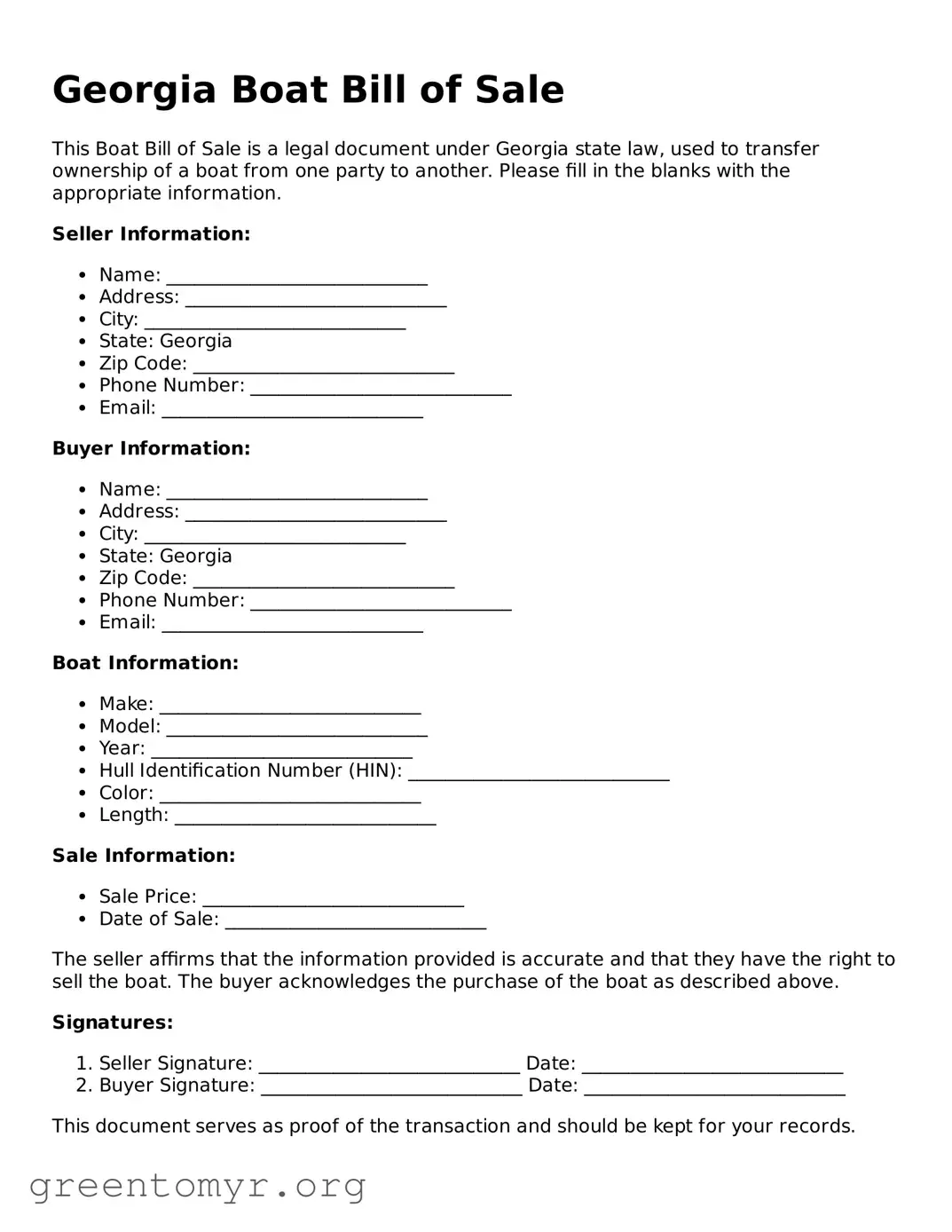
Georgia Boat Bill of Sale

This Boat Bill of Sale is a legal document under Georgia state law, used to transfer ownership of a boat from one party to another. Please fill in the blanks with the appropriate information.

Seller Information:

  • Name: ____________________________
  • Address: ____________________________
  • City: ____________________________
  • State: Georgia
  • Zip Code: ____________________________
  • Phone Number: ____________________________
  • Email: ____________________________

Buyer Information:

  • Name: ____________________________
  • Address: ____________________________
  • City: ____________________________
  • State: Georgia
  • Zip Code: ____________________________
  • Phone Number: ____________________________
  • Email: ____________________________

Boat Information:

  • Make: ____________________________
  • Model: ____________________________
  • Year: ____________________________
  • Hull Identification Number (HIN): ____________________________
  • Color: ____________________________
  • Length: ____________________________

Sale Information:

  • Sale Price: ____________________________
  • Date of Sale: ____________________________

The seller affirms that the information provided is accurate and that they have the right to sell the boat. The buyer acknowledges the purchase of the boat as described above.

Signatures:

  1. Seller Signature: ____________________________ Date: ____________________________
  2. Buyer Signature: ____________________________ Date: ____________________________

This document serves as proof of the transaction and should be kept for your records.

PDF Form Features

Fact Name Description
Purpose The Georgia Boat Bill of Sale form serves as a legal document to record the sale and transfer of ownership of a boat.
Governing Law The sale of boats in Georgia is governed by the Official Code of Georgia Annotated (O.C.G.A.) § 52-7-1 et seq.
Required Information The form typically requires details such as the buyer's and seller's names, addresses, and the boat's description.
Notarization While notarization is not always required, having the bill of sale notarized can provide additional legal protection.
Tax Implications The buyer may be responsible for paying sales tax based on the purchase price of the boat, according to Georgia law.
Record Keeping Both the buyer and seller should keep a copy of the completed bill of sale for their records.
Vehicle Identification Number (VIN) Including the boat's Hull Identification Number (HIN) is essential for identification and registration purposes.
Condition of Sale The form can include a clause regarding the condition of the boat, indicating whether it is sold "as is" or with warranties.
Transfer of Title The bill of sale may be used to facilitate the transfer of the boat's title, which must also be completed separately.
State-Specific Form Georgia has its own specific form for the bill of sale, which can often be found online or at local boating offices.

Guide to Using Georgia Boat Bill of Sale

To complete the Georgia Boat Bill of Sale form, gather all necessary information about the boat, the seller, and the buyer. After filling out the form, both parties will need to sign it to validate the transaction. Once signed, it is advisable to keep copies for personal records.

  1. Obtain the Georgia Boat Bill of Sale form. This can be done online or through local boating authorities.
  2. Fill in the date of the transaction at the top of the form.
  3. Enter the name and address of the seller in the designated section.
  4. Provide the name and address of the buyer in the appropriate fields.
  5. Describe the boat, including its make, model, year, and hull identification number (HIN).
  6. Indicate the purchase price of the boat clearly.
  7. Include any additional details or conditions of the sale if necessary.
  8. Both the seller and buyer must sign and date the form at the bottom.
  9. Make copies of the completed form for both parties' records.

Get Answers on Georgia Boat Bill of Sale

What is a Georgia Boat Bill of Sale?

A Georgia Boat Bill of Sale is a legal document used to record the sale of a boat between a buyer and a seller. This form serves as proof of the transaction and includes essential details about the boat, the parties involved, and the terms of the sale. It helps protect both parties by documenting the transfer of ownership.

What information is required on the form?

The Georgia Boat Bill of Sale typically requires the following information:

  • Names and addresses of both the buyer and seller
  • Description of the boat, including make, model, year, and hull identification number (HIN)
  • Sale price of the boat
  • Date of the transaction
  • Signatures of both parties

Is a bill of sale required in Georgia?

While a bill of sale is not legally required for every boat sale in Georgia, it is highly recommended. Having a bill of sale can provide legal protection and serves as proof of ownership. Additionally, it may be necessary for registering the boat with the Georgia Department of Natural Resources.

Can I create my own Boat Bill of Sale?

Yes, you can create your own Boat Bill of Sale as long as it includes all the necessary information. Many templates are available online, or you can draft your own document. Ensure that it is clear and includes all relevant details to avoid any disputes later.

Do I need to have the bill of sale notarized?

Notarization is not a requirement for a Georgia Boat Bill of Sale. However, having the document notarized can add an extra layer of authenticity and may be beneficial if disputes arise. It is advisable to check with local authorities or the buyer/seller to see if notarization is preferred.

What should I do with the completed bill of sale?

After completing the bill of sale, both the buyer and seller should keep a copy for their records. The seller may also need to provide a copy to the Georgia Department of Natural Resources when registering the boat under the new owner's name.

Are there any fees associated with the bill of sale?

There are no fees specifically associated with creating a Boat Bill of Sale in Georgia. However, the buyer may need to pay fees for boat registration and titling once the sale is complete. These fees vary based on the boat's value and other factors.

What if the boat has a lien or is financed?

If the boat has a lien or is financed, it is crucial to address this before completing the sale. The seller should ensure that the lien is paid off and that they have the title in hand. Buyers should verify the status of the title to avoid future complications.

Common mistakes

Filling out the Georgia Boat Bill of Sale form can be straightforward, but many individuals encounter pitfalls that can lead to complications. One common mistake is failing to include all required information. This includes not only the seller's and buyer's names but also the boat's details, such as the hull identification number, make, model, and year. Omitting any of this information can create issues during registration.

Another frequent error involves incorrect dates. Buyers and sellers sometimes forget to date the form or accidentally enter the wrong date. This oversight can lead to confusion regarding ownership transfer and may complicate future transactions.

Inaccurate descriptions of the boat are also a problem. The form requires specific details about the boat, and vague descriptions can lead to disputes. It’s essential to provide a clear and thorough description to ensure both parties are on the same page.

People often neglect to sign the document. Both the seller and buyer must sign the Boat Bill of Sale for it to be valid. Failure to obtain signatures can render the transaction incomplete and unenforceable.

Another mistake is not providing a clear method of payment. Whether it's cash, check, or another form, specifying how the payment will be made is crucial. This clarity helps prevent misunderstandings later on.

Some individuals overlook the importance of having witnesses. While not always required, having a witness can provide additional legitimacy to the transaction. This is especially important if any disputes arise in the future.

Additionally, people may forget to keep a copy of the completed form. Retaining a copy is vital for both the seller and buyer. This document serves as proof of the transaction and can be referenced if any issues occur later.

Failing to check local laws can also lead to complications. Regulations regarding boat sales can vary by county or municipality. It's important to be aware of any specific requirements that may apply to your area.

Another common oversight is not verifying the buyer's identity. Ensuring that the buyer is who they claim to be is essential. This step can help prevent fraud and protect the seller's interests.

Lastly, people sometimes rush through the process. Taking the time to carefully review the form before submission can prevent many of these mistakes. A thorough check can save time and hassle down the line.

Documents used along the form

When completing a boat sale in Georgia, several other forms and documents may be necessary to ensure a smooth transaction. These documents help clarify ownership, registration, and compliance with state regulations. Below is a list of commonly used forms that accompany the Georgia Boat Bill of Sale.

  • Georgia Boat Registration Application: This form is required to officially register the boat with the state. It includes details such as the boat's make, model, and hull identification number.
  • Title Transfer Form: If the boat has a title, this document is essential for transferring ownership from the seller to the buyer. It includes information about both parties and the boat.
  • Affidavit of Ownership: This form may be needed if the seller cannot provide a title. It serves as a sworn statement confirming ownership and can help prevent disputes.
  • Bill of Sale for Motorized Equipment: If the boat includes a motor, this document records the sale of the motor separately, detailing its condition and specifications.
  • Sales Tax Form: Buyers may need to complete this form to report the sales tax owed on the purchase. It ensures compliance with state tax laws.
  • Inspection Certificate: Some buyers may request an inspection certificate to verify the boat's condition. This document can provide assurance regarding safety and functionality.

Having these forms ready can facilitate the sale process and protect both the buyer and seller. Being well-prepared helps ensure that all legal requirements are met and that the transaction is completed without complications.

Similar forms

The Boat Bill of Sale form serves as a crucial document in the transfer of ownership for a boat. It is similar to several other documents used in various transactions. Below is a list of nine documents that share similarities with the Boat Bill of Sale form, highlighting their functions and characteristics.

  • Vehicle Bill of Sale: This document is used to transfer ownership of a motor vehicle. Like the Boat Bill of Sale, it includes details about the buyer, seller, and the vehicle, ensuring a clear record of the transaction.
  • Real Estate Purchase Agreement: This agreement outlines the terms of a property sale. Similar to the Boat Bill of Sale, it includes information about the parties involved and the property being sold, providing legal protection for both sides.
  • Motorcycle Bill of Sale: This form is specifically designed for the sale of motorcycles. It shares similarities with the Boat Bill of Sale by documenting the transaction and providing necessary details about the motorcycle and its ownership.
  • Aircraft Bill of Sale: Used for the sale of aircraft, this document is akin to the Boat Bill of Sale. It includes information about the aircraft and the parties involved, ensuring proper transfer of ownership.
  • Personal Property Bill of Sale: This form is used for the sale of personal items, such as furniture or electronics. Like the Boat Bill of Sale, it serves as proof of the transaction and details the items being sold.
  • Trailer Bill of Sale: This document is specifically for the sale of trailers. It is similar to the Boat Bill of Sale in that it provides essential information about the trailer and the transaction, protecting both buyer and seller.
  • Business Asset Bill of Sale: Used for transferring ownership of business assets, this document parallels the Boat Bill of Sale by detailing the assets being sold and the terms of the sale.
  • Livestock Bill of Sale: This form is used in the sale of livestock. Like the Boat Bill of Sale, it documents the transaction and provides information about the animals being sold.
  • Equipment Bill of Sale: This document is used for the sale of various types of equipment. It shares the same purpose as the Boat Bill of Sale, ensuring that the transaction is recorded and both parties are protected.

Dos and Don'ts

When filling out the Georgia Boat Bill of Sale form, it’s important to be thorough and accurate. Here’s a helpful list of dos and don’ts to guide you through the process.

  • Do ensure that all fields are filled out completely. Missing information can lead to delays.
  • Do provide accurate details about the boat, including the make, model, year, and hull identification number.
  • Do include the sale price clearly to avoid any confusion later on.
  • Do have both the buyer and seller sign the document to validate the sale.
  • Don't use white-out or any correction fluid. If you make a mistake, simply cross it out and write the correct information next to it.
  • Don't forget to include the date of the sale. This is crucial for record-keeping.
  • Don't leave any blank spaces. If a section doesn’t apply, write “N/A” instead.
  • Don't neglect to keep a copy for your records. Having a personal copy can be beneficial in the future.

By following these guidelines, you can ensure that your Boat Bill of Sale is filled out correctly, making the process smoother for both the buyer and the seller.

Misconceptions

The Georgia Boat Bill of Sale form is an important document for anyone buying or selling a boat in the state. However, several misconceptions exist about this form. Here are ten common misunderstandings:

  1. It's not necessary for small boats. Many believe that a bill of sale is only required for larger vessels. In Georgia, a bill of sale is recommended for all boat transactions, regardless of size.
  2. Only the seller needs to sign it. Some think that only the seller's signature is required. In fact, both the buyer and seller should sign the document to ensure its validity.
  3. It doesn’t need to be notarized. While notarization is not mandatory, having the bill of sale notarized can provide additional protection and verification for both parties.
  4. It's the same as a title. A bill of sale is not a title. The bill of sale serves as proof of the transaction, while the title proves ownership.
  5. It can be handwritten. Some people believe that a handwritten bill of sale is sufficient. While it can be handwritten, using a standardized form is often recommended for clarity and completeness.
  6. It’s only for private sales. This misconception suggests that a bill of sale is unnecessary for dealer transactions. However, even when buying from a dealer, having a bill of sale is beneficial for record-keeping.
  7. It doesn’t need to include a description of the boat. Some assume that basic information is enough. A detailed description, including the make, model, and hull identification number, is crucial for clarity.
  8. Once signed, it cannot be changed. Many think that after signing, no changes can be made. If both parties agree, they can amend the document as needed, but it’s best to initial any changes.
  9. It’s only useful for tax purposes. While it can be used for tax purposes, the bill of sale also serves as a crucial record for ownership transfer and proof of purchase.
  10. It’s not needed if the boat is registered. Some believe that registration alone suffices. However, a bill of sale is still necessary to document the transaction and establish ownership.

Understanding these misconceptions can help ensure a smoother transaction when buying or selling a boat in Georgia. Always consider consulting a professional if you have questions about the process.

Key takeaways

When filling out and using the Georgia Boat Bill of Sale form, consider the following key takeaways:

  • Essential Information: Include the full names and addresses of both the buyer and the seller. This ensures clarity in ownership transfer.
  • Accurate Description: Provide a detailed description of the boat, including the make, model, year, and hull identification number (HIN). This helps prevent disputes.
  • Sale Price: Clearly state the sale price of the boat. This is important for both parties and may be required for tax purposes.
  • As-Is Condition: Specify whether the boat is sold "as-is." This informs the buyer that they accept the boat's current condition.
  • Signatures Required: Ensure both the buyer and seller sign the document. This validates the transaction.
  • Notarization: While not mandatory, having the bill of sale notarized can add an extra layer of authenticity and may be beneficial for future reference.
  • Keep Copies: Each party should retain a copy of the signed bill of sale for their records. This serves as proof of the transaction.