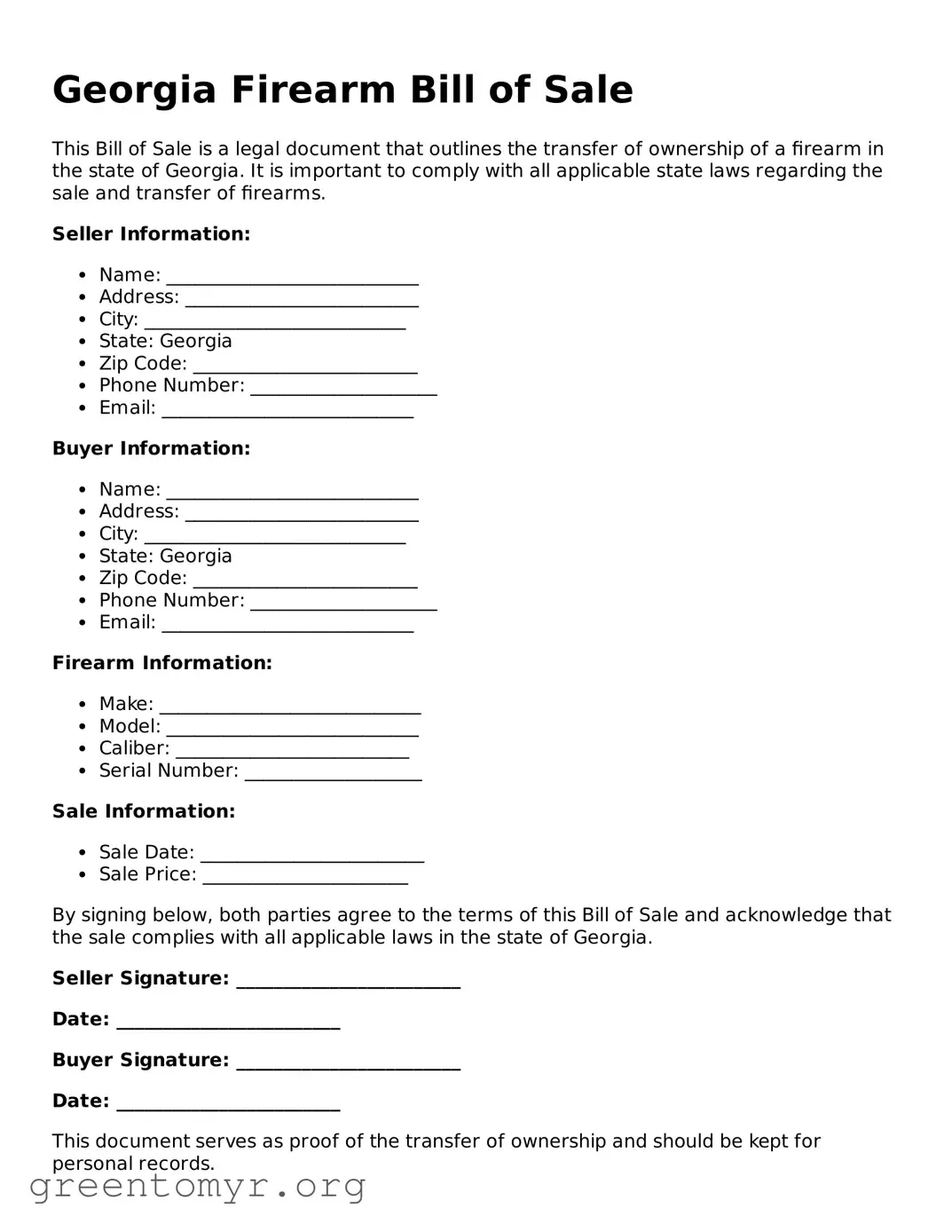
In Georgia, the Firearm Bill of Sale form serves as an essential document for anyone involved in the private sale or transfer of firearms. This form provides a clear record of the transaction, ensuring that both the buyer and seller have a mutual understanding of the terms. Key elements typically included in the form are the names and addresses of both parties, a detailed description of the firearm being sold, and the date of the transaction. Additionally, the form often requires the seller to affirm that they are legally allowed to sell the firearm, while the buyer acknowledges their eligibility to purchase it. By documenting these details, the Firearm Bill of Sale helps protect both parties and can be a valuable asset in case of future disputes. Understanding the importance of this form is crucial for anyone looking to navigate the complexities of firearm ownership and sales in Georgia.
Georgia Firearm Bill of Sale
This Bill of Sale is a legal document that outlines the transfer of ownership of a firearm in the state of Georgia. It is important to comply with all applicable state laws regarding the sale and transfer of firearms.
Seller Information:
Buyer Information:
Firearm Information:
Sale Information:
By signing below, both parties agree to the terms of this Bill of Sale and acknowledge that the sale complies with all applicable laws in the state of Georgia.
Seller Signature: ________________________
Date: ________________________
Buyer Signature: ________________________
Date: ________________________
This document serves as proof of the transfer of ownership and should be kept for personal records.
| Fact Name | Description |
|---|---|
| Purpose | The Georgia Firearm Bill of Sale form is used to document the sale or transfer of firearms between private parties. |
| Governing Law | This form is governed by Georgia state law, specifically O.C.G.A. § 16-11-131, which addresses the sale and transfer of firearms. |
| Parties Involved | The form typically includes information about both the seller and the buyer, ensuring that both parties are clearly identified. |
| Firearm Details | It requires detailed information about the firearm being sold, including make, model, and serial number, to ensure accurate identification. |
| Witness Requirement | While not mandatory, having a witness sign the form can provide additional verification of the transaction. |
| Legal Age | Both the buyer and seller must be at least 18 years old to legally engage in the sale of a firearm in Georgia. |
| Record Keeping | It is advisable for both parties to keep a copy of the completed Bill of Sale for their records, as it serves as proof of the transaction. |
| Notarization | Notarization is not required for the Bill of Sale in Georgia, but it can add an extra layer of authenticity to the document. |
Completing the Georgia Firearm Bill of Sale form is a straightforward process. This document serves as a record of the sale and transfer of ownership of a firearm. Follow these steps to ensure that the form is filled out correctly.
A Georgia Firearm Bill of Sale is a legal document used to record the sale or transfer of a firearm between two parties. This form provides proof of the transaction and details about the firearm, including its make, model, and serial number.
While Georgia law does not require a Bill of Sale for private firearm sales, it is highly recommended. A Bill of Sale can help protect both the buyer and seller by providing a written record of the transaction.
The Bill of Sale should include the following information:
Yes, you can create your own Bill of Sale as long as it includes all the necessary information. There are also templates available online that can be used to ensure that all required details are included.
No, notarization is not required for a Bill of Sale in Georgia. However, having the document notarized can add an extra layer of authenticity and may be beneficial if any disputes arise in the future.
If the firearm has a lien, it is important to resolve that lien before completing the sale. The seller should ensure that the lien is paid off and that they have clear ownership of the firearm to avoid legal issues.
Yes, you can sell a firearm to someone from another state, but federal and state laws must be followed. The buyer may need to have the firearm transferred through a licensed dealer in their state, and it is advisable to check the laws in both states before proceeding with the sale.
If you lose the Bill of Sale, it is advisable to create a new one. Both parties should sign the new document and keep copies for their records. This ensures that there is still a record of the transaction.
Yes, certain individuals are prohibited from purchasing firearms in Georgia. These include individuals who have been convicted of a felony, those with restraining orders, and individuals deemed mentally incompetent by a court. It is important for the seller to verify the buyer's eligibility before completing the sale.
Templates for a Georgia Firearm Bill of Sale can be found online through various legal websites and resources. It is important to ensure that the template complies with Georgia state laws and includes all necessary information.
Filling out the Georgia Firearm Bill of Sale form is an important step in ensuring a legal and smooth transaction when buying or selling firearms. However, many individuals make mistakes that can lead to complications down the line. Understanding these common errors can help ensure that the process is completed correctly.
One common mistake is failing to include all required information. The form requires specific details such as the buyer's and seller's names, addresses, and the firearm's make, model, and serial number. Omitting any of this information can render the bill of sale invalid.
Another frequent error is not signing the document. Both the buyer and seller must sign the bill of sale to confirm the transaction. Without signatures, the form does not hold legal weight, which could lead to disputes about ownership later on.
Inaccurate descriptions of the firearm can also cause issues. It is essential to provide precise details about the firearm being sold. Misstating the model or serial number can create confusion and may even lead to legal problems if the firearm is linked to a crime.
Some individuals mistakenly believe that a bill of sale is unnecessary for private sales. In Georgia, while it is not legally required, having a bill of sale is highly recommended. It serves as proof of the transaction and can protect both parties in case of future disputes.
Another error is not keeping a copy of the bill of sale. After the form is completed and signed, both parties should retain a copy for their records. This documentation is crucial for verifying ownership and can be important for legal purposes in the future.
People often overlook the importance of including the date of the transaction. Without a clear date, it may be challenging to establish when the sale occurred, which can be critical in legal situations.
Some sellers may not verify the buyer’s eligibility to purchase a firearm. It is the seller's responsibility to ensure that the buyer is legally allowed to own a firearm. Failing to do so can result in serious legal consequences for the seller.
Lastly, not using a witness can be a missed opportunity for added security. While not required, having a third-party witness can provide an additional layer of verification for the transaction, which can be beneficial if disputes arise later.
By being aware of these common mistakes, individuals can navigate the process of filling out the Georgia Firearm Bill of Sale form more effectively. Taking the time to ensure accuracy and completeness can prevent future complications and contribute to a smoother transaction.
The Georgia Firearm Bill of Sale form is a crucial document for anyone involved in the sale or transfer of firearms in Georgia. It serves as proof of the transaction and outlines important details about the firearm and the parties involved. Along with this form, several other documents may be necessary to ensure a smooth and legal transfer. Below is a list of commonly used forms and documents.
Using these documents in conjunction with the Georgia Firearm Bill of Sale form can help ensure that all legal requirements are met during the sale or transfer of a firearm. Proper documentation protects both the buyer and seller and promotes responsible firearm ownership.
When filling out the Georgia Firearm Bill of Sale form, it’s important to follow certain guidelines. Here are some things you should and shouldn't do:
Following these tips will help ensure that the transaction goes smoothly and is legally sound.
Understanding the Georgia Firearm Bill of Sale form is crucial for anyone involved in the sale or purchase of firearms in the state. However, several misconceptions often arise. Here are seven common misconceptions and clarifications regarding this form:
Many people believe that a Bill of Sale is unnecessary for private firearm sales. In Georgia, while it is not legally required, having a Bill of Sale is highly recommended for documentation purposes and to protect both parties involved.
Some assume that the Bill of Sale must be notarized to be valid. In Georgia, notarization is not a requirement, but it can add an extra layer of authenticity and may be beneficial in disputes.
There is a misconception that the Bill of Sale is only relevant for handguns. In reality, it applies to all types of firearms, including rifles and shotguns.
Some people think that only licensed dealers can utilize a Bill of Sale. In fact, both private sellers and buyers can use this form to document their transaction.
Many believe that the Bill of Sale is a government-issued form. This is incorrect; it is a private document created by the parties involved in the transaction.
There is a notion that a Bill of Sale is immutable once signed. However, parties can agree to amend the document, but both must consent to any changes.
Finally, some think that having a Bill of Sale absolves them of all legal responsibilities. While it provides some protection, it does not shield either party from liability if the firearm is used in a crime or if other legal issues arise.
By addressing these misconceptions, individuals can navigate firearm transactions in Georgia more effectively and responsibly.
When filling out and using the Georgia Firearm Bill of Sale form, several important points should be kept in mind. These key takeaways will help ensure a smooth transaction and compliance with state laws.