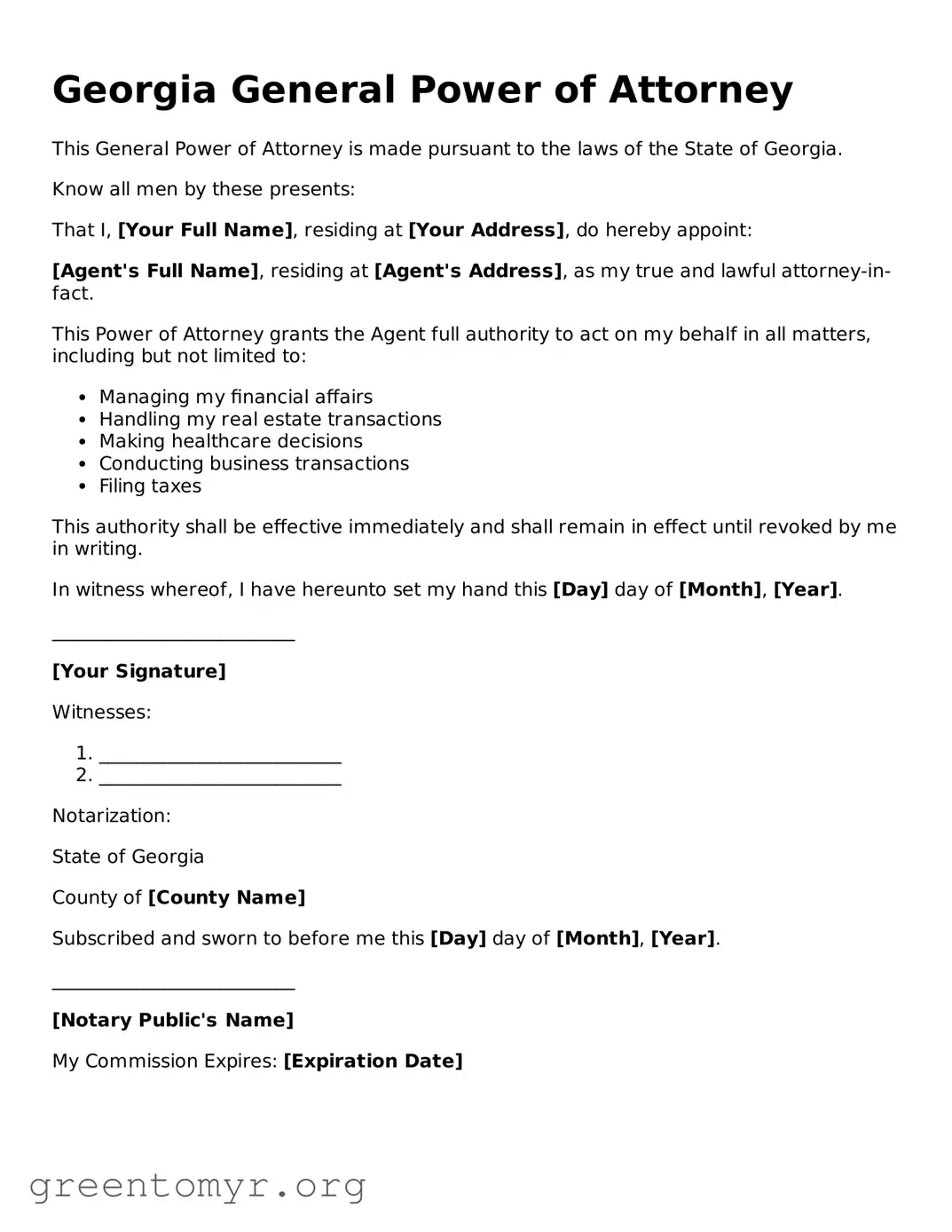
In the state of Georgia, the General Power of Attorney form serves as a crucial legal document that empowers an individual, known as the agent or attorney-in-fact, to make decisions on behalf of another person, referred to as the principal. This form encompasses a wide range of powers, allowing the agent to manage financial affairs, handle real estate transactions, and make healthcare decisions if specified. It is important to note that the authority granted can be broad or limited, depending on the principal's preferences. The form must be executed with specific formalities, including the principal's signature and, in many cases, the notarization of the document. Understanding the nuances of this form is essential for anyone considering designating a trusted individual to act on their behalf, particularly in situations where they may become incapacitated or unable to manage their affairs. The General Power of Attorney not only facilitates the smooth handling of financial and legal matters but also provides peace of mind to the principal, knowing that their interests will be safeguarded by a trusted individual.
Georgia General Power of Attorney
This General Power of Attorney is made pursuant to the laws of the State of Georgia.
Know all men by these presents:
That I, [Your Full Name], residing at [Your Address], do hereby appoint:
[Agent's Full Name], residing at [Agent's Address], as my true and lawful attorney-in-fact.
This Power of Attorney grants the Agent full authority to act on my behalf in all matters, including but not limited to:
This authority shall be effective immediately and shall remain in effect until revoked by me in writing.
In witness whereof, I have hereunto set my hand this [Day] day of [Month], [Year].
__________________________
[Your Signature]
Witnesses:
Notarization:
State of Georgia
County of [County Name]
Subscribed and sworn to before me this [Day] day of [Month], [Year].
__________________________
[Notary Public's Name]
My Commission Expires: [Expiration Date]
| Fact Name | Description |
|---|---|
| Definition | A General Power of Attorney in Georgia allows an individual to designate someone else to manage their financial and legal affairs. |
| Governing Law | The General Power of Attorney form in Georgia is governed by the Georgia Uniform Power of Attorney Act (O.C.G.A. § 10-6B-1 et seq.). |
| Durability | This form can be made durable, meaning it remains effective even if the principal becomes incapacitated, unless stated otherwise. |
| Revocation | The principal can revoke the General Power of Attorney at any time, provided they are mentally competent to do so. |
After obtaining the Georgia General Power of Attorney form, carefully follow these steps to complete it accurately. Ensure that all information is correct and that the form is signed in accordance with Georgia law.
A General Power of Attorney (GPOA) in Georgia is a legal document that allows one person, known as the principal, to appoint another person, referred to as the agent or attorney-in-fact, to make decisions on their behalf. This authority can cover a wide range of matters, including financial transactions, property management, and legal affairs. The GPOA becomes effective immediately upon signing unless specified otherwise.
In Georgia, anyone who is at least 18 years old and mentally competent can be appointed as an agent in a General Power of Attorney. This can include family members, friends, or even professionals such as attorneys or financial advisors. However, it is crucial to choose someone trustworthy, as the agent will have significant control over the principal’s affairs.
Yes, in Georgia, a General Power of Attorney must be signed in the presence of a notary public to be legally binding. Additionally, it is advisable to have one or more witnesses present during the signing. This helps to ensure that the document is valid and can be recognized by financial institutions and other entities.
Absolutely. A principal can revoke a General Power of Attorney at any time, as long as they are mentally competent. To revoke the GPOA, the principal should provide written notice to the agent and any institutions or individuals that may have relied on the document. It is also wise to create a formal revocation document and have it notarized for added clarity.
If the principal becomes incapacitated, the General Power of Attorney remains in effect unless it specifically states otherwise. This means that the agent can continue to act on behalf of the principal, managing their affairs as needed. However, if the principal wishes for the power to end upon incapacity, they should consider creating a Durable Power of Attorney instead.
Yes, a General Power of Attorney can have limitations. The principal can specify certain actions that the agent is not allowed to undertake. Common limitations include restrictions on selling real estate or making gifts. It is important for the principal to clearly outline any limitations in the document to avoid confusion or misuse of power.
No, a General Power of Attorney is primarily for financial and legal matters. For healthcare decisions, a separate document known as an Advance Directive or Healthcare Power of Attorney is required. This document allows the agent to make medical decisions on behalf of the principal if they are unable to do so themselves.
When completing the Georgia General Power of Attorney form, individuals often overlook critical details that can lead to complications later on. One common mistake is failing to specify the powers granted. It is essential to clearly outline what authority the agent will have. Without this clarity, the agent may not be able to act effectively on behalf of the principal.
Another frequent error is neglecting to date the document. A missing date can create confusion about when the powers take effect and can raise questions about the validity of the form. Always ensure that the date is clearly indicated to avoid any potential disputes.
Many people also forget to sign the form in the presence of a notary public. In Georgia, notarization is a requirement for the General Power of Attorney to be legally binding. Skipping this step can render the document ineffective, leaving the principal’s wishes unfulfilled.
Additionally, individuals often fail to consider the choice of agent. Selecting someone who may not be trustworthy or capable can lead to issues down the line. It is crucial to choose an agent who is responsible and understands the principal's values and wishes.
In some cases, people do not provide a backup agent. If the primary agent is unable or unwilling to fulfill their duties, having an alternate can ensure that the principal's affairs are still managed. This foresight can prevent complications and ensure continuity.
Another mistake is not reviewing the form thoroughly before submission. Errors in names, addresses, or other personal information can invalidate the document. Taking the time to double-check all details is a simple yet effective way to avoid problems.
Lastly, individuals sometimes forget to communicate their intentions to their agent and family members. Open discussions about the powers granted and the principal’s wishes can prevent misunderstandings and ensure that everyone is on the same page. Clear communication is vital for the effectiveness of a General Power of Attorney.
The Georgia General Power of Attorney form is a crucial document that allows an individual, known as the principal, to appoint someone else, referred to as the agent, to manage their financial and legal affairs. In conjunction with this form, several other documents may be relevant to ensure comprehensive management of one’s affairs. Below is a list of commonly used forms and documents that may accompany the General Power of Attorney in Georgia.
Each of these documents serves a specific purpose and can complement the Georgia General Power of Attorney. Together, they provide a comprehensive framework for managing both financial and healthcare decisions, ensuring that the principal's wishes are respected and upheld.
When filling out the Georgia General Power of Attorney form, it’s important to be thorough and careful. Here are ten things you should and shouldn’t do to ensure the document is completed correctly.
Many people have misunderstandings about the Georgia General Power of Attorney form. Here are seven common misconceptions and the truth behind them.
Understanding these misconceptions can help you make informed decisions about your legal documents and your future.
When considering the Georgia General Power of Attorney form, it is essential to understand its implications and the responsibilities it entails. Here are some key takeaways to keep in mind:
Understanding these points will help ensure that the process of filling out and using the Georgia General Power of Attorney form is smooth and effective. Always consider seeking guidance from a legal professional if you have questions or concerns.