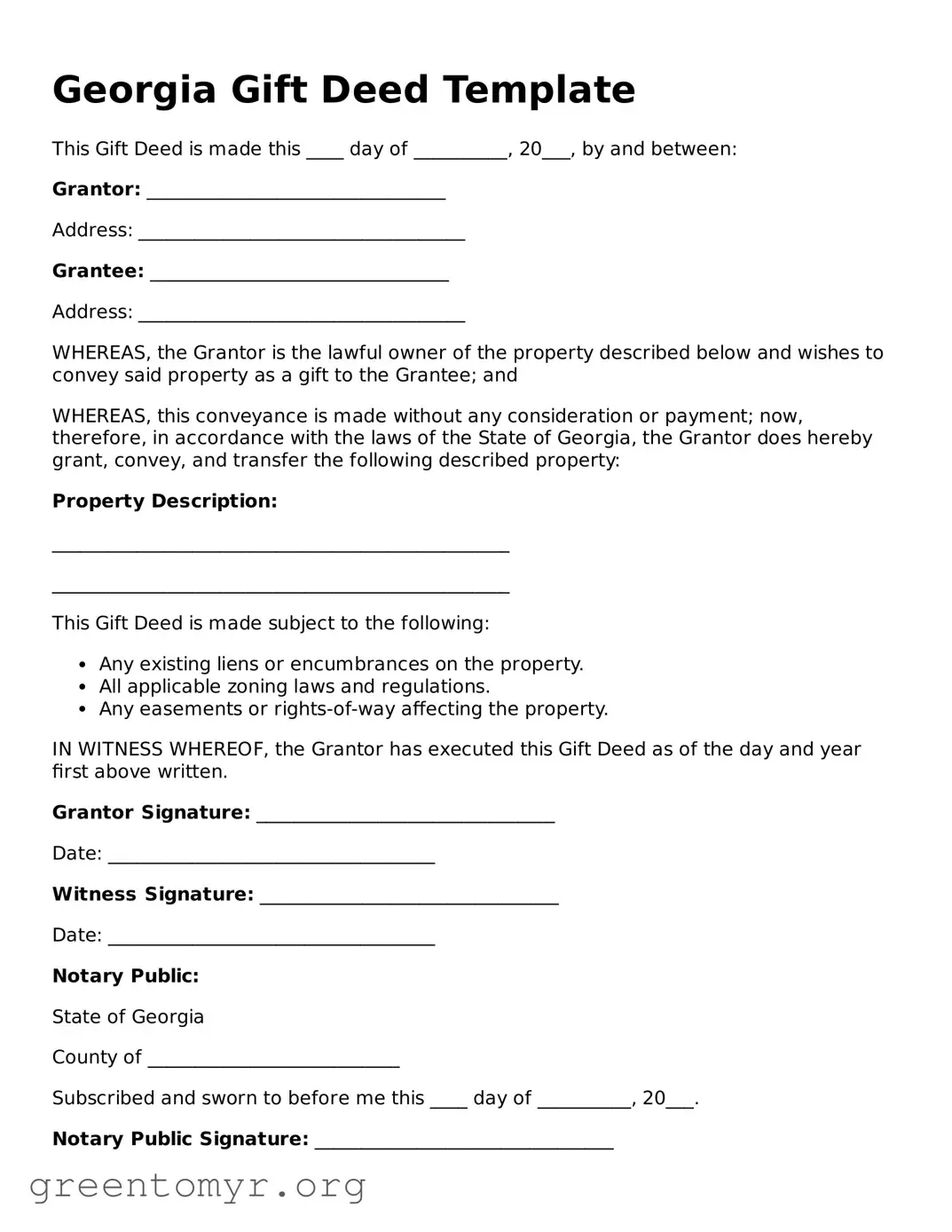
The Georgia Gift Deed form serves as a vital instrument for individuals wishing to transfer property without the exchange of money. This legal document allows a property owner, known as the grantor, to convey ownership of real estate to another party, referred to as the grantee, as a gift. By using this form, the grantor can ensure that the transfer is executed properly, providing clarity and protection for both parties involved. The form typically includes essential details such as the names and addresses of the grantor and grantee, a description of the property being gifted, and any conditions or limitations associated with the transfer. Furthermore, the Gift Deed must be signed in the presence of a notary public to ensure its validity. Understanding the nuances of this document is crucial for anyone considering a property transfer in Georgia, as it outlines the rights and responsibilities of both the giver and the recipient, ultimately facilitating a smooth and legally binding transaction.
Georgia Gift Deed Template
This Gift Deed is made this ____ day of __________, 20___, by and between:
Grantor: ________________________________
Address: ___________________________________
Grantee: ________________________________
Address: ___________________________________
WHEREAS, the Grantor is the lawful owner of the property described below and wishes to convey said property as a gift to the Grantee; and
WHEREAS, this conveyance is made without any consideration or payment; now, therefore, in accordance with the laws of the State of Georgia, the Grantor does hereby grant, convey, and transfer the following described property:
Property Description:
_________________________________________________
_________________________________________________
This Gift Deed is made subject to the following:
IN WITNESS WHEREOF, the Grantor has executed this Gift Deed as of the day and year first above written.
Grantor Signature: ________________________________
Date: ___________________________________
Witness Signature: ________________________________
Date: ___________________________________
Notary Public:
State of Georgia
County of ___________________________
Subscribed and sworn to before me this ____ day of __________, 20___.
Notary Public Signature: ________________________________
My Commission Expires: _______________________
| Fact Name | Description |
|---|---|
| Definition | A Georgia Gift Deed is a legal document used to transfer property as a gift from one person to another without any exchange of money. |
| Governing Law | The Georgia Gift Deed is governed by the Official Code of Georgia Annotated (O.C.G.A.) § 44-5-30. |
| Requirements | The deed must be in writing, signed by the donor, and notarized to be valid. |
| Consideration | No monetary consideration is needed for a gift deed. It is a voluntary transfer. |
| Tax Implications | Gift taxes may apply if the value of the gift exceeds the annual exclusion limit set by the IRS. |
| Revocation | A gift deed cannot be revoked once it is executed and delivered, unless specific conditions are met. |
| Recording | It is recommended to record the gift deed with the county clerk to provide public notice of the transfer. |
| Legal Effect | The recipient of the property gains full ownership rights once the gift deed is properly executed and delivered. |
Once you have the Georgia Gift Deed form ready, you can begin filling it out. This process involves providing specific information about the property and the parties involved. After completing the form, you will need to have it signed and notarized before recording it with the county clerk.
A Gift Deed is a legal document used to transfer ownership of property from one person to another without any exchange of money. In Georgia, this form is commonly used when a property owner wishes to give their property to a family member or friend as a gift. The deed must be signed by the donor (the person giving the gift) and should be recorded with the county clerk's office to ensure the transfer is official and public.
To complete a Gift Deed in Georgia, you will need the following information:
It’s important to ensure all information is accurate to avoid complications in the future.
Yes, in Georgia, the Gift Deed must be notarized to be legally binding. This means that the donor must sign the document in the presence of a notary public, who will then affix their seal to the deed. Notarization helps verify the identities of the parties involved and confirms that the donor is willingly giving the property as a gift.
Yes, there can be tax implications associated with gifting property. The donor may be subject to federal gift tax if the value of the property exceeds the annual exclusion limit set by the IRS. As of 2023, this limit is $17,000 per recipient. If the gift exceeds this amount, the donor may need to file a gift tax return. Additionally, the recipient may face capital gains tax if they later sell the property. It is advisable to consult with a tax professional to understand the full implications.
To record a Gift Deed in Georgia, follow these steps:
Recording the deed ensures that the property transfer is documented and recognized by the state.
Once a Gift Deed is signed and recorded, it is generally considered final and cannot be revoked. However, if the donor wishes to revoke the gift, they may need to take specific legal actions, such as creating a new deed that explicitly states the revocation. It is crucial to seek legal advice if there is a desire to change or revoke a gift after the deed has been executed.
When completing the Georgia Gift Deed form, individuals often make several common mistakes that can lead to complications in the transfer of property. Awareness of these errors can help ensure a smoother process.
One frequent mistake is failing to provide complete and accurate information about both the donor and the recipient. This includes not only names but also addresses and any necessary identification numbers. Incomplete details can result in delays or even legal disputes.
Another common error is neglecting to include a legal description of the property being transferred. This description should be precise and can typically be found in the property's deed. Without it, the deed may be considered invalid.
Individuals sometimes forget to sign the document. A signature from the donor is essential for the deed to be legally binding. Additionally, if the property is jointly owned, signatures from all owners may be necessary.
Not having the deed notarized is another mistake. Georgia law requires that a gift deed be notarized to be effective. Failing to have it properly notarized can render the deed unenforceable.
Some people mistakenly assume that a gift deed does not require witnesses. In Georgia, having witnesses sign the deed is not mandatory, but it is recommended to add an extra layer of protection against future disputes.
Another issue arises when individuals attempt to use outdated forms. Laws and requirements can change, so it is crucial to ensure that the most current version of the Gift Deed form is being utilized.
People often overlook the tax implications of gifting property. While Georgia does not impose a gift tax, it is essential to understand that the recipient may face other tax consequences. Consulting with a tax professional can provide clarity on this matter.
Additionally, some individuals do not retain copies of the completed deed. Keeping a copy is important for both parties, as it serves as proof of the transfer and can be referenced in the future if needed.
Finally, failing to record the deed with the county clerk’s office is a significant mistake. Recording the deed is necessary to provide public notice of the property transfer and protect the recipient’s ownership rights.
When preparing a Georgia Gift Deed, it’s essential to consider other documents that may be required or beneficial in the process. These forms help ensure clarity and legality in the transfer of property. Here’s a list of commonly used forms and documents that often accompany a Gift Deed in Georgia.
Understanding these documents can streamline the process of transferring property through a Gift Deed. Each form plays a vital role in ensuring that the transaction is legal, clear, and beneficial for all parties involved.
A Gift Deed is an important legal document, but it shares similarities with several other documents. Here’s a list of eight documents that are comparable to a Gift Deed, along with how they relate to it:
Understanding these similarities can help clarify the purpose and function of a Gift Deed in the realm of property transfer.
When filling out the Georgia Gift Deed form, it is important to approach the task with care and attention to detail. Below are some guidelines to help ensure that the process goes smoothly.
Things You Should Do:
Things You Shouldn't Do:
When it comes to the Georgia Gift Deed form, several misconceptions can lead to confusion. Understanding these misconceptions can help individuals navigate the process of gifting property more effectively. Here are four common misunderstandings:
Many people believe that a Gift Deed functions like a Sale Deed. However, the key difference lies in consideration. A Sale Deed involves a transaction where the buyer pays for the property, while a Gift Deed transfers property without any payment or exchange. This distinction is crucial for tax implications and legal ownership.
Some individuals think that a verbal agreement suffices for gifting property. In reality, a Gift Deed must be in writing and signed by the donor. Proper documentation not only formalizes the gift but also protects both parties in case of future disputes.
Another common belief is that once a Gift Deed is executed, it cannot be undone. While it is true that gifts are generally irrevocable, there are circumstances under which a donor may retain the right to revoke the gift. For example, if the donor includes a provision in the deed allowing for revocation, this can be legally binding.
Many people assume that gifting property through a Gift Deed is tax-free. While there are exclusions, such as the annual gift tax exclusion, gifts can still trigger tax implications. Understanding these potential tax consequences is essential for both the donor and the recipient.
When filling out and using the Georgia Gift Deed form, it is essential to understand the following key takeaways: